-
-
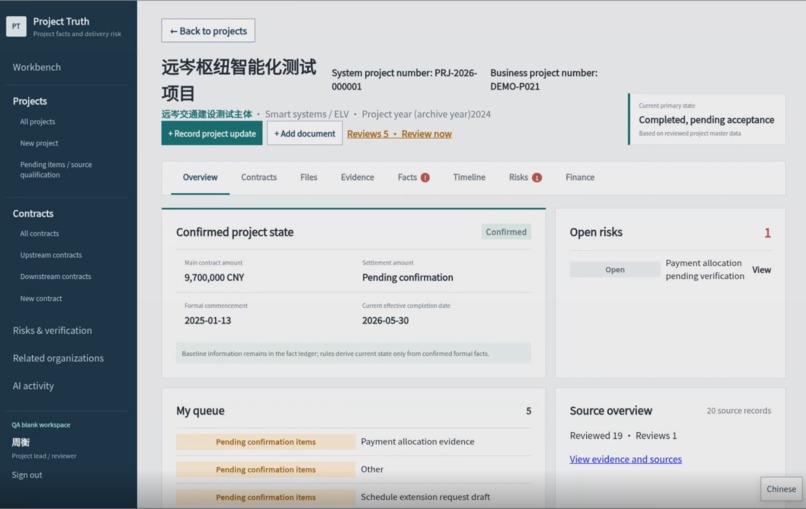
Project overview — confirmed state, open risk, work queue, and source status
-
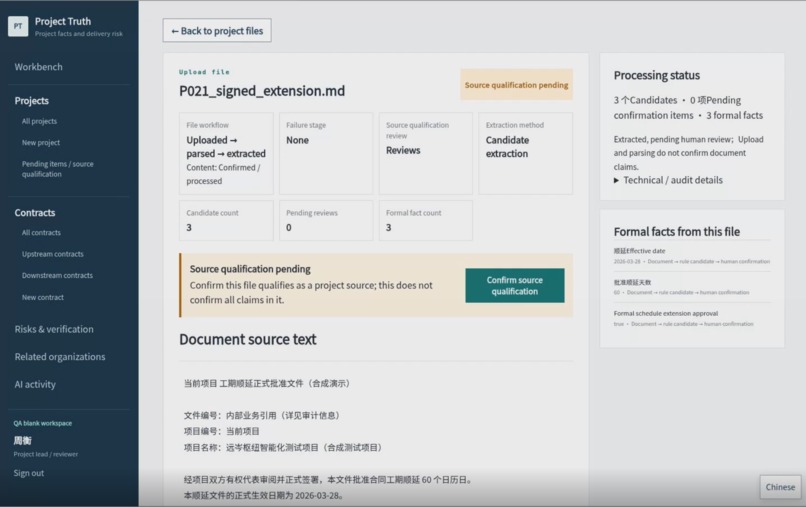
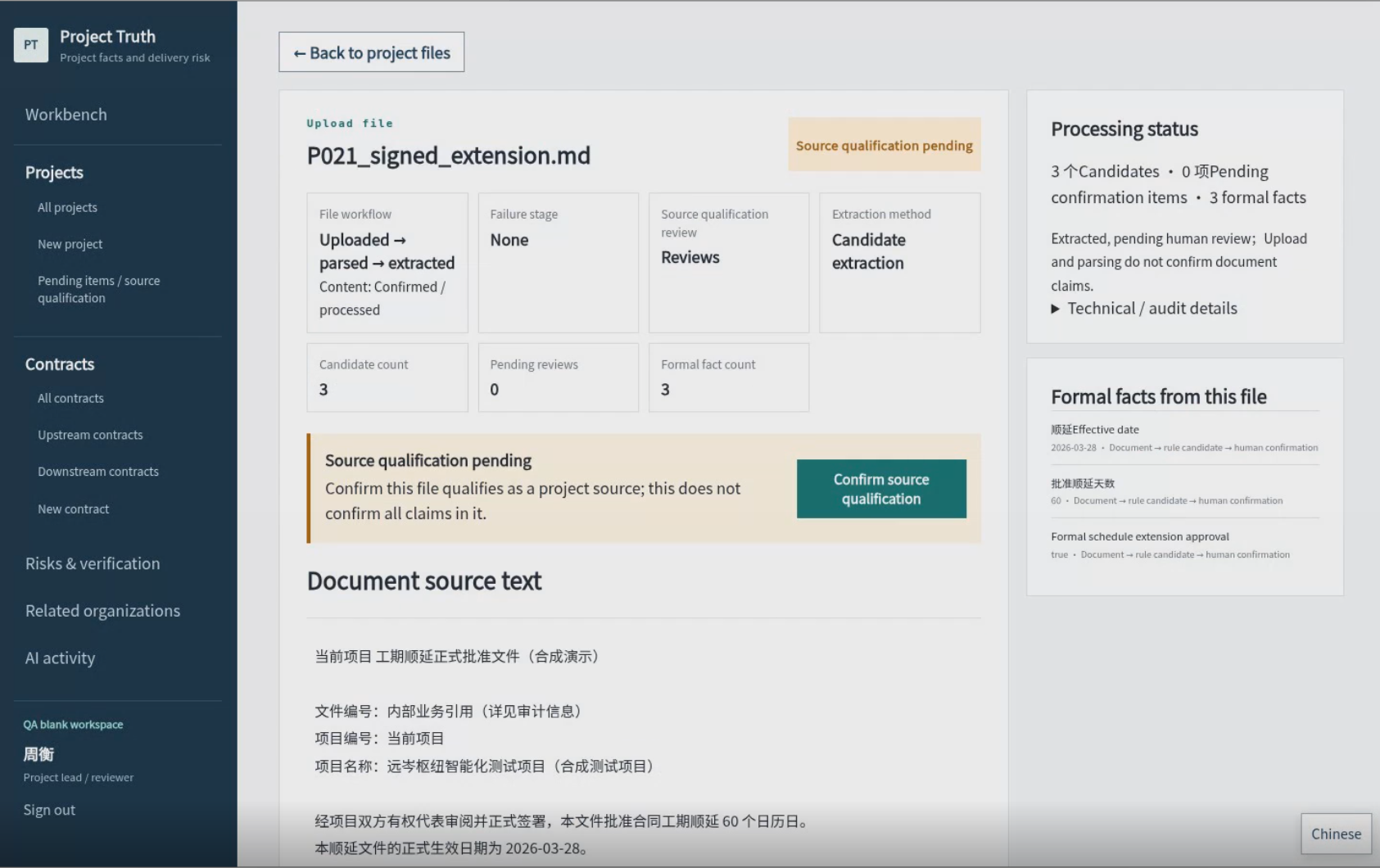
Document intake — source qualification, candidate extraction, and formal facts
-
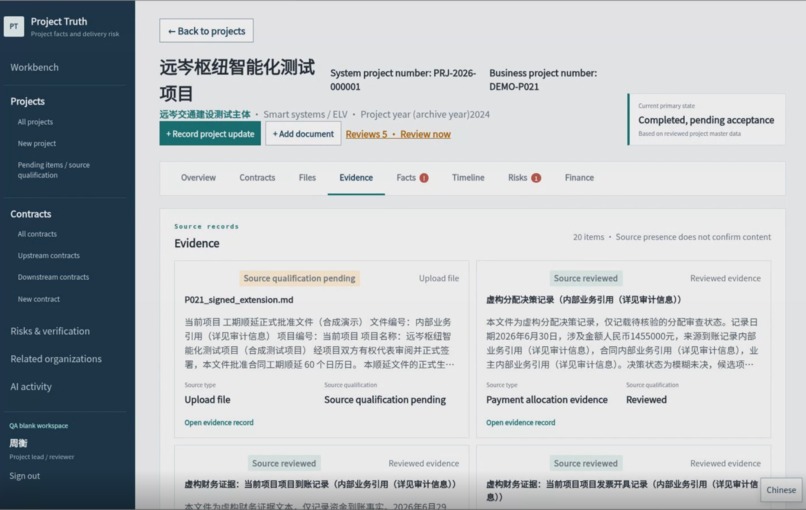
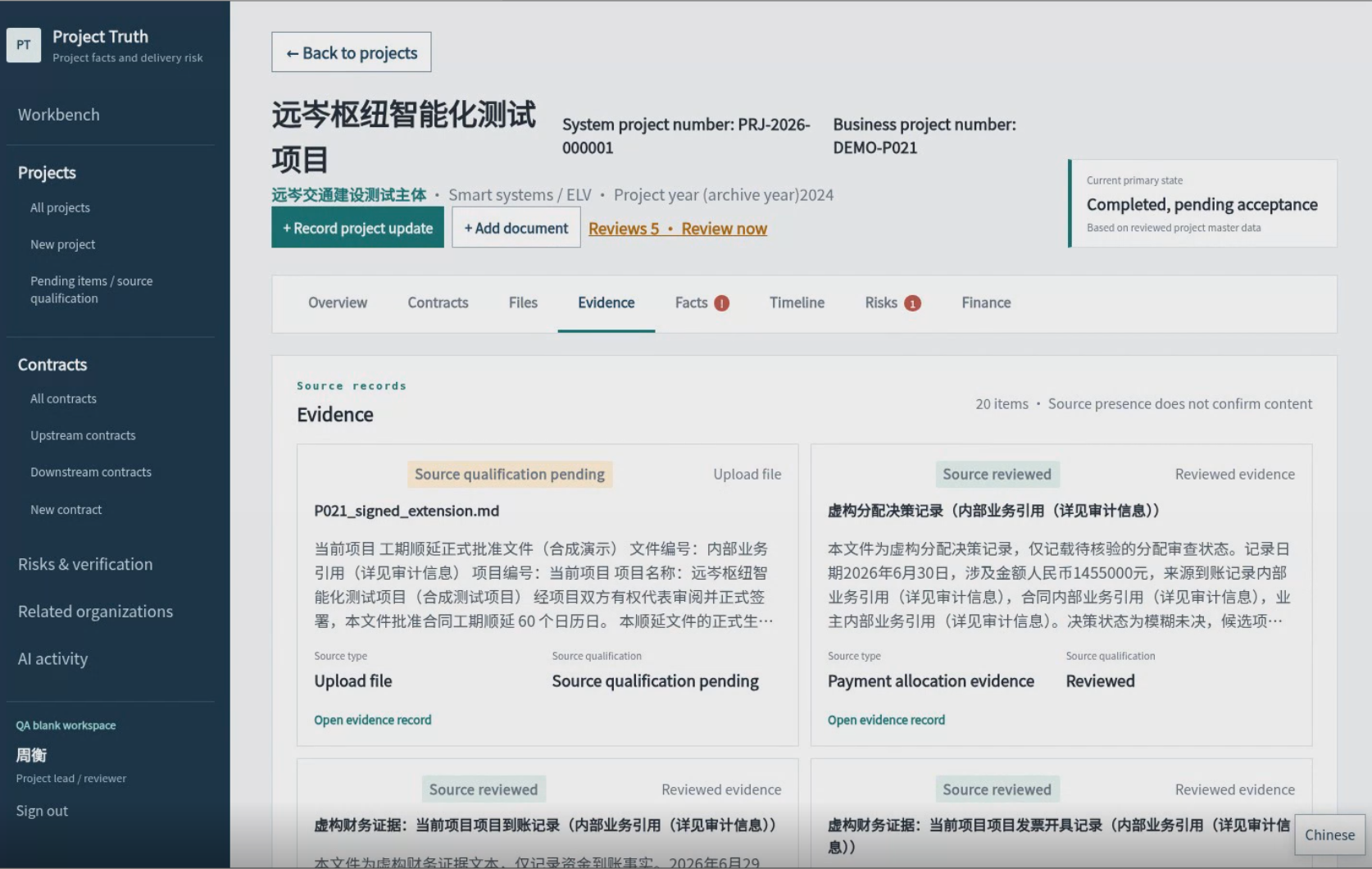
Evidence workspace — pending and reviewed source records remain traceable
-
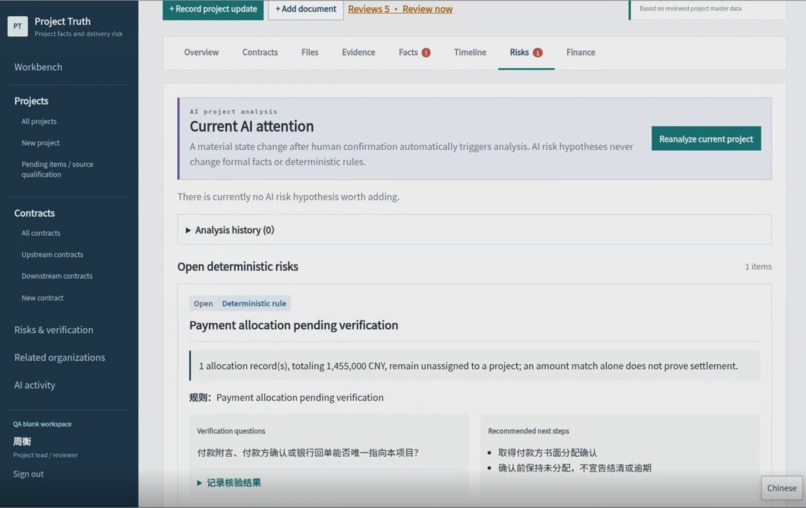
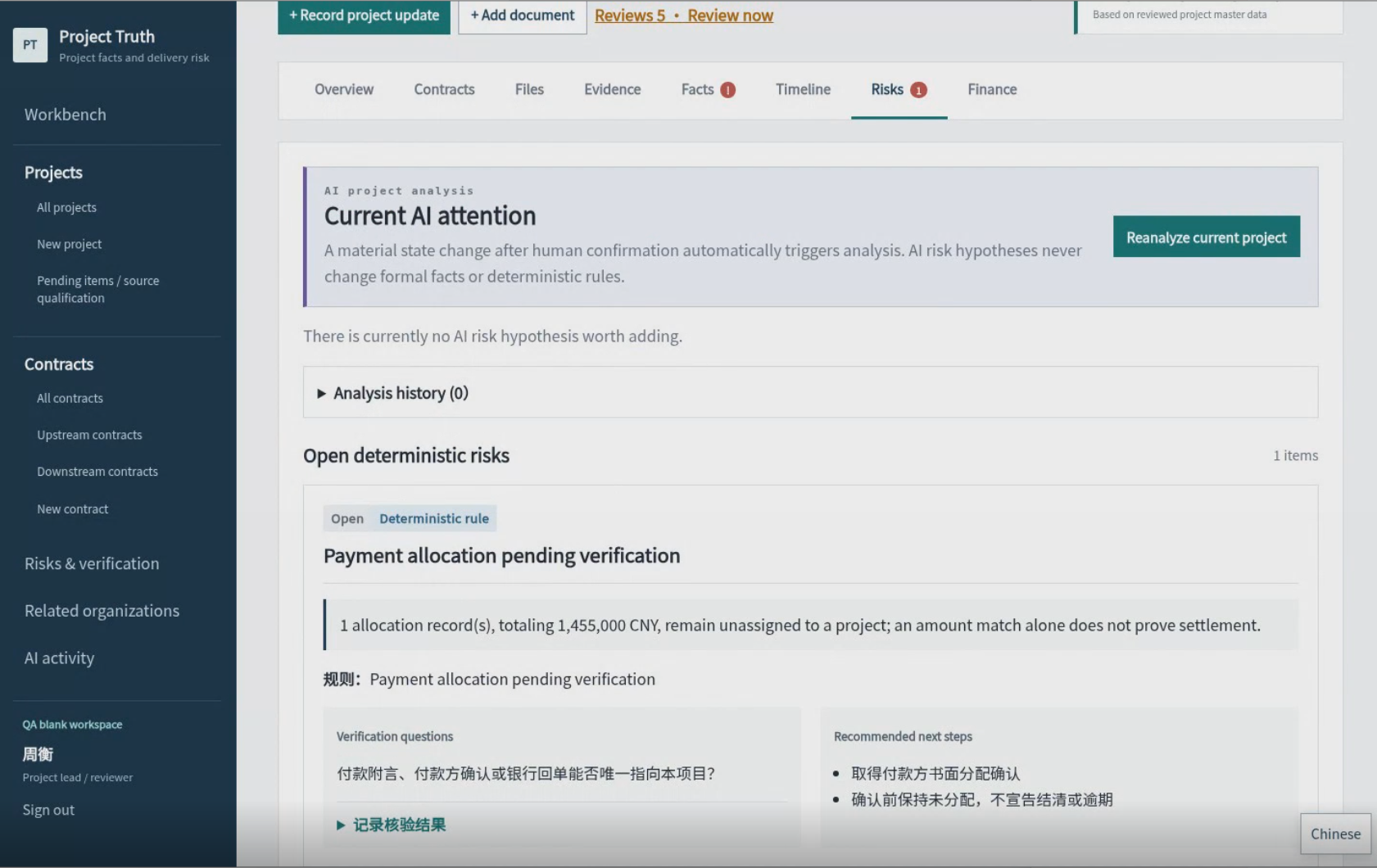
Risk & verification — deterministic payment risk with evidence questions and next steps
-
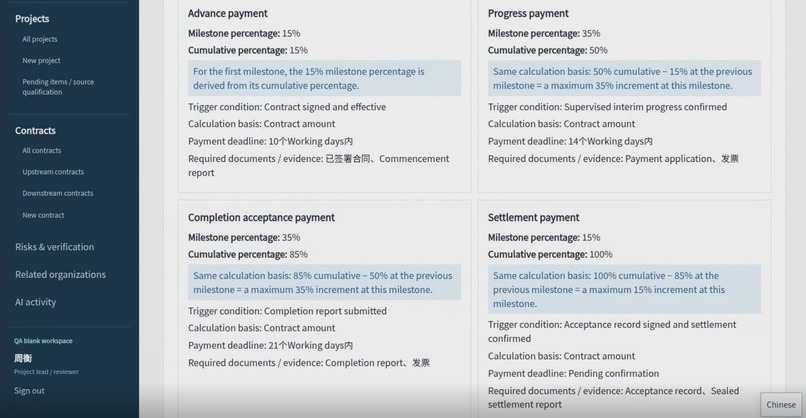
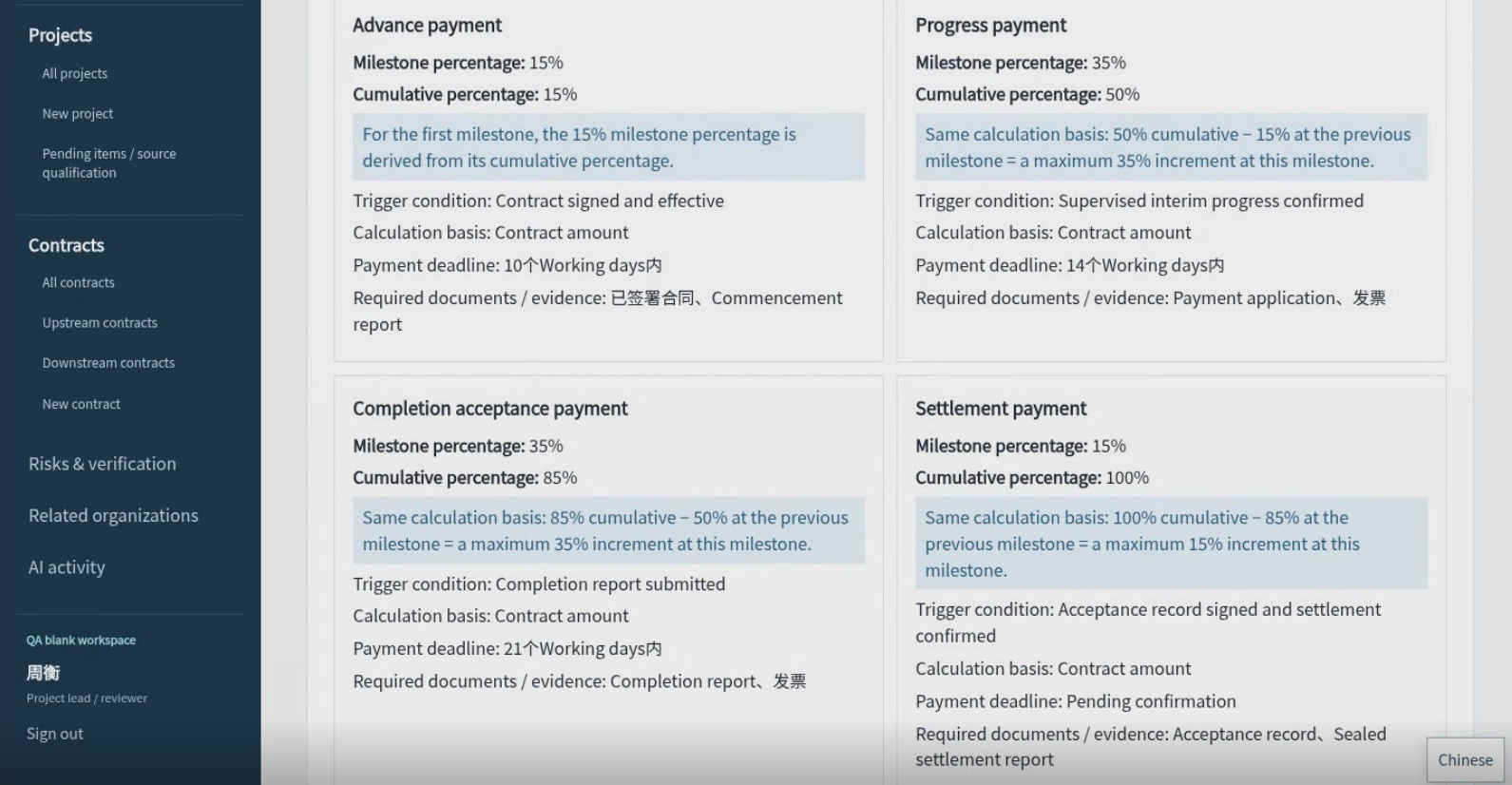
Finance — the main contract’s cumulative milestones and same-basis increments remain explainable
-
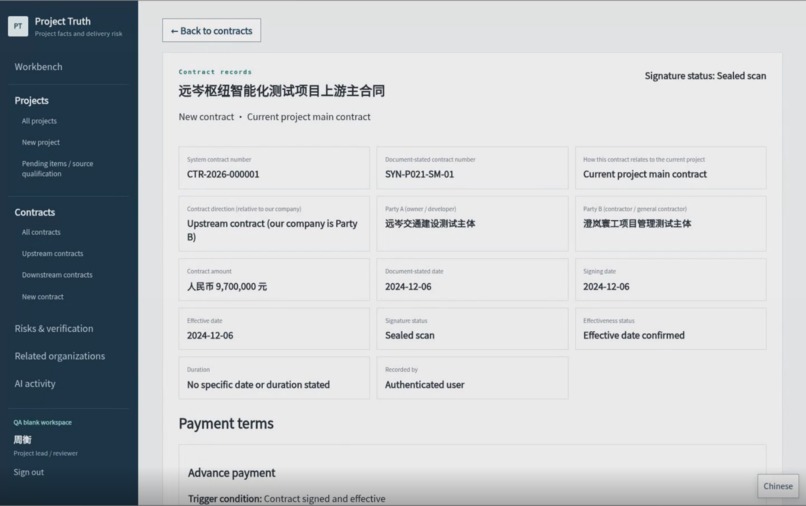
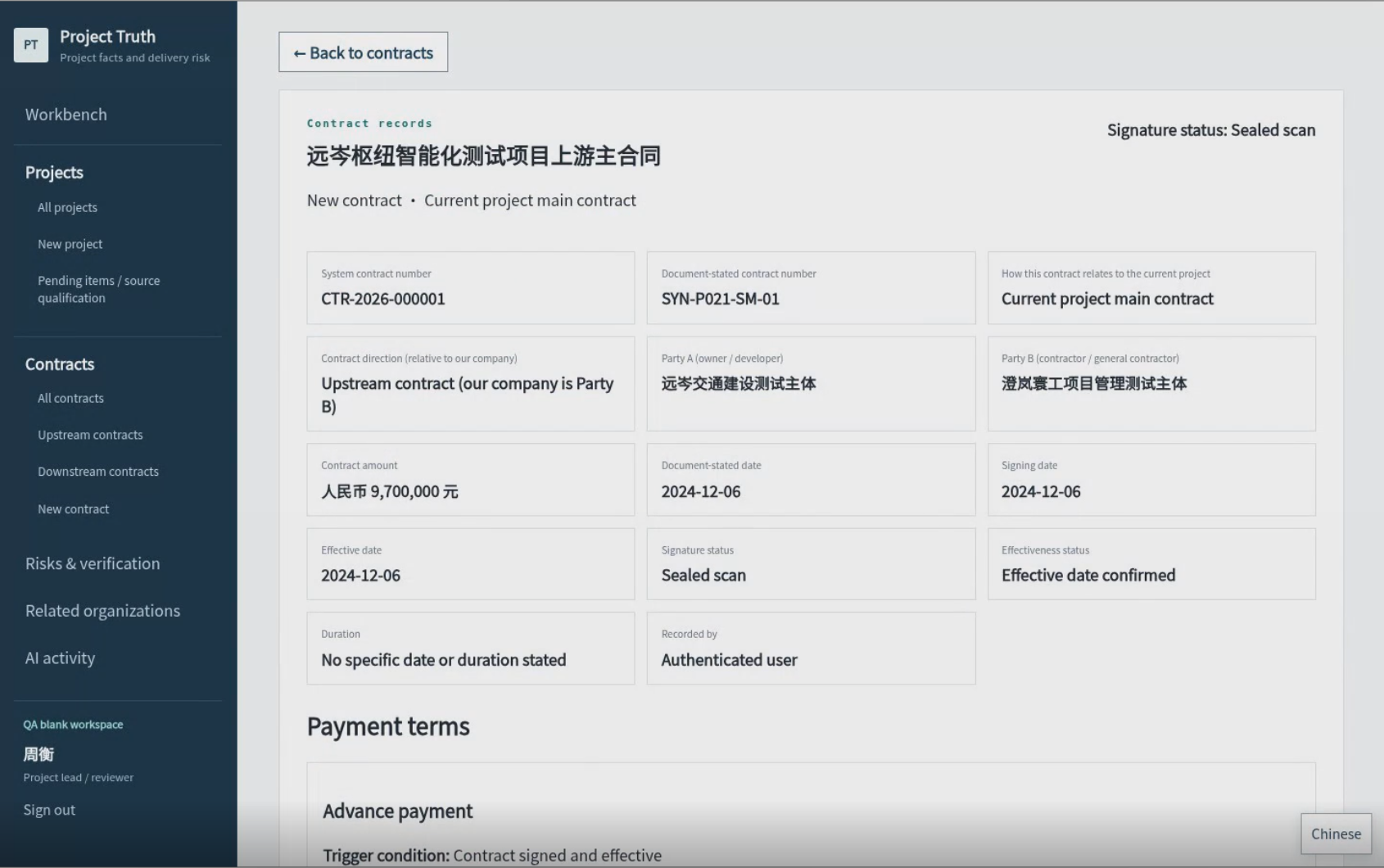
Contract detail — structured parties, dates, amount, status, and payment terms
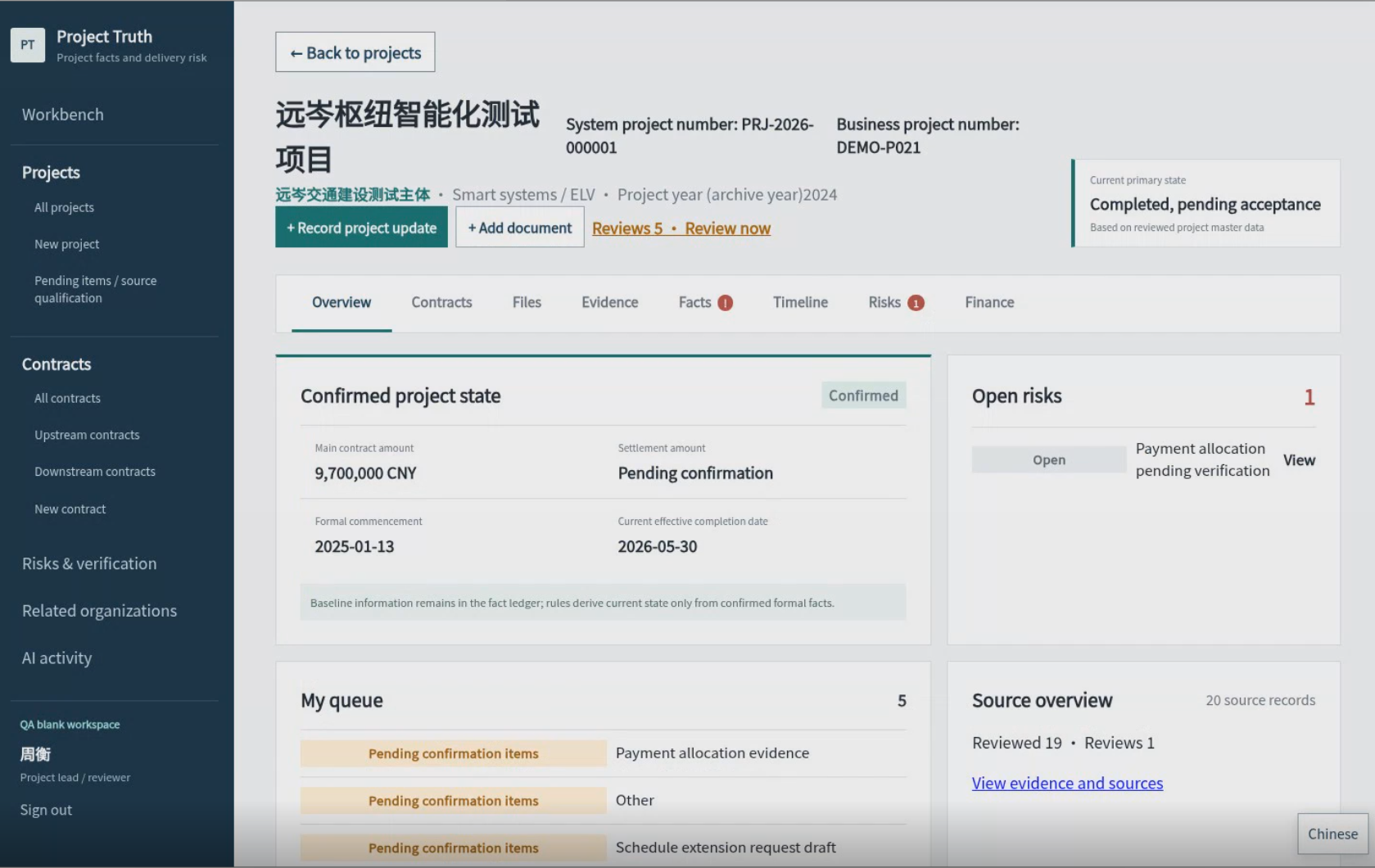
Judge demo: Watch directly on Vimeo
If the embedded player needs a refresh, the direct Vimeo link above opens the same final demo.
Inspiration
Project teams do not merely lack summaries. They lack a trustworthy, explainable current state when contracts, uploaded documents, payment records, dates, and informal updates disagree.
A fluent AI summary can actually make this worse if an unreviewed statement quietly becomes an accepted deadline, amount, or risk conclusion.
Project Truth started from a simple product question:
What if AI could help understand a project without being allowed to silently rewrite project truth?
What it does
Project Truth is an evidence-first workspace for project facts and delivery risk.
It turns contracts, project documents, and delivery signals into a continuously maintained project state while keeping every important conclusion traceable to evidence.
The workflow separates:
- source evidence
- extracted candidate facts
- human-confirmed facts
- deterministic project state
- deterministic risks
- AI-assisted hypotheses and recommendations
- actionable verification questions
Uploaded documents are parsed and extracted into candidates rather than automatically becoming formal facts.
Important claims require human confirmation before entering the formal project ledger.
Deterministic rules then recompute project state, deadlines, payment conditions, and risks from confirmed information.
AI is used where semantic understanding adds value — extraction, relationship interpretation, verification questions, and recommendations — while remaining visibly separate from confirmed truth.
Core demo flow
The final demo shows four connected workflows:
1. Document → Truth
A project document enters the workspace, remains traceable to its source, and produces reviewable candidate facts.
Human confirmation determines what becomes part of the formal project state.
2. Truth → Project State
Confirmed facts and business events form a project timeline and continuously maintained current state instead of remaining fragmented across documents.
3. State → Risk → Verification
Deterministic rules surface a payment-allocation risk.
Rather than inventing an answer, Project Truth turns the unresolved evidence gap into an actionable verification question for the project team.
4. Contract → Finance Control
For the main contract shown in the demo, payment obligations are structured into cumulative milestones:
15% → 50% → 85% → 100%
with same-basis increments:
15% → 35% → 35% → 15%
Each milestone keeps its trigger condition, calculation basis, required evidence, and review state visible.
How we built it
Project Truth is built as a local-first web application using:
- Next.js
- React
- TypeScript
- SQLite
- Zod
- Node.js
- Playwright
- document parsing for DOCX/PDF workflows
- structured deterministic rules for dates, project state, payment milestones, and risk evaluation
- AI-assisted semantic extraction and review layers
The architecture deliberately separates three responsibilities:
- Deterministic rules for calculations and state transitions that should be reproducible.
- AI for semantic interpretation and relationship reasoning.
- Human confirmation for important project facts and formal actions.
This boundary is one of the core design decisions of the product.
Challenges we ran into
Keeping AI useful without letting it become the source of truth
The largest design challenge was preventing confident model output from silently becoming authoritative project data.
We solved this by making candidates, confirmed facts, deterministic state, and AI hypotheses explicit product states rather than hiding them behind a single summary.
Grounding document extraction
Document extraction had to remain traceable to original evidence while still being practical for review.
We added source-grounded candidates, evidence records, human confirmation, and explicit source-qualification states.
Making long contracts usable with real AI latency
A payment extraction pass originally resent an entire contract and could hit a 180-second timeout.
We changed the pipeline to deterministically locate the relevant payment clauses first, reducing that pass from roughly 7,343 characters to about 942 characters — an 87% reduction — while preserving grounded extraction.
Keeping financial logic on one calculation basis
Cumulative percentages and incremental payment percentages are easy to mix incorrectly.
Project Truth preserves both cumulative milestones and same-basis increments so the financial view remains explainable.
Accomplishments that we're proud of
- Built a complete evidence → candidate → confirmation → project-state workflow.
- Preserved a strict boundary between confirmed facts, deterministic rules, and AI-assisted analysis.
- Implemented project-level and cross-project risk and verification queues.
- Structured contract payment milestones with evidence and review status.
- Added source-grounded document intake and evidence traceability.
- Built deterministic handling for dates, project events, payment conditions, and risk propagation.
- Created a sealed synthetic demo universe with no private production data.
- Completed the final judge demo against a frozen release with zero relevant console errors.
- Delivered the project as a solo hackathon build.
What we learned
The most important lesson was that trustworthy AI products are not only about model quality.
They need an explicit truth architecture.
Rules should calculate what can be calculated deterministically. AI should interpret what requires semantic reasoning. Humans should retain authority over facts and actions that materially change the project state.
That separation made Project Truth more explainable, auditable, and useful than a conventional document-summary interface.
What's next
The next step would be connecting Project Truth to real enterprise delivery signals such as ERP, finance, payment, and document-management systems.
Instead of relying on project managers to manually maintain every change, objective signals such as payments, receipts, approvals, and delivery events could enter the same evidence pipeline as high-confidence candidate events.
The core principle would remain unchanged:
AI can help understand project reality, but verified evidence remains the foundation of project truth.
Built With
- ai
- next.js
- node.js
- pdf-parse
- playwright
- react
- sqlite
- typescript
- zod


Log in or sign up for Devpost to join the conversation.