-
-
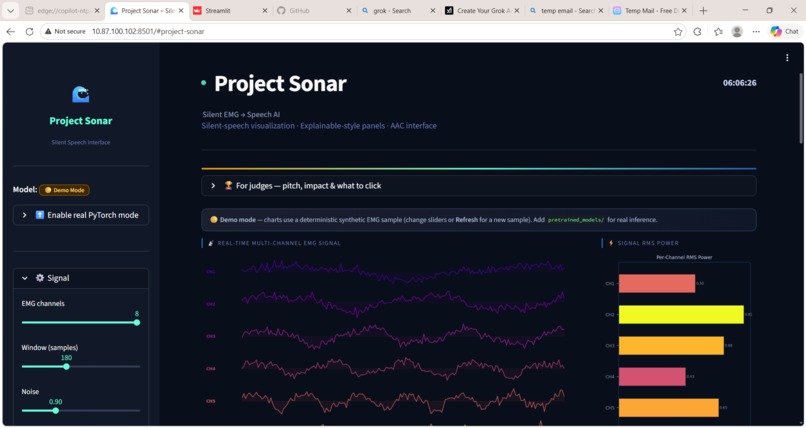
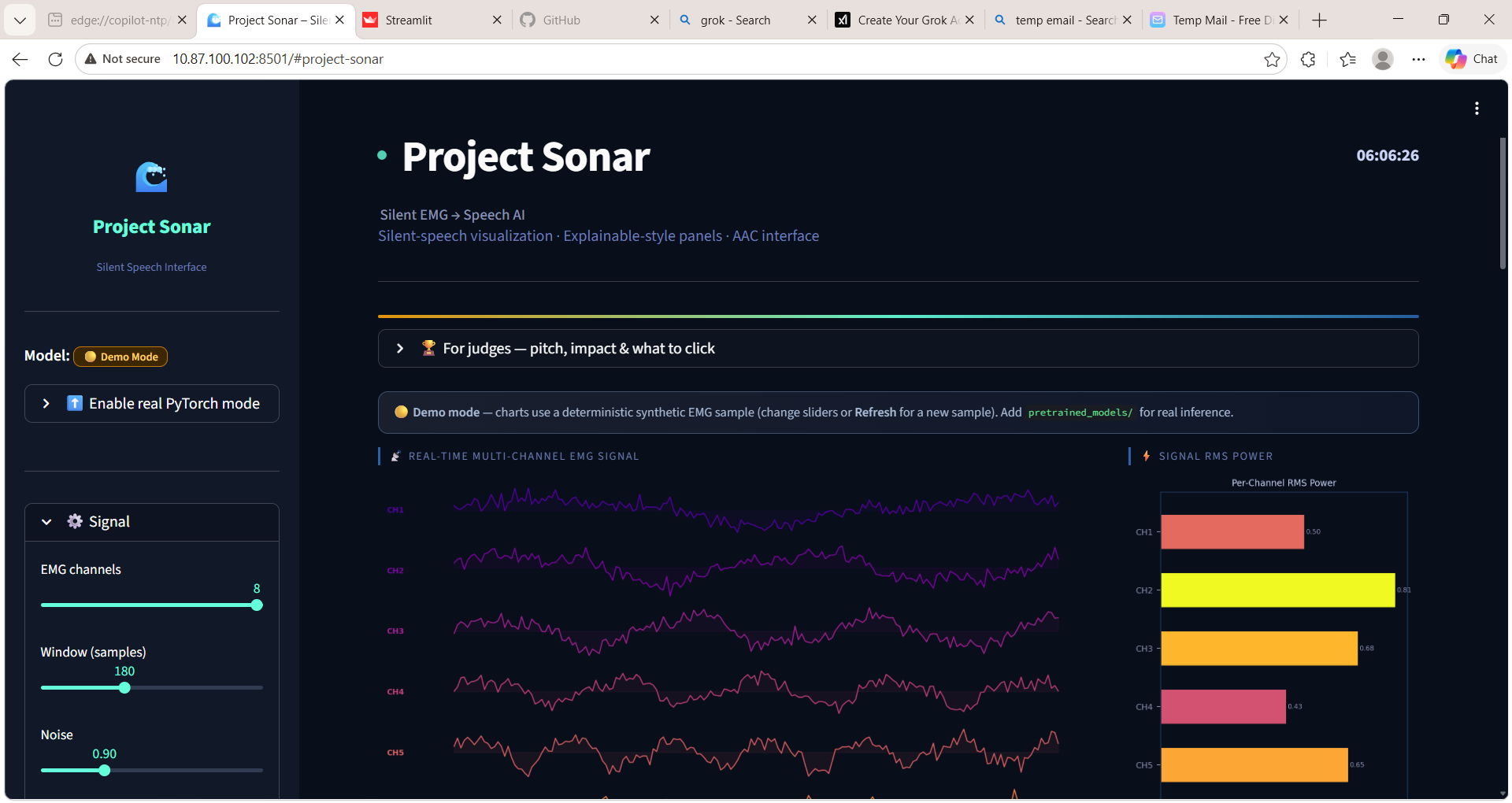
Project Sonar is an AI-powered Silent Speech Interface that converts EMG signals (muscle movements) into text and speech in real time.
🚀 Inspiration
Communication is essential, yet many individuals with speech impairments face challenges expressing themselves. We were inspired to build a system that enables “silent communication” using technology.
The idea of combining AI with EMG (Electromyography) signals motivated us to create an assistive solution that allows users to communicate without speaking, improving accessibility and inclusivity.
⚡ What it does
Project Sonar is an AI-powered Silent Speech Interface that converts EMG signals (muscle movements) into text and speech in real time.
It captures subtle muscle activity from the face or throat and translates it into meaningful language, enabling users to communicate silently and efficiently.
🛠️ How we built it
We developed the system using a combination of signal processing, deep learning, and a user-friendly interface:
- Processed EMG signals to remove noise and extract meaningful features
- Built deep learning models (Transformer-based) for prediction
- Converted predicted outputs into speech using a vocoder
- Designed an interactive UI using Streamlit
Overall pipeline:
EMG Signals → Preprocessing → AI Model → Text Output → Speech Generation
🧗 Challenges we ran into
- Handling noisy and inconsistent EMG signals
- Limited availability of training data
- Achieving real-time performance with low latency
- Integrating multiple components (AI models, UI, audio output) seamlessly
🏆 Accomplishments that we're proud of
- Successfully built an end-to-end silent speech system
- Integrated EMG signal processing with deep learning models
- Achieved real-time text and speech output
- Created a functional and interactive user interface
- Developed a project with strong real-world impact in accessibility
📚 What we learned
- Hands-on experience with deep learning models (Transformers)
- Signal processing techniques for biosignals
- Building complete AI pipelines from data to deployment
- Importance of user-centric and accessibility-focused design
🔮 What's next for Project Sonar – Silent Speech Interface using EMG & AI
- Improve accuracy with larger and more diverse datasets
- Add multilingual support for global usability
- Integrate with wearable EMG hardware devices
- Optimize for mobile and real-time deployment
- Expand use cases in healthcare and assistive technologies

Log in or sign up for Devpost to join the conversation.