-
-
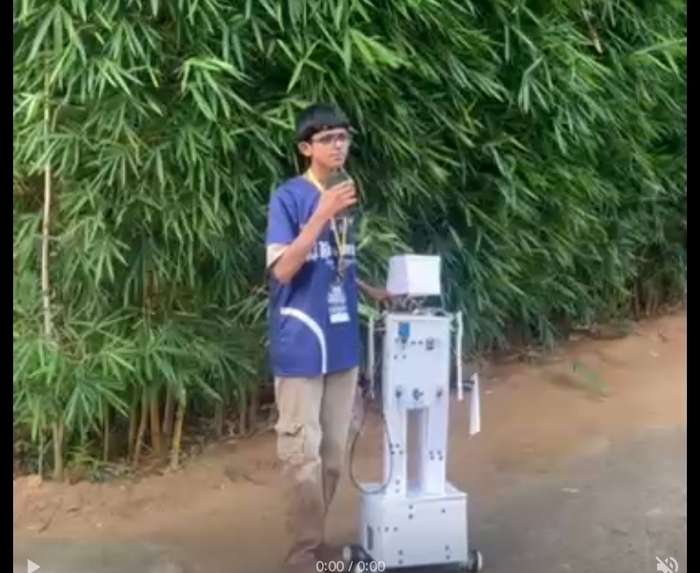
The 5th swarm agent is officially ready! He has hot-swappable batteries, advanced tracking, and a slight attitude if I forget his name....
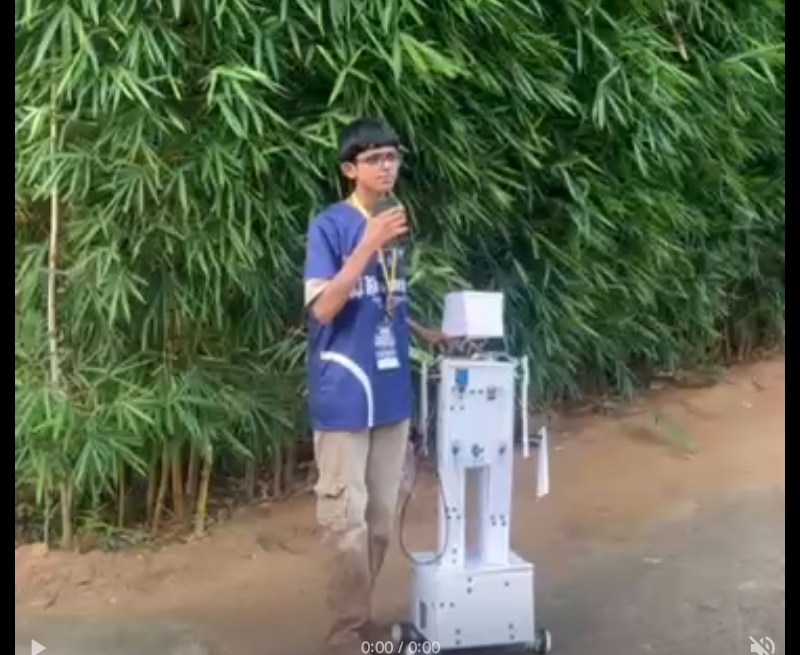
Inspiration The inspiration for this project came from witnessing the sheer helplessness of human emergency teams during the critical initial hours following a natural disaster or structural collapse in India. High-risk zones are frequently plagued by toxic gas leaks, structural instability, and unpredictable terrain, making manual entry incredibly dangerous. I kept asking myself: Why force human responders to head blindly into an active danger zone when a synchronized network of cheap, collaborative machines can do it first? My goal was to prove that a 9th-grade student working completely solo could design an advanced, decentralized air-to-ground robotic network for under ₹1.5 Lakh that provides continuous, live field telemetry to save human lives. What it does Project S.M.A.L.L. (Synchronized Monitoring & Autonomous Localized-response Layer) is a 9-agent heterogeneous swarm network built for real-time disaster tracking and mapping. The architecture splits the heavy lifting between four autonomous aerial drones and five ground-based tracking and acting bots. The four flying drones function as overhead observation nodes, mapping structural layouts and spotting wide-scale hazards from above. The five ground units physically cross debris fields, navigate obstacles, and actively gather localized data. The system features a custom local project website and telemetry dashboard that displays unified sensor data, lets remote human supervisors monitor agent positions, and supports an instant manual override mode to control individual bots during critical scenarios. How we built it Building this 9-agent network entirely solo meant tackling everything from firmware logic to physical electrical engineering. Each robot and drone runs an embedded ESP32 microcontroller to manage immediate reflex actions like distance-based obstacle avoidance. To establish communication in a destroyed zone without standard internet or cellular data, I built an ad-hoc local mesh network utilizing high-efficiency ESP-NOW protocols. A single central Raspberry Pi acts as an on-site edge computing server, pulling sensor arrays from the ESP32 network and hosting the live user interface dashboard locally. To ensure the swarm can mathematically track a continuous coordinate space and map out hazardous terrain with zero blind spots, I calculated the network’s total tracking coverage using spatial distribution equations: (\mathbb{P}(\text{Coverage})=1-\prod {i=1}^{4}\left(1-\frac{\pi R{i}^{2}}{A}\right)) Where ( R_i ) represents the sensory radius of an individual aerial drone agent, and ( A ) is the total physical disaster zone area. Challenges we ran into The single greatest challenge I faced was severe battery drain, which initially forced me to completely power down an agent every time its battery ran low—breaking the continuous connection to the swarm mesh network. To fix this bottleneck, I designed a dual-rail power management circuit using low-drop ideal diode ORing logic to support hot-swappable battery technology. The biggest mathematical obstacle was preventing high reverse currents from destroying the lithium cells when a fresh battery rail was connected to a partially drained one: (I_{\text{reverse}}=\frac{V_{\text{pack1}}-V_{\text{pack2}}}{R_{\text{internal1}}+R_{\text{internal2}}}) By properly regulating (I_{\text{reverse}} ) through custom protection circuits, I made it possible to physically pop out a dead cell and snap in a new one while the microcontrollers stay powered up with zero downtime. Additionally, managing a large-scale project completely alone presents massive logistical challenges. When my computer's Windows key failed or my hardware was pushed to its absolute threshold while experimenting with 100 GB simulation environments, I had no team to fall back on and simply had to adapt. Accomplishments that we're proud of I am incredibly proud of engineering a fully functional, hot-swappable power system that maintains network connectivity with zero millisecond power drops. Seeing the code translate into actual physical coordination—where the ESP32 mesh network successfully pipes data from the air to the ground and updates my built-in project dashboard smoothly in real-time—proves that a high-end disaster monitoring setup can be built on a strict, accessible budget. What we learned This project taught me how to bridge the gap between abstract mathematical formulas and practical, grimy hardware engineering. I learned how data packets behave in decentralized systems, how to handle edge computing logistics, and how to write low-latency firmware. Above all, it proved to me that working solo in the 9th grade isn't a limitation; it forces you to understand every single line of code, every solder joint, and every component of your machine inside and out. What's next for Project SMALL The immediate next step for Project S.M.A.L.L. is transitioning the entire multi-agent control logic from independent microcontrollers over to distributed Raspberry Pi modules to unlock advanced on-board data processing if we qualify for the international stage. I am also planning to deploy a 4-robot demonstration cohort in real-world rugged field simulations to further optimize the autonomous pathfinding algorithms before the Techfest Grand Finale at IIT Bombay this December.
Built With
- c++
- chart.js
- css3
- esp-now
- esp32
- flask8.
- html5
- javascript
- python
- raspberry-pi
- websockets
- wifi

Log in or sign up for Devpost to join the conversation.