Inspiration
What it does
Executive Technical Report The Sovereign Algorithmic Human–AI Interaction System (SIGMA)
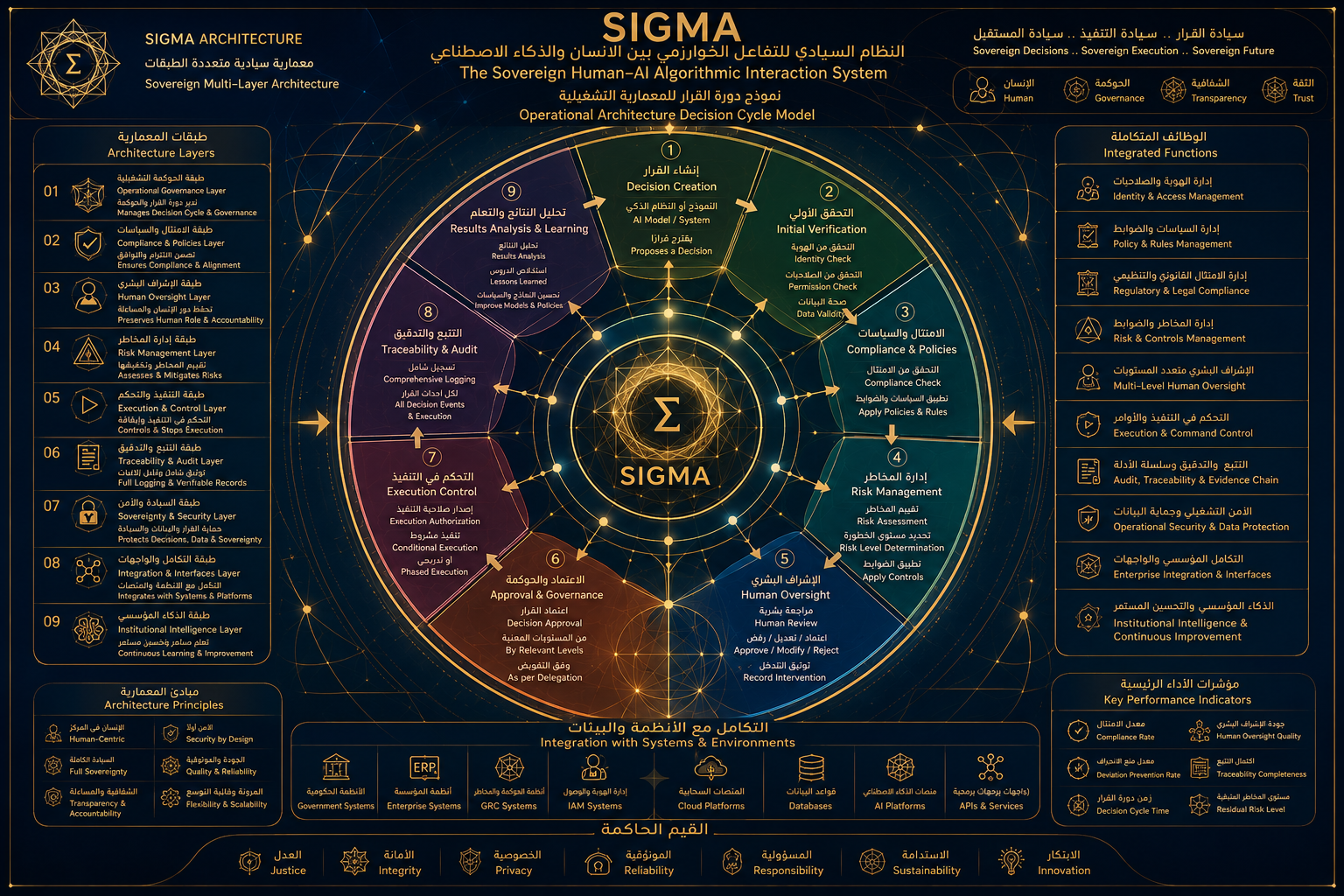
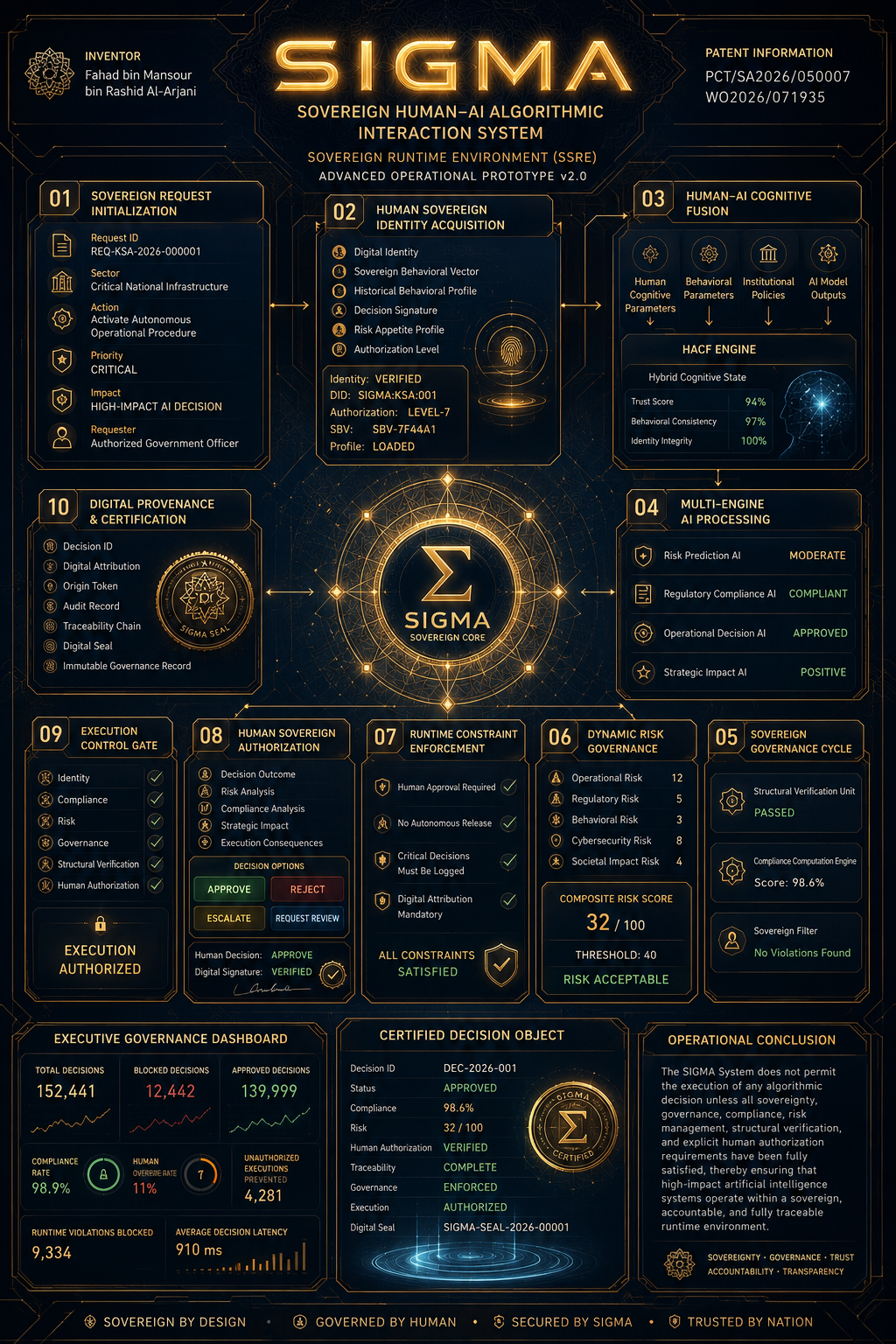
Executive Summary The Sovereign Algorithmic Human–AI Interaction System (SIGMA) is an engineering innovation that provides a sovereign operational architecture for governing the execution of artificial intelligence systems through the integration of governance, compliance, verification, risk management, documentation, evidence preservation, traceability, and human oversight within a unified pre-execution operational workflow. The system ensures that AI-generated outputs and algorithmic decisions are not approved or executed unless they successfully pass through governance, validation, compliance, and authorization mechanisms aligned with organizational policies, operational controls, and regulatory requirements. SIGMA enhances the reliability, accountability, transparency, and trustworthiness of AI operations while enabling auditable and traceable management of the entire operational decision lifecycle. The architecture is designed for seamless integration across heterogeneous technological environments without requiring replacement of existing AI systems. This report presents the engineering and strategic value of the invention and highlights its operational capabilities, supporting evaluation by governmental, industrial, regulatory, and commercial stakeholders while preserving the intellectual property scope and protection of the invention.
Importance of the Innovation Artificial intelligence is rapidly becoming a fundamental component of critical infrastructure, enterprise operations, industrial automation, financial services, healthcare, defense, and public administration. At the same time, international regulatory frameworks increasingly emphasize governance, transparency, accountability, risk management, human oversight, and compliance throughout AI operational lifecycles. Examples include: • UNESCO Recommendation on the Ethics of Artificial Intelligence • European Union Artificial Intelligence Act (EU AI Act) These developments demonstrate a global transition toward trustworthy and governed AI. SIGMA responds to this direction by introducing an operational architecture that integrates governance, compliance, verification, documentation, risk management, and human oversight directly into a unified operational lifecycle before execution, enabling responsible and structured deployment of AI systems.
Overview of the Invention SIGMA is an independent engineering architecture designed to regulate the operational lifecycle of artificial intelligence systems. Rather than allowing AI-generated outputs to proceed directly to execution, every operational decision passes through structured stages of: • Verification • Compliance validation • Risk assessment • Documentation • Policy enforcement • Human oversight • Execution authorization before execution or release. This operational workflow enhances reliability, transparency, accountability, auditability, documentation, evidence preservation, and decision traceability throughout the lifecycle. SIGMA is designed as a fully model-agnostic architecture, allowing integration with different AI engines and platforms without dependency on a specific model, vendor, or technology stack. The invention was internationally filed under the Patent Cooperation Treaty (PCT) under application number PCT/SA2026/050007 and internationally published on April 2, 2026, under publication number WO2026/071935. The International Search Report and Written Opinion issued under the PCT framework provide the technical evaluation supporting the invention within the international patent system.
Vision The vision of SIGMA is to enable organizations to operate artificial intelligence within a sovereign operational framework that combines innovation, governance, compliance, verification, documentation, cybersecurity, and human oversight. The system seeks to improve trust in AI-enabled operations, strengthen operational reliability, support responsible adoption of artificial intelligence, and maintain compatibility with current and future technological ecosystems.
Strategic Capabilities of SIGMA SIGMA is built upon an integrated governance engineering architecture providing: • AI operational governance • Algorithmic decision control • Regulatory compliance • Policy compliance • Operational risk management • Documentation management • Evidence preservation • Decision traceability • Decision provenance • Transparency • Explainability • Structural human oversight • Operational cybersecurity • External AI governance • Industrial decision control • Enterprise governance orchestration • Licensable governance architecture
Global Challenges Addressed by SIGMA Institutional adoption of artificial intelligence introduces significant operational and regulatory challenges. SIGMA addresses challenges including: • Limited governance throughout AI operational lifecycles • Direct execution of AI-generated decisions • Difficulty validating AI outputs before execution • Increasing operational and organizational risks • Weak traceability of decision origin • Limited transparency and explainability • Insufficient integration of human oversight • Fragmented governance across multiple AI platforms • Difficulty enforcing consistent governance policies • Compliance with evolving international AI governance requirements • Documentation inconsistency • Lack of structured evidence preservation
Target Stakeholders SIGMA is intended for organizations operating artificial intelligence in mission-critical environments, including: • Government entities • Sovereign institutions • Regulatory authorities • Defense and security organizations • Financial institutions • Healthcare organizations • Industrial and manufacturing enterprises • Energy and utilities providers • Transportation and logistics organizations • Smart cities • Critical infrastructure operators • AI technology providers • Large enterprises
Ease of Integration and Deployment SIGMA has been engineered as a flexible governance layer capable of integrating with existing technological environments without requiring redesign of enterprise systems or replacement of operational infrastructure. The architecture operates independently above existing AI systems while preserving current operational workflows and business continuity. Organizations can deploy SIGMA using their existing infrastructure, minimizing implementation cost, engineering complexity, deployment time, and operational disruption. The architecture also supports phased deployment strategies, enabling gradual adoption according to organizational priorities while maintaining future scalability.
Operational Efficiency and Performance SIGMA has been engineered to maintain high operational efficiency while preserving enterprise performance. Governance, verification, documentation, compliance, cybersecurity, and risk management mechanisms operate within the operational decision lifecycle while minimizing additional processing overhead. The architecture leverages existing enterprise infrastructure and supports scalable deployment without requiring major engineering modifications. This enables organizations to improve governance while maintaining operational continuity and performance.
Core Innovations
- Integration of Human Element into System Core Architecture Human oversight becomes an intrinsic structural component of the operational decision lifecycle rather than an external supervisory mechanism.
- Algorithmic Decision Engineering SIGMA governs decision timing, execution conditions, authorization pathways, approval mechanisms, and operational controls according to predefined governance policies.
- Embedded Governance within Decision Lifecycle Governance, compliance, verification, risk management, documentation, and policy enforcement are embedded directly into the operational workflow before execution.
- Embedded Cybersecurity in Decision Lifecycle Cybersecurity mechanisms become part of the operational decision lifecycle itself instead of functioning as isolated security controls.
- Integrated Documentation and Audit Architecture SIGMA incorporates native documentation, evidence preservation, auditability, and lifecycle recording capabilities that strengthen accountability, transparency, traceability, and regulatory readiness.
Conclusion SIGMA represents a sovereign operational governance infrastructure for artificial intelligence prior to execution. The system establishes a unified operational governance architecture integrating: • Governance • Compliance • Verification • Risk Management • Documentation • Evidence Preservation • Traceability • Transparency • Human Oversight • Cybersecurity within a single pre-execution operational workflow. By embedding governance directly into the operational lifecycle, SIGMA enables trustworthy, accountable, traceable, secure, and human-governed artificial intelligence while remaining compatible with diverse AI technologies, enterprise infrastructures, and future deployment models.
Executive Technical Report The Sovereign Algorithmic Interaction System between Humans and Artificial Intelligence (SIGMA)
Slide 1 — Cover SIGMA The Sovereign Algorithmic Interaction System between Humans and Artificial Intelligence Executive Technical Report Inventor Fahd bin Mansour bin Rashid Al-Arjani International Patent Application (PCT) PCT/SA2026/050007 International Publication WO2026/071935
Slide 2 — Executive Summary The SIGMA system represents a sovereign operational architecture for governing artificial intelligence decisions within enterprise environments. The system integrates: • Governance • Compliance • Verification • Risk Management • Documentation • Traceability • Human Oversight within a unified Sovereign Pre-Execution Decision Governance Lifecycle. Outcome • Improved decision reliability • Stronger governance enforcement • Multi-layer authorization before execution • Higher operational trust
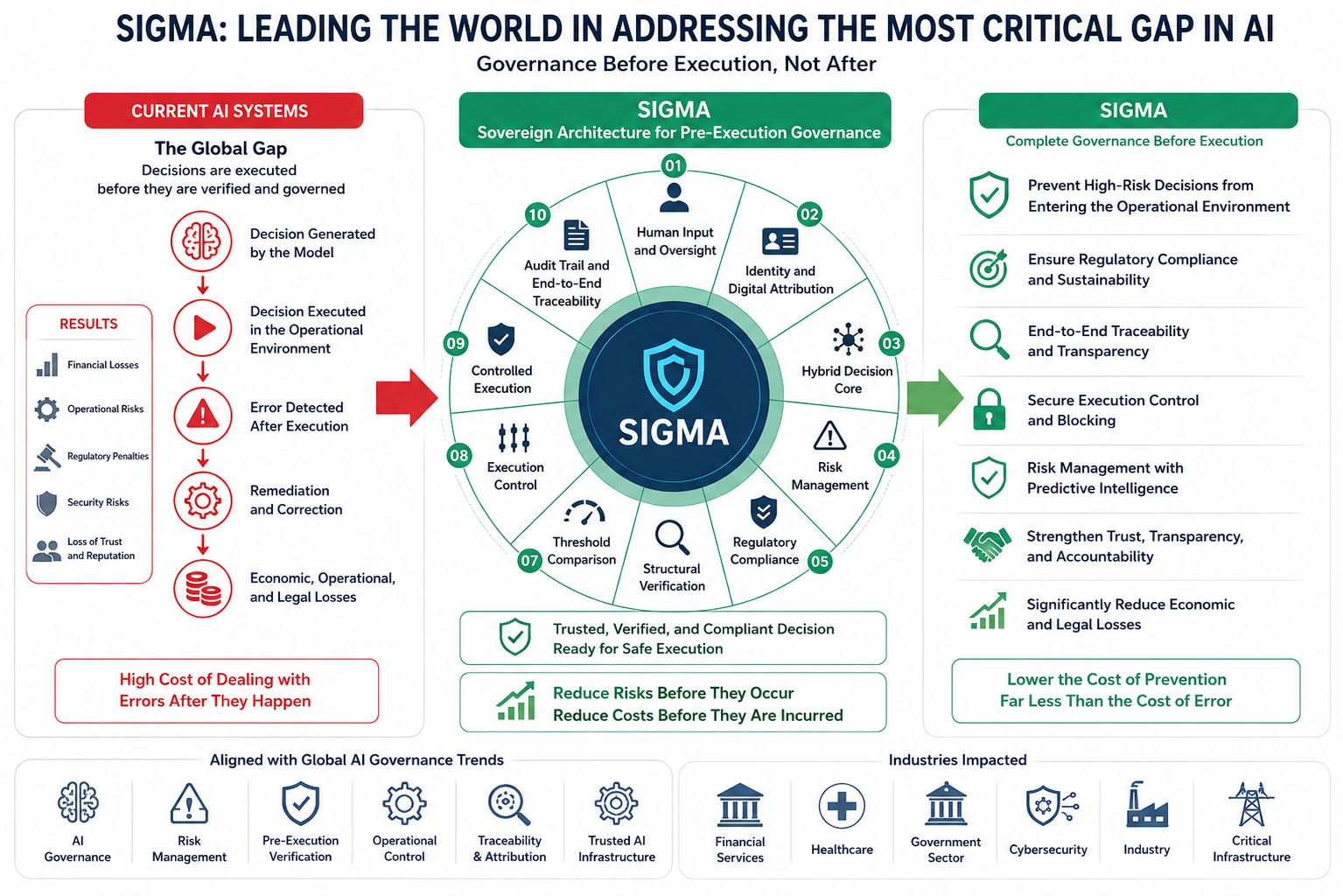
Slide 3 — Core Innovation SIGMA transforms artificial intelligence from: A system that produces directly executable decisions into A sovereign human-governed operational decision system where every critical AI decision is governed before execution.
Slide 4 — Global Problem Current AI environments continue to face critical operational challenges: • Direct execution of AI-generated outputs • Limited governance before execution • Weak auditability and traceability • Fragmented compliance frameworks • Increasing regulatory complexity • Separation of human authority from operational decision execution Result Increasing operational, regulatory and cybersecurity risks.
Slide 5 — Why SIGMA Matters As AI adoption accelerates worldwide: • AI is expanding into critical infrastructure • Regulatory requirements continue to grow • Organizations require trustworthy AI governance • Human accountability becomes increasingly essential International developments include: • EU AI Act • UNESCO AI Ethics Recommendation Emerging Requirement Govern AI before execution—not after execution.
Slide 6 — SIGMA Solution SIGMA operates as an independent sovereign governance layer positioned between AI systems and execution environments. Operational Flow AI ↓ SIGMA Governance ↓ Approval ↓ Execution SIGMA enforces: • Governance • Compliance • Verification • Risk Assessment • Documentation • Policy Enforcement • Human Oversight • Execution Authorization
Slide 7 — Decision Lifecycle Every operational decision passes through:
- AI Output Generation
- Decision Interception
- Compliance Validation
- Risk Assessment
- Documentation
- Policy Enforcement
- Human Oversight
- Execution Authorization Only authorized decisions proceed to execution.
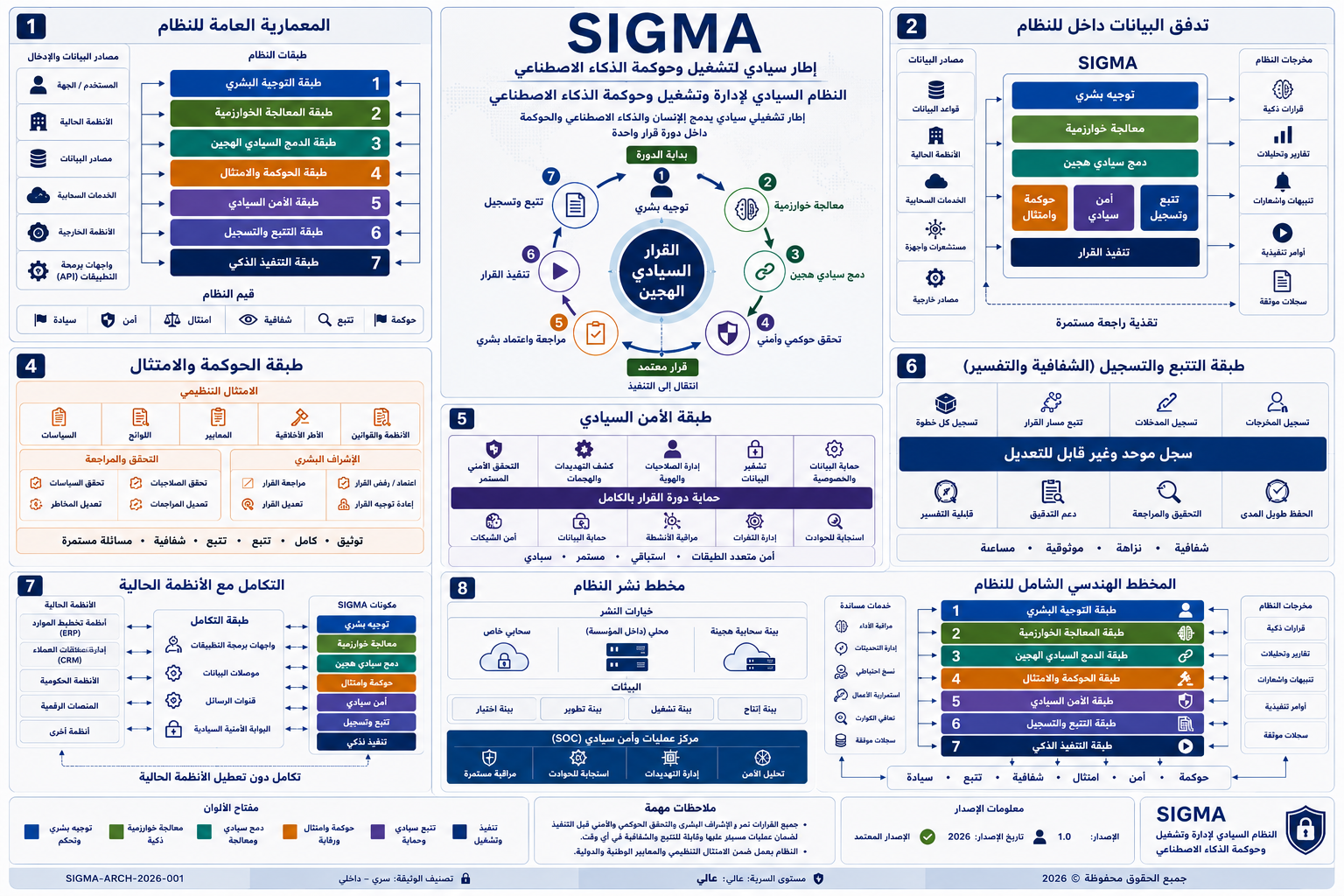
Slide 8 — System Architecture SIGMA operates as: • An independent governance layer • Positioned above any AI model • Compatible with existing infrastructures • Non-invasive deployment architecture • Fully Model-Agnostic Designed for integration rather than replacement.
Slide 9 — Strategic Capabilities • Pre-Execution AI Governance • Algorithmic Decision Control • Regulatory Compliance • Policy Enforcement • Operational Risk Management • Documentation Management • Evidence Preservation • Decision Traceability • Decision Provenance • Transparency • Explainability • Structural Human Oversight • Sovereign Cybersecurity • External AI Governance • Industrial Decision Control • Licensable Governance Architecture
Slide 10 — Core Engineering Innovations SIGMA introduces several engineering innovations: • Human authority embedded inside the decision core • Sovereign Decision Engineering • Native governance within operational workflows • Integrated cybersecurity before execution • Native documentation architecture • Built-in auditability • Integrated risk governance • Unified operational governance lifecycle
Slide 11 — Deployment & Integration SIGMA is designed for enterprise deployment. Benefits include: • No replacement of existing AI systems • Operates above current infrastructures • Incremental deployment • Reduced implementation costs • Faster organizational adoption • High interoperability Design Principle Integration—not disruption.
Slide 12 — Challenges & Target Markets Challenges Addressed • Missing pre-execution governance • Weak decision traceability • Operational AI risks • Fragmented compliance • Limited human oversight • Documentation inconsistency Target Markets • Government • Sovereign Institutions • Financial Services • Defense & Security • Healthcare • Energy • Industrial Operations • Smart Cities • Critical Infrastructure • Technology Companies
Conclusion SIGMA represents a Sovereign Operational Governance Infrastructure for artificial intelligence before execution. It establishes a new operational governance layer that integrates: • Governance • Compliance • Verification • Risk Management • Documentation • Traceability • Human Oversight • Security within a unified pre-execution operational architecture. SIGMA enables trustworthy, accountable, traceable, secure, and human-governed artificial intelligence for enterprise and sovereign environments.
How we built it
Challenges we ran into
Accomplishments that we're proud of
What we learned
What's next for اختراع حوكمة الذكاء الاصطناعي
Built With
- https://youtube.com/shorts/uq7utcjmv8i?si=zd7jzardyax6ccxw


Log in or sign up for Devpost to join the conversation.