-
-
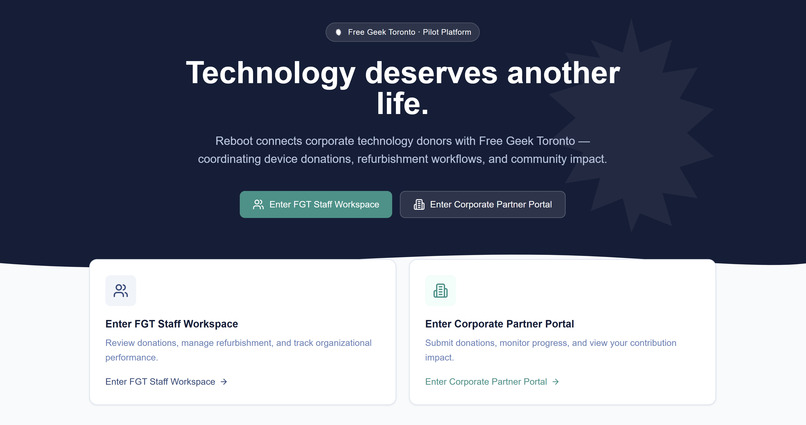
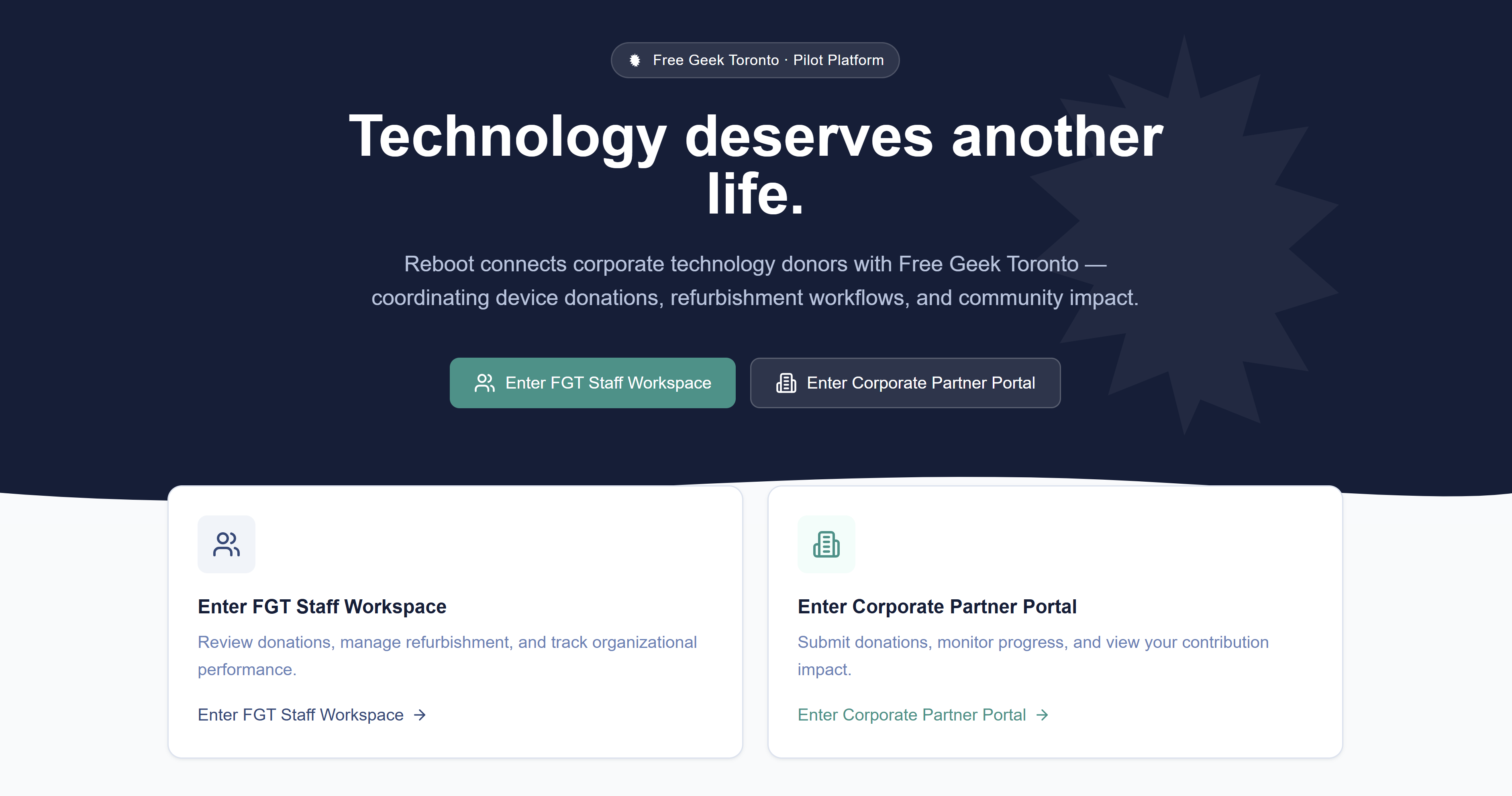
Landing Page
-
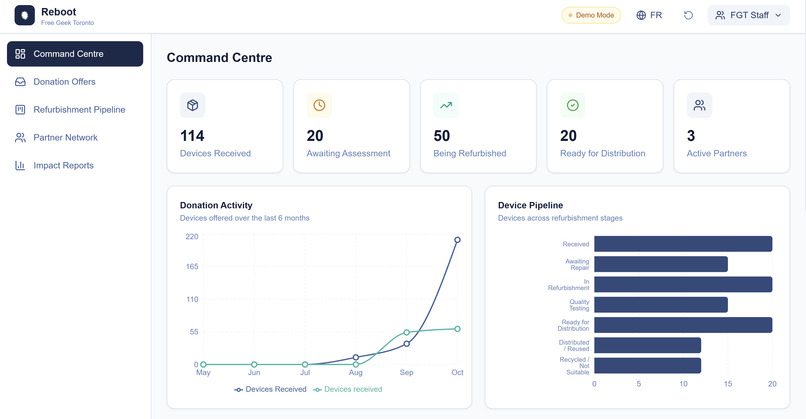
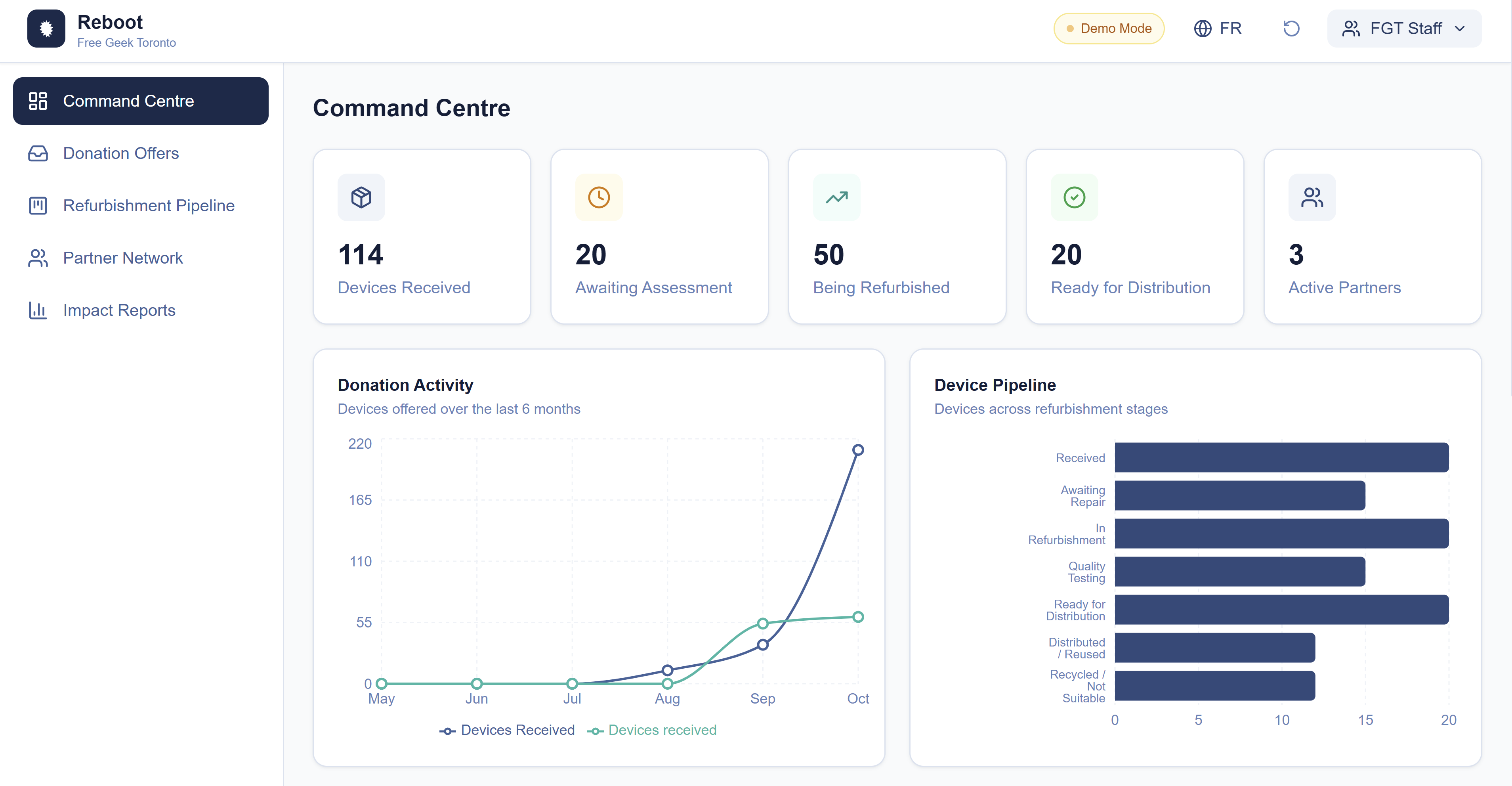
Staff Workspace Command Center
-
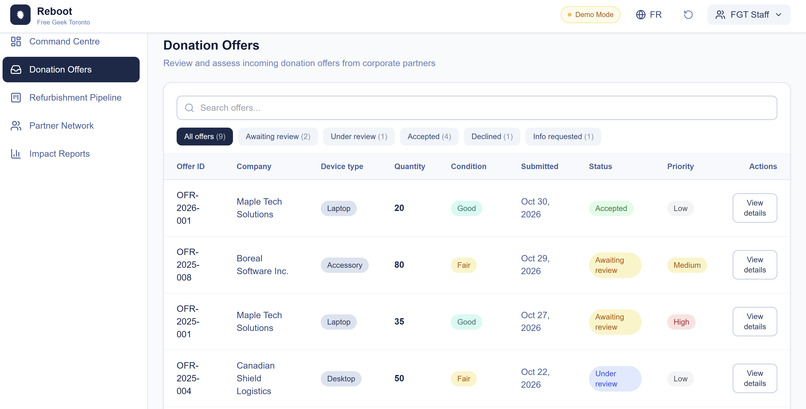
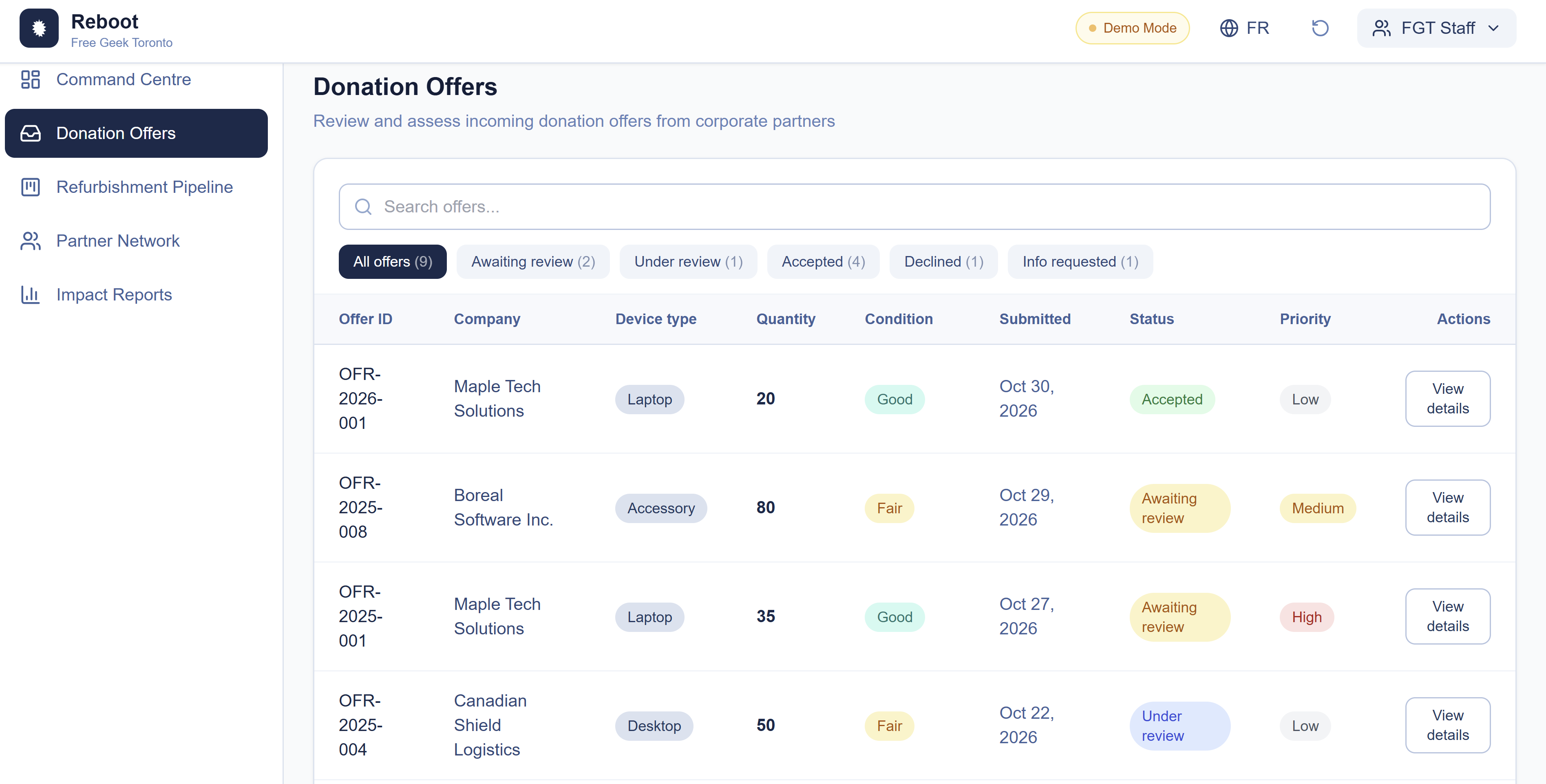
Donation Offers
-
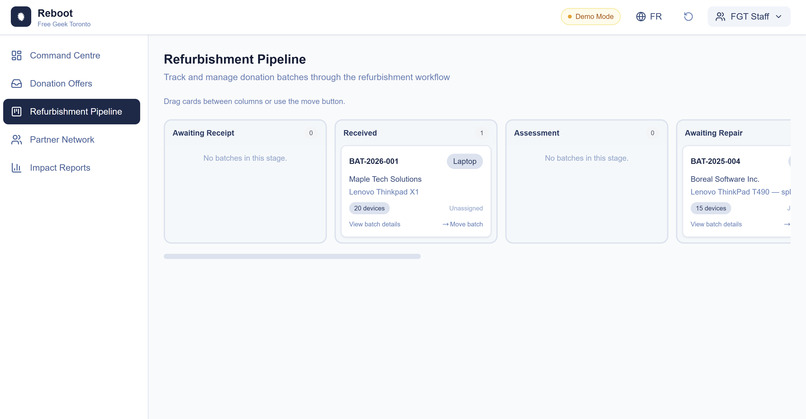
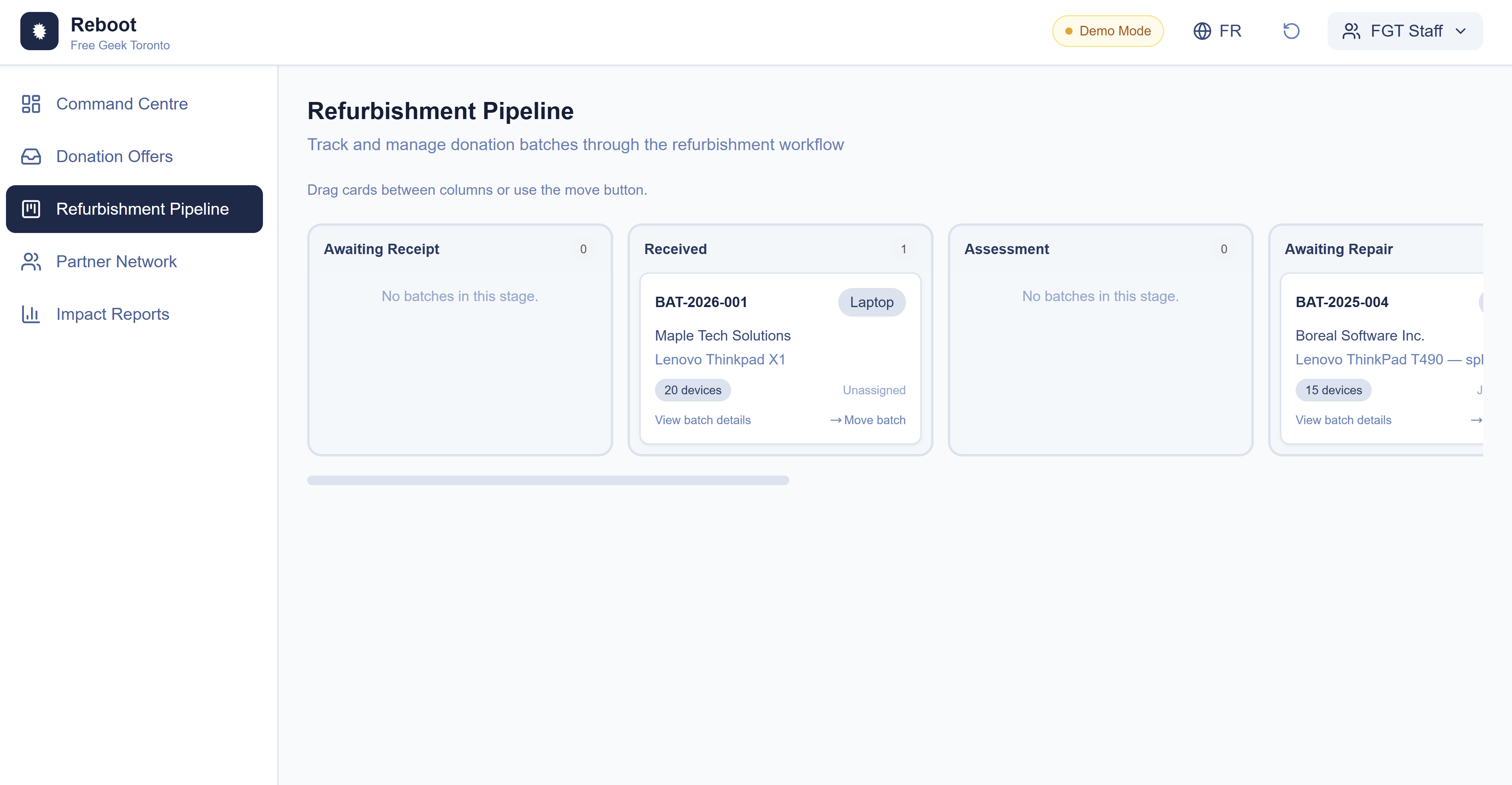
Refurbishment Pipeline
-
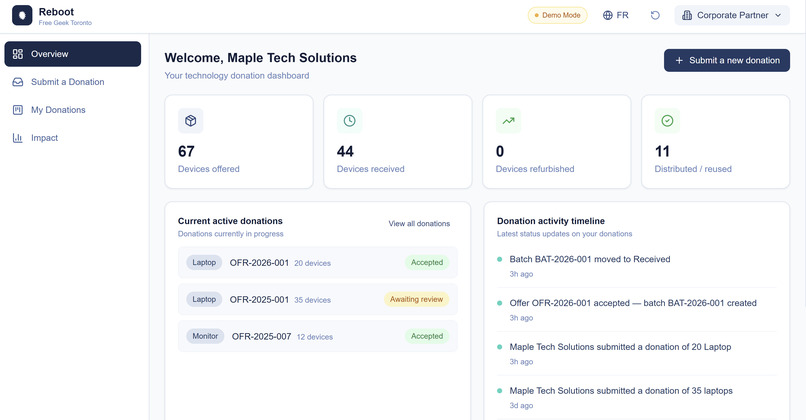
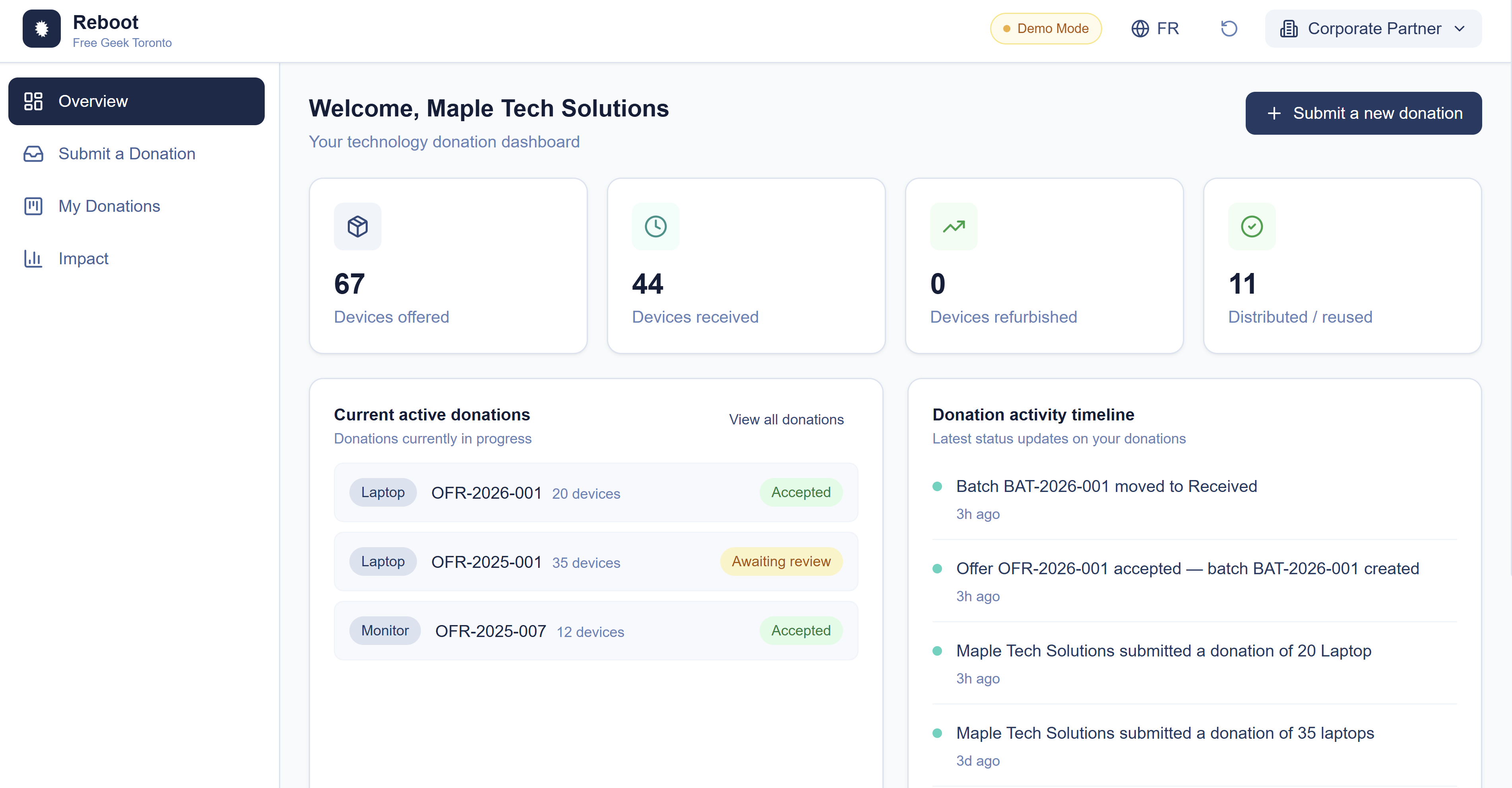
Corporate Partner Overview
-
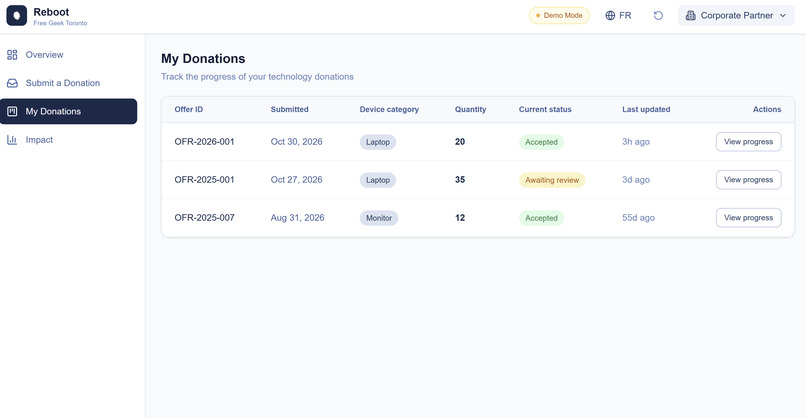
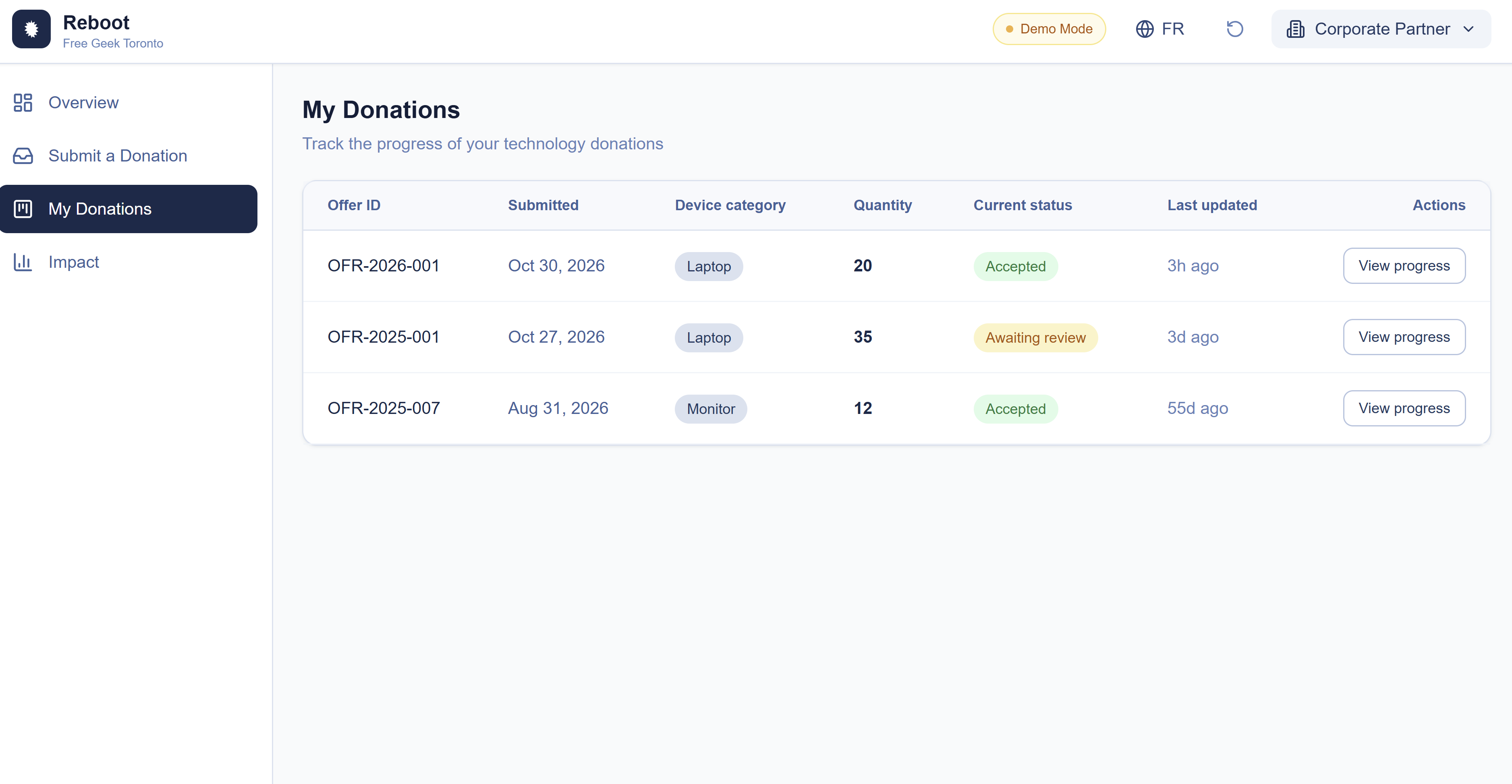
Corporate Partner's Donations
-
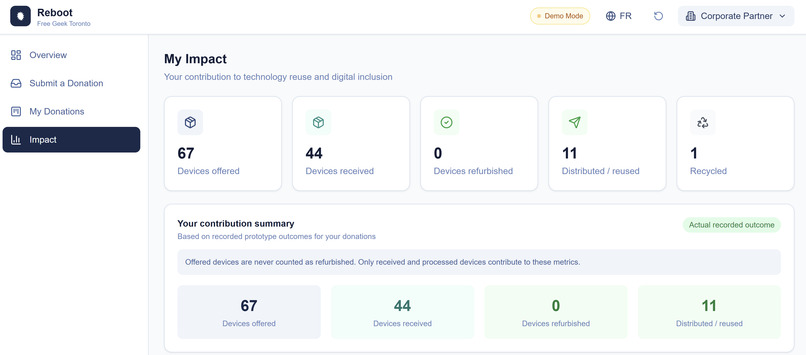
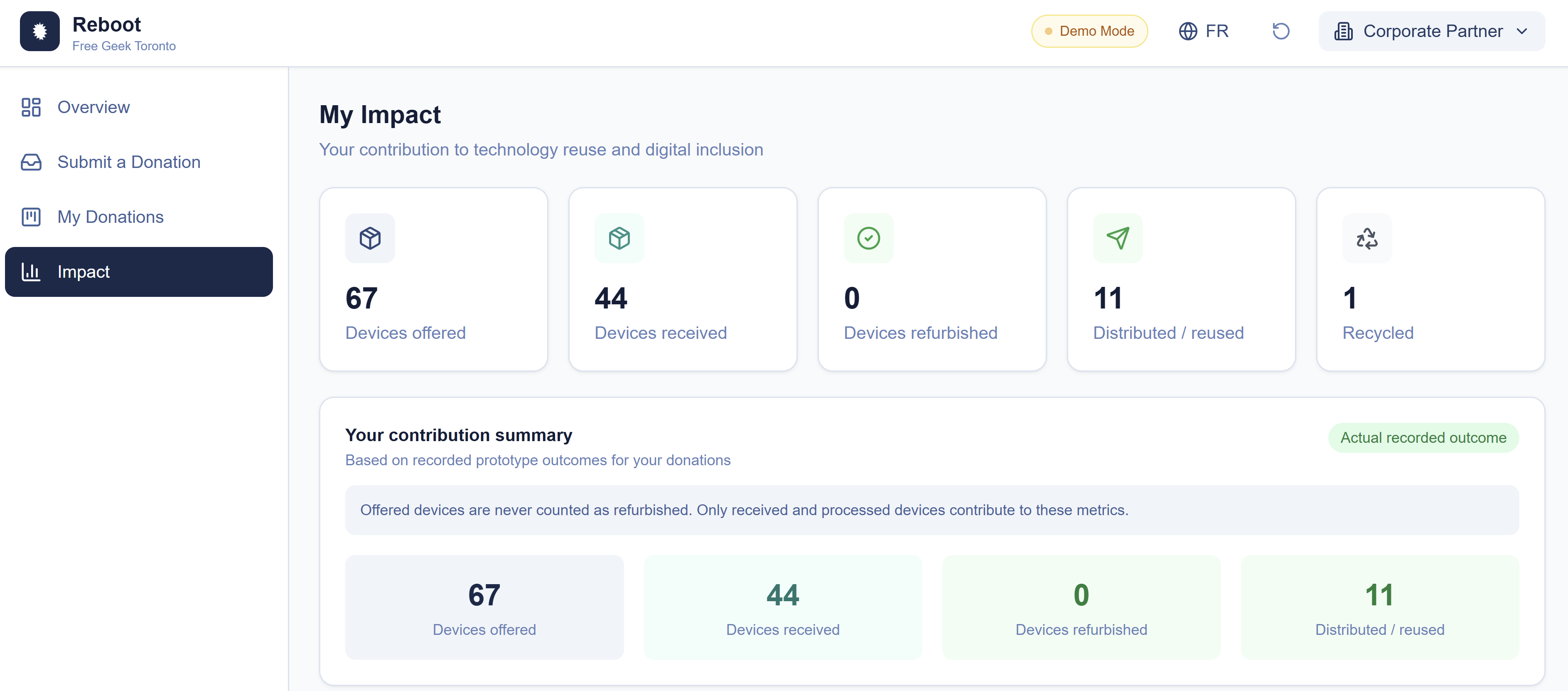
Corporate Partner's Impact
Inspiration
Technology is constantly being replaced. Businesses upgrade their equipment, perfectly usable laptops get left behind, and electronic waste continues to grow. Yet, for many people, access to a reliable computer remains a barrier to education, employment, and everyday digital participation.
We were inspired by Free Geek Toronto's mission to make technology more accessible through reuse, education, and community empowerment. We saw an opportunity to address one of its key challenges: making corporate technology donations more consistent, manageable, and useful.
We wanted to build something that could help turn surplus technology into meaningful opportunities for others.
What it does
REBOOT is a donation and refurbishment coordination platform designed to connect corporate technology donors with Free Geek Toronto.
It brings both sides of the donation process into one connected system.
For corporate partners, REBOOT provides a dedicated portal where organisations can:
- Submit offers for surplus laptops, desktops, and other devices.
- Track donation progress from submission to final outcome.
- View the refurbishment and reuse impact of their contributions.
For Free Geek Toronto, the platform provides tools to:
- Review, assess, and manage incoming donation offers.
- Evaluate device suitability, condition, and refurbishment requirements.
- Track donated devices through different stages of the refurbishment pipeline.
- Manage corporate partnerships and monitor donation activity.
- Generate impact reports showing device outcomes and partner contributions.
The goal is to make donations more predictable, reduce unnecessary processing effort, and help more usable technology reach people who need it.
How we built it
We built REBOOT as a web-based platform with two connected workspaces: an internal staff dashboard and a corporate partner portal.
The prototype uses React, TypeScript, and Vite, with Tailwind CSS for styling and Recharts for data visualisation.
We focused on creating a straightforward workflow that connects the entire donation lifecycle. When a corporate partner submits a donation offer, it appears in the staff workspace for assessment. Once accepted, it can be converted into a refurbishment batch and tracked through the pipeline.
The platform also includes donation intelligence to help staff evaluate offers using factors such as device condition, specifications, refurbishment requirements, and available processing capacity. Importantly, these assessments support staff decisions rather than replacing human judgement.
We populated the prototype with illustrative data to demonstrate the workflow, including fictional corporate partners, donation offers, refurbishment batches, and impact statistics.
Challenges we ran into
One of our biggest challenges was designing a solution that addressed operational efficiency without losing sight of Free Geek Toronto's social mission.
A larger donation is not necessarily a better donation. Accepting large quantities of unsuitable or difficult-to-refurbish devices could create additional work for an organisation with limited staff, space, and resources. We therefore needed to consider device quality, refurbishment effort, and processing capacity rather than simply prioritising donation volume.
Another challenge was connecting two different user experiences. Corporate partners need a simple way to contribute and understand the impact of their donations, while staff need more detailed tools to assess offers and manage inventory.
We also had to think carefully about data consistency. A device being offered is not the same as a device being received, refurbished, or distributed. Keeping these stages distinct was essential to making the platform's tracking and impact reporting meaningful.
Accomplishments that we're proud of
We're proud to have developed a working end-to-end prototype that demonstrates how corporate donations could be coordinated through a single platform.
Some of the key features we're particularly proud of include:
- Two connected workspaces: A corporate portal and an internal staff dashboard that share donation records.
- Donation management: Corporate offers can be submitted and reviewed through a structured workflow.
- Donation intelligence: Staff receive assessment guidance based on device suitability and operational considerations.
- Refurbishment tracking: Accepted donations can become batches and move through the refurbishment pipeline.
- Impact visibility: Partners and staff can view donation progress and recorded device outcomes.
Most importantly, we are proud that REBOOT is designed around the realities of a nonprofit organisation rather than simply maximising the number of devices collected.
What we learned
This project taught us that solving a problem for a nonprofit requires more than building software with an impressive feature set.
A solution must account for the organisation's actual capacity, resources, workflows, and long-term mission. More donations do not automatically mean more impact if an organisation cannot process them efficiently.
We also learned the importance of designing for multiple stakeholders. A platform must be simple enough for external partners while providing enough detail for the people managing operations behind the scenes.
Above all, we learned that technology can play an important role in the circular economy, not just by reducing waste, but by helping existing resources reach people who can benefit from them.
What's next for REBOOT
REBOOT is currently a working prototype, and there is plenty of room to develop it further.
Our next steps would include:
- Real-world validation: Work with Free Geek Toronto to understand its existing workflows and refine the platform around its operational needs.
- Pilot programme: Test the system with a small number of corporate donors and evaluate the donation process.
- Improved inventory management: Introduce more detailed device-level tracking, including specifications, repair history, and final outcomes.
- Data security: Explore secure data-wiping verification and clearer documentation throughout the donation process.
- Better reporting: Develop more detailed impact reports, with transparent methodologies for environmental estimates.
- Partnership growth: Make it easier for organisations to become recurring technology donors.
Our long-term vision is to help create a more connected and sustainable technology reuse ecosystem, where surplus devices can find their next purpose instead of becoming waste.
Technology moves forward. It shouldn't leave useful technology behind.
DISCLOSURE: AI assistance was used in the making of the project.
Built With
- ai-assisted
- bolt.new
- css
- javascript
- lucide
- react
- tailwind
- typescript
- vite

Log in or sign up for Devpost to join the conversation.