-
-
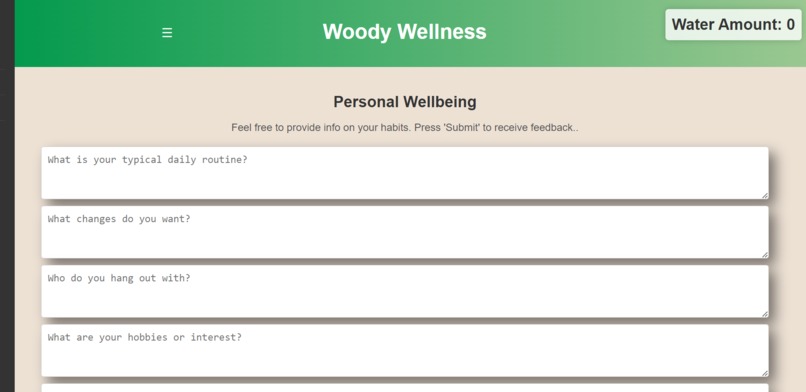
Initial page
-

General tree design

Inspiration
Our group has a strange composition. With two seniors and two freshmen (we call ourselves the 'Half Wits'), finding an idea we could all get behind seemed difficult. However, despite our age differences, one challenge remained ubiquitous to our group: finding a life balance in college. Whether you are a newbie freshman, still figuring out wherever your lecture hall is, or an experienced senior, searching for a job to propel yourself into adult life, many obstacles get in the way of finding balance. Countless responsibilities and random events leave little mental bandwidth to remember to live well in all aspects of one's life. We figured that having an app to remind and inspire ourselves and others to find balance in all areas of our lives would be the right project for this.
What it does
The web app prompts the user with five questions to gauge their life habits. The user's responses are then passed into a specifically engineered prompt that encourages the model to provide a list of mental and physical activities to help improve their situation.
How we built it
We started a Visual Studio Code Live Share environment which enables live collaboration on projects. A skeleton frame for the website's frontend and backend server was built via Python's Flask framework, HTML, and Javascript. Following this, core functionality was added to the web application. First, we worked to integrate AWS's Bedrock service to access the Claude 3 Haiku language model. We chose this model as it excels at engaging in human-like dialogue, natural language interpretation, and generating responses that align with human ethical values. These attributes made this model attractive as it aligned with our goals to provide very human life advice to very human users. After receiving a valid response from the Bedrock API, we engineered prompts for the AI to produce JSON files that could be easily processed for later usage. HTML and Javascript were then used to develop the rest of our web app. Finally, Heroku was used to deploy the website.
Challenges we ran into
The API call to the AWS language model took a (slightly disturbingly) long time to implement properly. As our team did not possess prior experience with Amazon Web Services, figuring out all the parts to make a successful call was challenging. As much as this process was a pain, it was just as much a rewarding experience that allowed us to exercise our problem-solving skills and rely on the resources we were provided.
Accomplishments that we're proud of
"It's too confusing. We refactored all our code. Don't use AWS." That's what we heard as we walked around during a break about halfway through the competition. We'd also been stuck on AWS for the past 2 hours and that approach started seeming more and more appealing. However, we stuck with it and eventually broke through. That moment felt great. We're also proud of our team cohesion. We successfully delegated tasks and worked together effectively. Most of all, we are proud of how we supported each other throughout development.
What we learned
We learned that painful bugs are always present. We might be churning out line after line of code now, but they could happen anytime. They're out there, always waiting to cripple our momentum, slow our development time, and drive us crazy. However, we also learned that with enough perseverance and determination, they can always be overcome. Most importantly, we learned that maintaining a positive mindset towards an issue, and not letting frustration set in, is one of the most critical values in solving these kinds of tedious tasks.
What's next for Woody Wellness
Built With
- amazon-web-services
- css
- flask
- heroku
- html
- javascript
- perplexity
- python
- visual-studio-code


Log in or sign up for Devpost to join the conversation.