-
-
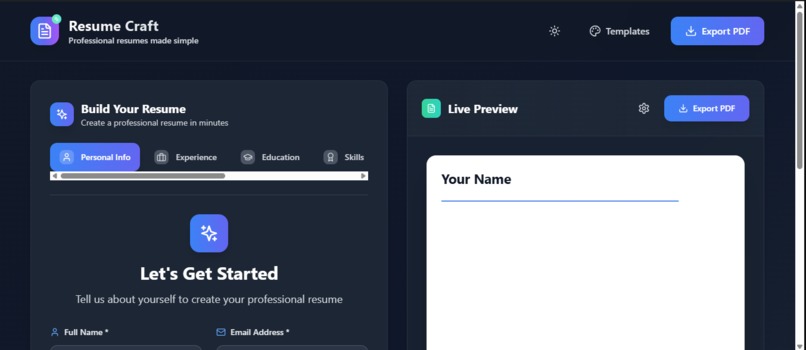
The begining page
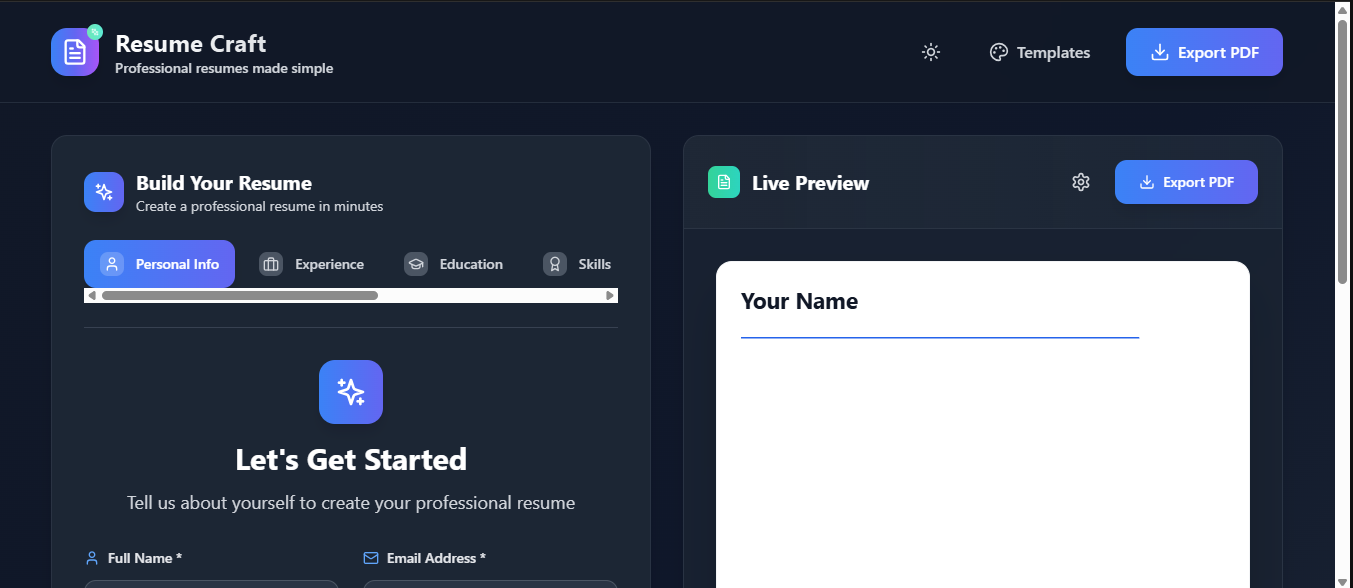
Inspiration The struggle of formatting: I wanted to solve a problem I've faced myself. I've spent hours tweaking margins and fonts when I should've been focusing on my content. I saw a need for a tool that eliminates this tedious process.
The need for personalization: I was tired of generic templates. My goal was to create a tool that helps users generate a unique and professional-looking resume that reflects their personal brand, without needing a design degree.
What it does Guided input: The application walks users through a step-by-step process to enter their personal information, work experience, education, and skills.
Template selection: Users can choose from a variety of professionally designed templates to instantly format their information.
Instant generation: With a single click, the tool generates a clean, well-formatted, and professional resume that can be downloaded as a PDF.
Customization options: I built in the ability for users to change colors and fonts to personalize their resume.
How I built it This is where you'll highlight the technologies you used and the process you followed as a solo developer.
Front-end: I used a framework like React, Angular, or Vue.js to build the user interface, making it dynamic and responsive.
Back-end (if applicable): If you had a server-side component, you could mention using Node.js, Python with Flask/Django, or Ruby on Rails to handle data processing.
Styling: I used CSS, Sass, or a UI library like Bootstrap or Material-UI to make the templates look great.
Data handling: I managed user input by storing it in local state to provide a smooth, real-time experience.
Challenges I ran into Juggling roles: As a solo developer, I was the designer, the front-end developer, the back-end developer, and the project manager. The biggest challenge was prioritizing features and managing my time effectively to get a working prototype built within the hackathon's deadline.
Debugging alone: When I hit a bug, there was no one else to turn to. I had to rely on my own problem-solving skills and resources like documentation and online forums to get past roadblocks.
PDF generation: Turning the HTML and CSS of the resume into a downloadable PDF was a complex problem I had to solve. I spent a lot of time troubleshooting different libraries to get the formatting just right.
Accomplishments I'm proud of A fully functional prototype: Going from an idea to a working application that provides a real solution in a very short amount of time, all by myself, is something I'm very proud of.
An intuitive user experience: I focused on making the tool incredibly easy to use, and I'm proud of how simple and straightforward the entire process is.
End-to-end development: I successfully handled every part of the project, from the initial design to the final deployment. This gave me a comprehensive understanding of the entire development lifecycle.
What I learned New technologies: I learned a new library, framework, or API specifically for this project. This forced me to quickly get up to speed on a new tool.
Extreme time management: I learned how to scope a project, prioritize tasks, and execute a plan from start to finish under immense pressure.
Self-reliance: I learned to trust my own abilities to solve complex problems and build a project from the ground up, entirely on my own.
What's next for Project Research User accounts and saving data: My next step would be to add a feature where users can create an account and save their information for future editing.
More templates: I'd like to add a wider variety of resume templates and more customization options.
AI-powered suggestions: I'd love to integrate AI to provide tips on what skills to include or to improve the wording of a bullet point.
Built With
- astro
- next.js
- react
- svelte
- tailwindcss
- vue.js

Log in or sign up for Devpost to join the conversation.