-
-
Recipé Key Features
Inspiration
So I asked my partner what's her ideal application that can make her life easier and less stressful. Guess what she said and I quote, "If only I can get an app to give me variety of options as to what I could make per time without me always going to Instagram to save meal videos." That was the lightbulb moment for me
Then I thought, What if we could build an app that helps with meal recommendations based on the cooking materials or resources you have available to you while also considering your dietary plans, allergies, and, in some cases, fitness goals and health requirements.
Beyond trying to solve this immediate need, this would be solving the problems a lot of people are facing globally, as a survey by Birds Eye found that 62% of people look for recipes online, compared to 59% who prefer cookbooks, while another study showed that only 8% of adults have never used the internet for cooking help.
But due to the time limitations, the team decided we should tackle the quick win, which is to develop an app that would help with meal recommendations based on what you currently have available at your disposal and go a step further in showing you how to prepare your preferred option with step-by-step guides and video recommendations, just so the user still has that help needed, like they get on Instagram videos.
What it does
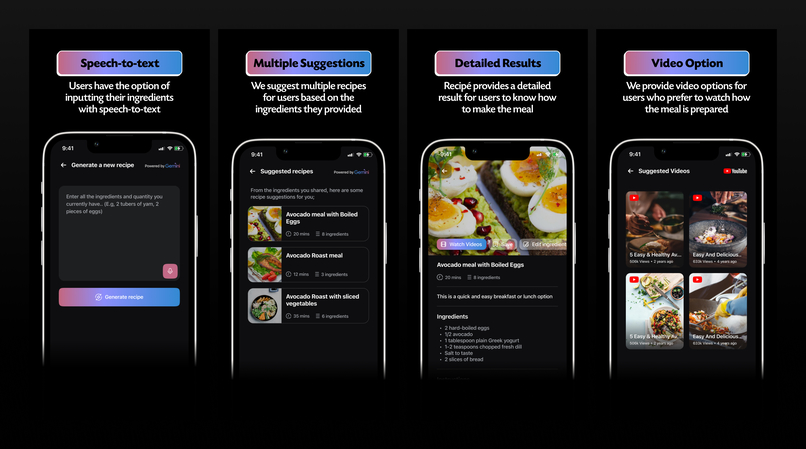
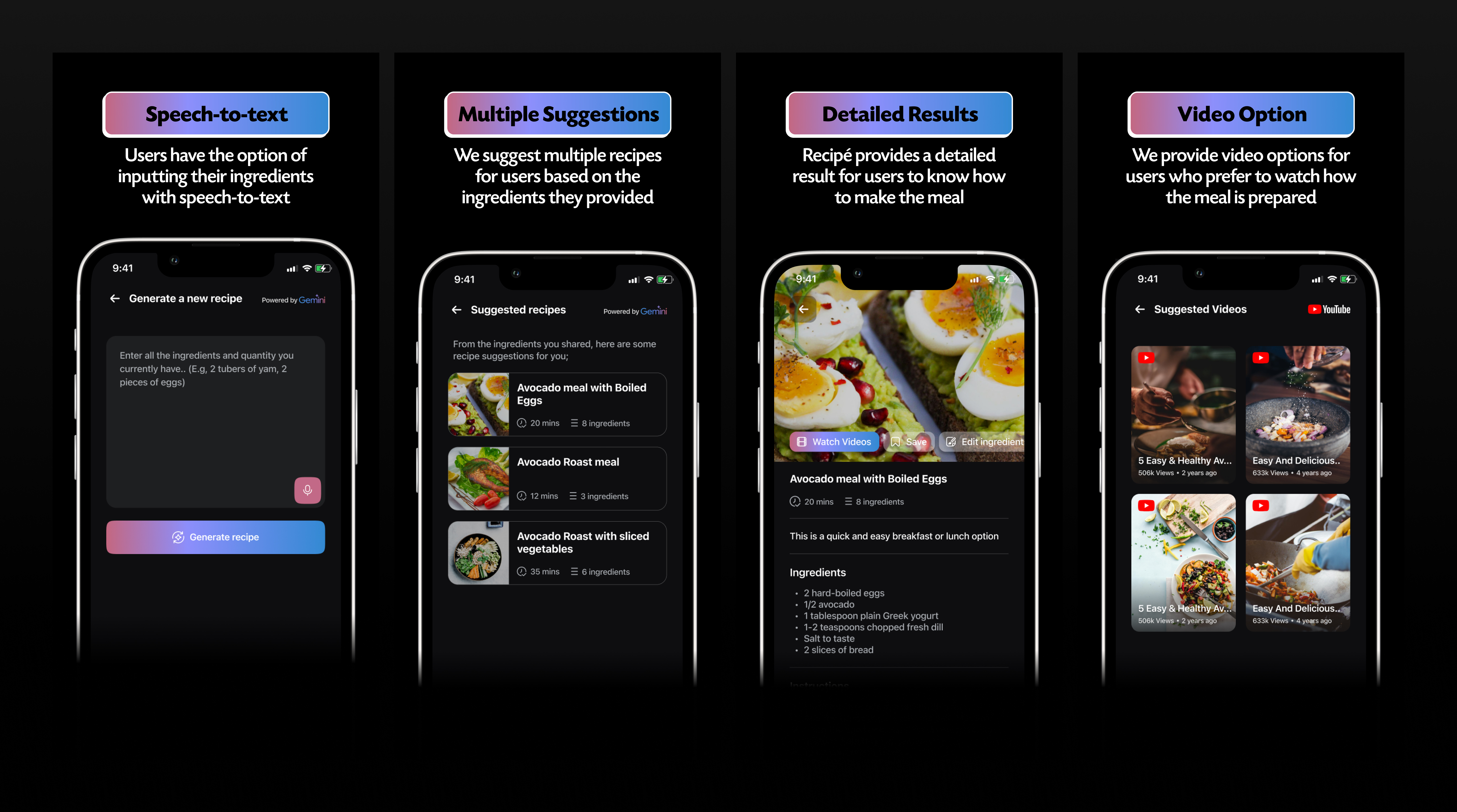
The app currently using Gemini helps users generate meal recommendations based on what you've put in or what they have available to them, either through directly typing this in or using the speech-to-text function.
Once the user is satisfied with the inputs, there is a confirmation screen that highlights the various inputs to enable the user to reaffirm that every detail was captured while having the ability to edit the details if the user needs to make any further additions or substractions.
On confirmation, the app generates various meal options that the user could make, therefore allowing the user select their preferred choice at the moment, which then takes them to the step-by-step guide on how to make this meal. In addition to this step-by-step guide, there are video recommendations which would also be recommended based on the user's preferred meal selection, which would allow the user to watch how to make this meal, especially in a situation where the meal is a "first time" one to the user
Given the user is satisfied with whatever options are selected, that preference can be saved so the user can always make future reference to it.
This is how far we could come given the time constraints we had and the challenges we encountered in the development and collaboration process.
How we built it
Gathering Requirements (Emmanuel Timehin-James):
We started by defining the core functionalities of the application. This involved understanding what problem we were trying to solve and what features were essential to addressing that problem.
Minimum Viable Product (MVP) Definition (The Team):
Together, we decided on the key features that would be included in the initial version of the app (MVP). This version would be built with the least amount of time and resources possible, allowing us to get it into users' hands quickly and gather feedback.
User Flow Development (Emmanuel Timehin-James):
Emmanuel mapped out the user journey within the app. This involved outlining the steps users would take to accomplish their goals within the application.
Prototype Design (James Otemolu):
James created a visual representation of the app using Figma, a design software. This prototype likely included mockups of screens and how they would interact with each other, giving us a clearer idea of the app's look and feel before actual development began.
App Development (Rebecca Saka):
Rebecca built the functional app using Flutter, a framework for creating mobile applications. Firebase, a backend development platform from Google, was used to manage data storage and user authentication.
The building process was iterative and not linear, as we had to go back and make edits and corrections to the prototype based on feedbacks
Challenges we ran into
One of the factors contributing to the app's vitality is its images. However, due to our inability to access Vertex AI's Imagen, we resorted to employing a keyword search for ingredient and recipe names. Unfortunately, this approach means we lack control over the images retrieved for both ingredients and recipes. Additionally, the limitations imposed by the Pexels API, restricting us to generating only 200 images per hour, compelled us to prioritize generating images solely for the recipes to avoid violating this rule.
Accomplishments that we're proud of
- Building this app with limited time and resources at our disposal
- Releasing to Beta testing on Test Flight
What we learned
- How to better interact with Gemini.
- We learned about more capabilities on Gemini.
What's next for Project Recipé?
- We need to integrate the geo location feature so meal recommendations can be more personalised.
- The onboarding process also needs to be personalised so user details like allergies and health issues can be specified so recommendations take these factors into considerations.
- Personalized suggestions by Gemini based on Fitness Plans for users.
- Also, there is a forum where familiar users on the app can share meal ideas and recipes amongst each other.

Log in or sign up for Devpost to join the conversation.