-
-
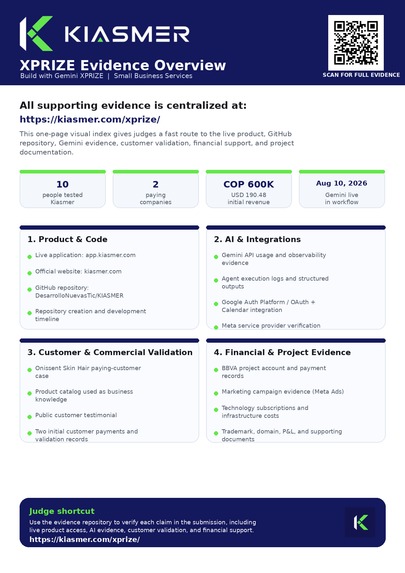
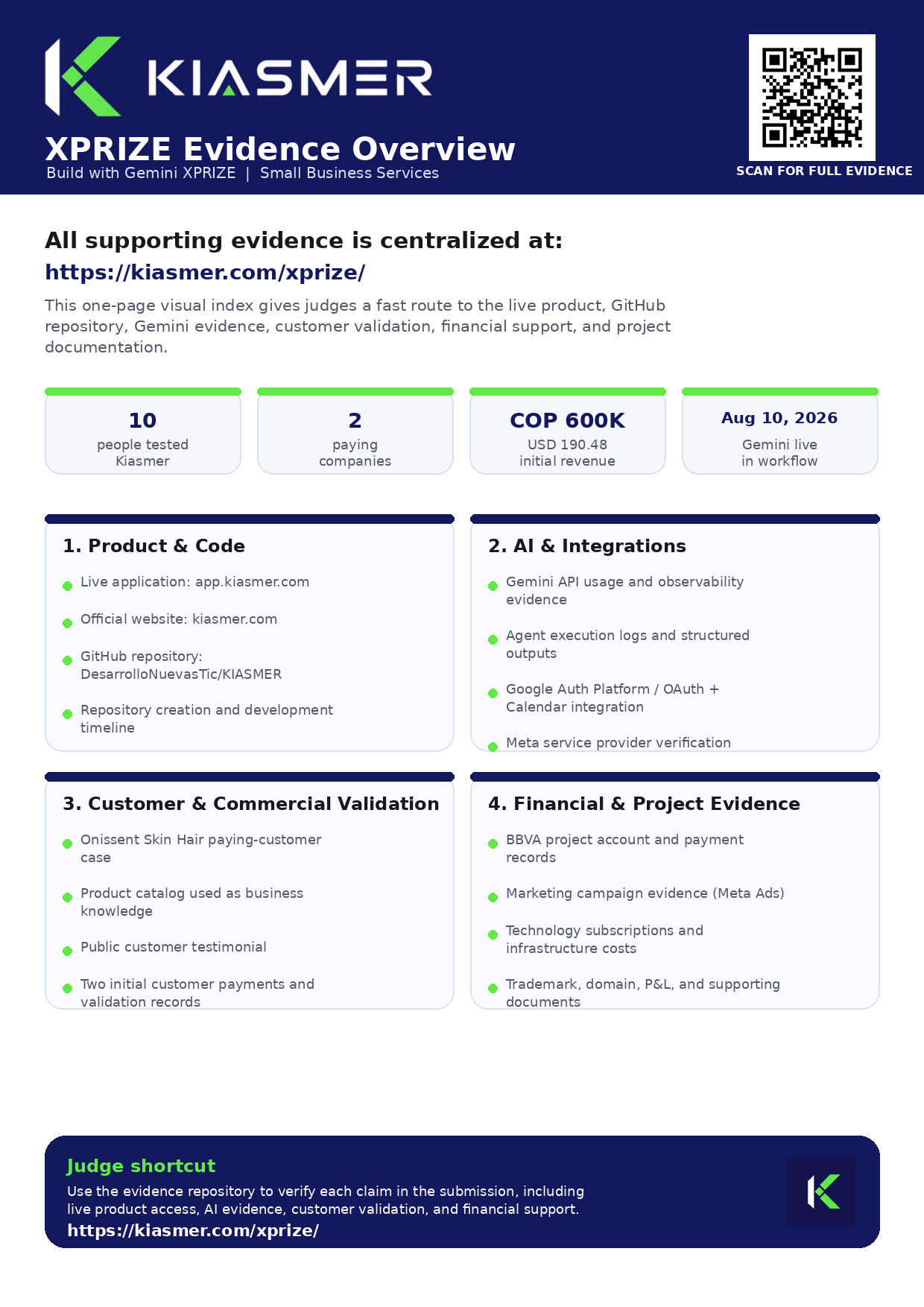
Centralized evidence overview with links to Kiasmer product, AI, customers, revenue, and project records.
Inspiration Kiasmer was born from observing a recurring problem among small businesses: many succeed in generating contacts through social media, advertising, or WhatsApp, but still lose opportunities because they cannot always respond on time, understand each prospect’s needs, and maintain consistent follow-up.
In businesses with small teams, every conversation depends on someone being available to respond, organize the information, and decide what should happen next. As the number of inquiries grows, that capacity becomes limited, and some commercial opportunities may be left unanswered or without continuity.
The challenge was not simply to automate messages, but to enable each conversation to move forward within an organized commercial process. That is why we developed a multi-agent system capable of handling inquiries, understanding needs, qualifying prospects, following up, scheduling meetings, and determining when a conversation should be escalated to a human.
The motivation behind Kiasmer is to give small businesses access to AI-supported customer service and commercial management capabilities without requiring a large sales team to maintain continuity across their opportunities.
What it does Kiasmer is a multi-agent artificial intelligence system for small businesses that receive prospects through digital channels, especially WhatsApp.
Each business configures its information, products, services, customer service rules, and commercial workflow in Kiasmer. Based on that context, the agents handle conversations, answer questions, identify needs, qualify prospects, and organize commercial opportunities.
During the interaction, the system can continue the conversation automatically, check availability, move toward scheduling an appointment, escalate the conversation to a human, or end the interaction when appropriate.
Relevant prospect information is recorded in the platform and can move through a pipeline-style conversion funnel, allowing the business to preserve history, follow up, and manage opportunities beyond a single conversation.
AI primarily handles initial customer interactions and repetitive tasks, while the human team focuses its time on situations that require advisory support, negotiation, or closing.
How we built it Kiasmer was built as a multi-agent platform designed to manage commercial conversations for small businesses. The project’s dedicated repository was created on July 1, 2026, and from there we progressively developed the messaging, automation, and commercial management integrations.
The platform uses Laravel 12, PHP 8.3, Vue 3, Node.js, PostgreSQL 14, and Redis. WhatsApp serves as the primary interaction channel, while Kiasmer centralizes prospects, opportunities, meetings, follow-up, and commercial stages within a single operation.
During development, we also advanced our integration with the Meta ecosystem. Centro de Desarrollo de Nuevas Tecnologías was verified by Meta as a service provider, and the Kiasmer application was associated with this verification, strengthening the infrastructure required to operate the solution across Meta channels.
The architecture was initially tested with another language model. On August 10, 2026, we integrated Gemini as the artificial intelligence engine of the multi-agent system, seeking greater response coherence and a stronger connection between the model and the platform’s operational functions.
Based on each company’s business context, rules, and conversation history, Gemini generates responses and can produce structured outputs associated with the expected next action. Through function calling, Kiasmer processes these outputs and executes the corresponding function within the platform.
During development, we also implemented mechanisms to register prospects, preserve conversation history, manage opportunities, perform follow-up, and visualize commercial progress through a dashboard and pipeline.
The system’s operation is verified through internal logs, platform metrics, and Gemini usage records, allowing us to review agent execution and progressively refine the workflows.
Challenges we ran into One of the main challenges was enabling Kiasmer to adapt to different customer segments and business models without having to build a separate solution for each company. To achieve this, we had to design a configuration framework capable of incorporating business knowledge, products, services, rules, objectives, and commercial workflows into the context used by the agents.
The challenge was not only to generate correct responses, but also to maintain coherence throughout the interaction and achieve sufficient reliability to connect AI decisions with real actions within the commercial process.
The architecture was initially tested with another language model. We later migrated to Gemini to achieve greater response coherence and more consistent interactions. Its function calling capability allowed us to connect model outputs with Kiasmer’s real functions in a more structured way.
We also faced technical challenges related to WhatsApp integration, including session management, connection stability, and conversation synchronization. During development, WhatsApp also began evolving toward a model that incorporates usernames and business-scoped identifiers, allowing people to interact without necessarily sharing their phone number. This requires us to prepare Kiasmer’s architecture to correctly identify and associate contacts, conversations, prospects, and histories without relying exclusively on the phone number as the primary identifier.
This change also creates an opportunity to strengthen user privacy, but it requires us to progressively adapt the logic for identification, persistence, and contact association within the follow-up module.
Our goal has been to move from a solution that simply converses to a configurable, reliable multi-agent system capable of evolving alongside the channels on which it operates.
Accomplishments that we're proud of One of our main accomplishments was turning an automated customer service concept into a functional multi-agent system capable of handling real commercial conversations and connecting those interactions with actions within the commercial process.
During the hackathon, we integrated Gemini into Kiasmer’s operational workflow, structured prospect and opportunity management, incorporated follow-up, meetings, and human escalation, and established technical evidence through logs and model usage metrics.
We also brought the solution to real users. Ten people tested Kiasmer, and two companies decided to purchase the service, each making an initial payment of COP 300,000 (approximately USD 95.24), for a total of COP 600,000 (approximately USD 190.48) in initial revenue.
Another important accomplishment was completing the verification of Centro de Desarrollo de Nuevas Tecnologías by Meta as a service provider, with the Kiasmer application associated with that verification within the Meta ecosystem.
One of our validation cases is Onissent Skin Hair, a cosmetics manufacturer and distributor that incorporated its commercial catalog as knowledge used by Kiasmer and became one of the solution’s first paying customers.
Beyond building a functional platform, we are especially proud of achieving an initial stage of verifiable technical and commercial validation: an operational product, real users, paying customers, initial revenue, and evidence of artificial intelligence being used within the commercial process.
What we learned We learned that building an AI solution for sales is not only about generating good responses. The real challenge is turning a conversation into reliable decisions and actions within a real commercial process.
We also learned that the quality of the system depends heavily on how each company’s knowledge, service rules, commercial objectives, and workflow are structured. For this reason, configuration became a core capability of Kiasmer, allowing the system to adapt to different customer segments without having to build a separate solution for each business.
Migrating to Gemini allowed us to confirm the value of combining language generation with function calling. This made it easier to separate the interpretation and decision produced by the model from the action that Kiasmer subsequently executes.
Validation with real users and paying customers also reinforced another important lesson: AI creates more value when it complements the human team. Agents can handle initial interactions, maintain continuity, and manage repetitive tasks, while people focus their time on advisory work, negotiation, and closing.
Finally, we learned that a technically functional solution only begins to become a business when there is real usage, feedback, and willingness to pay. Our experience with the first users and customers allowed us to move from validating only the technology to beginning to validate the commercial model as well.
What's next for Kiasmer The next step for Kiasmer is to consolidate operations with our first customers, expand our usage history, and measure more precisely how conversations, prospects, opportunities, meetings, and follow-up activities evolve through the platform.
We will also continue strengthening the Gemini integration, especially its role in decision-making within conversational workflows, the use of function calling, and its connection with operational functions such as availability checks, appointment scheduling, follow-up, and human escalation.
Another priority will be to further standardize configuration by customer segment, so that new businesses can set up their knowledge, rules, products, services, and commercial workflows with less implementation time while maintaining consistency in agent responses.
Kiasmer’s official launch is scheduled for September 15, 2026, from 8:00 a.m. to 10:00 a.m., with support from the Huila Chamber of Commerce. The event will include an in-person component for business owners in Neiva and virtual participation for entrepreneurs from other cities in Colombia.
In the medium term, we aim to consolidate specific business segments in Colombia and then begin expanding into Spanish-speaking markets across Latin America, leveraging a common multi-agent architecture that can be adapted to the knowledge and commercial workflows of different types of businesses.
Built With
- baileys
- docker
- function-calling
- gemini
- gemini-api
- github
- google-auth-platform
- google-calendar
- google-cloud
- laravel-12
- multi-agent-ai
- node.js
- oauth-2.0
- php-8.3
- postgresql-14
- redis
- vue-3
- whatsapp-business
- whatsapp-cloud-api

Log in or sign up for Devpost to join the conversation.