-
-
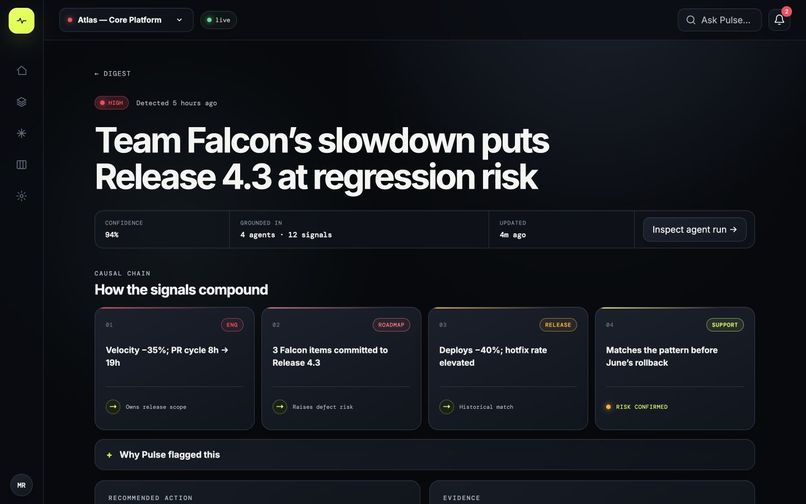
Engineering Risk - Details
-
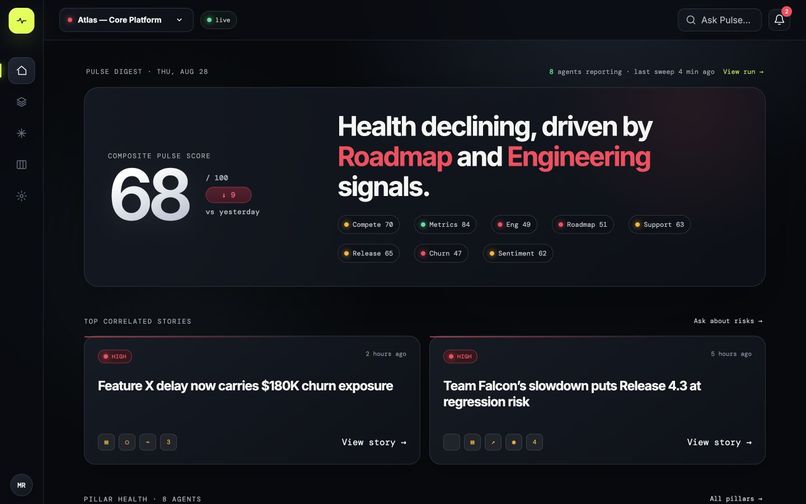
Health Dashboard
-
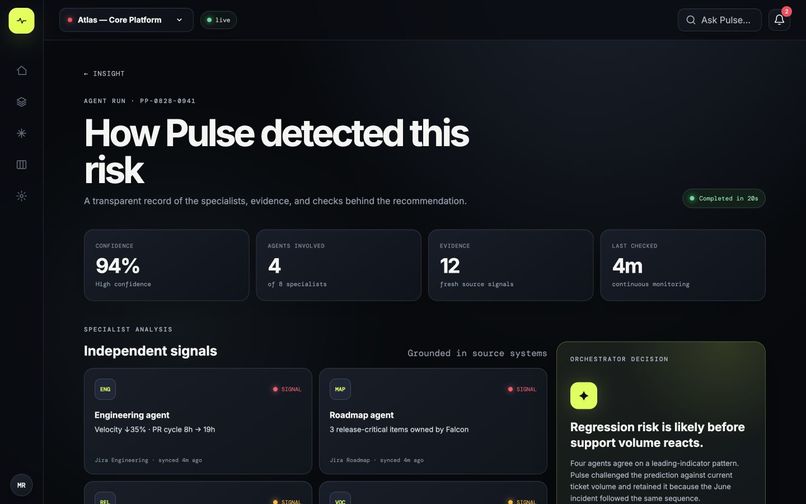
How it works?
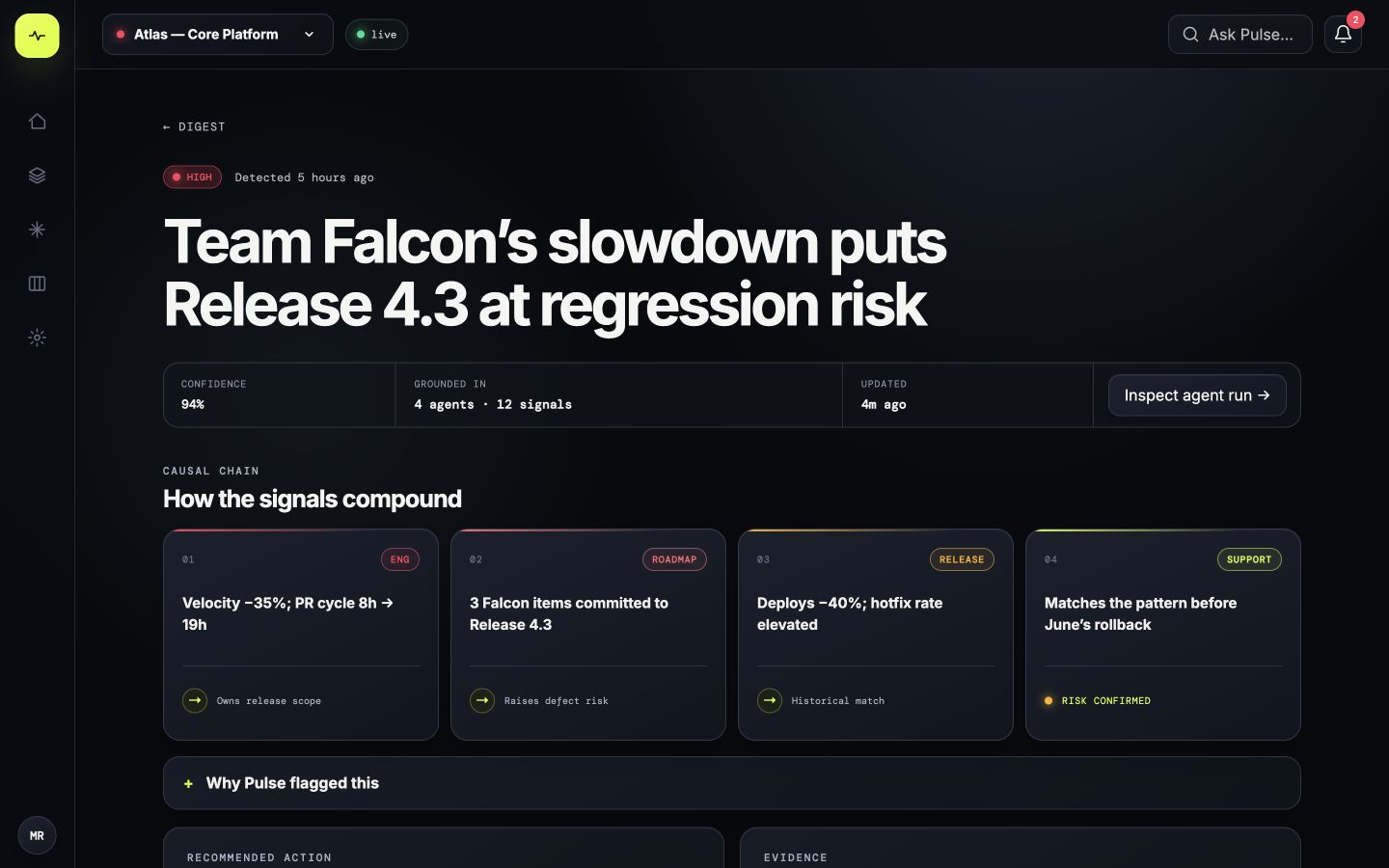
Inspiration
The idea came from a familiar Monday product review. The roadmap showed a major release as “on track,” but the engineering team had slowed down, pull requests were taking twice as long to merge, and two release-critical items were still unfinished. In another meeting, Customer Success mentioned that a large customer was waiting for the same release before renewing. Support had also started receiving complaints related to the delayed capability. Each team knew one part of the story, but nobody saw the complete risk. The roadmap stayed green until the release slipped. Only afterward did the organization connect the engineering slowdown, delivery risk, customer frustration, and renewal exposure. We started imagining an AI teammate that could have joined those signals earlier and said: “These events are related. Here is the evidence, here is what may happen next, and here is the action most likely to prevent it.” That became Product Pulse—an AI Product Operations Manager that identifies cross-functional risks early, explains its reasoning, coordinates human-approved action, and checks whether the intervention worked.
What it does
Product Pulse is an AI Product Operations Manager that helps product leaders detect cross-functional risks before they become missed releases, customer escalations, or churn.
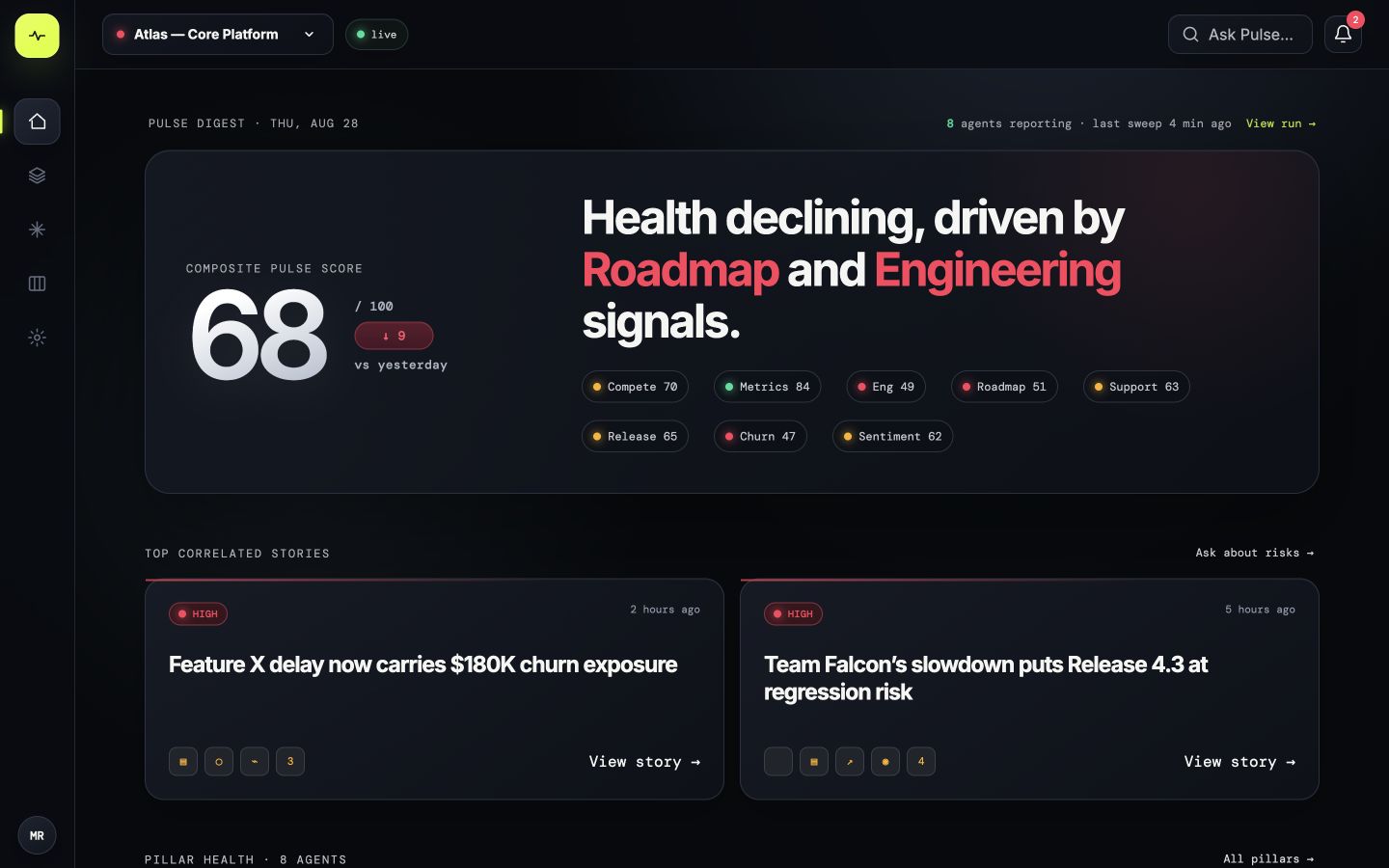
Eight specialist agents monitor Competitive Intelligence, Product Metrics, Engineering Health, Roadmap Health, Support and Voice of Customer, Release and Delivery, Churn Risk, and Stakeholder Sentiment. A Pulse Orchestrator connects their findings into prioritized causal stories.
Instead of presenting another collection of alerts, Product Pulse explains how the signals relate, shows the supporting evidence, challenges its own hypothesis, and recommends a specific intervention. A human reviews the proposed Jira action and Slack notification before execution. Product Pulse then monitors the underlying signals to verify whether the intervention worked.
The prototype includes onboarding, a daily Pulse Digest, eight agent pillar views, causal stories, inspectable agent runs, Ask Pulse, human-approved action creation, an accountability board, and outcome verification.
How we built it
We began by mapping the product-leadership workflow as a closed decision loop:
Observe → Detect → Correlate → Challenge → Recommend → Approve → Execute → Verify
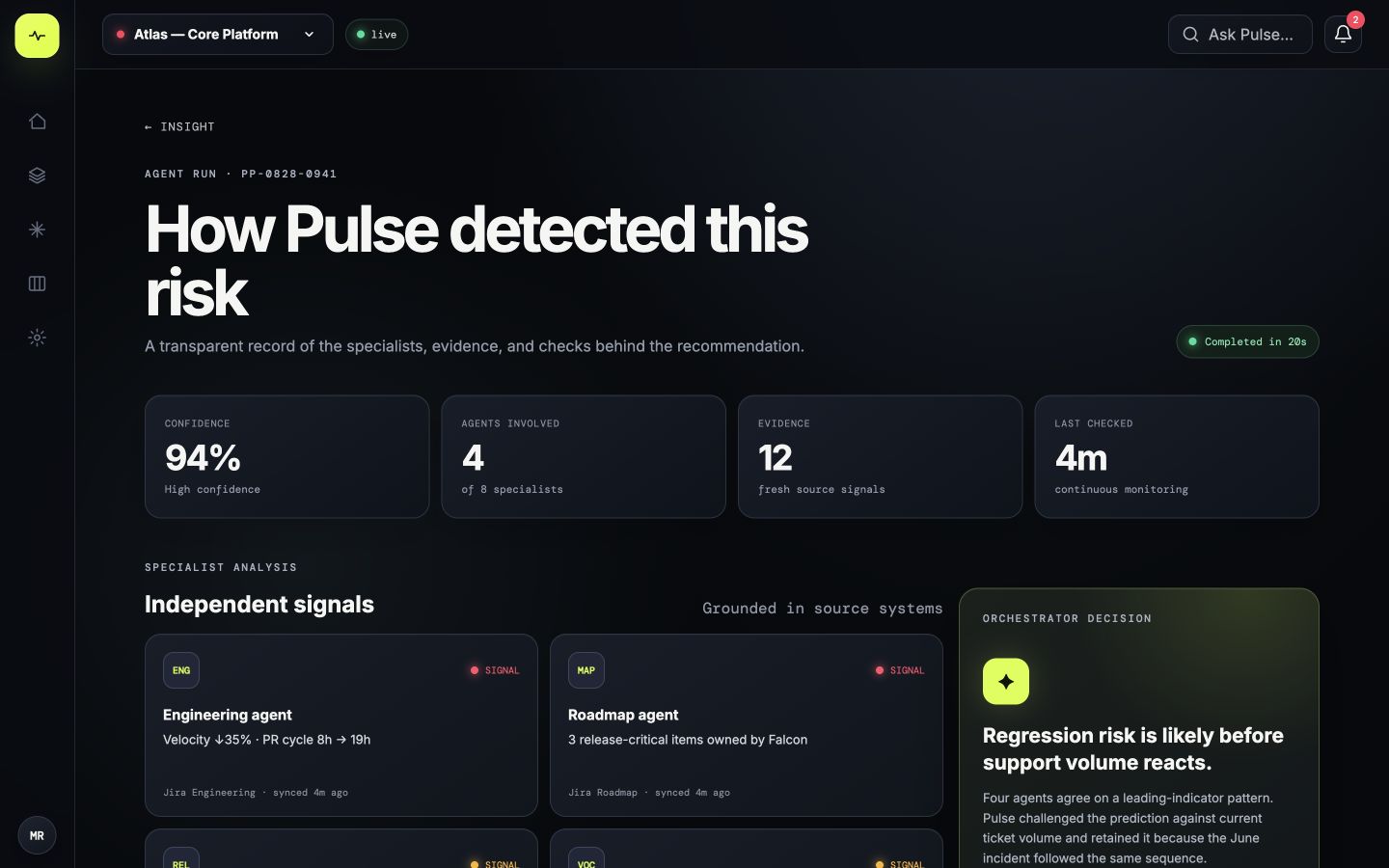
We designed eight specialist agents, each responsible for a distinct product domain, and an orchestrator that reasons across their assessments. Every high-priority insight includes confidence, freshness, contributing agents, source evidence, counter-signals, business exposure, and a recommended owner.
For the hackathon prototype, we implemented the complete interaction model using HTML, CSS, and JavaScript with deterministic mock data. This allowed us to demonstrate the end-to-end agent experience clearly without requiring access to sensitive enterprise systems. Jira, Slack, analytics, CRM, support, and CI/CD integrations are simulated.
The responsive prototype is deployed on Vercel, with source code and product documentation available on GitHub.
Challenges we ran into
The biggest challenge was turning a large amount of operational data into something that reduces cognitive load instead of creating another noisy dashboard. We had to decide which signals deserved immediate attention and which details should remain available only when a user investigates further.
A second challenge was making multi-agent reasoning understandable. Simply stating that several agents contributed was not enough. We designed an inspectable run that shows each agent’s assessment, the evidence it used, how the orchestrator connected the signals, and how the prediction was tested against counter-evidence.
We also had to balance autonomy with trust. Product Pulse needed to do more than summarize information, but external actions could not feel uncontrolled. We addressed this with an explicit approval step that previews the Jira payload, owner, deadline, rationale, and Slack notification.
Finally, fitting a complete enterprise workflow into a polished hackathon prototype required careful prioritization and several rounds of UX refinement.
Accomplishments that we're proud of
We are most proud that Product Pulse demonstrates a complete agentic loop rather than stopping at an AI-generated insight.
The prototype begins with fragmented operational signals, connects them into an explainable causal story, recommends a concrete intervention, requests human approval, simulates coordinated execution, and verifies the result during a later monitoring sweep.
We are also proud of the transparency built into the experience. Users can inspect which agents participated, which evidence influenced the recommendation, how fresh the evidence is, how confident the system is, and which counter-signals were considered.
The prototype includes eight distinct product-health domains while maintaining one coherent interaction model across desktop and mobile layouts. It makes a complex multi-agent system feel like a focused product-operations teammate rather than a collection of disconnected tools.
What we learned
We learned that the value of an enterprise agent is not measured by how much information it can generate. Its value comes from deciding what deserves attention, explaining why, and helping people complete the next responsible action.
We also learned that explainability must be part of the product experience, not a technical appendix. Confidence scores alone are insufficient. Users need source provenance, freshness, contributing perspectives, counter-evidence, and a clear distinction between observed facts and agent interpretation.
Another important lesson was that human approval does not make a system less agentic. When designed correctly, it allows the agent to perform meaningful investigation, coordination, and preparation while preserving accountability for consequential actions.
Finally, outcome verification is essential. Without checking what happened after an action, an AI product-operations system cannot improve its recommendations or demonstrate business value.
What’s next for Product Pulse
The next step is a connected enterprise pilot using read-only integrations with Jira, Slack, product analytics, support platforms, and CRM systems. This would allow the specialist agents to evaluate real operational signals while keeping all external actions in preview mode.
We would then add authenticated Jira and Slack execution, role-based approvals, persistent workspaces, audit logs, organization-specific policies, and evaluation infrastructure for measuring accuracy, false positives, cost, and latency.
Over time, Product Pulse could learn organization-specific patterns by comparing accepted and dismissed recommendations with verified outcomes. This would improve prioritization and enable reusable intervention playbooks.
Our long-term vision is for Product Pulse to become a trusted operating layer for product organizations: continuously detecting emerging risks, coordinating the right people, and measuring whether each intervention protected revenue, delivery time, or customer outcomes.
Built With
- agentic-ai
- ai-agents
- ci/cd
- crm
- css3
- customer-support
- enterprise-software
- explainable-ai
- html5
- human-in-the-loop
- javascript
- jira
- multi-agent-systems
- product-analytics
- product-management
- product-operations
- responsible-ai
- responsive
- slack
- vercel

Log in or sign up for Devpost to join the conversation.