Inspiration
If you’ve ever tried to watch a movie using a projector at home, you know how frustrating the setup can be. Between adjusting angles, fixing keystone distortion, and finding a flat surface, it can take tens of minutes before you’re actually ready to watch.
We wanted to eliminate that friction entirely. Our goal was simple: make projectors as seamless and intelligent as modern TVs. Just point, play, and enjoy. That vision led to Project Projection.
What it does
Projectors have remained largely unchanged for years, leaving significant room for innovation. Our solution introduces an AI-powered correction system designed to enhance projection quality and simplify setup.
By integrating a camera directly into the projector, our system continuously monitors the projected image and compares it to the intended output. Using this data, the AI can detect surface irregularities, depth variations, and distortions caused by uneven walls or objects. It then dynamically adjusts the projection in real time to compensate, resulting in a clearer, more accurate image.
In addition, the AI automatically corrects angles, focus, and blur, dramatically reducing setup time, especially for at-home users. The result is a smarter, more adaptive projector that delivers high-quality visuals on virtually any surface with minimal effort.
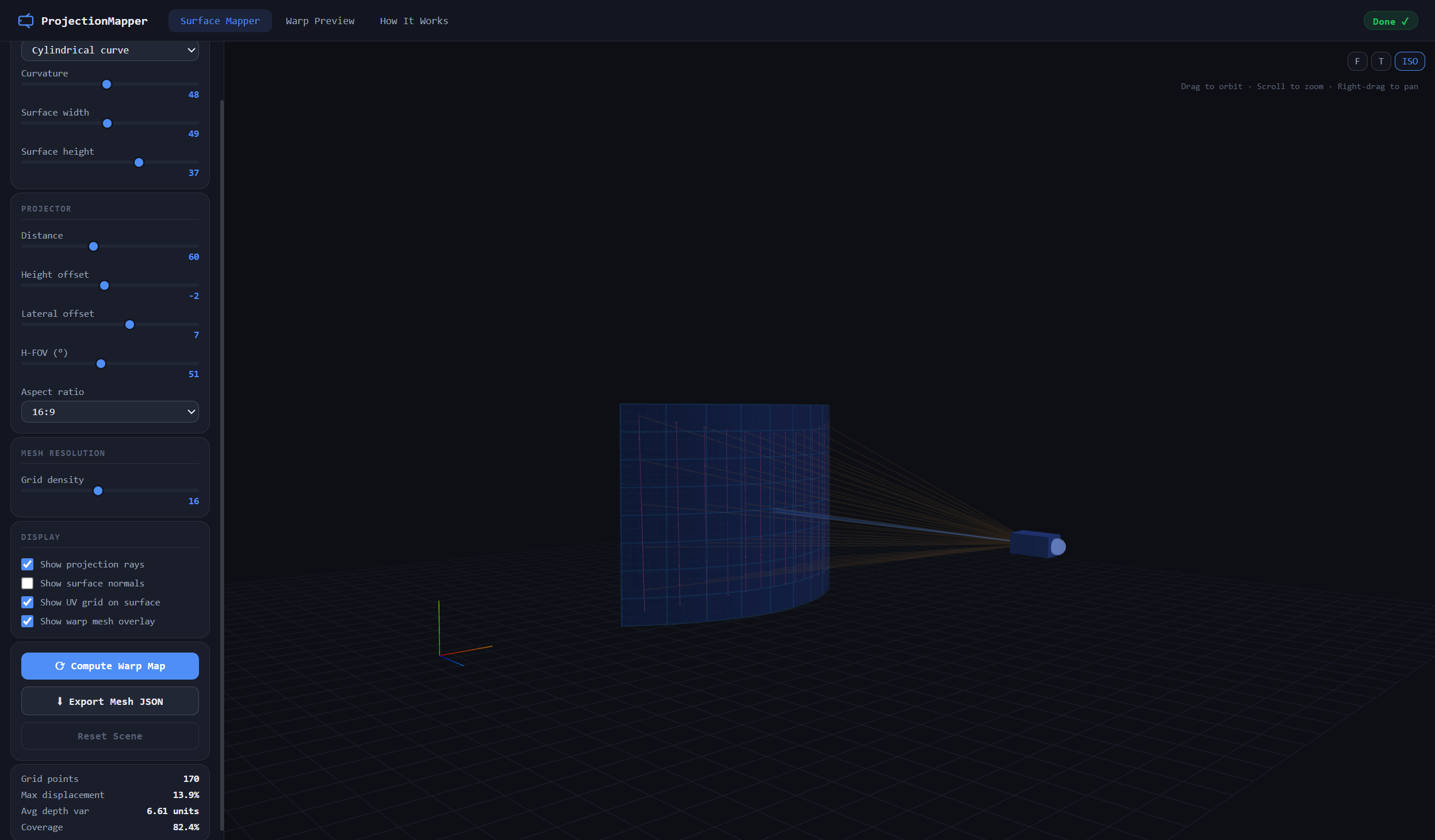
Our demo showcases a simplified version of this concept in action. Using a sample wall, we first overlay a grid onto the surface to capture its shape and contours. We then map the intended projection onto this grid, adjusting it to align with the surface’s geometry before displaying the final image. This demonstrates how projections can be pre-corrected to account for irregular surfaces, ensuring a more accurate and visually consistent result.
How we built it
We built our prototype using a combination of computer vision and geometric mapping techniques.
A camera feed is used to capture the projection surface in real time We apply grid detection and perspective transformation to model the surface geometry Image warping algorithms remap the intended projection to match the detected surface A simple UI allows users to upload images and visualize the corrected projection
Our implementation focuses on simulating the correction pipeline in software, demonstrating how a projector could intelligently adapt its output before displaying it.
Challenges we ran into
One of the biggest challenges was accurately detecting and modelling irregular surfaces. Real-world walls are rarely flat, and even small inconsistencies can cause noticeable distortion.
We also faced difficulties in:
Aligning the projected grid precisely with the captured surface Handling perspective transformations in a stable and visually convincing way Ensuring the remapped image still looked natural after heavy warping
Balancing performance with accuracy was another challenge, especially when aiming for real-time correction.
Accomplishments that we're proud of
We’re proud of turning a complex, hardware-heavy idea into a working software demo within a short hackathon timeframe.
In particular:
Successfully demonstrating surface-aware projection mapping Building a clear visual pipeline from detection to mapping and corrected output Creating an intuitive demo that communicates the concept effectively
We took an idea that typically requires specialized equipment and made it accessible and understandable.
What we learned
Through this project, we gained hands-on experience with computer vision, image transformation, and real-time rendering concepts.
We also learned:
How powerful simple geometric transformations can be when applied correctly The importance of visualization when explaining complex systems How to scope an ambitious idea into a functional prototype under time constraints
What's next for Project Projection
Next, we want to take this concept closer to a real-world product.
Future improvements include:
Integrating depth sensing (e.g., LiDAR or stereo vision) for more accurate surface mapping Moving from a demo pipeline to real-time, low-latency correction Expanding support for dynamic environments where objects move in front of the projection Exploring hardware integration with actual projector systems
Ultimately, we envision a future where projectors require zero manual setup, adapting instantly to any environment and delivering a perfect image every time.
Built With
- claude
- css
- html
- javascript


Log in or sign up for Devpost to join the conversation.