-
-
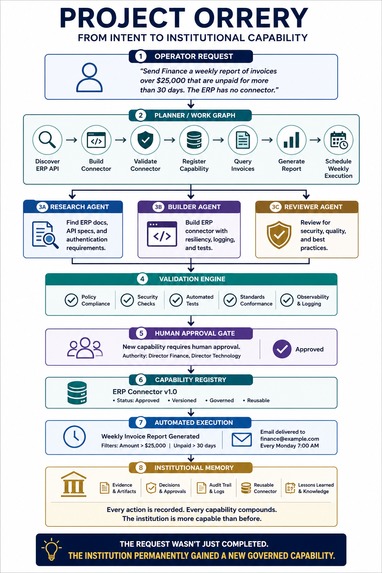
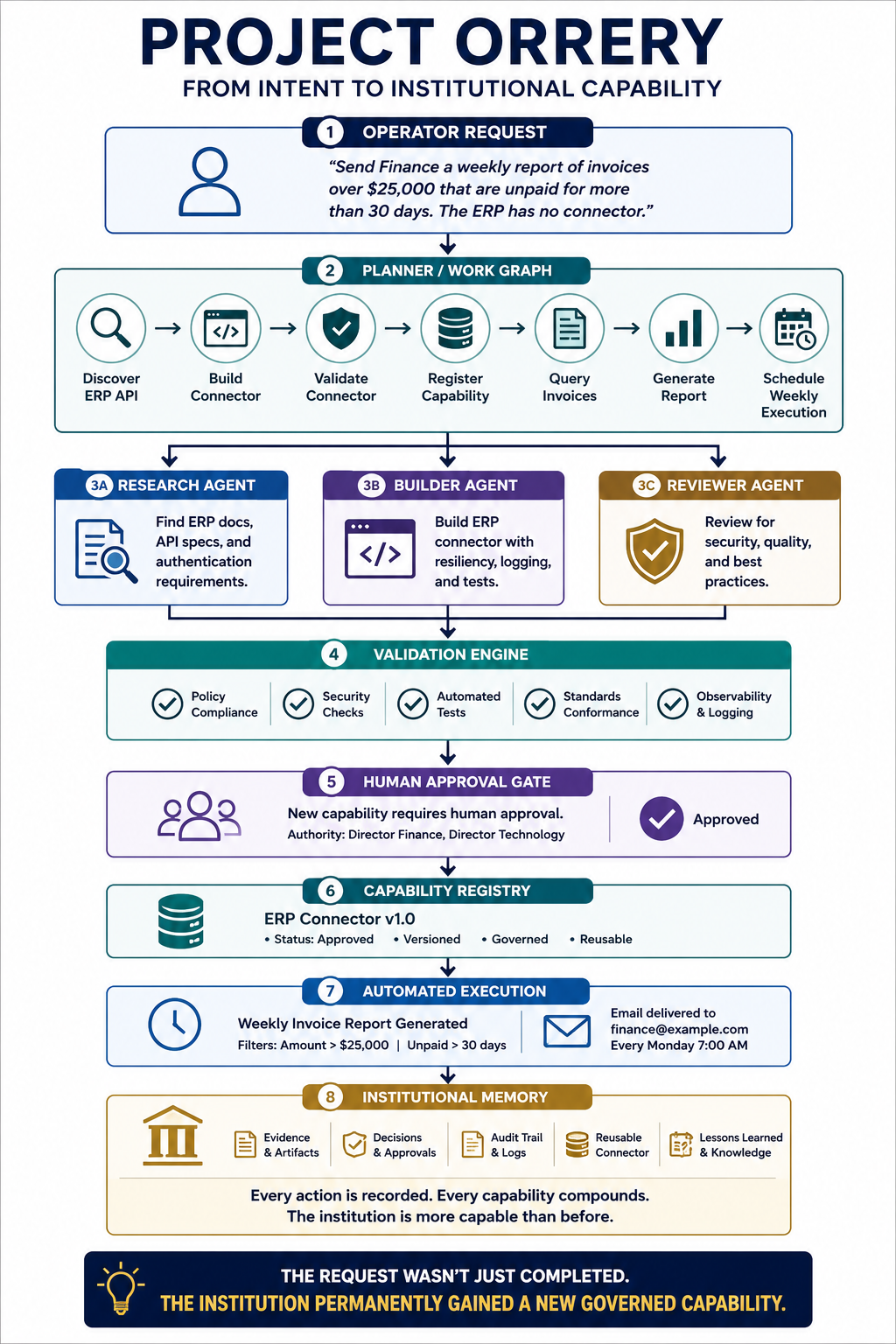
General workflow.
-
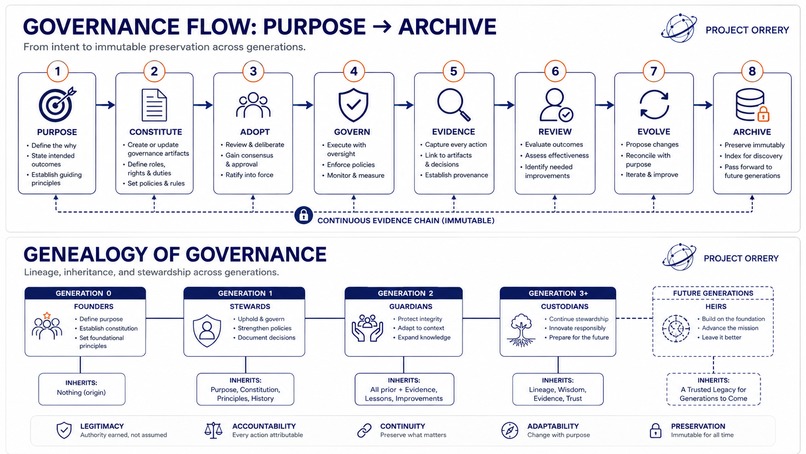
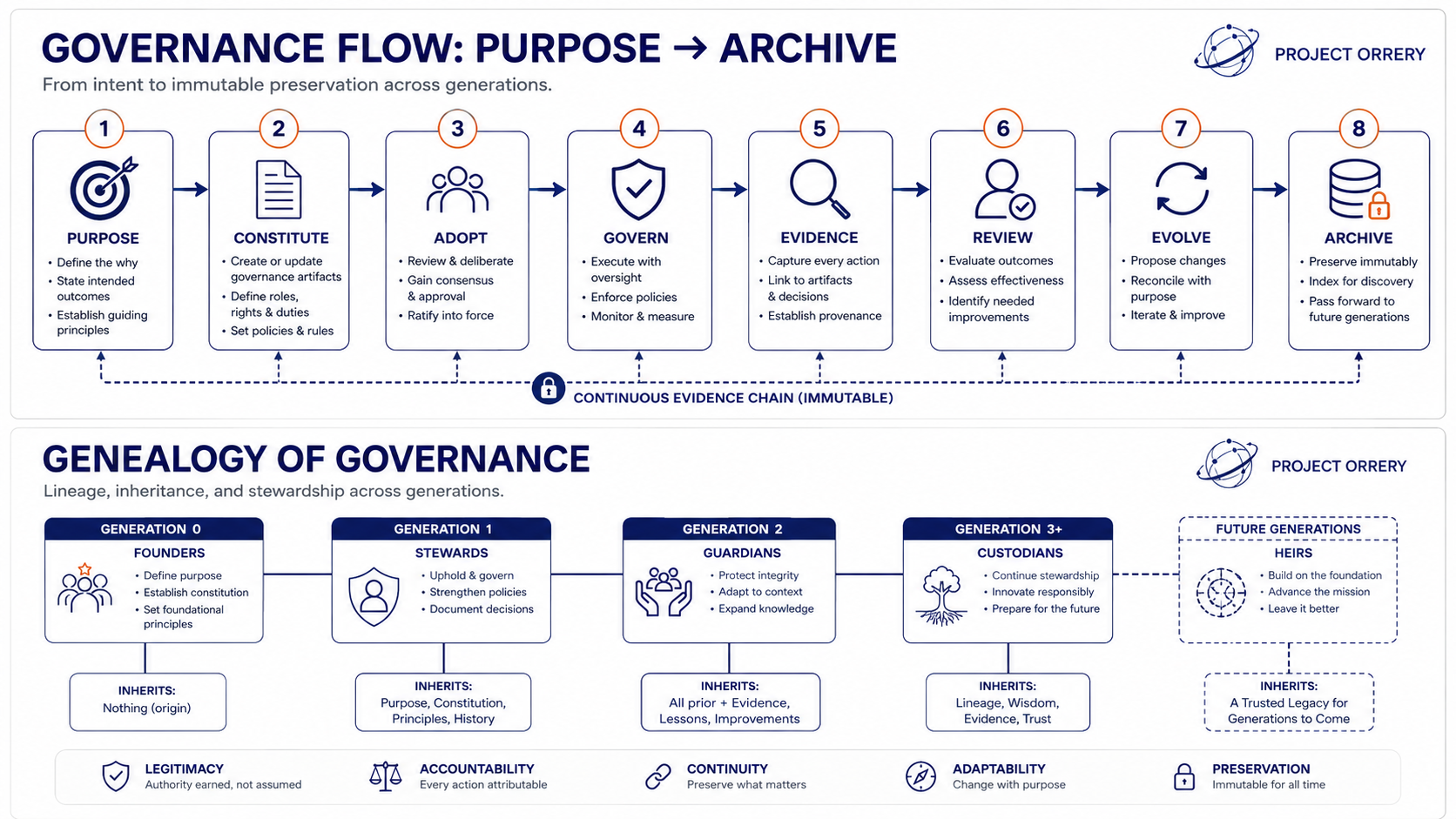
Governance
Inspiration
Organizations are rapidly adopting AI assistants, agents, and automation systems. Many are designed to increase autonomy and reduce the amount of direct human involvement. As someone working in cybersecurity, governance, and enterprise technology, I kept returning to the same unanswered question:
Who is accountable when AI begins performing real organizational work?
An AI system may be capable of investigating a problem, proposing a solution, generating code, reviewing results, and executing changes. But capability is not authority.
That distinction became the foundation of Project Orrery.
Inspired by the mechanical orreries that model planetary systems, I envisioned a platform in which many independent actors could operate together while remaining observable, governed, and accountable. Rather than building another chatbot or coding agent, I set out to build a control plane for AI-enabled work.
What it does
Project Orrery transforms high-level intent into governed execution. Instead of manually directing every step, an operator specifies an outcome. The system coordinates planning, implementation, review, evidence collection, approvals, validation, and reporting through distinct roles and controlled workflows.
A central design principle is separation of responsibilities. The planner does not approve its own plan. The builder does not validate its own work. Reviewers evaluate results and evidence independently. Human operators retain authority wherever organizational judgment, risk acceptance, or consequential decisions are required.
Today, Project Orrery exists as a working local-first prototype that demonstrates governed workflows across planning, building, review, validation, and operator approval.
How we built it
Project Orrery was built as a local-first control-plane prototype with a Python-based runtime and a browser interface.
The system represents work as governed state rather than as an unstructured conversation. Plans, jobs, role assignments, reviews, evidence, approvals, and execution results are treated as related parts of a controlled workflow.
The interface was designed as an operational console rather than a conventional chatbot. It emphasizes workflow state, role separation, active work, findings, approvals, and requests for operator attention.
The architecture is intended to remain model- and tool-agnostic so that different models and systems can eventually be selected according to capability, cost, privacy, locality, and organizational policy.
Challenges we ran into
Building the system presented challenges that went well beyond model selection.
Multi-agent environments can drift into circular behavior, repeatedly planning, revising, and reviewing without making meaningful progress. Orrery therefore needs bounded iteration, detection of repeated findings, explicit terminal states, and escalation when further automation is no longer increasing confidence.
Another challenge was preserving evidence. Most AI systems are optimized to produce answers. Enterprise environments require more. Organizations must be able to reconstruct decisions, understand why actions were taken, review approvals, trace changes, and demonstrate that required controls were followed long after the work is complete.
For that reason, evidence became a first-class architectural component rather than an afterthought.
A further challenge was balancing autonomy with control. Too many approval prompts make automation impractical. Too few create risk and weaken accountability. The system must allow routine work to proceed while creating strong gates around consequential, destructive, privileged, or ambiguous actions.
Accomplishments that we're proud of
Project Orrery has grown beyond a collection of prompts into a working control-plane prototype with distinct planning, building, review, validation, and operator responsibilities.
The prototype demonstrates that multiple AI roles can contribute to meaningful work without allowing one agent to propose, implement, approve, and declare its own work successful.
It also establishes a foundation for structured workflow state, visible approval points, evidence-oriented execution, bounded review cycles, and a local operational interface.
Most importantly, the project demonstrates the core idea that AI can do more work while remaining subordinate to explicit governance and human authority.
What we learned
The most important lesson was that agent orchestration is not primarily a model-selection problem. It is a systems-engineering and authority-design problem.
Models can already generate plans, code, analyses, reviews, and recommendations. The harder questions are who is permitted to act, what evidence is required, how work is independently validated, when automation should stop, and where human authority must remain intact.
I also learned that observability in an AI workflow must include more than technical telemetry. Operators need visibility into roles, workflow transitions, evidence, approvals, findings, and human intervention.
Governance does not have to eliminate speed. Properly designed boundaries can make autonomy more practical because operators can allow the system to proceed within known limits rather than supervising every individual step.
What's next for Project Orrery
The next phase is to continue refining the control-plane interface and make the system more useful for real operational work.
Future development will expand the evidence model, improve the visibility of relationships across workflow iterations, connect additional models and tools, and strengthen policy, approval, validation, and rollback capabilities.
The longer-term goal is to expand Orrery beyond isolated assistants into a coordinated enterprise execution fabric that can work across source control, cloud platforms, monitoring, identity, security, collaboration, and business systems.
The vision is simple:
Allow AI to do more work without requiring organizations to surrender governance, evidence, or human authority.
Project Orrery is my attempt to make that future possible.
Built With
- codex
- gpt-5.6
- python

Log in or sign up for Devpost to join the conversation.