Inspiration
Artificial intelligence is often introduced through definitions, slides, and disconnected examples. For students and first-time learners, terms such as computer vision, machine learning, natural language processing, and deep learning can feel abstract before they ever become meaningful.
I wanted to explore a different question:
What if someone’s first introduction to AI was not a textbook, but a world they could explore?
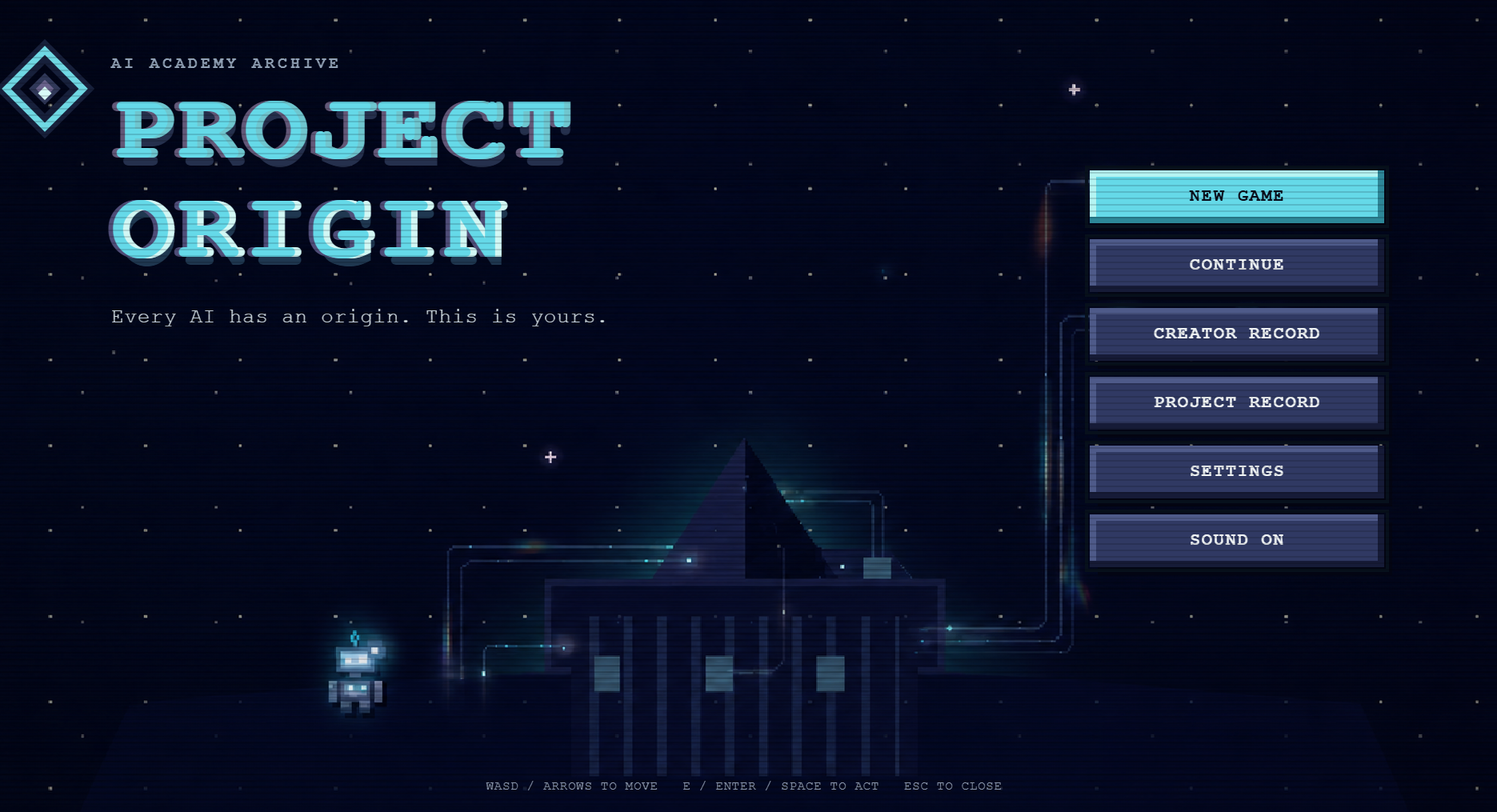
That idea became PROJECT ORIGIN, a browser-based pixel-art educational RPG built around the tagline:
Every AI has an origin. This is yours.
The player controls a small, outdated robot whose intelligence modules are missing. By entering different laboratories, completing interactive challenges, and restoring those modules, the player gradually learns how major areas of AI work.
The goal was not to create another quiz platform. I wanted players to perform an action, observe how the system changes, and only then receive the explanation behind what they experienced.
What it does
PROJECT ORIGIN is a playable introduction to artificial intelligence designed for students, beginners, and people without a technical background.
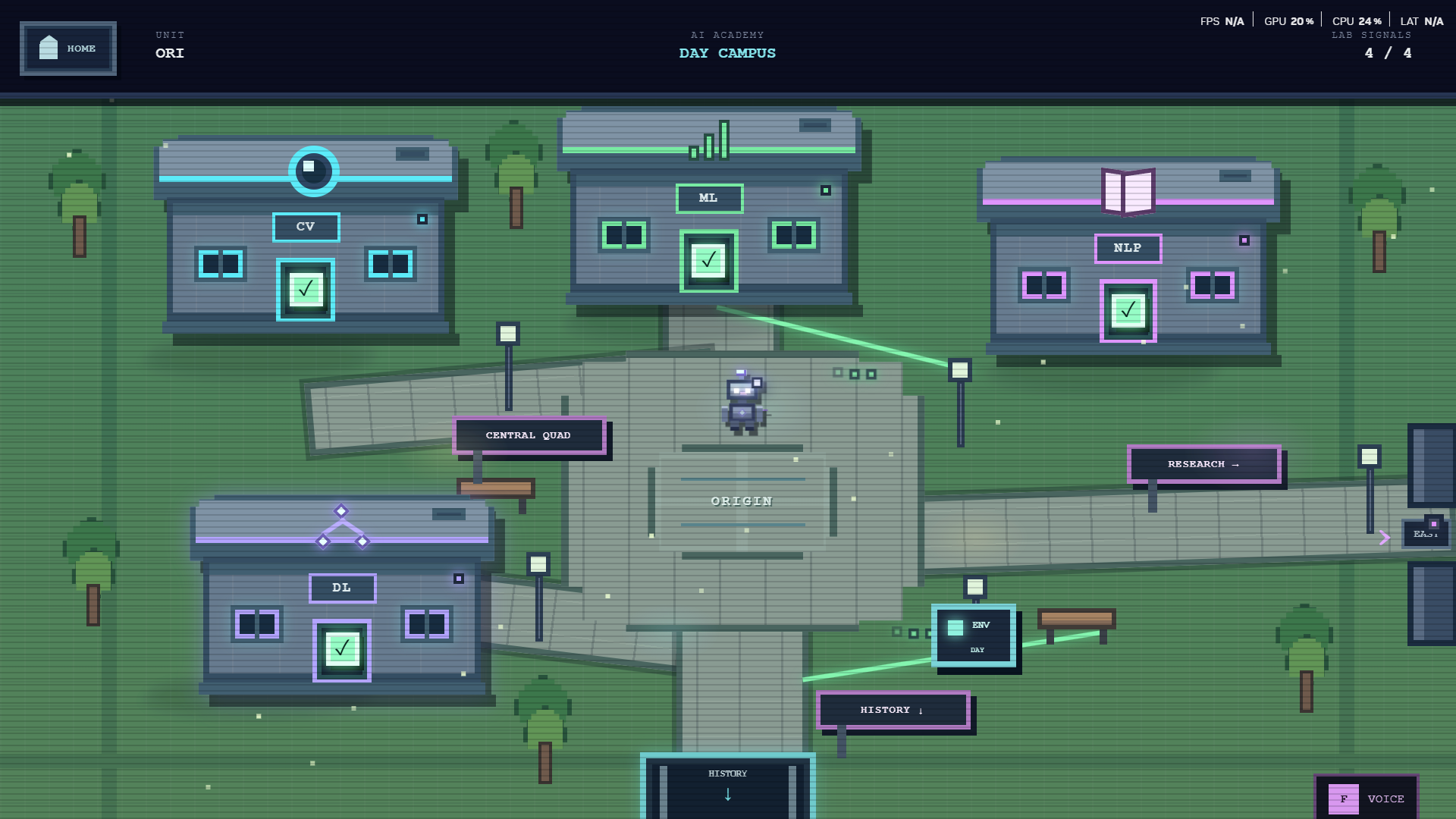
Players explore the AI Academy Central Plaza, where four laboratories represent four foundational AI fields:
Computer Vision Machine Learning Natural Language Processing Deep Learning
Each Lab contains three short learning activities followed by a larger final challenge.
In the Computer Vision Lab, players classify images, locate objects, label elements in a frozen road scene, and watch an autonomous vehicle respond.
In the Machine Learning Lab, players work with labeled examples, decision boundaries, feature-based decisions, and an automated factory inspection system.
In the NLP Lab, players break sentences into tokens, predict missing words, compare meaning, and explore how attention connects words within a sequence.
In the Deep Learning Lab, players connect neural paths, strengthen signals through layers, tune parameters, and control the learning rate of a gradient-descent simulation.
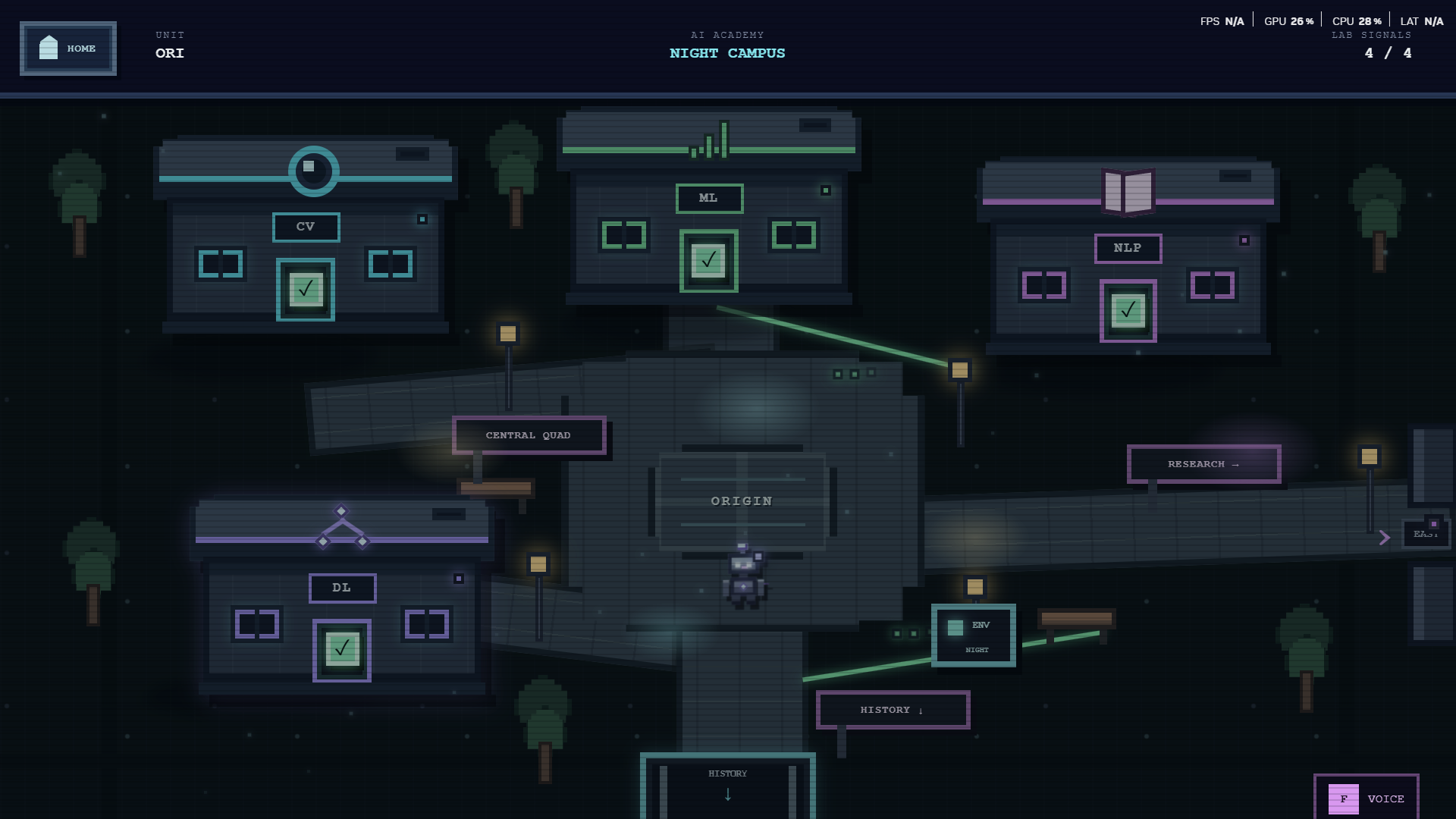
The world also responds to progress. Restoring modules changes the Academy, activates devices, unlocks abilities, opens new areas, and introduces different atmosphere states such as Day, Dusk, Night, and Sandstorm.
Beyond the four Labs, players can explore AI history through separate event and contributor exhibitions. The experience runs directly in the browser, requires no account, saves progress automatically, and supports desktop and mobile landscape play.
How we built it
PROJECT ORIGIN was built with:
React Vite TypeScript CSS Canvas and browser-based visual effects Web Audio API localStorage PWA and fullscreen support
The game uses a fixed 16:9 logical viewport so that movement, collision, interface positioning, and mini-games remain consistent across desktop and mobile screens.
I developed the project through a phase-based workflow using GPT-5.6 and Codex, rather than attempting to generate the entire game from one prompt.
I first defined the learning goal, player experience, and product direction. GPT-5.6 helped transform those rough ideas into detailed development specifications covering:
Gameplay flow Educational intent Technical constraints Desktop and mobile controls Save migration Failure and retry states Acceptance criteria Regression tests
I then passed each specification to Codex. Codex worked directly inside the real repository, inspected the existing architecture, implemented the feature in React and TypeScript, ran builds and tests, and reported the files it changed.
Every phase followed a similar loop:
Human direction → GPT-5.6 specification → Codex implementation → Manual validation → Revision
Files such as PROJECT_SPEC.md and PROJECT_STATUS.md were used to preserve the project’s long-term rules and current implementation state. Each Codex task was instructed to inspect these documents, preserve completed systems, run the production build, test the new feature, and state known limitations honestly.
This helped prevent each new phase from becoming an isolated AI-generated prototype.
Challenges we ran into
One of the largest challenges was turning complex AI ideas into mechanics that were simple enough for beginners without becoming misleading.
For example, gradient descent could not simply be presented as a ball rolling with uncontrolled physics. The movement needed to communicate learning rate, overshooting, slow convergence, instability, and local minima while remaining predictable and understandable.
Another challenge was ensuring that the project felt like a game rather than a collection of quizzes. Each activity needed visible state changes, immediate feedback, retry behavior, and a connection to the larger world.
Mobile support also introduced significant complexity. Touch input, virtual controls, contextual interaction buttons, fullscreen behavior, landscape orientation, safe areas, and small-screen readability all needed to work within the same logical game coordinate system.
Save compatibility became increasingly important as more Labs, maps, achievements, atmosphere settings, and story states were added. New fields had to be migrated safely without resetting older progress.
Finally, working with AI development tools required strict scope control. Without detailed constraints, an implementation agent could rewrite working systems, create duplicate logic, or expand the project beyond its intended size. Clear requirements and manual testing were essential.
Accomplishments that we're proud of
I am especially proud that PROJECT ORIGIN became a connected product rather than four unrelated educational demos.
The four AI fields are represented through different forms of interaction, but they still belong to the same world, progression system, visual language, and story.
Other accomplishments include:
Four complete foundational AI Labs with distinct final challenges A world that visibly changes as the player restores intelligence modules A contextual interaction system that only appears near usable objects A communication ability unlocked after completing NLP Separate AI history-event and contributor exhibitions A reusable Day, Dusk, Night, and Sandstorm atmosphere system Automatic save restoration and backward-compatible save migration Desktop keyboard, mobile touch, fullscreen, and PWA support Procedural audio behavior integrated with atmosphere changes A development process supported by specifications, builds, tests, and manual regression checks
Most importantly, the project demonstrates that introductory AI education can be interactive, visual, and emotionally engaging without requiring a backend, account, or external AI API.
What we learned
The most important lesson was that effective AI-assisted development is not about finding one perfect prompt.
Large projects need to be divided into phases that an AI system can understand, implement, test, and verify.
I learned that a strong requirement must explain more than what to build. It should also define:
Why the feature exists What the player should learn Which systems must not be changed What counts as success What failure states should look like How older progress should be protected Which regression tests must be performed
I also learned that manual validation remains essential. A successful build does not prove that a mechanic is understandable, enjoyable, responsive, or educational.
My responsibility was to test the experience, identify weak results, reject implementations that did not match the intended learning goal, and send the problem back through another planning and implementation cycle.
AI accelerated the work, but product direction, scope control, educational judgment, and final approval still required human ownership.
What's next for PROJECT ORIGIN
The next stage is focused on refinement rather than uncontrolled expansion.
Planned improvements include:
Final visual and audio polish across all maps and Labs More consistent character portraits, environmental assets, and interface effects Additional accessibility and mobile-performance improvements Expanded educational explanations and optional deeper-learning panels Support for additional languages Classroom playtesting with students and first-time AI learners A lightweight educator guide for using the game as an introduction to AI
The Research Lab already introduces possible future modules:
Reinforcement Learning Generative AI Agent Intelligence
These areas could eventually become playable expansions, but the current priority is to ensure that the foundational experience remains clear, memorable, and complete.
PROJECT ORIGIN began as an experiment in teaching AI through play. Its next step is to become a learning experience that can be tested with real learners and improved through their feedback.
Built With
- codex
- css3
- git
- github-jobs
- gpt-5.6
- html5
- javascript
- localstorage
- mobileweb
- openai
- pwa
- react
- typescirp
- vercel
- vite


Log in or sign up for Devpost to join the conversation.