`
Inspiration
AI-assisted dev teams now finish work faster than the business can review it or change direction. Ten tasks go in on Monday, seven are done by Wednesday, a new batch arrives from leadership, and the original requester is still reviewing the first two. Tools like Jira and Monday.com need people to manage the project instead of doing the work. Drift, duplicates and contradictions are found only after someone has built the wrong thing.
ONI stands for Objective, Needs, and Impact. These criteria are vital to define and execute a project.
What it does
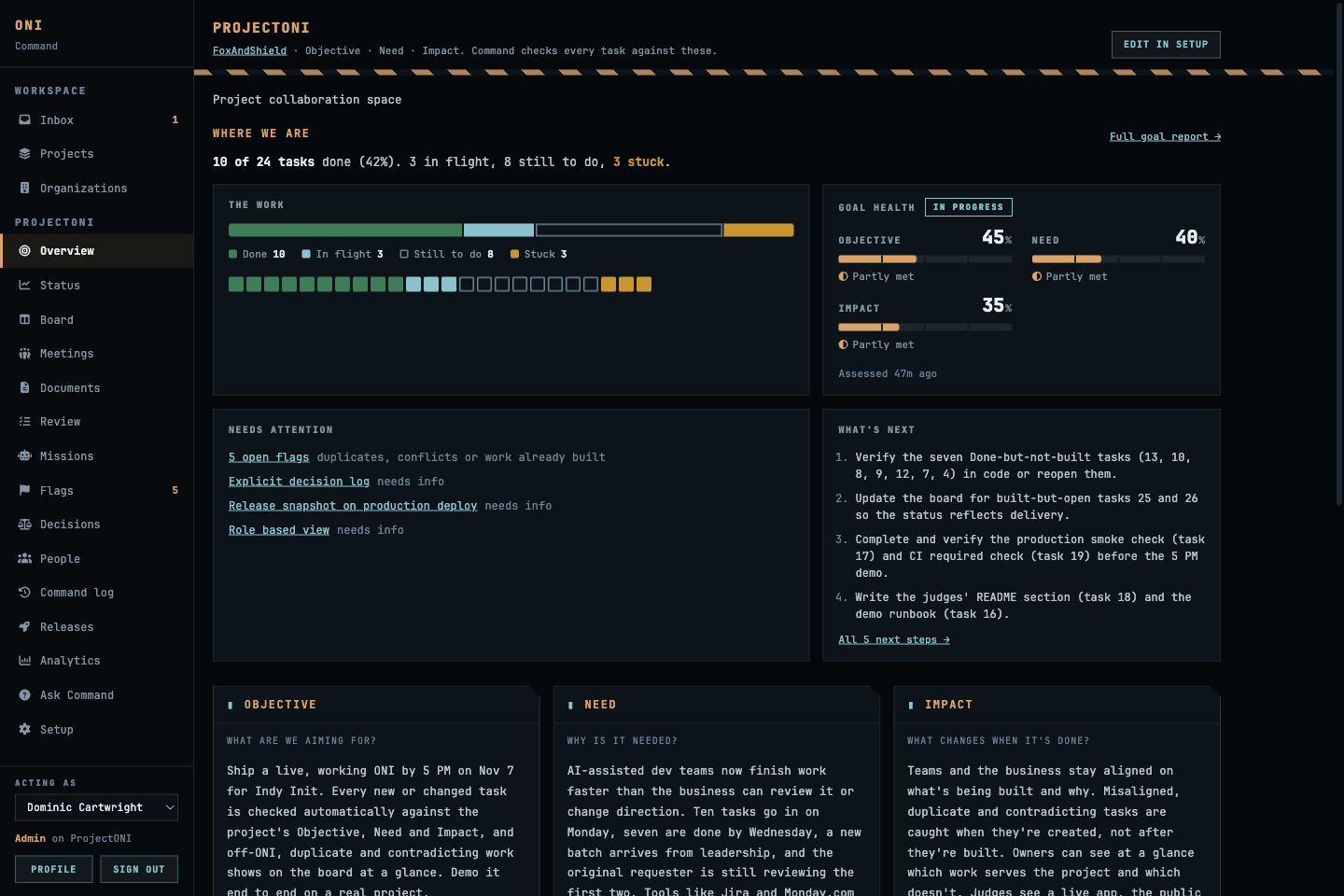
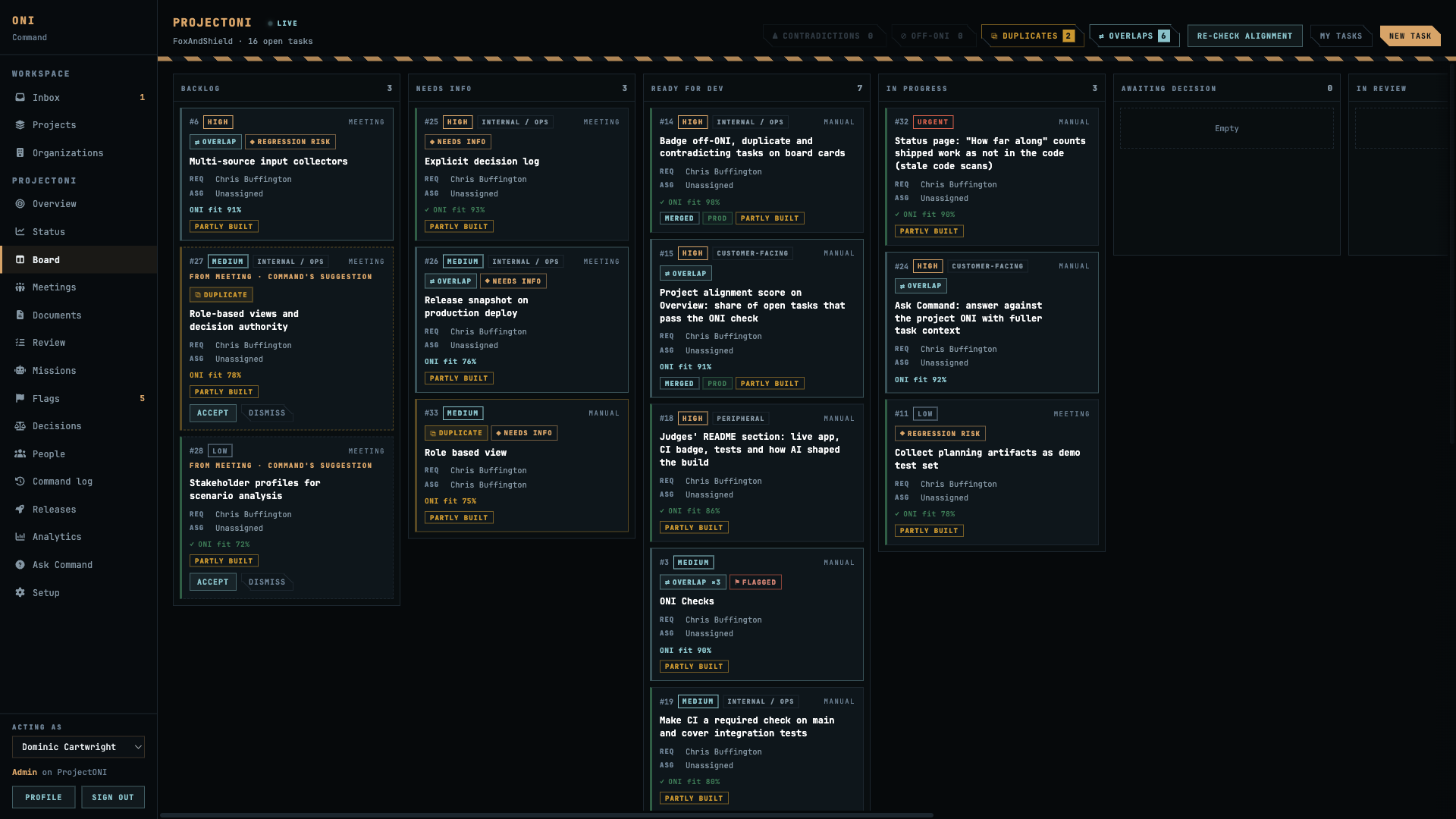
ONI is a project board that ties every task to the project's Objective, Need and Impact.
- ONI checks: every new or changed task is checked against the project's ONI as soon as it's written. Off-goal work, duplicates, overlaps and contradictions are flagged on the board, and a "Directional shift?" prompt goes to the owner.
- Feasibility scan: each task is marked Ready, Needs info (with specific questions), or a regression risk.
- Command: paste meeting notes and ONI updates the board itself (moves tasks, reassigns, suggests new tasks), logs every change, and lets you undo any of them.
- Live code tracking: a GitHub PR that names
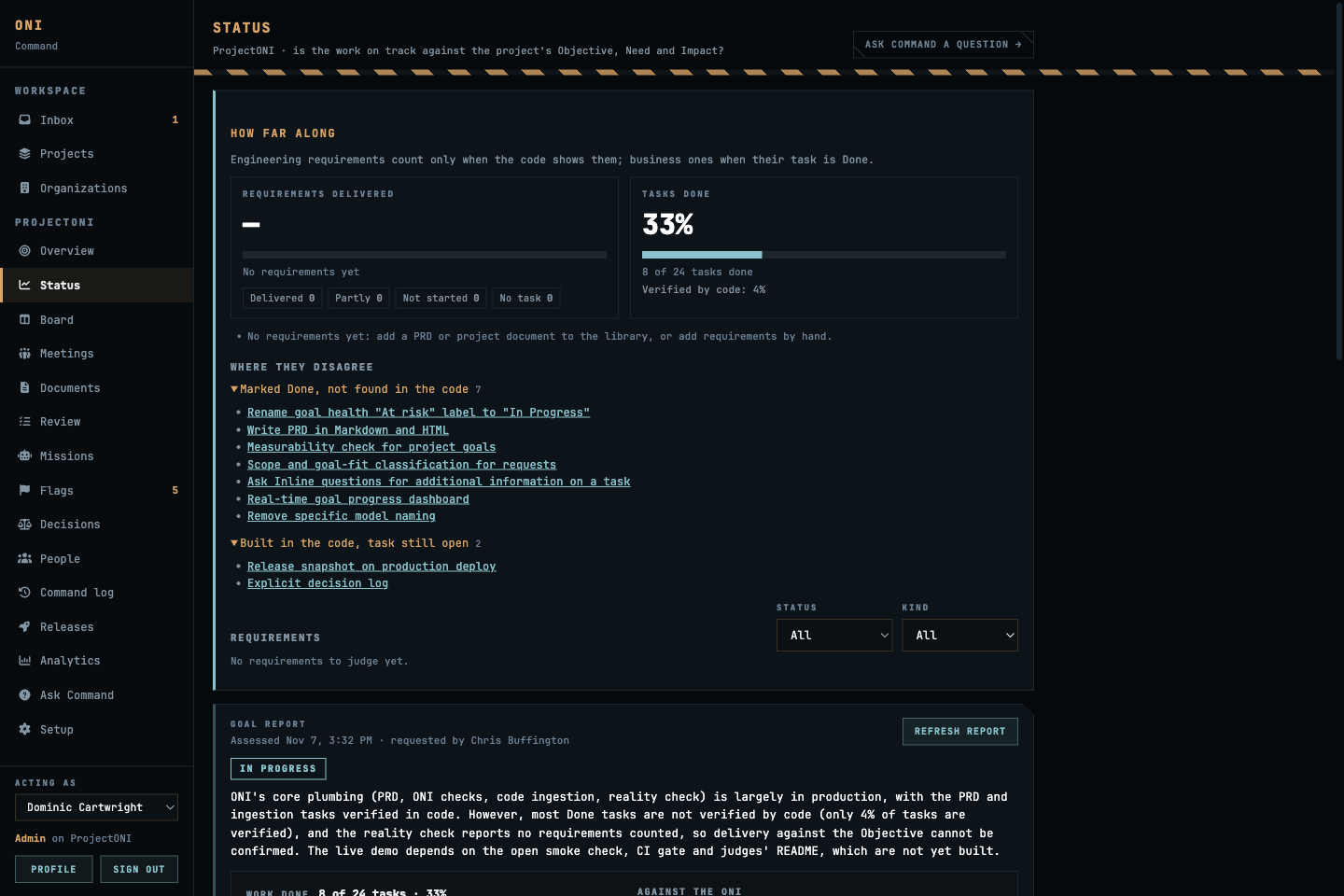
ONI-<id>moves the task to In review when it opens and to Done when it merges. Production deploys create releases with AI-written notes. - Reality check: the Status page compares requirements, the board and the code itself, and calls out work marked Done that isn't in the code.
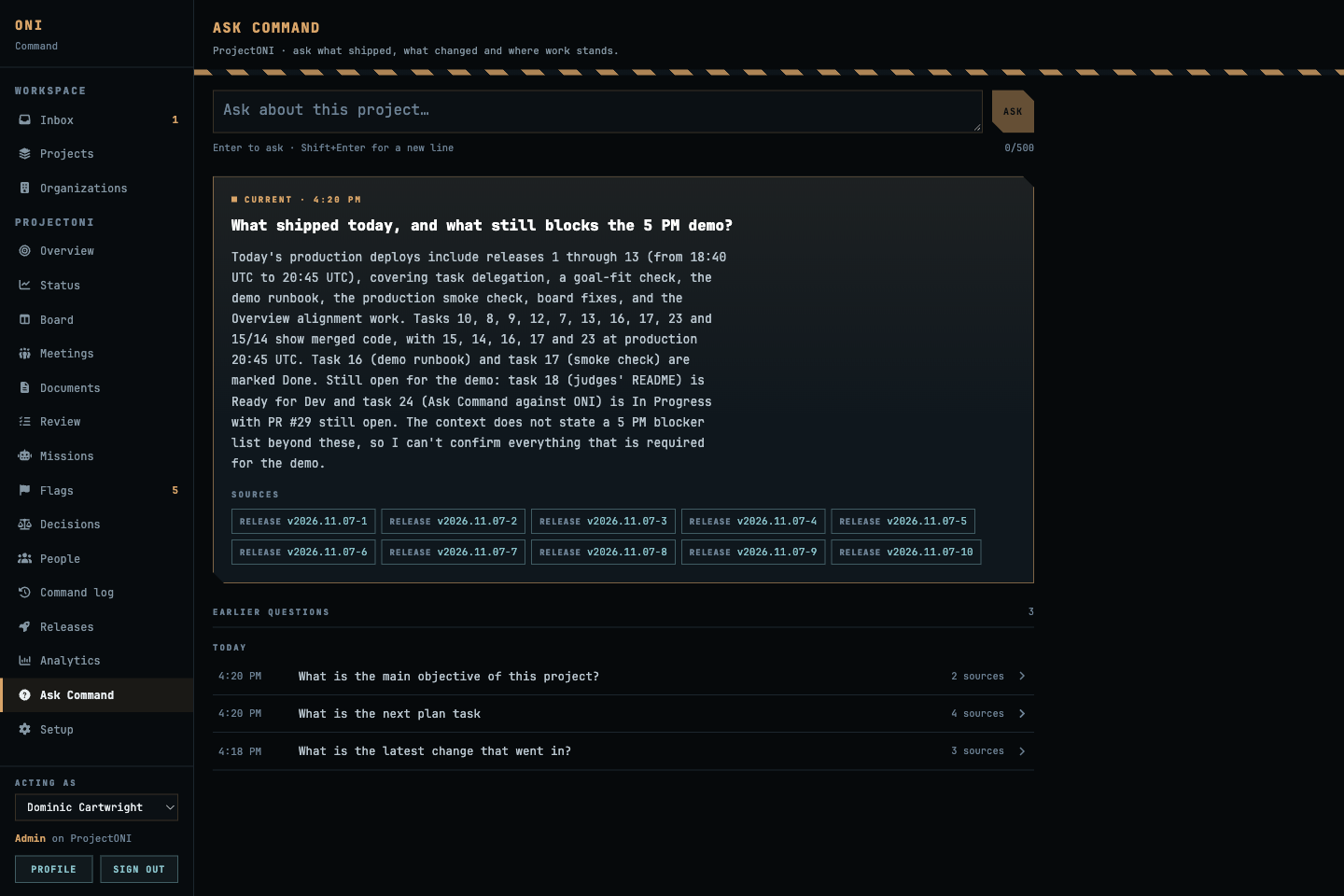
- Ask Command: ask questions about the project and get answers that cite their sources from tasks, decisions, documents and code.
- Also included:
- a document library that builds tasks from PRDs, never storing the original text, only the indexed chunks
- a decision log
- Spartan agents for research, code, design and process work
- stakeholder profiles built from meeting history
- Slack notifications, Calendar check-ins and analytics
How we built it
- Space Station gave every agent the team's memory. Our memory vault records every Claude Code session and synced meeting. Every agent session started with the project's rules, decisions and meeting notes already loaded, and lessons from one session carried into the next. With several developers and agents pushing at once, none started from scratch.
- Stack: Vue 3 + TypeScript frontend and a Spring Boot 3.5 / Java 21 backend in one repo, on Postgres with Flyway migrations, deployed as a single Heroku app.
- Two AI models, each with a clear job:
- TypeSafe Jev is the classifier. It answers typed yes/no, multiple-choice and scoring questions, and the routing on probability and confidence lives in our code.
- Claude Haiku 5.5 is the only Claude model we use. It's called only when Jev is unsure, or to write short text, which keeps cost and latency low.
- AI output is untrusted: every ID that comes back is validated against the project before anything happens.
- AI-native development: we planned from a PRD written the night before and recorded decisions as we went. Several developers and their Claude Code agents worked on
mainat the same time, with lower-cost Haiku subagents taking well-defined tasks. - Every change has a CHANGELOG entry saying what changed, why, and how it was verified. ONI tracked its own build: the ProjectONI board is the real project.
Challenges we ran into
- Calling AI safely: Claude and Jev are slow and sometimes fail, and they must never hold a database lock. Every AI job follows the same three steps: snapshot under a row lock, call the model with no transaction open, apply only if the row hasn't changed since. A restart marks in-flight jobs as failed so they can be retried.
- Two checks racing on one task: the feasibility scan and the ONI check both finish on a new task. We had to decide which takes precedence, and make sure the task's status moves exactly once.
- Stale code scans: the reality check reported shipped work as "not in the code" because those scans ran minutes before their PR merged. We now trust only scans made after the task's latest merge, and re-scan Done tasks when the code changes.
- Task references match too easily: a PR description that just mentioned
ONI-14linked that task and moved it to Done. It was a good reminder that automation acts on whatever text it's given. - Many people and agents pushing to one branch: constant rebases and CHANGELOG conflicts. The rule was to keep everyone's work, never discard it.
Accomplishments that we're proud of
- A live app on Heroku, demoed on its own real project rather than mock data.
- 172 commits and 31 merged PRs from Nov 6 to Nov 7, with about 750 automated tests (335 frontend, 217 backend unit, 195 integration against real Postgres) and CI on every PR.
- 23 decision records and a CHANGELOG with a dated entry for every change, a clear record of how AI shaped the build.
- The board catches problems at creation: off-goal, duplicate and conflicting tasks are flagged within seconds of being written.
- "Done" can be checked against the code itself, not just the board.
What we learned
- Classify first, generate second. Typed questions with probabilities are cheaper, faster and easier to test than free-form generation. Most decisions can be made in code once the right question has been asked.
- Goals have to be measurable from day one. We added a measurability check because vague ONI produces vague alignment.
- Freshness matters as much as accuracy. A correct answer about yesterday's code is a wrong answer today.
- Agents need strict rules. Pulling before every change, logging every change and validating every AI output kept a crowded repo coherent.
What's next for Project ONI
- More inputs: Slack, issue trackers and meeting transcripts arriving automatically, not pasted in.
- An alignment score: a project-wide number on the Overview, with clear explanations of why each task was flagged.
- Spartans that ship: code agents opening draft PRs automatically from tasks marked Ready, with people reviewing and approving.
- Stakeholder simulation: "How would the COO handle this?", answered from that person's own decision history.
- Integrations with existing boards: run on top of Jira and Monday.com so teams adopt it without migrating.
- Piloting ONI with Fox & Shield client projects.
For demo purposes, see demo account login details in the Github readme.
Built With
- claude
- heroku
- java
- jev
- postgresql
- spacestationai
- vue
