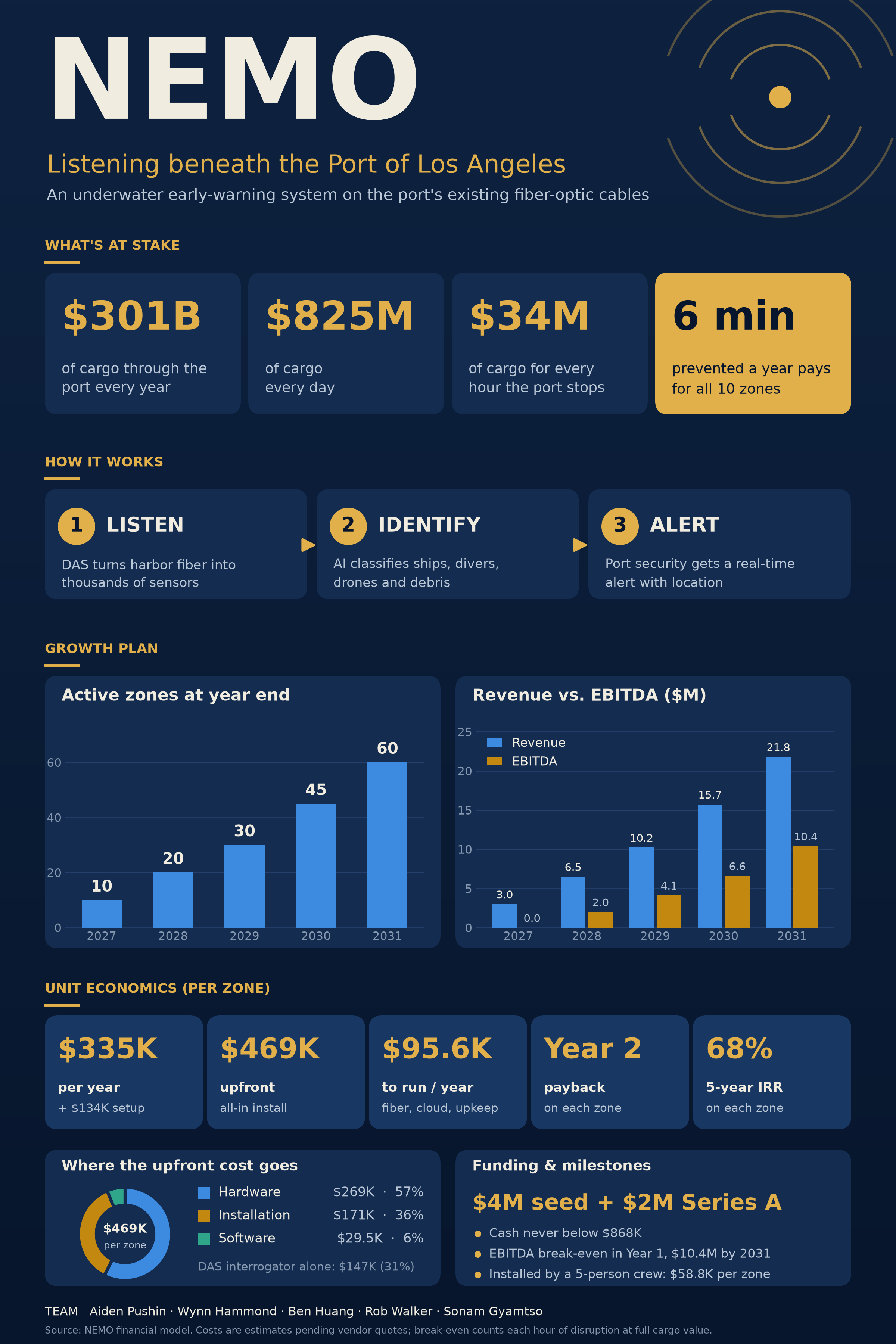
Inspiration Every day, roughly $825M of cargo moves through the Port of Los Angeles, about $34M every hour (Port of Los Angeles). Radar and ship transponders (AIS) show what’s on the surface and what chooses to broadcast. Nobody watches what moves underwater. A ship running dark, a diver, an underwater drone or debris in the channel can slip in unnoticed and shut down traffic. With LA28 bringing the world to Los Angeles, and subsea pipes being cut in places like the Baltic Sea, we wanted to give the port an underwater picture without laying a single new cable.
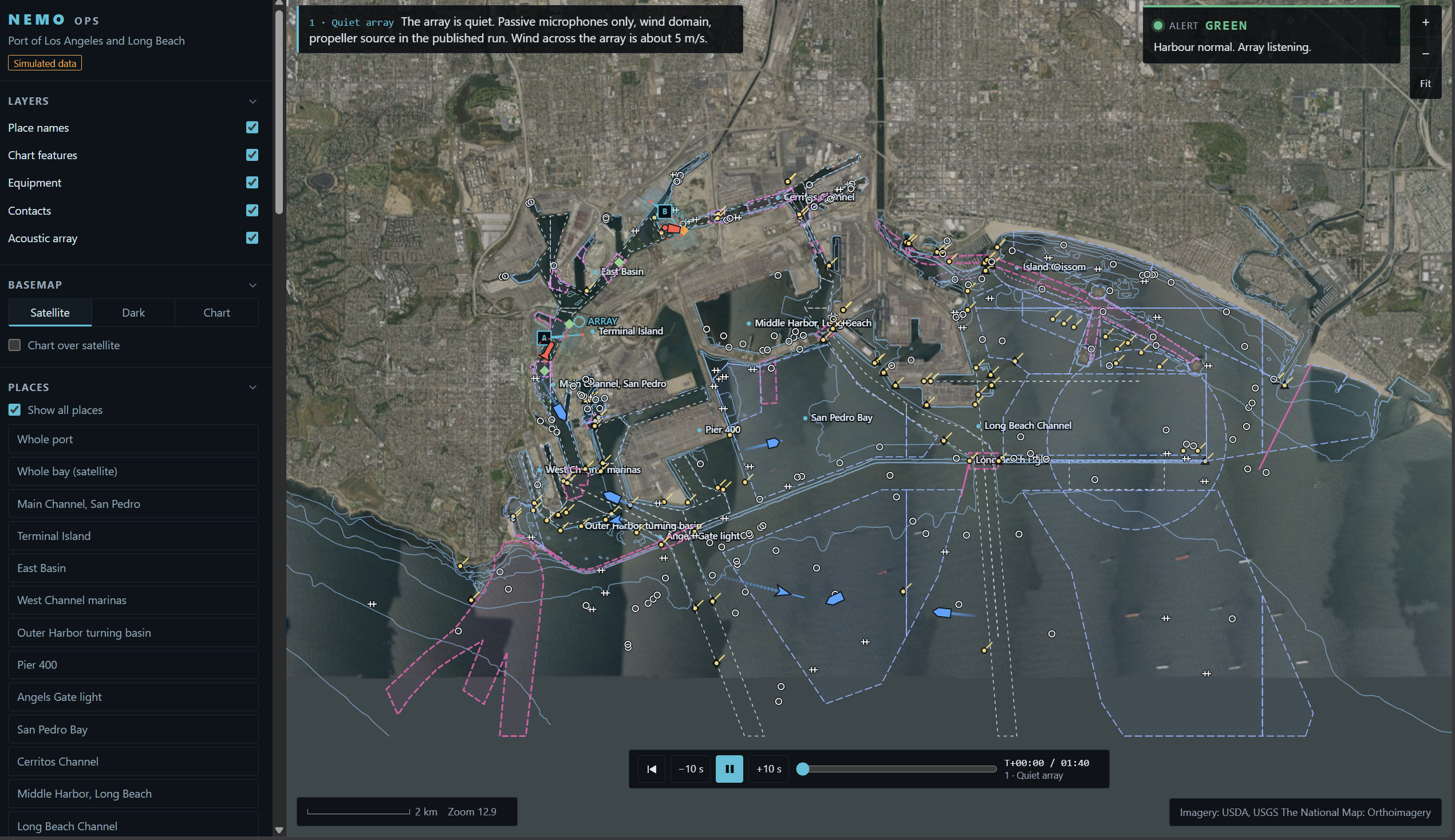
What it does Nemo turns the port’s existing fiber-optic cables into an underwater early-warning system. -Listen: a DAS (distributed acoustic sensing) interrogator turns a fiber run into thousands of vibration sensors, and hydrophones fill the gaps. -Identify: AI tells ships, small boats, divers, underwater drones and debris apart, then cross-checks each contact against AIS ship-transponder data to flag vessels running dark. -Alert: port security gets a real-time alert with the location before it turns into a delay or a threat. It’s dual-use. Civilian buyers include the Port of LA, CBP and terminal operators. Defense buyers include the U.S. Navy, the U.S Coast Guard, and allied navies protecting harbors and bases.
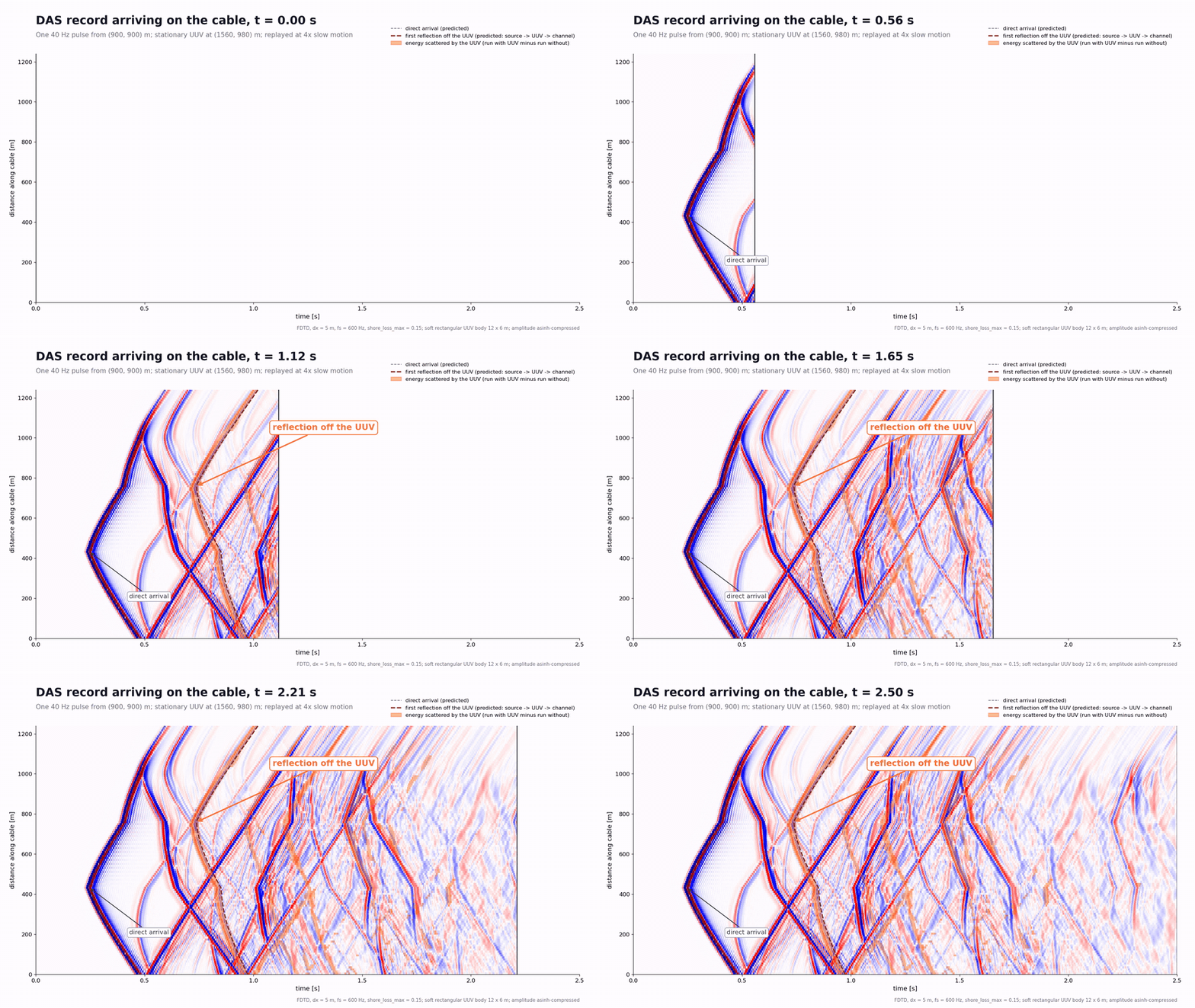
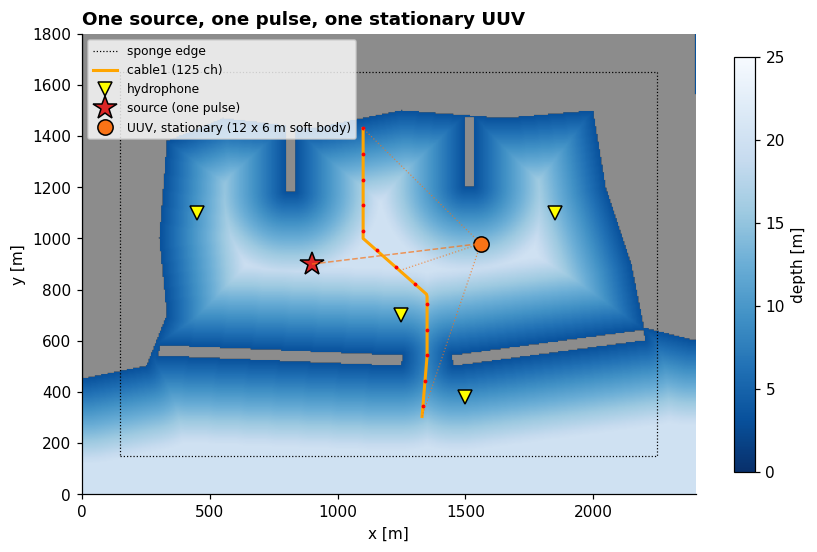
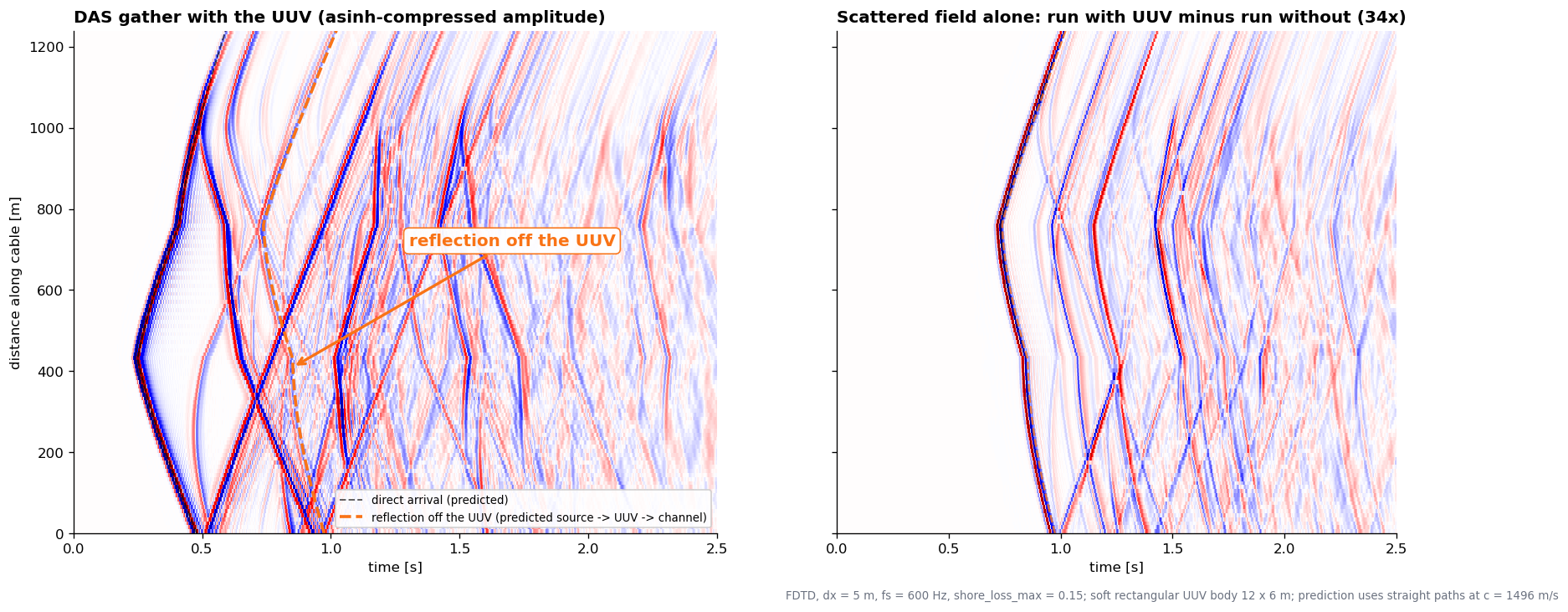
How we built it -Demo: Using sequential images, we simulated a moving ship and a static target. As we stack these images, the target emerges. The data we used is simulated and is based on a synthetic example. -System design: we specified a monitored “zone” as one DAS interrogator on an existing fiber run, four hydrophones, an edge AI server, a shore station with an AIS receiver, and a live dashboard. -Bill of materials: we built a 42-line bill of materials covering hardware, software, installation and yearly operating costs. That includes a 5-person install crew, boats, divers, permits and cable burial. Interrogator pricing comes from public purchases (95K–200K). -Financial model: a full 5-year model with staffing, taxes, cash flow, funding and per-zone returns, used to set pricing and our raise.
Challenges we ran into -Time: Hard to do thorough modeling given time constraints. -Classified Information: couldn’t find exact location of fiber optic cables in/around the port of Los Angeles. This made the modeling more challenging. -Unknowns we couldn’t price: permitting, in-water work and fiber access have no public price list, so many costs are estimates for now.
Accomplishments that we’re proud of -A clear break-even: if Nemo prevents about 6 minutes of port disruption a year, the full 10-zone Port of LA system pays for itself. -Unit economics that work: at $335K per zone per year, each zone pays back in about 2 years with roughly a 68% return. -A full path from pilot to scale: from 10 to 60 zones, about $21.8M in Year-5 revenue, and a $4M seed to put ten live zones in the Port of LA. -A working demo: Using sequential images, we simulated a moving ship and a static target. As we stack these images, the target emerges. The data we used is simulated and is based on a synthetic example.
What we learned -Existing infrastructure is a cheat code: fiber already in the harbor removes the hardest and most expensive part of underwater sensing. -Dual-use widens the market: the same sensor serves port operations, homeland security and naval force protection. -The money is in the details: a 5-person crew, boat days and permits move the business case as much as the hardware does. -How government buying works: FEMA Port Security Grants, SBIR and DARPA programs shape who can pay and when.
What’s next for Project Nemo -Real quotes: firm prices for interrogators, hydrophones, marine contractors and fiber access. -Real data: a bench test on a fiber run to record and label real underwater signatures. -Discovery interviews: with the Port of LA, Port Police, the U.S Navy and the U.S Coast Guard, to confirm who buys and from which budget. -Non-dilutive funding: apply to SBIR and DARPA, and line up a pilot zone ahead of LA28. Export review: plan the ITAR/EAR process for allied ports and AUKUS partners.
Acronyms AI: Artificial Intelligence AIS: Automatic Identification System, the transponder system ships use to broadcast their identity, position and course AUKUS: Australia–United Kingdom–United States security partnership CBP: U.S. Customs and Border Protection DARPA: Defense Advanced Research Projects Agency DAS: Distributed Acoustic Sensing, a technique that turns a fiber-optic cable into a continuous line of vibration sensors EAR: Export Administration Regulations FEMA: Federal Emergency Management Agency ITAR: International Traffic in Arms Regulations LA28: The 2028 Los Angeles Olympic and Paralympic Games SBIR: Small Business Innovation Research, a federal grant program for small businesses

Log in or sign up for Devpost to join the conversation.