-
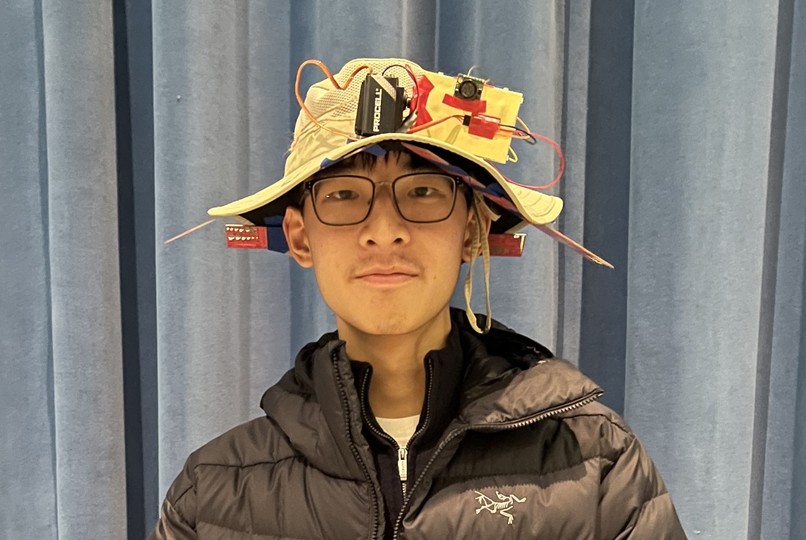
With its sonar sensor always facing forward, Eye-as' cap accessory is always on the lookout for walking hazards.
-
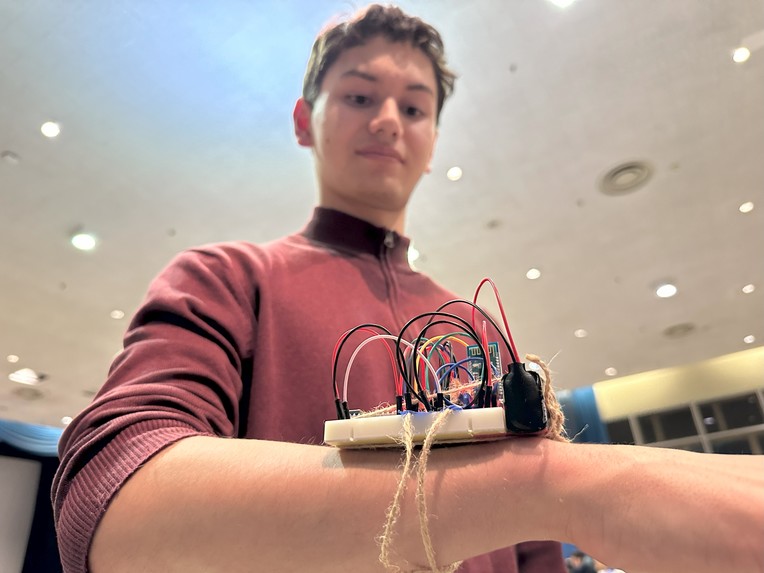
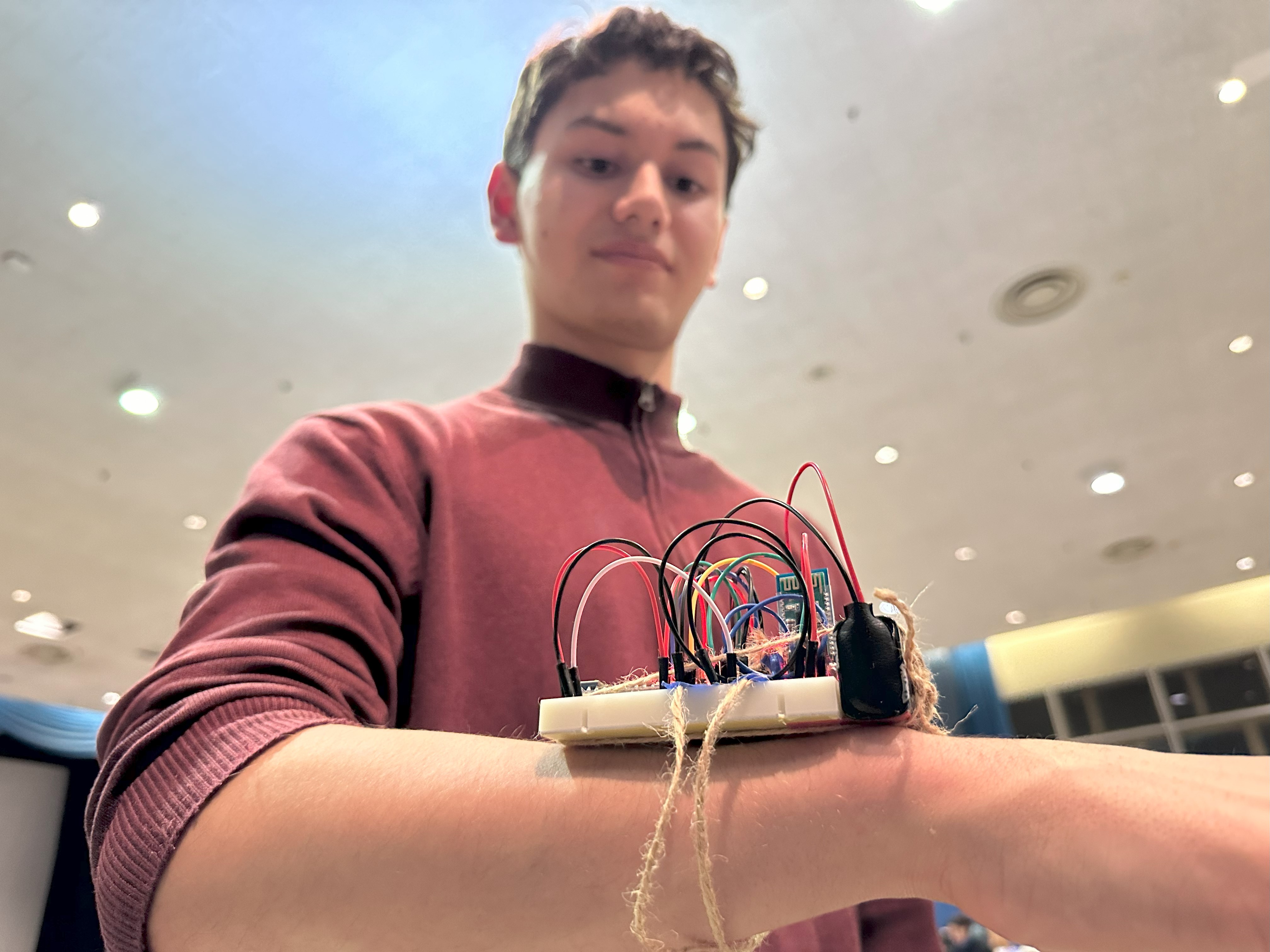
Eye-as' bracelet accessory listens for a signal from the cap accessory and buzzes when a hazard is detected.
-
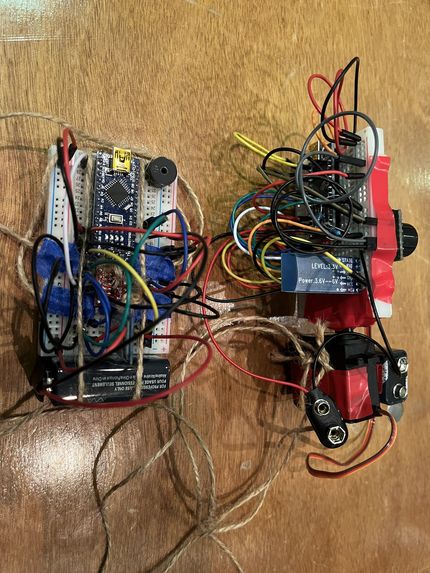
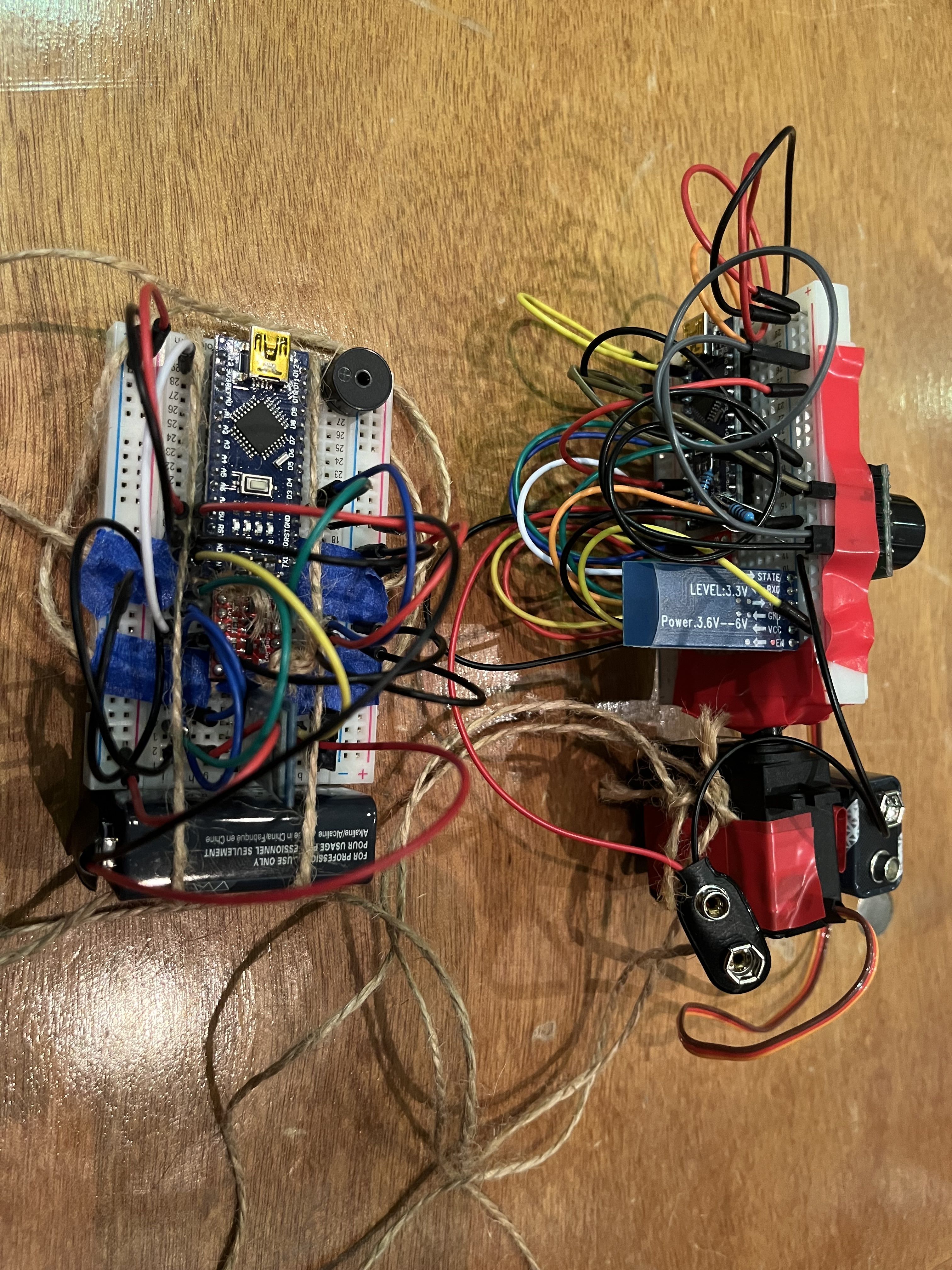
The bracelet (left) and cap (right) accessories shown side-by-side. In action, the two modules interface via Bluetooth.
-
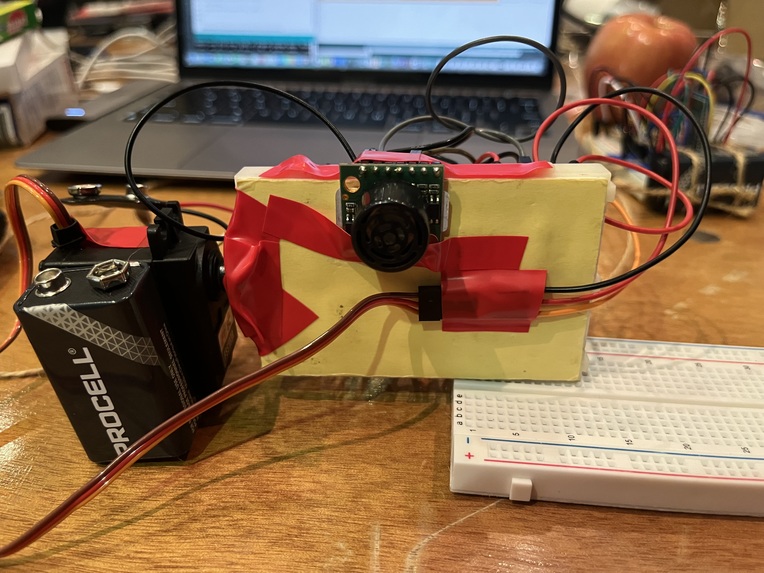
Close-up of the front of the cap accessory, showing the sonar sensor mounted on a breadboard which can be rotated by the servo motor.
-
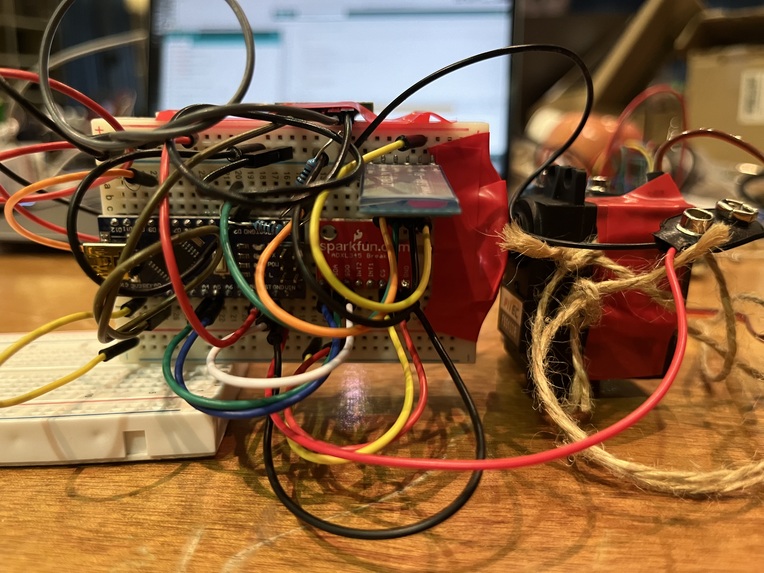
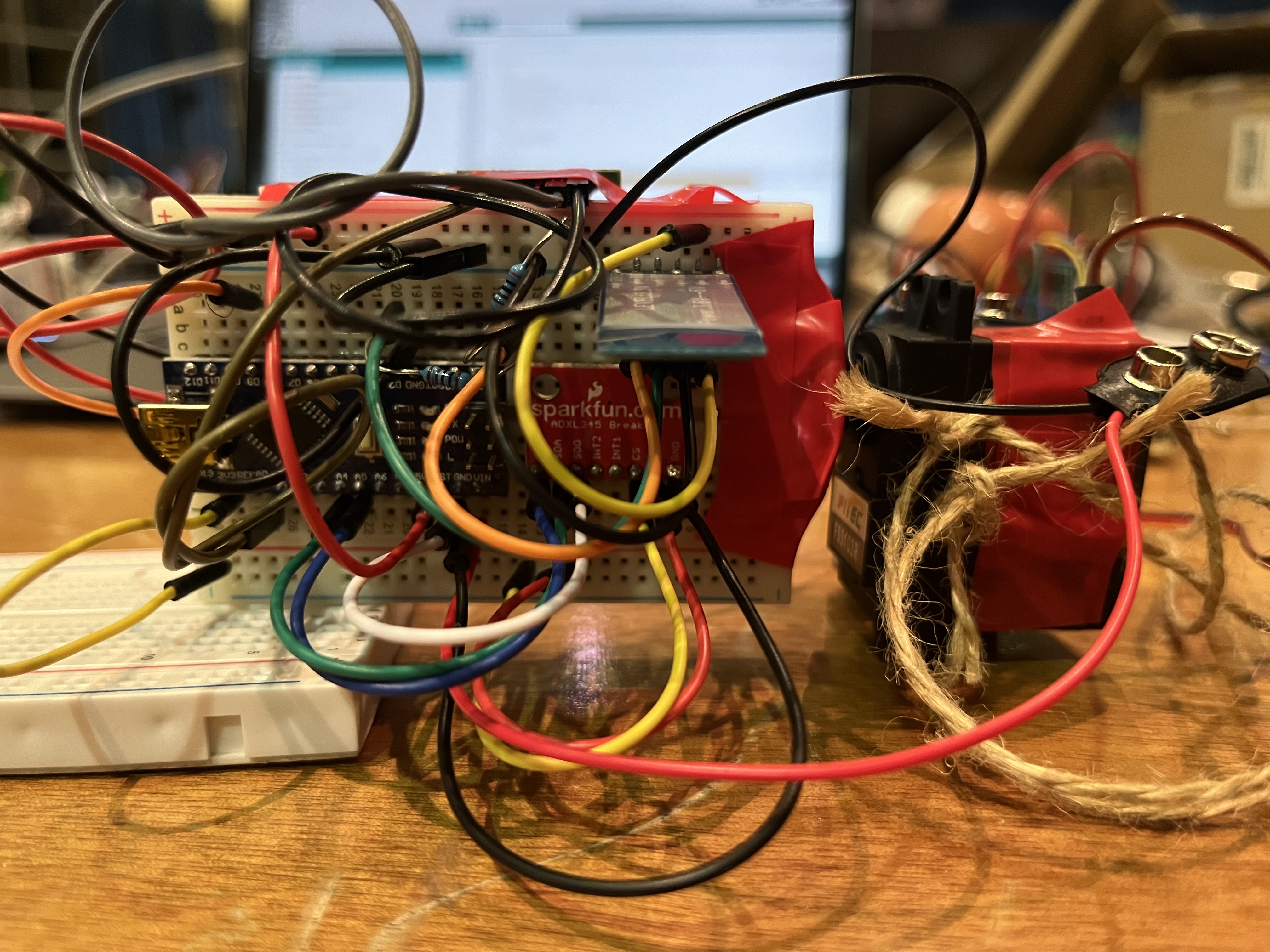
Close-up of the back of the cap accessory, showing the connections of the Arduino, accelerometer, servo motor, and Bluetooth module.


What inspired Eye-as?
The white cane is an effective and beloved tool for the visually impaired. It allows the blind to sense their surroundings through tactile feedback, giving them a greater degree of independence in commuting to work or navigating their neighborhood (Perkins Institute).
We were shocked to learn that, despite the white cane's benefits, less than 10% of the visually impaired use one on a daily basis (Perkins Institute). For one, cane users can face a steep learning curve (Yin), which can be intimidating without mobility training. Secondly, canes can't detect objects that hang at head height (Yin), like raised decks or tree branches. A secondary system, like a sonar-based sensor, would provide an additional layer of protection.
With that, we set out to create Eye-as to help novice and experienced cane users detect upper-body obstacles. We had two principles in mind:
Keep things simple -- and keep the white cane. There have been many attempts at making electronic "smart canes" that augment the standard white cane with additional sensors, but none of them have gained traction (Yin). In fact, electronic feedback could interfere or distract with the natural tactile feedback of the walking stick (Yin).
Aim for cost-effective and scalable. While white canes cost anywhere between $20 and $80, many electronic canes can set someone back by hundreds of dollars (Yin). Any extra bulk the visually impaired have to carry should also be minimized. We're confident that our Eye-as breadboard prototype can be made into a small, wearable PCB-based device under $80.
What does Eye-as do?
When we first decided on addressing the theme of accessibility for the visually impaired, one of our first ideas was to modify a walking stick with ultrasonic (obstacles, stairs) and water (puddle) sensors. However, after some online research, we saw how non-electronic canes were already sufficient for the problems the electronics would aim to solve. Instead, we sought to instead provide a secondary aid that could act alongside the already established walking stick.
Blind cane users generally sweep the ground more than the space in front of their eyes for danger, making them vulnerable to upper-body obstacles. The wearable accessories we propose use a sonar sensor mounted on a visually impaired person's head to protect against these hazards.
Eye-as' cap and bracelet accessories are in constant Bluetooth communication. When the cap detects a potential obstacle within a certain range, it sends a signal to the bracelet. Upon receiving a consistent signal from the cap, the bracelet then emits a sound using an onboard buzzer, alerting a blind user to a hazard. In addition to this, Eye-as' cap makes use of an accelerometer and a servo motor to always position the sonar sensor forward -- perfect for maximizing the sensor's utility and handling the many different walking postures cane users can have.
What was the process of building Eye-as? What did we learn?
To better the accessory’s effective sensory field, we mounted our sonar sensor on a servo in tandem with an accelerometer. We had not used a servo with a microcontroller before, so this experience would be valuable for future robotics projects. For instance, we learned the difference between the non-continuous and the continuous servo. Also, we learned how to read values from the accelerometer to stabilize servo rotation. This pairing has application in robotics systems, particularly those that demand precise motion.
This hackathon was also our first experience with setting up wireless connections. Using the HC-05 Bluetooth chip, we studied how to set up a master-slave relationship between two Bluetooth modules, allowing us to get multiple Arduinos to talk to each other. This involved executing AT commands to set up a Bluetooth pairing and working through the unexpected surprises of the wireless world. The HC-05 chip setup also included soldering - we soldered a logic level converter to reduce the Arduino’s 5V transmission signals to the Bluetooth module’s 3.3V demands. This endeavor into wireless technology offers exciting possibilities for future Arduino projects, as we now can bind multiple sensors wirelessly and at a distance.
What's next for Eye-as?
Less bulk equals better wearability: The breadboard prototype of Eye-as is pretty unwieldy -- not ideal for wearable technology. Luckily, most of its size comes from using boards for components such as the accelerometer and microcontroller instead of individual components. In fact, with a PCB-based design rather than a breadboard-based one, we believe Eye-as can be shrunk to a size capable of fitting on every hat and wrist.
The many possibilities of Bluetooth: Because of its Bluetooth compatibility, Eye-as can be expanded to many different applications. Using tactile feedback (like a phone vibration) in addition to an audible buzzer could improve Eye-as' usability for a wider visually impaired audience.
What does the name mean?
An eyas (pronounced eye-us!) is another name for a young falcon. We thought the idea of Eye-as' cap accessory on a hat was similar to a falcon perched on a ledge -- keeping a steady and vigilant eye for any hazards.
Sources
Perkins Institute for the Blind. "10 fascinating facts about the white cane" (2024). [https://www.perkins.org/10-fascinating-facts-about-the-white-cane/]
Yin, Steph. "Why is creating electronic canes for the blind so hard?" (2019). [https://whyy.org/segments/why-is-creating-electronic-canes-for-the-blind-so-hard/]
Built With
- adxl345-accelerometer
- arduino-nano
- c-programming-language
- giant-continuous-rotation-servo
- hc-05-bluetooth-module
- logic-level-converter
- sonar-range-finder

Log in or sign up for Devpost to join the conversation.