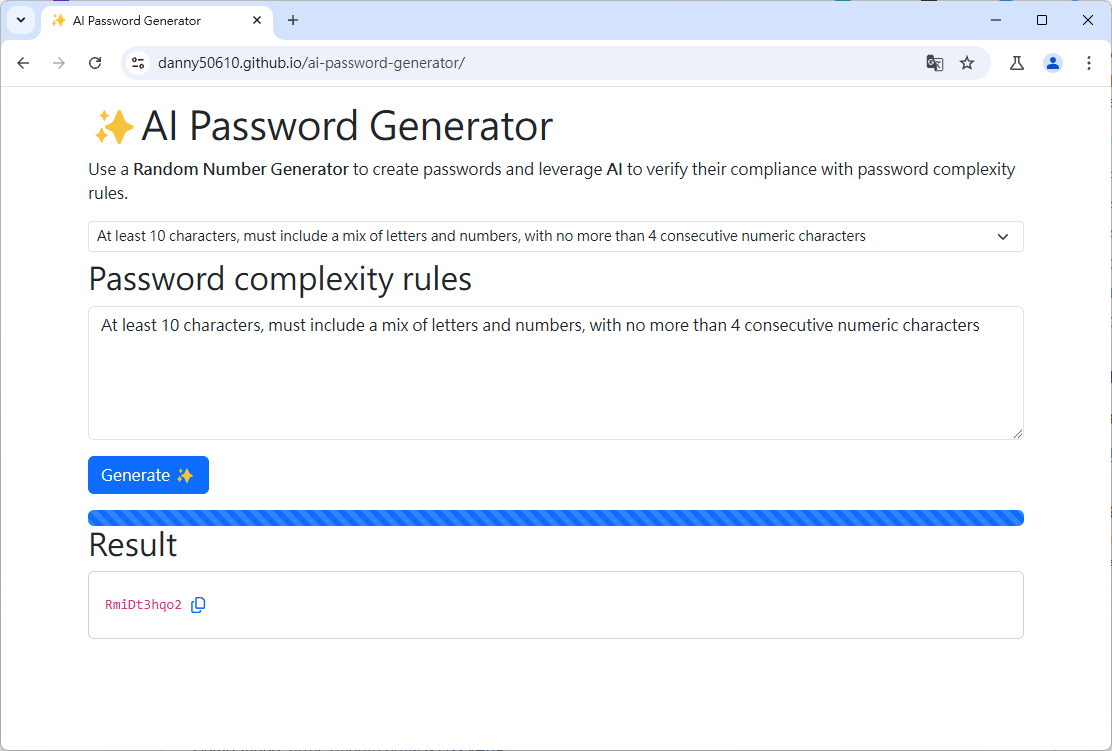
Inspiration
Simple passwords are easy targets for brute-force attacks.
Many companies, therefore, require passwords in their systems to meet specific complexity criteria.
However, these complexity requirements often leave users feeling confused and frustrated.
With the advancements in AI, it’s time to let AI help people create stronger passwords.
What it does
The security of a password primarily relies on its randomness.
Currently, LLMs do not have the capability to securely generate truly random strings.
However, we can utilize LLMs to check if a password meets the company's requirements.
With Chrome Built-in AI, privacy and security concerns are addressed, as all processing is handled locally.
This ensures that passwords do not leave the user’s device, reducing the risk of interception over the network or on servers.
How we built it
We built the interface using Vite and Bootstrap and integrated Chrome Built-in AI to analyze password complexity rules.
- Prompt API: Extracts parameters for the password generator from the rules, then validates the password and rules together using AI.
- Translator API, Language Detector API: Handles non-English rules by translating them into English before AI processing.
Challenges we ran into
AI responses sometimes fell short of expectations, but we managed to improve outcomes through prompt engineering.
Accomplishments that we're proud of
Successfully integrated the Prompt API, enabling the tool to understand natural language instructions.
What we learned
With Chrome Built-in AI, processing natural language is no longer a distant dream.
Even small models can deliver impressive results.
What's next for AI Password Generator
Enhancing accuracy through prompt engineering or using LoRA to train the model with more examples, improving its precision.
Built With
- chrome-built-in-ai
- javascript
