Prototype link (Please submit a link to a playable prototype, not a link to your design file) Link
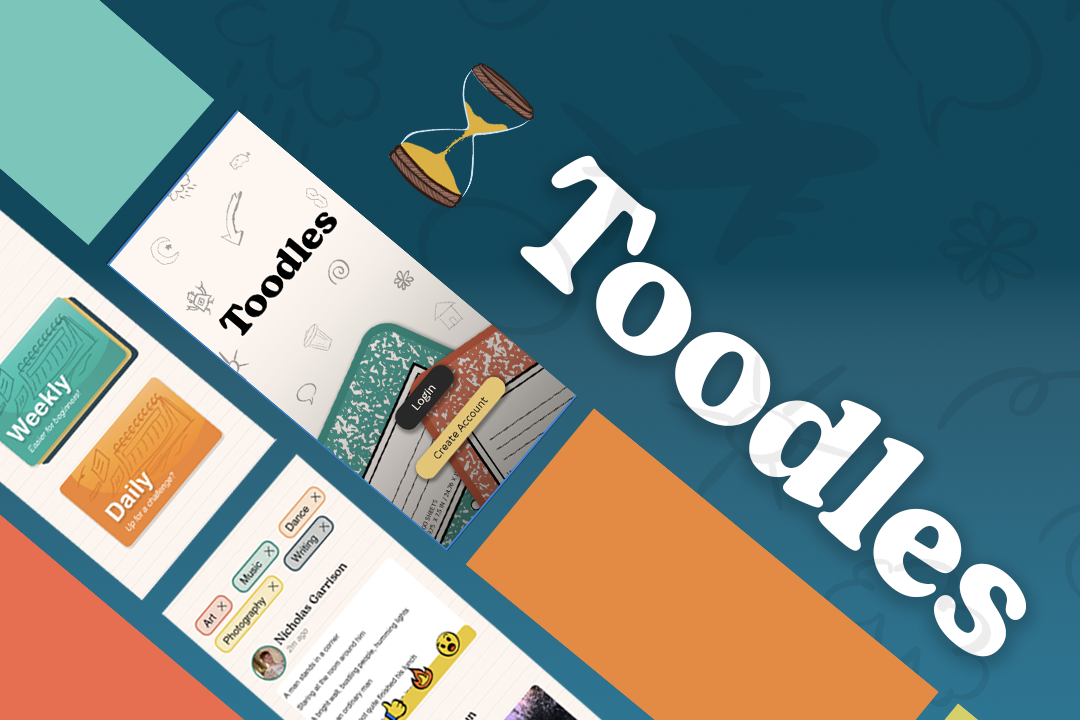
Describe your project (max 150 words) Toodles is a platform where either once a day or once a week users will be given a prompt and will be asked to create something. Whether that's a poem, a video, a piece of music, or even a card trick, every medium is fair game, it’s up to you to make your own unique creation. In a world full of deadlines, stress, and shortcuts to success, Toodles tries to make people slow down and remember what it means to be human.
With an AI chatbot that will help point individuals in the right direction, but still requires them to take agency in your own creations, and a feed full of others’ past submissions that can be added to users’ inspiration boards, regardless of how creative people think they are, they can be inspired, test their limits, and be unequivocally themselves in the midst of the chaos of daily life.
- Describe your research process and findings. If you conducted any surveys or interviews, please include the survey form and/or interview questions here. If you conducted secondary research by pulling from online sources, please include a link to your sources. (Max 500 words) Write your answer here. For our research process we employed the usage of 1:1 interviews as well as a simple survey promoted through social media. The focus of our research was based around how do people perceive their own creativity, their views/usage of social media, and how the constraints of time affect their lives.
For our 1:1 interviews we focused on talking with 6 creatives, all in a diverse set of backgrounds being a musician, artist, poet, designer, architect, and a videographer. Our focus was brought to these types of individuals as we wanted to pinpoint the fears that are beginning to rise alongside the growth of AI while also trying to find what drives people to create. The questions we asked were, “How do you differentiate between something that is made by AI and something that is made by a human?”, as well as “How do you find the time to slow down and be creative?” During the interviews however, one clear distinction was made, time makes things human. Time sunk into creations gives life to details, visions, and polished products, but with the efficiency and convenience of AI, the essence that is bound with that time disappears.
To supplement the information gathered from our 1:1 interviews we created a survey meant to collect data particularly on the amount of time people spent on social media, their interest in the social media app BeReal, what inspires them, their usage of ChatGPT, and their belief on how creative they were. We also focused on advertising it on social media in order to garner a larger sample of data. From all 94 of the responses gathered it was found that the average person spends at least 2.5 hours on social media apps per day. We also found that despite its initial success in 2022, BeReal had a dramatic fall off with 73.6% of individuals surveyed saying they didn’t use the app anymore with the most common reasons being that eventually it felt like a waste of time or that it felt ingenuine after some time.
One shocking piece of information that was brought to our attention however, was that 75.9% of people surveyed felt inspired when they learned something new and 72.4% of people felt inspired while listening to music. This exposed two mediums that a majority of people felt more connected to. One issue we found was that 50.6% of people surveyed utilized AI in order to summarize or write for them, tagging onto the issue of efficiency compensating for time. Another common issue was that the majority of people rated themselves a 7 or below in terms of creativity which indicates that many people believe that they are either average or below average in terms of creativity.
https://forms.gle/2K6e2LbC28gG9RTg8
- Describe your most important design decisions. What research findings and/or user testing results led you to make these decisions? (Max 500 words) One of the biggest design decisions we made was to make the vast majority of our assets hand drawn. When talking with the creatives during the 1:1 interviews they mentioned a lot about how important details were in the process of creating true human art, and so creating an emphasis on that was incredibly important during our design process as a means to promote more human creations and diverse visions.
The other major point of our design was that we wanted to improve upon the model that the viral BeReal had utilized. By having a daily prompt that is released at an unknown time and being given only an hour to create something that resonates with you in alignment with the prompt, it creates a consistent cycle of creation within the community. We focused a lot of our attention to the complaints that survey respondents had about BeReal, mainly being that it felt ingenuine, served no purpose besides just taking the picture, and that it got repetitive. To solve these issues we decided to give our app other purposes rather than just taking pictures, you can browse through others creations and add them to an inspiration board. By also allowing individuals to post any form of medium, it provides a wide variety of possibilities for people to answer the prompts as it is purely subjective in what people may believe is the best portrayal of certain topics.
Another intentional choice was the incredibly broad responses of the AI Chatbot. This is because as collected by our survey, the majority of people use AI, with 51.1% of them using it to generate ideas. We want to force people to take agency for their own creations rather than relying on something else to tell their story for them. One of the creatives that we spoke with put it very well in that when people use AI to create something, you feel regret because it is not genuine compared to someone who puts their passion into making a form of art. The action to allow the user themselves to choose whether or not to receive help from the AI is an intentional play on our part so that the user becomes more aware of their actions. By introducing several “barriers” (swiping down the tab, then being prompted to answer a “yes” or “no” question), the user has to repeatedly confront their inner selves about if they want to receive help from AI. Although the AI chatbot is there to help users with the creative process, we also hope that introducing minor barriers in the process to get there will help them realize that it is not something they need to rely on to truly create.
Built With
- figma
- photoshop
- procreate

Log in or sign up for Devpost to join the conversation.