What if you could feel the edges of your own assumptions?
Most of us move through the world confident we understand it. We've read the news, we've scrolled the feeds, we know how things work. But knowing about the world and genuinely understanding the people in it are completely different things.
Project Nafasi started with a single question: what would it take to make someone feel not just know that their picture of the world is incomplete?
The Inspiration
We kept coming back to a specific kind of person. Not someone ignorant or malicious. Someone ambitious, educated, well-intentioned who had quietly built their entire life inside a bubble they couldn't see. The person who reaches their goal and realizes it wasn't theirs to begin with. The person who has never been challenged by a reality fundamentally different from their own.
We wanted to build something for them. Something that didn't lecture. Something that interrupted.
What We Built
Project Nafasi is a two-part system: a network of public cube installations and a personal app that together track and expand what we call horizon sense the previously unmeasurable human capacity to perceive beyond your own assumptions.
The Cube stands in public spaces. All four sides identical. No front, no back, no wrong approach. Every day at midnight, a single sentence from one real person's life appears on every face. No name. No country. No context. Just words and the faint sound of music composed from their story.
"Why is it so hard to make friends here?"
"We don't have a word for lonely here."
"The market burned down and we rebuilt it in four days."
The sentence stays for 24 hours. The same words catch a morning commuter differently than they catch someone walking home at night. That's intentional. The city collectively holds one human life in its awareness for a full day.
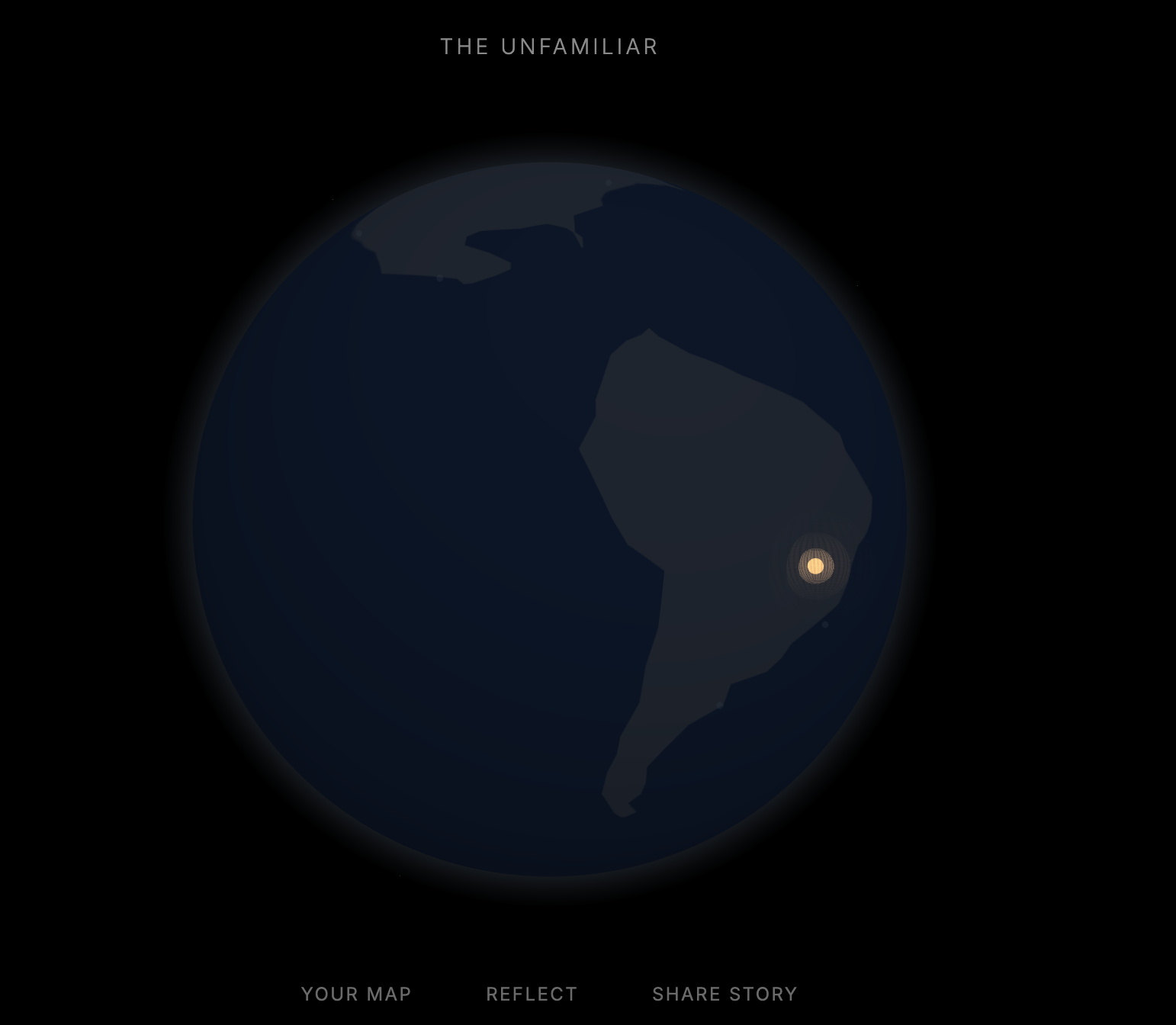
The App is where the experience deepens. At its center is a dark, slowly rotating globe mostly unlit, scattered with small points of warm amber light where stories live. The darkness is intentional. The vastness of what remains unknown is the point.
Users tap a dot. A story opens first just the single line, then music, then the full story in someone's own words, then a second voice from the same place who sees things differently. The contradiction is never resolved. The user has to sit with it.
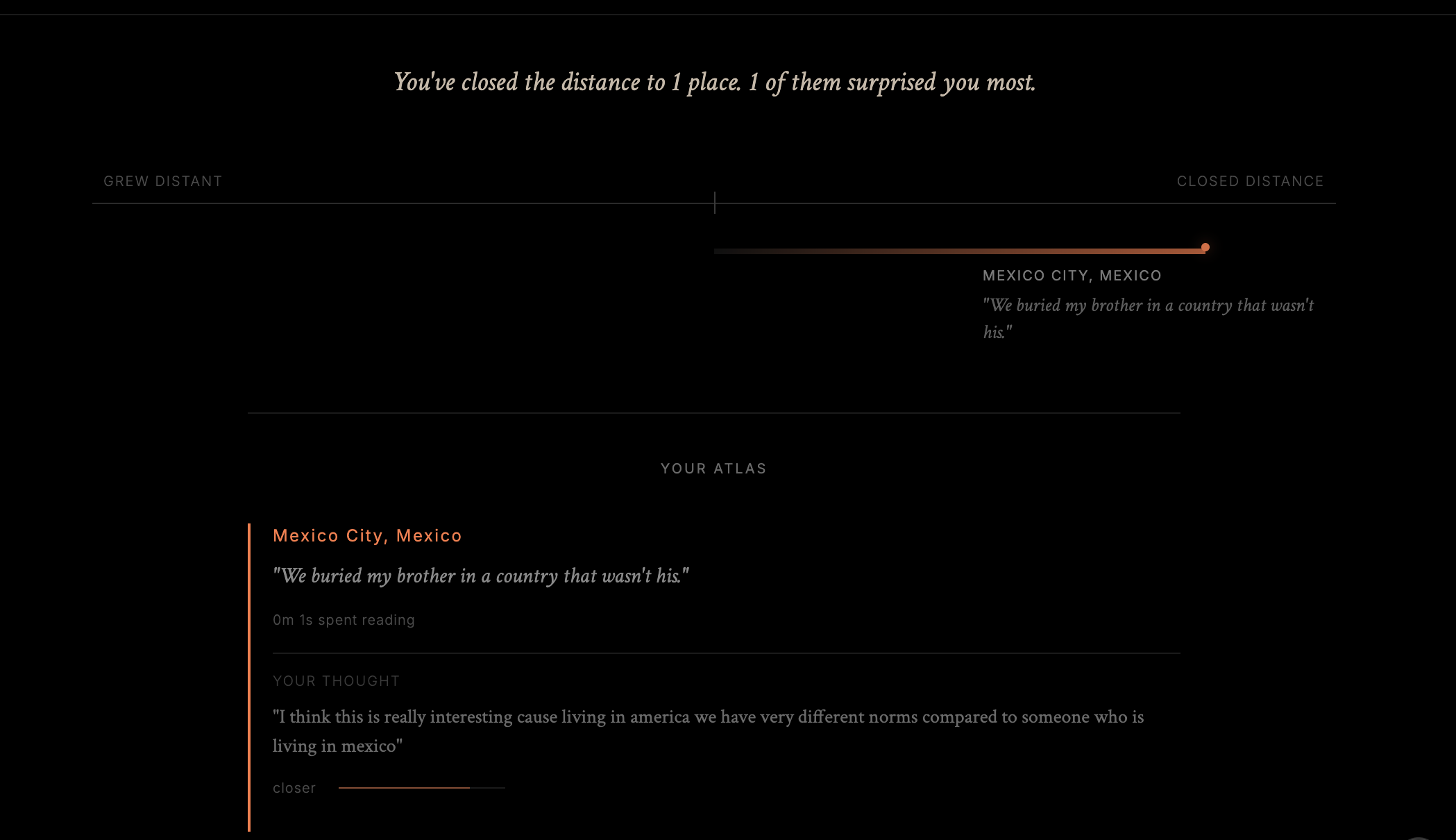
Before and after each story, a single slider asks one question: how well do you feel you understand life here? The gap between those two answers measured silently against reading depth, time spent, and whether they stayed through the contradiction becomes the truest measure of worldliness we could design.
The Metric
We spent a long time trying to quantify something unmeasurable. Every solution we tried felt either too gamified or too vague.
The answer we landed on wasn't a score. It was a map.
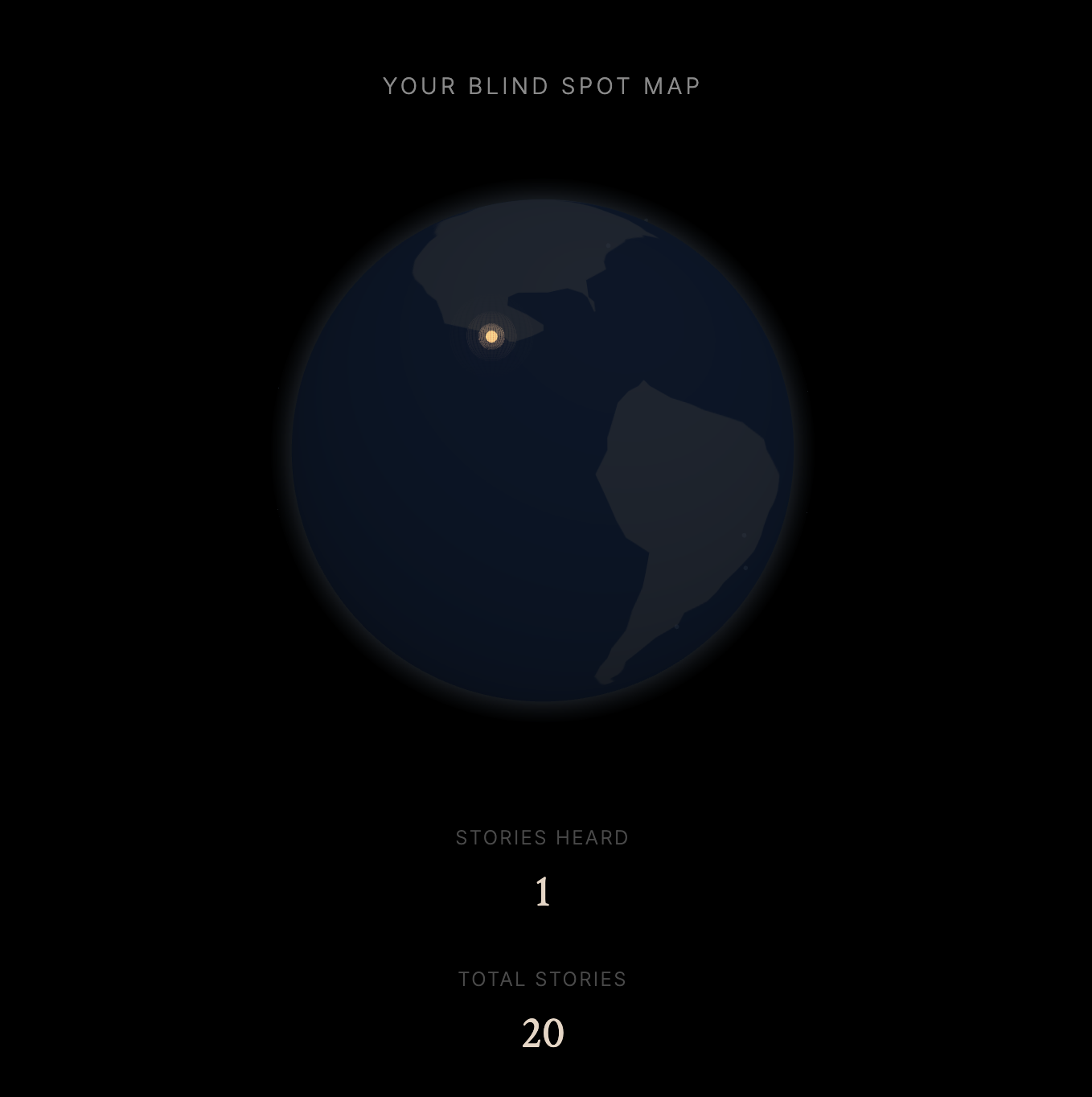
Your globe fills slowly with warmth — each dot moving from cold grey to glowing amber as you genuinely engage with stories from that part of the world. The darkness always dominates. The goal is never completion. And months later, the app quietly surfaces something you wrote on day one — "most people different from me want safety and familiarity" — and asks simply: do you still think that?
No judgment. No score. Just the question sitting there.
What We Learned
The hardest design problem wasn't the globe or the metric. It was trust. We kept asking — how do you build a tool that measures growth without turning growth into performance?
The answer was to make the experience hard enough to fake that only genuine engagement gets through. You can't rush the music. You can't skip the contradiction. The button that lights the dot — "I sat with this" — only means something because you chose to press it.
We also learned that accessibility couldn't be an afterthought. An app about expanding beyond your bubble that requires a smartphone excludes the people who might need it most. So the cube works without the app. Dwell time is the interface. The longer you stand, the more the story gives you. No phone needed. No account required. Just stillness.
The Challenges
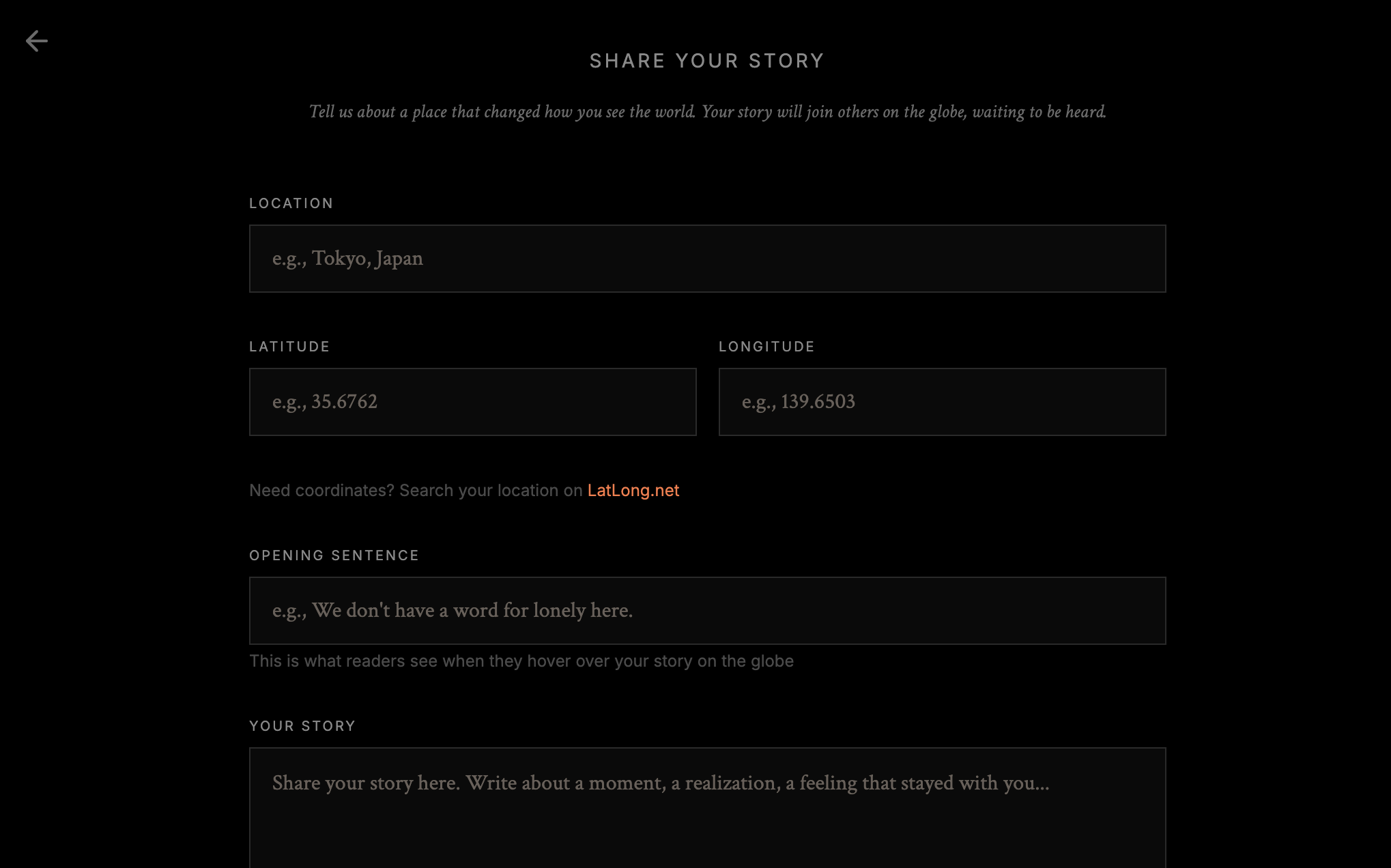
Bias was our constant tension. Every story has a narrator. Every narrator has a position. We stopped trying to remove bias and started trying to make it visible — multiple voices from the same place, contradicting each other, with no resolution offered. The friction between accounts is where the learning happens.
Placement of the cubes was harder than we expected. Distance between portals is the wrong variable. The right question is: does this cube sit between two worlds that don't currently talk to each other? Twenty cubes in the right places do more than two thousand in the wrong ones.
The Bigger Idea
Project Nafasi is not an empathy app. Empathy is the outcome, not the feature. What we built is a sensing system — one that makes the edges of your assumptions felt, slowly and honestly, over time.
The world is full of lives you've never considered.
Project Nafasi brings one to you every day.
NOTE:
Check out our slides here for more information! (note very interactive) https://www.figma.com/deck/FQXBACJ6hLzh9J21E7kkCZ
Built With
- figmamake
- react


Log in or sign up for Devpost to join the conversation.