-
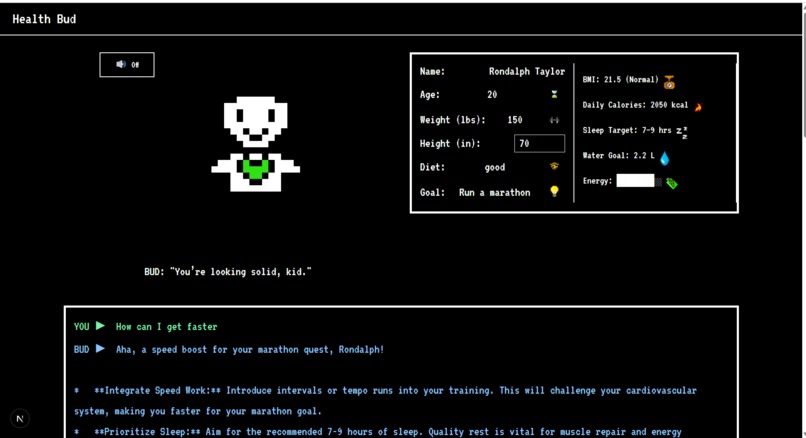
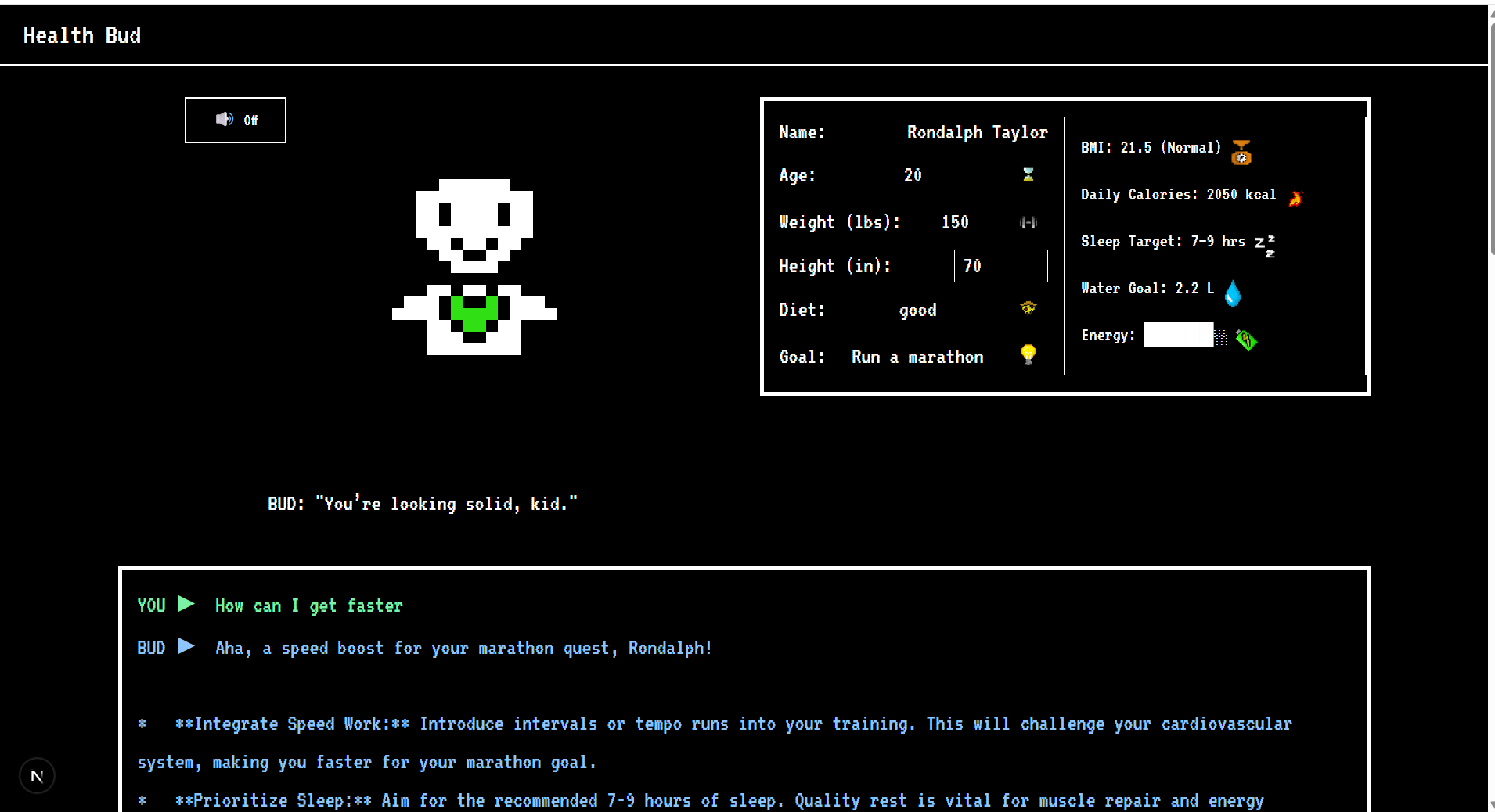
User asking the great Health Bud how to improve their marathon speed
Inspiration
We wanted to create a health tool that felt personal and engaging rather than clinical. The idea of blending a retro RPG aesthetic with modern AI came from the question: What if your health assistant felt like an in-game companion instead of an app? For most of us, this was also our first hackathon, so we wanted to build something ambitious, fun, and polished within 24 hours.
What it does
Health Bud is a retro-styled health companion that:
Talks to the user through an RPG-style dialogue system
Analyzes personal stats like BMI, calories, water intake, and sleep recommendations
Generates personalized health advice using Gemini
Classifies user concerns (injury, heart issues, mental health, etc.)
Uses the Google Places API to recommend real-world locations such as gyms, clinics, therapists, and rehab centers
Displays everything in a pixel-art interface with animations, sound effects, and a typewriter text engine
How we built it
Frontend: Next.js + Tailwind, custom pixel art, audio cues, dialogue system, boot sequence, and a turn-based chat viewer.
Backend: Express.js with Gemini 2.5 Flash for health reasoning and natural language understanding.
APIs: Google Places for location recommendations tied to a custom health-need classifier.
Logic: We implemented BMI and other calculated metrics using LaTeX-friendly formulas for clarity and consistency.
Challenges we ran into
Tailwind’s class-purging system broke several dynamic color changes
ESM import issues in Node caused multiple backend crashes early on
The typewriter engine initially erased the first character due to hidden whitespace in Gemini responses
Integrating Gemini + Places under time pressure required debugging CORS, environment variables, and rate limits
Managing sprite states, audio timing, and chat flow simultaneously created complex UI behavior
Coordinating GitHub forks, merges, and conflicts as a first-time team took adjustment
Accomplishments that we're proud of
Building a surprisingly polished full-stack app in one weekend
Shipping a complete health assistant with real-world recommendations
Designing a unique retro aesthetic with sprites, sound, and animated dialogue
Successfully integrating multiple APIs and an AI model
Getting the entire team contributing across different parts of the project despite this being our first hackathon
What we learned
How to structure prompts for reliable, safe, and concise AI responses
How to combine multiple external APIs into a unified user experience
How to manage React state for animations, audio, and incremental text rendering
How to collaborate under real deadlines using Git, forks, and live debugging
How to balance creativity with technical constraints during rapid development
What's next for *****
Adding full conversation memory and long-term health goal tracking
Expanding the classifier to support more detailed medical categories
Introducing mini health “quests” that guide users toward habits or routines
Creating a mobile-friendly version
Allowing Bud to adapt its personality and sprite animations based on long-term user behavior
Integrating more data sources (fitness trackers, step counters, wearables)
Built With
- css
- express.js
- google-gemini
- google-places
- html
- next.js
- node.js
- pixelart
- react.js
- tailwind
- typescript

Log in or sign up for Devpost to join the conversation.