-
-
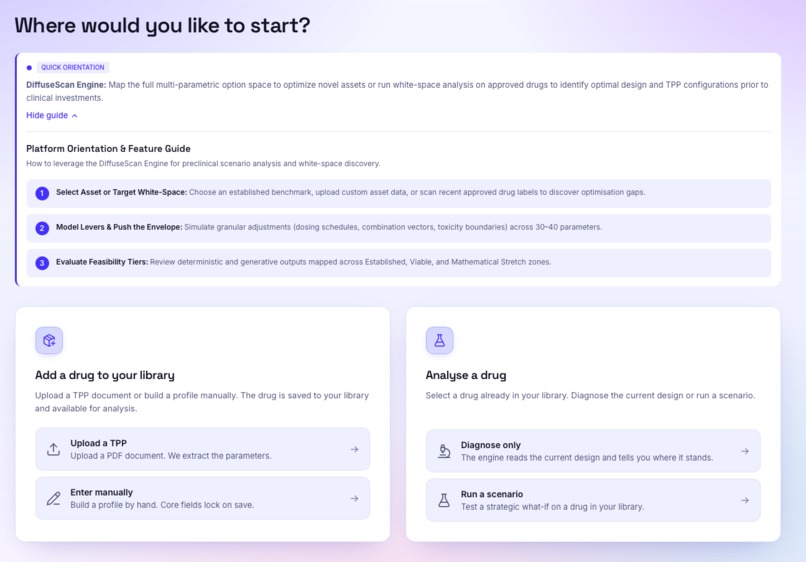
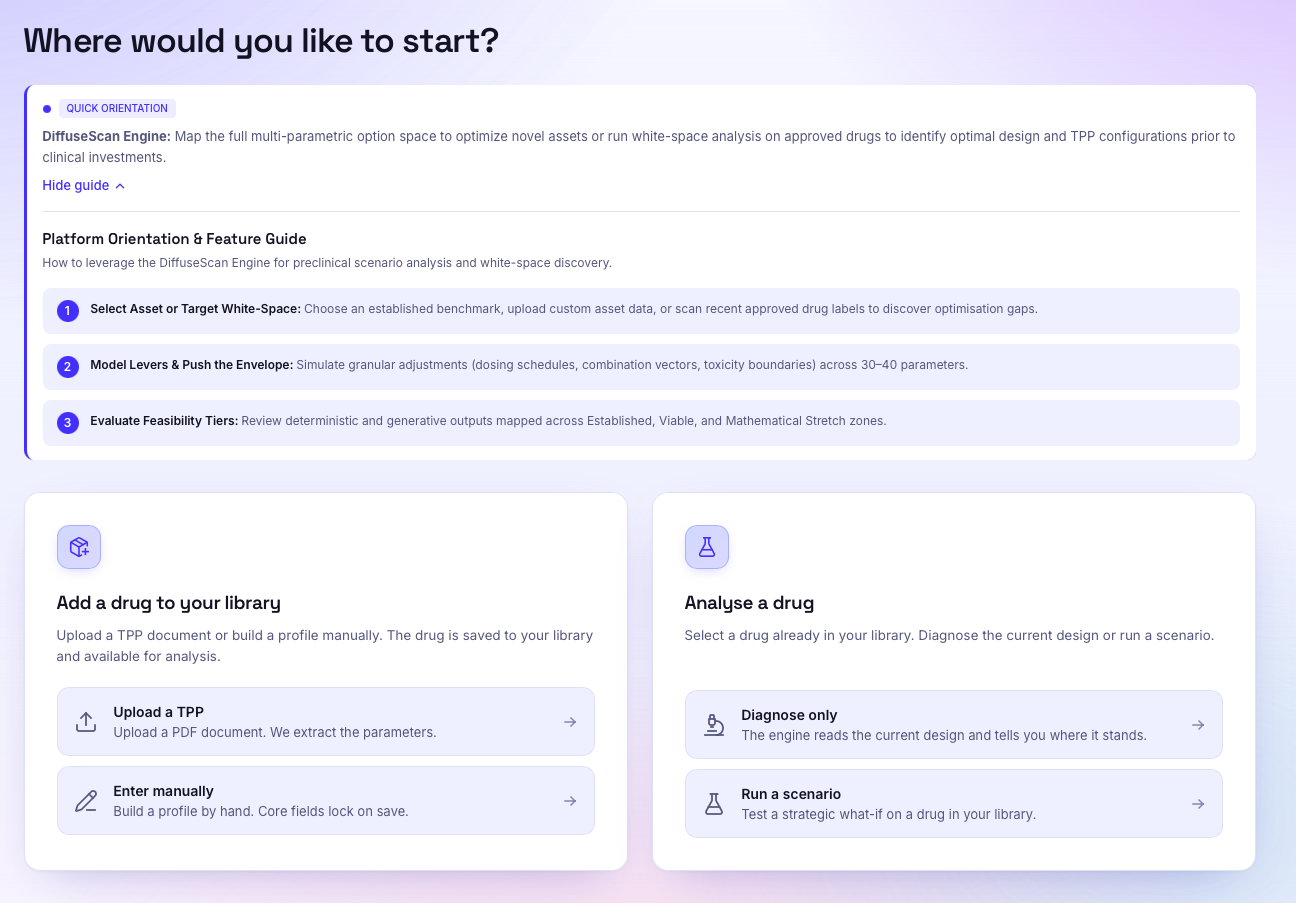
HomePage
-

Drug Library
-
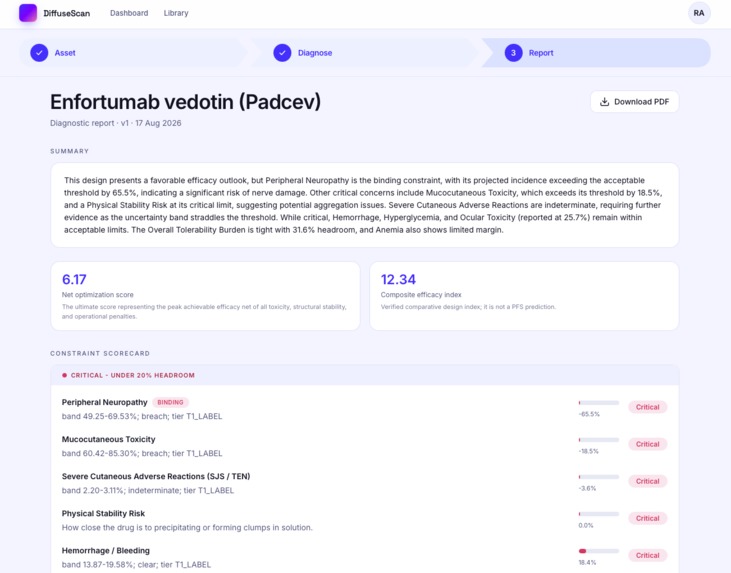
Diagnostic
-
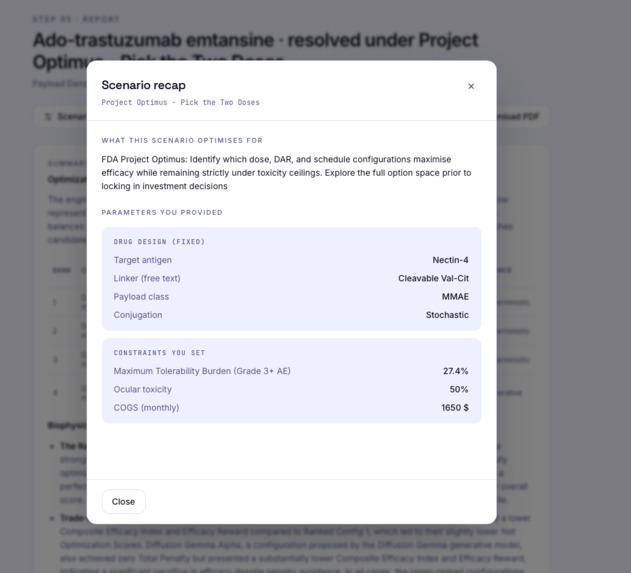
Scenario Run 1
-

Scenario Menu
-
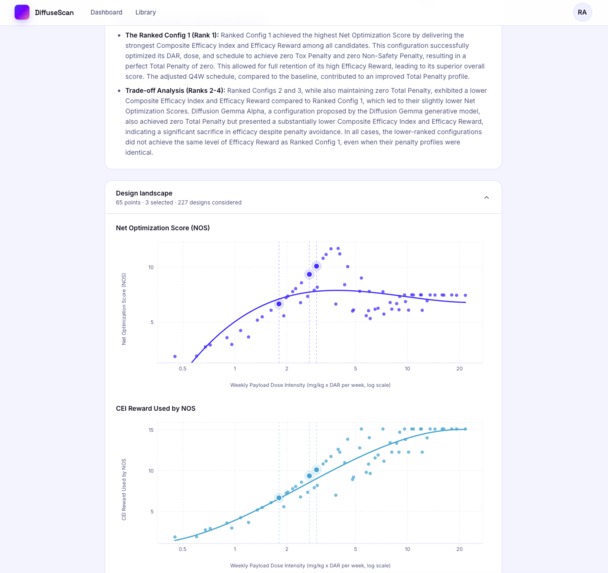
Optimus Output 1
-

Optimus Output 2


Inspiration
Bringing a single cancer drug to market requires a decade and over a billion dollars in capital. The most catastrophic financial mistakes are made earliest, when molecular designs and trial protocols are locked in before clinical development teams can visualize the full trade-off landscape. Antibody-Drug Conjugates (ADCs) perfectly exemplify this bottleneck: they present a hyper-complex, interdependent design space where altering the payload, linker, conjugation site, or Drug-to-Antibody Ratio (DAR) shifts the systemic exposure limit, which in turn reshapes the entire programme's safety profile and manufacturing economics.
Today, the industry is paralyzed by the Translate-to-Clinic Gap. Scientists engineer structurally elegant, highly potent molecules in a vacuum, only to watch them shatter against predictable human toxicity walls or manufacturing constraints in Phase 1 or 2 trials. The mandate is no longer just finding a molecule that binds to a target; it is computationally finding a clinical protocol that scales economically, survives human variance, and clears stringent regulatory mandates.
Current in-silico tools are structurally incapable of "whole-canvas" exploration:
| Existing Tool / Approach | Primary Mechanism | The Architectural Flaw |
|---|---|---|
| Traditional QSP (Quant. Systems Pharmacology) | Models PK/PD pathways over time using dense differential equations. | Passive & High Latency: Analyzes proposed configurations post-hoc; computationally prohibitive for sweeping millions of states simultaneously. |
| Standard MPO (Multi-Parametric Optimization) | Adjusts continuous parameters sequentially via local gradient search. | The "Hill-Climber" Trap: Autoregressive and vulnerable to local optima; incapable of large categorical leaps across discontinuous penalty landscapes. |
| Unconstrained Generative AI (Pure LLMs / Diffusion) | Rapidly generates novel chemical and structural states. | The Hallucination Deficit: Generates structures that violate strict biophysical limits, fail CMC scalability, or trigger fatal toxicity overlap. |
| High-Throughput Screening (HTS) | Brute-force physical testing of massive compound libraries. | Economically Inefficient: Capital-intensive trial-and-error that cannot predict downstream clinical toxicity or FDA compliance. |
The Operating Model Challenge: Scientists are forced into isolated, linear silos. Medicinal chemists design the architecture, pharmacologists model the delivery constraints, and clinical strategists guess the dosing schedule. If a fatal flaw is discovered at step three, the asset is sent back to step one.
Our Mission: To eradicate the linear R&D bottleneck. We are giving scientists the generative freedom of DiffuseScan to explore massive, discrete structural leaps, anchored by a deterministic biophysics engine that guarantees the output is safe, manufacturable, and clinically viable.
What it does
The engine treats oncology drug development as a continuous constraint-satisfaction problem across an expansive 16-node state space. It evaluates up to forty parameters, from molecular choices (payload sub-class, linker chemistry) to operational variables (dosing intervals, clinical settings).
The platform operates in two distinct modes:
1. Diagnostic Mode (A Priori Evaluation)
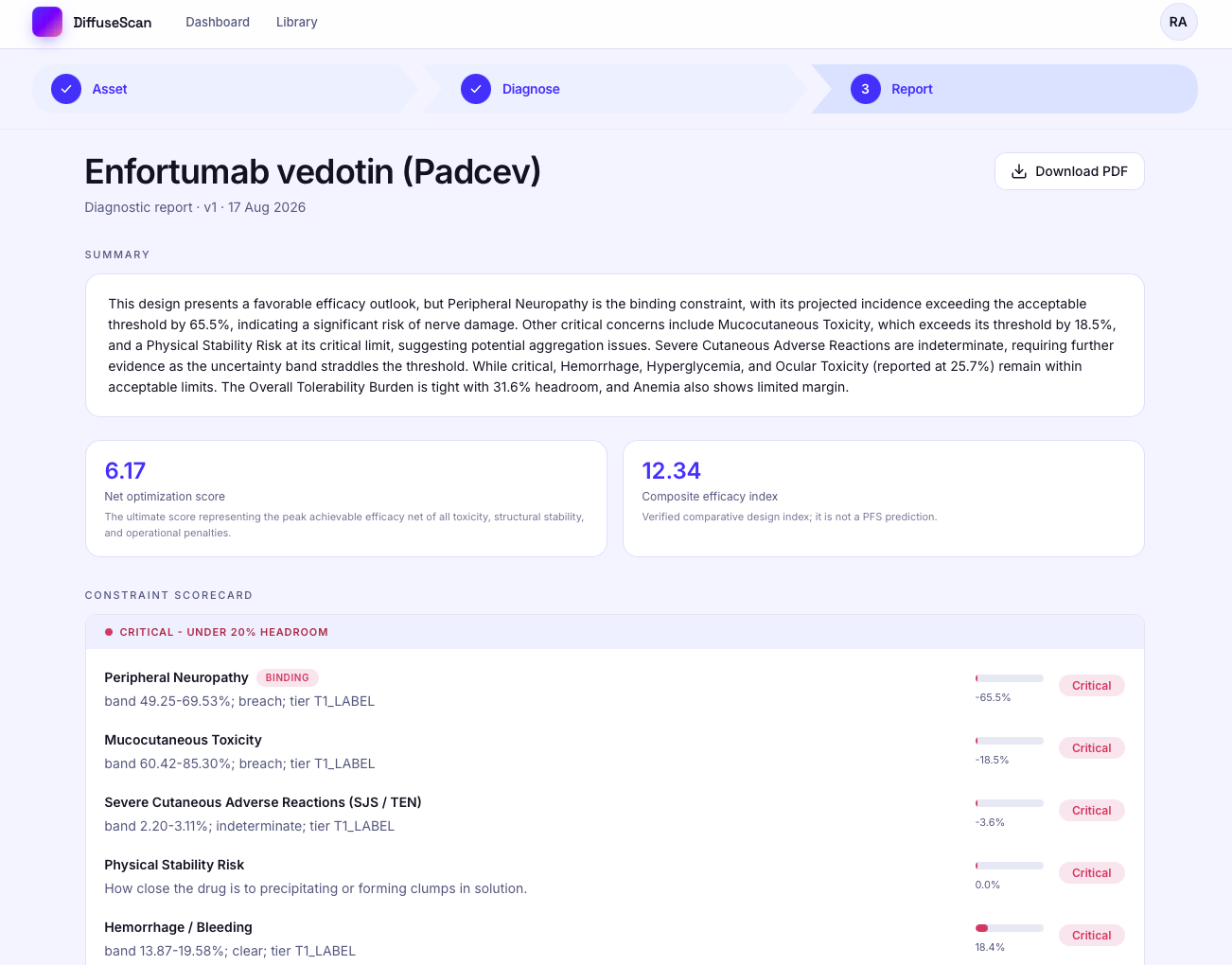
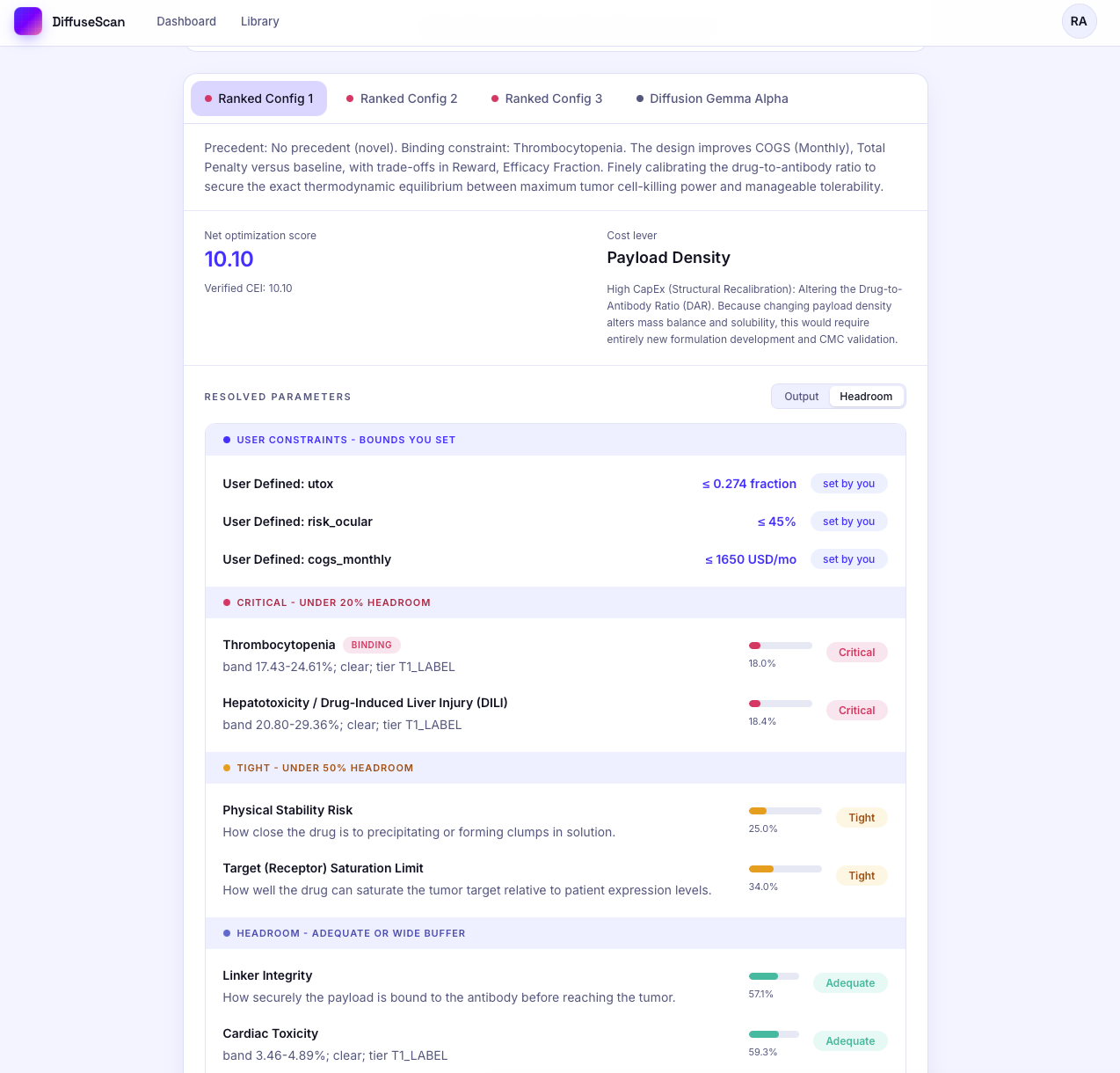
The engine ingests a static asset and instantly grades it against the laws of physics, returning a biophysical "credit score." It calculates the Composite Efficacy Index (CEI), a deterministically computed scalar metric that synthesizes an ADC's intrinsic kill-potential against the constraints of tumor surface capacity (B_max) and acquired resistance. This is displayed alongside a constraint scorecard that ranks risk by headroom, and is cross-referenced against real-world clinical analogues.
2. Sweep Mode (Run-Dependent Optimization)
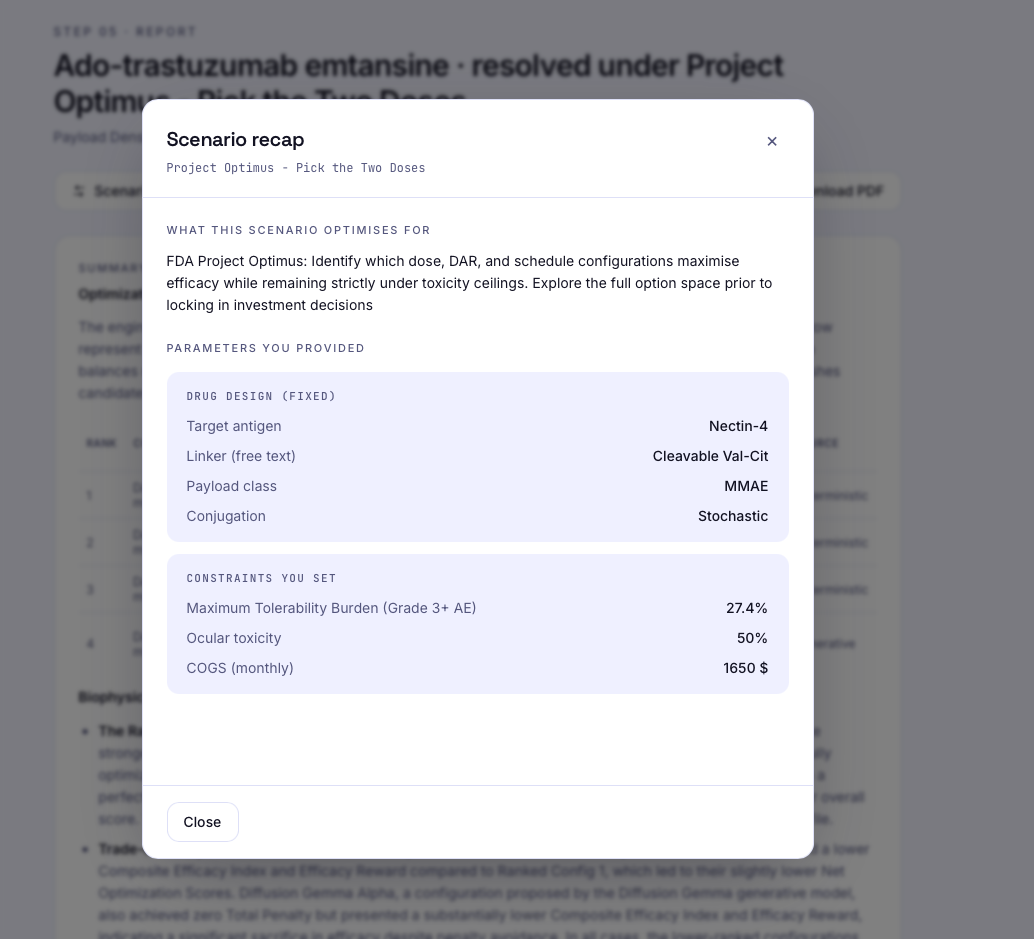
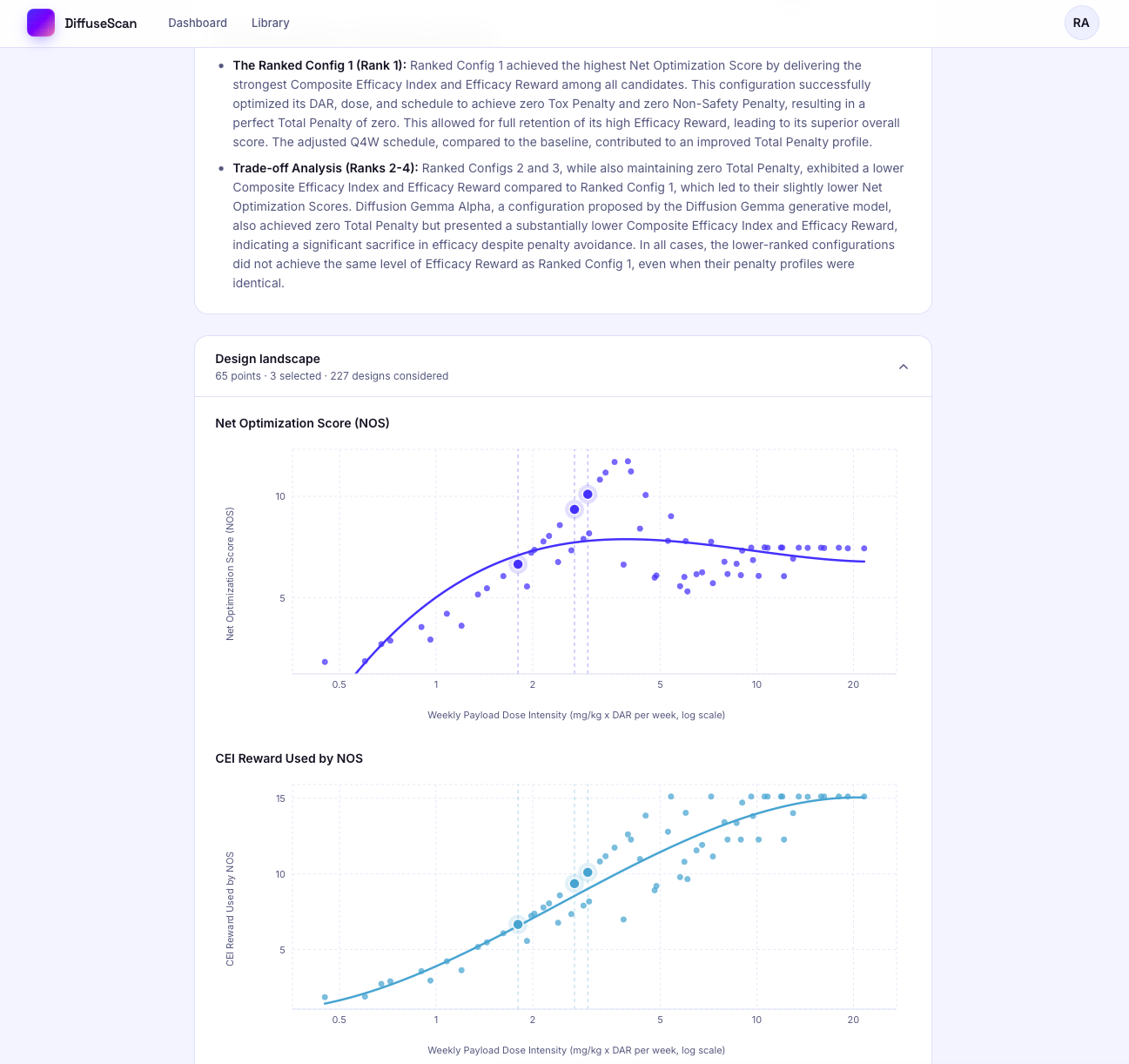
When tasked with a protocol redesign (e.g., an FDA Project Optimus dose-selection mandate), the engine explores millions of configurations. It optimizes a global reward function to output the Net Optimization Score (NOS), balancing the upward pull of the CEI against safety vetoes and economic margins, returning a ranked shortlist of buildable, Phase 2-ready regimens.
Key challenges addressed by the Fusion Architecture
- Eradicating the "Dead Patient Fallacy": Generative AI faces skepticism for hallucinating biologically impossible drugs. By using our deterministic biophysics engine as a strict classifier-free guidance mechanism, the diffusion model is forced to obey reality. It cannot output a configuration that violates target antigen limits, intracellular half-lives, or manufacturing cost ceilings.
- Resolving the Clinical Triad Simultaneously: A "whole-canvas" approach doesn't just design a molecule; it designs the clinical regimen. It resolves the payload class, conjugation mechanics, optimal dose, and clinical setting (e.g., 1L vs. 3L+) simultaneously. If altering structural mechanics drives up toxicity, the deterministic engine and diffusion model resolve that tension globally in a single step.
- Easing Regulatory Compliance: FDA mandates like Project Optimus require computationally proven "optimal biologic doses," currently costing biopharma tens of millions in reactive, multi-arm Phase 1b trials. Our framework predictively maps the exact optimal dose that maximizes tumor kill while remaining safely buffered from toxicity walls, delivering Phase 2 readiness with zero clinical capital burn.
How we built it
Standard autoregressive models commit to decisions sequentially (token by token) and cannot hold interdependent clinical and structural variables in a single view. To solve this, we built a proprietary Fusion Architecture, bridging a generative diffusion model with deterministic biophysics to denoise and refine the entire design canvas simultaneously.
Because high-fidelity, standardized ADC outcome data is scarce, we engineered a biophysical-simulation pipeline to generate vast quantities of synthetic training data. This data trains an open-weights Gemma diffusion model to understand the latent space of clinical protocol design.
During a sweep, the optimizer generates thousands of candidate regimens, processing them through deterministic mathematical knots (e.g., Knot K1 for delivery, Knot K9 for COGS). The application is driven by a Next.js front end and a FastAPI service. The models are served on Google Cloud Vertex AI, with structured constraint data in Cloud SQL for PostgreSQL, while the Gemini API translates the engine's dense tensor mathematics into clinician-ready, plain-language reasoning.
Challenges we ran into
1. Data scarcity and synthetic generation
There is not enough public, standardized Antibody-Drug Conjugate (ADC) outcome data to train a diffusion model directly on clinical endpoints. We bypassed this by engineering a mechanistic simulation pipeline that synthesizes training data entirely from strict biophysical parameters, grounding our open-weights model in the laws of physics rather than sparse or heavily siloed clinical approximations.
2. Engineering a computable objective function
Standard optimization algorithms failed when applied to the discontinuous realities of human biology. We had to architect an entirely new mathematical stack from the ground up to handle the friction of drug design:
- Defining a unified efficacy scalar. We needed to mathematically compare radically different molecules (e.g., a DAR-8 Topoisomerase-I against a DAR-4 Auristatin) across different clinical settings. We engineered the Composite Efficacy Index (
CEI), a universal scalar that deterministically merges raw molecular data (apoptotic ceilingsE_max, potencyEC_50) with physiological delivery constraints (C_tumor). - Abolishing hard cut-offs. Naive models evaluate toxicity with binary pass/fail logic, discarding highly potent designs that sit marginally over a limit. We replaced blunt cut-offs with Soft-Knot Energy (
E_soft), a continuous mathematical force field. It acts as a repulsive gradient, exponentially pushing back on the algorithm as a configuration approaches a toxicity wall, shifting our engine from cliff-edge optimization to structural stability mapping. - Simulating dynamic biological friction. We could not treat a heavily pre-treated tumor the same as a treatment-naive one. We built dynamic tuning priors into the matrix, automatically penalizing the payload's efficacy through setting-dependent heterogeneity down-scalars (
η) and clonal resistance up-scalars (ω) to account for real-world disease variations. - Resolving dimensional volatility. Subtracting raw toxicity variance from a clinical index caused large-number cancellation and chaotic scoring swings. We resolved this by fusing the metrics into a Multiplicative Exponential Discount. This mathematically bounded the state space, allowing us to safely modulate the stringency of the algorithm.
3. The trust deficit (explainability)
A recommendation is useless to a clinician or Search & Evaluation (S&E) team without transparent reasoning. Black-box AI is fundamentally un-licensable in biopharma. We engineered the platform so that every parameter shift in the output (e.g., stretching a dosing schedule from Q3W to Q4W, or switching to site-specific conjugation) is explicitly traced to the deterministic rule, toxicity boundary, or economic penalty that forced the change.
Accomplishments that we're proud of
We compressed work that takes an expert team weeks of cross-disciplinary debate into resolved, mathematically ranked, and fully explained outputs in minutes. Beyond raw computational speed, we achieved key scientific and architectural milestones:
- Bridging the real-world data gap via biophysical synthetic generation. We resolved the fundamental clinical data scarcity bottleneck that cripples standard machine learning in oncology. By building a high-fidelity synthetic data generation engine grounded in deterministic physics (simulating non-linear receptor saturation, internalization kinetics, and clearance mechanics), we created a vast, biologically sound training foundation. This allowed us to train our open-weights diffusion model on millions of physically valid multi-parametric configurations, entirely bypassing the risk of training on sparse, noisy, or heavily siloed human trial data.
- Empirical dose-response tracking. We successfully back-tested our engine against clinical trial records. By deploying dynamic tuning scalars, specifically the clonal resistance (
ω) and target heterogeneity (η) penalties, the model accurately tracked and replicated the empirical dose-response curves of approved standard-of-care ADCs. This validated that our Composite Efficacy Index is not a theoretical abstraction, but a metric that mirrors real-world biological response. - Unifying cross-disciplinary silos. We expanded the scope of in-silico optimization beyond molecular binding, bridging clinical development and operational reality. In legacy R&D, medicinal chemistry, toxicology, and CMC (Chemistry, Manufacturing, and Controls) operate in disconnected silos, allowing costly trade-offs to fall through the cracks. By hardcoding operational constraints (such as the
Ψ_COGSmargin friction triggered by site-specific conjugation) directly into the global reward function, the engine evaluates a protocol as a unified commercial asset. - Honest, bounded optimization. Most optimization algorithms solve for the "Naive Peak": the absolute highest efficacy possible, which typically sits directly on the edge of a lethal toxicity cliff. Our architecture utilizes Soft-Knot Energy (
E_soft) to mathematically repel the configuration away from that cliff. The engine surfaces a design at the Global Optimum that is safely buffered, structurally stable, and manufacturable, rather than blindly chasing maximum raw tumor kill. - Analog-anchored reasoning. We ground every computed output in named, approved real-world clinical analogues. This ensures that when the engine recommends a complex protocol adjustment, a clinician or S&E executive can immediately sanity-check the AI's reasoning against historical drugs they already know.
What we learned
- Multi-parametric diffusion outperforms linear design. Sequential, linear decision-making inherently obscures the best clinical protocols. By replacing autoregressive logic with simultaneous multi-parametric optimization, using a diffusion model to "in-paint" missing variables across the entire canvas, we unlocked novel structural insights and viable configurations that traditional step-by-step methods completely miss.
- Tuned biophysics accurately tracks in-vivo biology. We proved that computational models do not need to rely solely on massive clinical datasets to predict human outcomes. By anchoring the engine in mechanistic biophysics and applying dynamic tuning scalars (such as target heterogeneity
ηand clonal resistanceω), the platform successfully tracked and replicated the empirical dose-response curves of real-world biology. - "Black-box" AI is commercially non-viable. In biopharma, a recommendation is useless without its proof. Black-box AI is a non-starter for clinical and S&E teams. Validation is mandatory, and embedding our generative model within a deterministic mathematical framework establishes the uncompromising confidence executives require. In this industry, the reasoning is the product just as much as the recommendation.
- The clinical data bottleneck is solvable. The pervasive lack of standardized, high-volume ADC outcome data is the primary hurdle for machine learning in oncology. We learned that overcoming this data paucity is entirely possible through synthetic generation. High-fidelity synthetic data, grounded strictly in the laws of physics rather than sparse clinical approximations, can successfully carry and train a generative model.
- There is a massive commercial appetite for mathematical validation. We validated the market demand. There is a deep customer appetite among pharma executives for computational tools that complement manual expert consensus. They actively seek out mathematical validation to stress-test their pipelines and eliminate cross-disciplinary blind spots before locking in billion-dollar clinical trials.
What's next for DiffuseScan.ai by Mito AI
Our primary vector is evolving the platform from a regulatory dose-optimization tool into the definitive operating system for biopharma capital allocation: a modality-agnostic foundation for in-silico oncology. We are scaling the architecture across four strategic horizons:
- Full-lifecycle asset optimization. We are expanding the scenario-runner to computationally resolve the exact cross-disciplinary tensions that dictate commercial viability. Rather than just finding the optimal dose, the engine will design configurations to explicitly beat competitor efficacy benchmarks within strict manufacturing cost envelopes, de-risk sentinel toxicities for front-line IO combinations, and dynamically adjust dosing schedules to clear rigid payer efficacy floors and Phase III supply budgets.
- Real-time landscape integration. We will connect the architecture to live clinical and competitive data streams. As new outcome data is published, the platform's baseline diagnostic scalars will be updated, ensuring that a Diagnostic Mode evaluation always stress-tests an asset against the real-time global landscape.
- Modality-agnostic expansion. We will translate the underlying deterministic biophysics matrix beyond Antibody-Drug Conjugates. By mapping the unique physical, kinetic, and safety constraints of CAR-Ts, radioligands, and bispecific T-cell engagers, we will solidify the engine as a truly modality-agnostic oncology framework.
- Biology-bounded generative discovery. We will continue fine-tuning Diffusion Gemma to evolve the platform from deterministic evaluation to complementary deep generative discovery. By embedding our mechanistic priors, kinetic limits, and toxicity walls directly into the model's latent space, the engine will surface highly predictive, novel Target Product Profiles (TPPs) and chemical configurations that exist in the blind spots of traditional grid searches. Our ambition is that this will generate entirely new, biologically viable options to add to the optimized frontier.
Built With
- ai
- diffusionmodels
- django
- gemini
- gemma
- langchain
- lora
- loveable
- next.js
- openweb
- postgresql
- python
- react
- vertexai


Log in or sign up for Devpost to join the conversation.