-
-
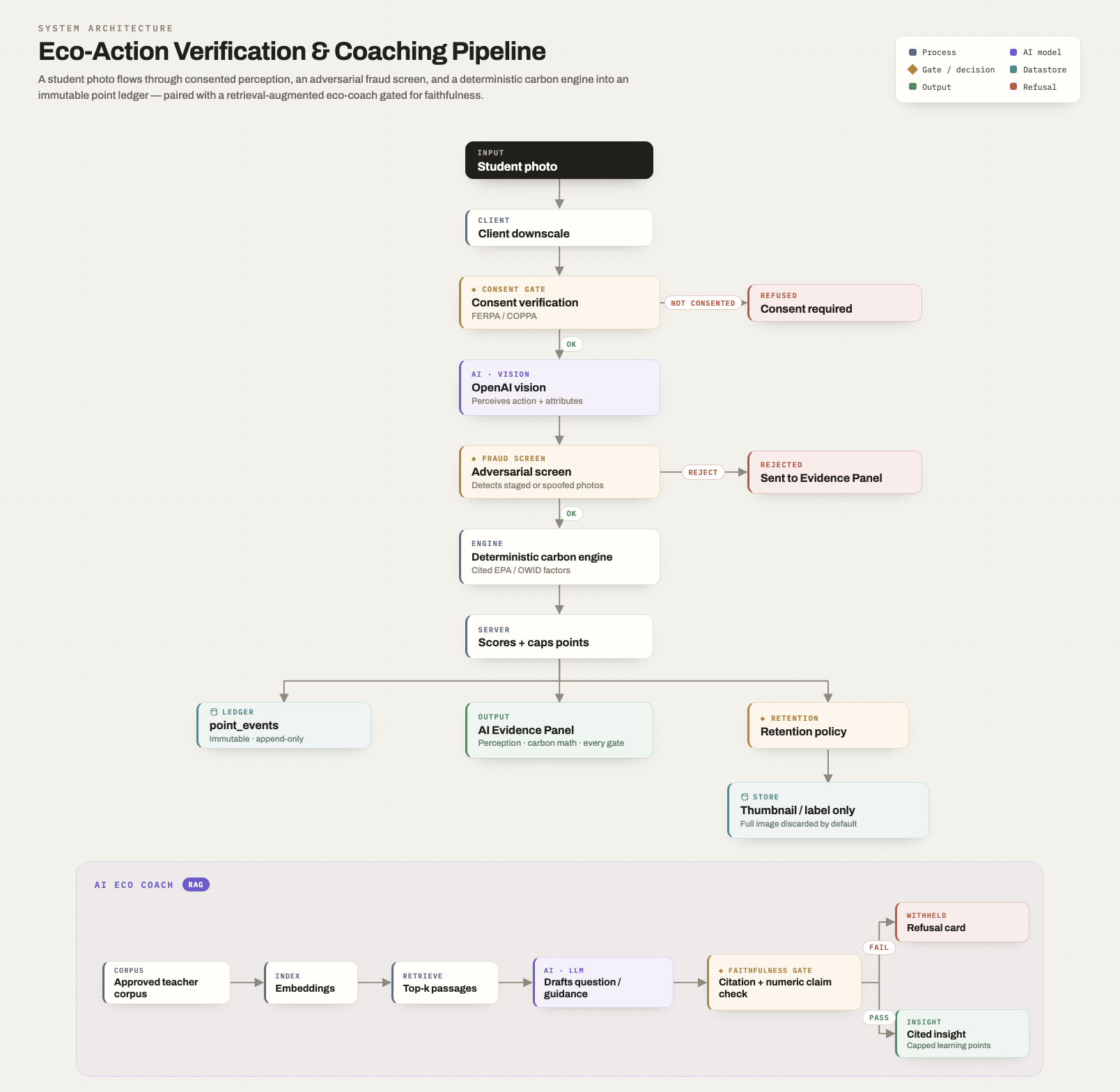
EcoRise's AI Pipeline Architecture
Inspiration
Most sustainability apps fall into one of two traps. Some teach environmental science passively, like a textbook you scroll through and forget. Others gamify "green" actions but trust whatever the user types, so the points and the carbon savings are basically made up.
When generative AI gets added to the mix, it usually makes the problem worse, because the model is allowed to guess at impact numbers and hand out rewards it has no business handing out.
We wanted to build something that takes both the learning and the proof seriously. EcoRise is a school and community platform where students learn environmental science from cited sources, log real eco actions, and compete on leaderboards, without ever letting the AI invent impact or award unverified points. The guiding rule for the whole project is simple: the AI perceives and drafts, but a deterministic, cited engine decides every point and every kilogram of carbon.
What it does
EcoRise connects the full loop from learning to verified action. A student learns from a cited, teacher-approved source through the AI Eco Coach, which uses retrieval over an approved corpus and refuses to answer rather than hallucinate when it cannot ground a claim. The student then logs a real action by uploading a photo. OpenAI vision perceives the action and its measurable attributes, but it never sets the impact itself. A deterministic carbon engine computes the kilograms of CO2e from published EPA and OWID emission factors, complete with a formula and an uncertainty range, and a server-side rubric calculates the points. Anti-fraud gates flag photos of screens, stock images, and AI-generated images before anything counts. The leaderboard then rewards verified behavior rather than self-reported claims. For our v2 we built the School Footprint Insights dashboard, which is the centerpiece of our Direction B entry, "My School's Hidden Footprint." It ingests five institutional datasets covering energy, water, trash and recycling, transportation, and cafeteria waste, with 59 school days of data loaded on startup. From there it does four distinct things:
Anomaly detection. A rolling 14-day z-score flags any building reading that sits more than 1.5 standard deviations above normal. There is no LLM here, so every flag is fully auditable. A typical card reads "Main Building used 111% more electricity than normal." Cafeteria forecasting. An ordinary least squares regression, implemented from scratch using the normal equations solved by Gaussian elimination, predicts next week's food waste with a confidence band rather than a single false-precision number. Ranked recommendations. Up to four candidate actions are sorted by estimated impact, each with a one-sentence reason drawn from the data so a human can sanity-check it. A generative weekly digest. OpenAI writes one plain-language paragraph for eco-club students, clearly labelled and visually separated from the deterministic cards, with a deterministic fallback when no API key is set.
Crucially, the AI cannot move a recommendation from proposed to approved. A named human role, the Sustainability Coordinator or Cafeteria Manager, has to approve it before it becomes a school-wide goal.
How we built it
The frontend is React 19 with Vite. The backend is Node.js and Express, with SQLite through better-sqlite3 and sqlite-vec for vector KNN retrieval. Authentication uses JWT in httpOnly cookies with bcrypt password hashing. The AI layer is deliberately split. OpenAI vision handles eco-action analysis, and a custom CNN exported to ONNX handles offline trash detection. The AI Eco Coach uses retrieval-augmented generation over approved source chunks, with citation validation, faithfulness and numeric-claim gates, and daily and weekly point caps. Every deterministic calculation, including the anomaly z-scores, the regression, the carbon math, and the points rubric, runs on the server where the model cannot touch it. We also built a privacy engine for FERPA and COPPA, with a consent gate before any minor's photo is processed, image retention minimization, teacher review, account export and delete, and an audit log. The evaluation harness measures the system in-app rather than asserting that it works, reporting citation validity, faithfulness, refusal precision, hallucination rate, and retrieval Recall@k and MRR.
Challenges we ran into
The hardest part was deciding what the AI is not allowed to do. It is tempting to let the model produce a tidy impact number, but a wrong number erodes trust and can cause real harm, such as the cafeteria under-ordering food and leaving students without enough to eat. Implementing the OLS regression from scratch, with day-of-week and post-holiday features and an RMSE-derived confidence band, took real care so that every prediction card could honestly show its own assumptions. Building the faithfulness gate that rejects any answer introducing a number not found in its source chunks was another challenge, since it meant treating our own AI as untrusted by default.
Accomplishments that we're proud of
What we're most proud of is that we didn't build a dashboard with AI bolted on as an afterthought, but a genuine three-layer reasoning system instead. A trained ML model handles the quantitative anomaly detection using a rolling 14-day average with sigma-deviation flagging, an LLM generates the natural-language explanation and the "Why" reasoning behind each recommendation, and a human approval gate sits on top of both. That design directly answers the hackathon's hardest warning that data visualization is not AI, which happens to be exactly where most high school submissions fall apart. The feature we're proudest of is the AI Recommendations and Human Approval Gate, because each card pairs a model-generated suggestion with an LLM-written justification, a quantified CO₂e impact estimate, and a real decision control where you can approve, assign, or flag it as inaccurate. That's responsible-AI design done the way it should be, where the model proposes and the human disposes while the entire system stays auditable from start to finish. We also managed to get the intelligence-to-content ratio right, since roughly three-quarters of the demo is the reasoning layer rather than the charts, and that balance is the single thing judges tend to reward most in an environment-track build.
What we learned
Treating the AI as untrusted and wrapping it in deterministic, cited checks made the product both easier to demo and easier to defend. Every important claim ends up backed by a source, a deterministic check, or a measured evaluation. We also learned how much a small design choice, such as showing a range instead of a single predicted number, can change how trustworthy a system feels.
What's next for project
We want to replace the synthetic institutional datasets with real school readings through the same schema, expand the documented migration path from sqlite-vec to pgvector for scale, and broaden the teacher-approved corpus so the Eco Coach can ground answers across more topics.
Built With
- antigravity
- bcrypt
- better-sqlite3
- claude
- claude-design
- codex
- css
- express.js
- gemini
- html
- javascript
- jwt
- node.js
- onnx
- openai
- python
- react
- sqlite
- sqlite-vec
- vite
- vitest


Log in or sign up for Devpost to join the conversation.