Inspiration
Small grain warehouses often depend on paper records, spreadsheets, and disconnected calculations to manage stock, sales, purchases, customers, suppliers, and cash. This makes daily work slower and increases the risk of incorrect inventory balances, missing payments, and accounting mistakes.
We built مشروع سنابل ال مساعد (Grain Warehouse ERP) to provide a clear Arabic desktop system designed specifically for the real workflow of a grain warehouse. The goal was not to create a generic ERP, but a practical tool that understands weight-based inventory, wholesale and retail sales, changing prices, customer credit, supplier balances, and the need for safe financial controls.
What it does
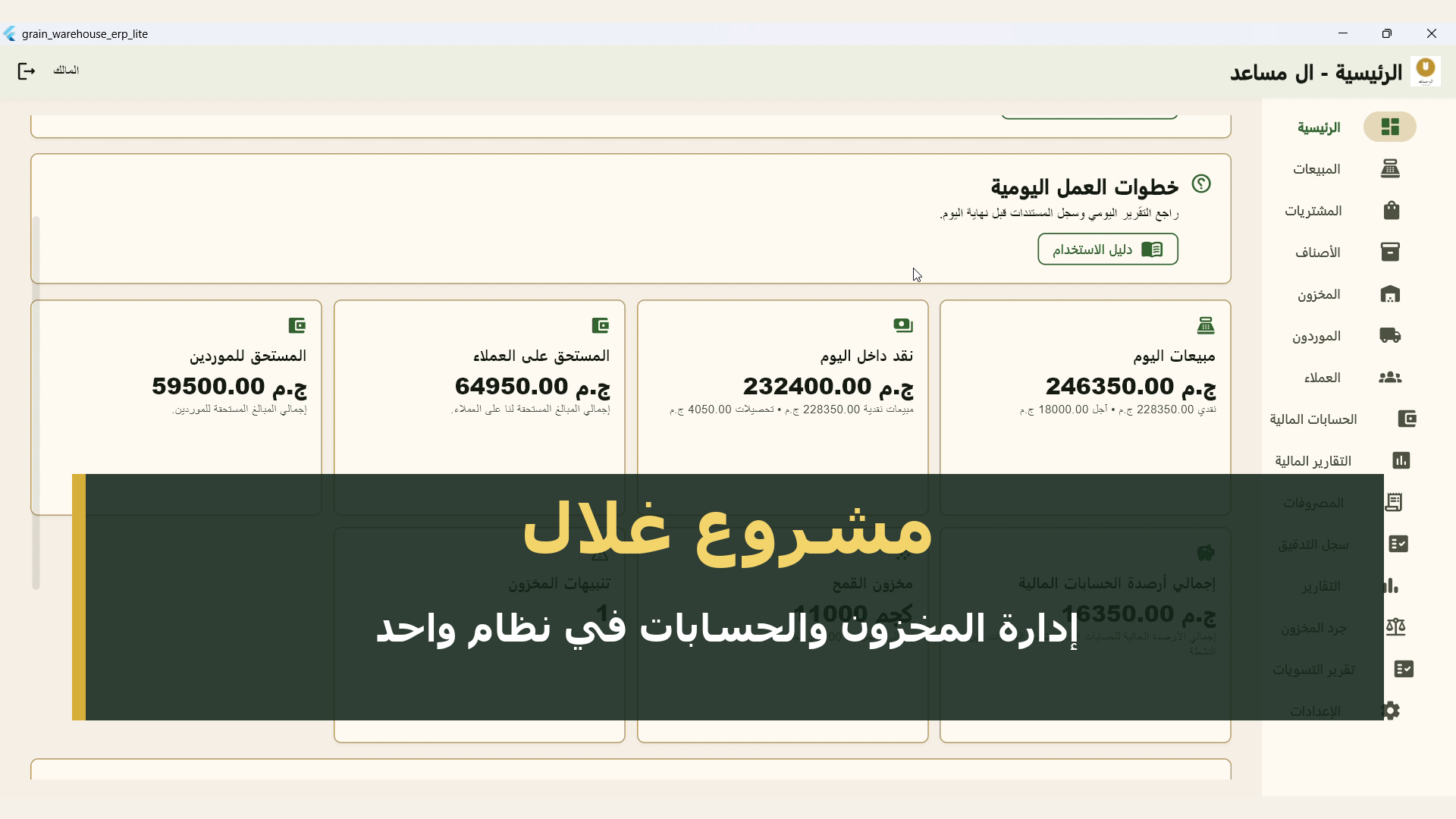
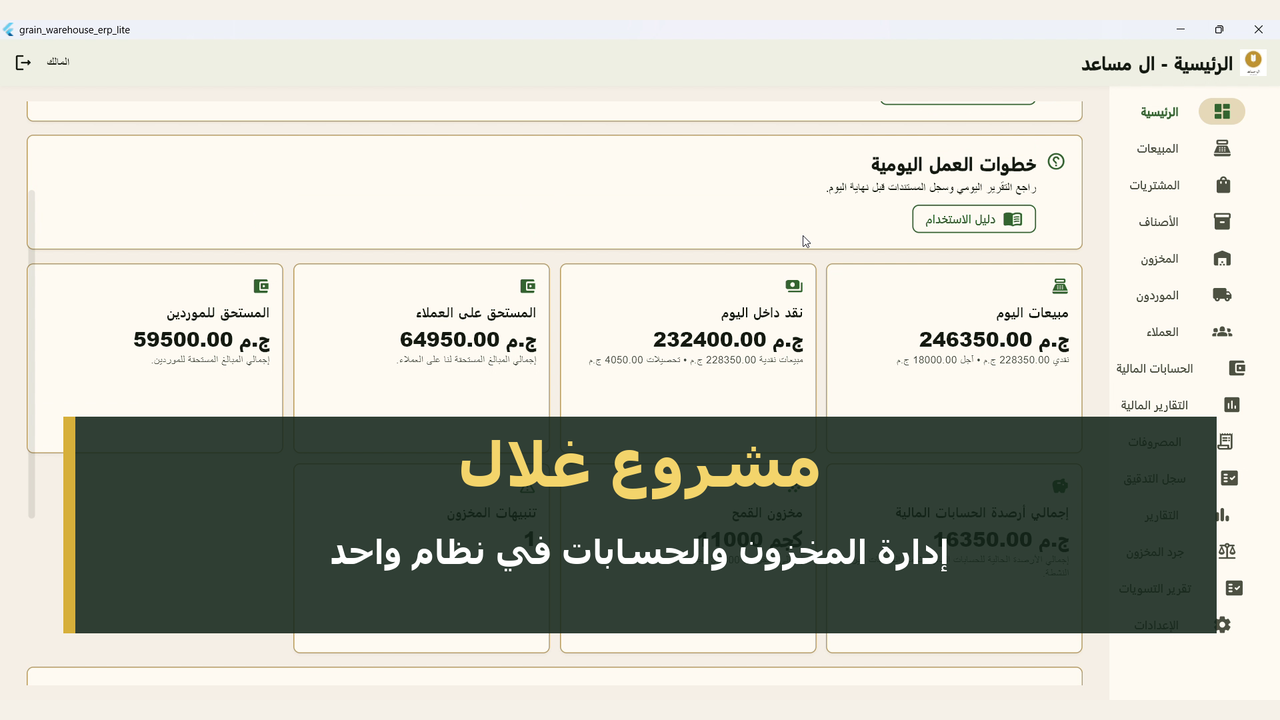
مشروع سنابل ال مساعد is a Windows desktop ERP application for managing a single grain warehouse.
The system includes:
- Arabic right-to-left interface designed for Windows.
- Owner and employee roles with separate permissions.
- Product management using kilograms and tons.
- Default prices, minimum selling prices, and optional reference costs.
- Inventory ledger with opening balances, purchases, sales, adjustments, stocktaking, and cancellation entries.
- Protection against selling more than the available stock.
- Multi-item cash and credit sales invoices.
- Customer accounts, collections, balances, and statements.
- Supplier accounts, payments, balances, and statements.
- Purchase recording linked to suppliers and inventory.
- Expenses connected to financial accounts and payment methods.
- Financial accounts for cash, banks, and wallets.
- Account balances, statements, payment-method reports, expense analysis, and reconciliation reports.
- Document history with clear visibility of cancelled transactions.
- PDF previews and exports for supported business documents.
- Business branding with an establishment name, logo, and selectable themes.
- Period closing and financial reconciliation with protected reopening controls.
- Backup, restore preview, validation, and owner-protected data deletion.
- An Arabic help guide and first-run guidance.
- A permission-controlled AI assistant with twelve read-only financial and operational actions.
The system is designed to keep stock, customer balances, supplier balances, and financial-account movements connected to the same business transaction instead of recording them separately.
How I built it
The application was built with Flutter and Dart as a Windows desktop product.
Development was divided into small, controlled phases. Each phase had a narrowly defined scope, implementation boundaries, regression tests, and verification requirements.
I treated accounting correctness as a core product requirement. Sales, purchases, collections, supplier payments, expenses, cancellations, inventory movements, and financial-account entries were reviewed as connected operations.
I also designed the system around safe operational boundaries:
- Permission checks happen before protected data is read.
- Financial reports are read-only.
- Inventory cannot become negative through normal sales.
- Closed periods reject new transactions.
- Restore operations are validated before writing data.
- Data deletion requires owner authorization and a backup.
- Cancelled documents remain visible for auditability.
- AI actions cannot silently modify business data.
The final Windows release was verified through automated testing, static analysis, release-build validation, end-to-end demonstrations, package-integrity checks, and playback of the final competition demo.
How I used Codex
Codex was used as an engineering agent inside the repository.
It helped me:
- Review the existing architecture and product documentation.
- Divide large requirements into small implementation phases.
- Inspect accounting, inventory, permission, backup, and document boundaries.
- Implement narrowly authorized changes.
- Add and update automated tests.
- Run focused regression groups and the complete test suite.
- Verify Flutter and Dart analysis results.
- Validate the Windows release build.
- Audit visible navigation and owner workflows.
- Prepare source-safe delivery packages.
- Verify file inventories and SHA-256 checksums.
- Produce release-readiness and competition-readiness documentation.
Codex was not allowed to make uncontrolled changes. Every phase had explicit scope limits, and the repository was checked before and after execution.
How I used GPT-5.6
GPT-5.6 was used for product reasoning, accounting analysis, planning, and quality control.
It helped transform real warehouse needs into clear technical decisions, including:
- Weight-based inventory rules.
- Cash and credit transaction behavior.
- Customer and supplier ledger directions.
- Financial-account integration.
- Role and permission boundaries.
- Period-closing and reconciliation rules.
- Backup and restore contracts.
- Safe AI action boundaries.
- Test scenarios and acceptance criteria.
GPT-5.6 was also used to review completed phase reports, identify missing evidence, challenge unsafe assumptions, and keep deferred roadmap features separate from completed functionality.
The combination of GPT-5.6 for structured reasoning and Codex for repository execution allowed us to move quickly without sacrificing verification.
Challenges I faced
One of the biggest challenges was keeping inventory and accounting behavior consistent across every operation.
A sale affects stock, a customer balance, and possibly a financial account. A purchase affects stock, a supplier balance, and financial reporting. Collections, payments, expenses, cancellations, closing, and restore operations must preserve the same accounting meaning.
Another challenge was maintaining a simple interface while supporting many connected workflows. The application needed to be understandable to a first-time warehouse employee while still providing the owner with detailed reports, reconciliation, audit history, and safety controls.
Windows release verification and media preparation also introduced practical challenges. Automated UI capture could not access the application window, so the final screen recording was captured manually and then edited with synchronized Arabic narration and captions.
Accomplishments that I'm proud of
- Completed a working Arabic Windows ERP instead of a static prototype.
- Connected inventory, customers, suppliers, expenses, and financial accounts.
- Implemented protected period closing and reconciliation.
- Added validated backup and restore workflows.
- Preserved transaction-level financial-account information in backups.
- Implemented permission-controlled, read-only AI actions.
- Created supported PDF business documents with establishment branding.
- Passed 1,460 automated tests, with one expected skip and no failures.
- Completed Flutter and Dart analysis without issues.
- Verified the Windows release candidate and source-safe delivery package.
- Produced a public-ready competition video under three minutes with Arabic narration and captions.
What I've learned
I learned that an ERP system should not be judged only by the number of screens it contains. Its real value comes from the consistency of the rules connecting those screens.
I also learned that AI-assisted development works best when the agent has clear boundaries, verifiable acceptance criteria, and permission to stop when evidence is missing.
Using GPT-5.6 and Codex together helped me treat documentation, tests, accounting rules, release packaging, and user experience as parts of the same product rather than separate tasks.
What is next
The current release focuses on a single Windows desktop installation for one warehouse.
Future roadmap items include:
- Cloud synchronization.
- Android access.
- Secure multi-device operation.
- Additional payment flexibility.
- Extended reporting and analytics.
- Further visual modernization of the interface.
These features are intentionally presented as future work and are not claimed as part of the current completed release.
مشروع سنابل ال مساعد turns daily grain-warehouse operations into organized, reviewable, and safer business data — in one clear Arabic system.

Log in or sign up for Devpost to join the conversation.