Inspiration
The inspiration for DeskPaw stems from the bittersweet reality of the modern pet parent: for us, a workday is eight hours of tasks and meetings, but for our pets, it is a lifetime of waiting. While we are immersed in the complexities of our professional lives, our pets exist in a world where time is measured only by our absence. They sit by the window watching shadows lengthen, or curl up on a piece of our worn clothing, searching for a scent that is slowly fading. This "double-sided separation anxiety" created a need for something deeper than a cold, third-party surveillance camera. We realized that pet owners don't just want to monitor their pets; they want to feel them. DeskPaw was born from the desire to transform that static video feed into a living, breathing digital twin, a "desktop heartbeat" that mirrors the life of our pets in real-time.
Furthermore, the concept was fueled by the "interaction paradox" of the modern workspace. In a professional environment, silence is often mandatory, making it impossible to tenderly call out to a pet through a traditional microphone without feeling self-conscious or disruptive. We were inspired to leverage Voice Cloning and AI-driven TTS (Text-to-Speech) to give owners a "silent voice." By allowing users to type messages that are delivered in their own familiar cadence and tone, we bridge the sensory gap. DeskPaw isn't just a piece of software; it is a spiritual anchor, a tool that turns the cold glass of a computer screen into a window of warmth, ensuring that no matter how demanding the job, the bond between human and cat remains unbroken and audible.
What It Does
DeskPaw creates a seamless emotional and functional bridge between working pet owners and their pets at home through two tightly connected systems.
1. The Virtual Companion (Desktop Interface)
The platform generates a high-fidelity 3D desktop avatar that serves as a living digital representation of the physical pet.
Behavioral Mirroring
The 3D model is not a static icon. It dynamically reflects the pet’s real-time status, movements, and emotional cues captured through the home camera system, creating a continuous sense of presence.
Management & Care Hub
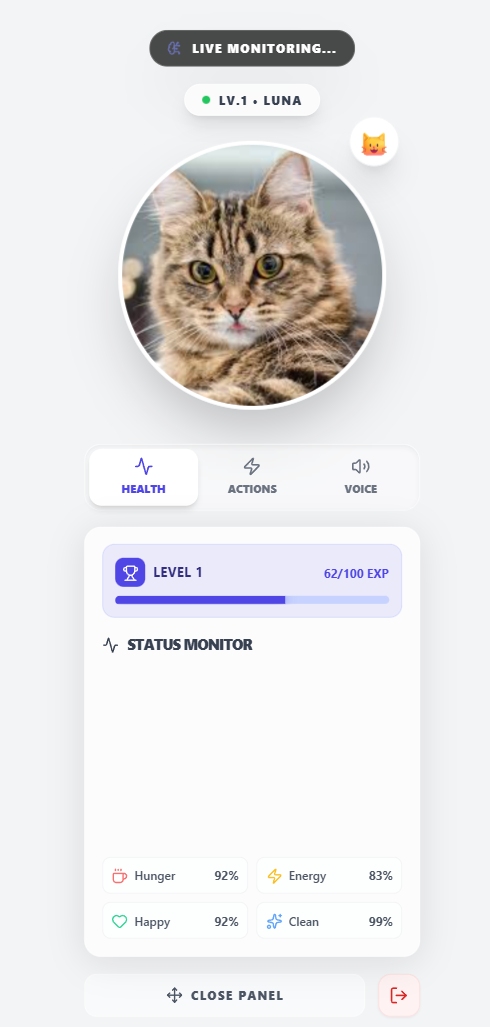
The interface functions as a silent personal assistant for daily pet care. It tracks and visualizes essential routines and health records, providing timely reminders for feeding, water changes, and medical milestones such as vaccinations and deworming.
2. The Physical Bridge (Home Interaction)
The core innovation of DeskPaw lies in its ability to enable real-time, two-way emotional and behavioral interaction between the owner and the pet.
AI Voice Synthesis (Silent Input)
Using voice cloning and AI-driven text-to-speech technology, DeskPaw enables “silent communication.” When users type a message at work, it is delivered at home in their own familiar voice, cadence, and tone.
Proactive Summoning & Proximity Alerts
Users can activate a “Call” function to summon their pet using synthesized voice. Through AI-powered motion detection and facial recognition, the system identifies when the pet enters the camera’s field of view. The desktop avatar then sends immediate visual or haptic notifications, ensuring no moment of connection is missed.
Visual-Auditory Interaction Loop
A fully integrated live video system allows users to see, “speak” to, and observe their pet’s reactions in real time, forming a continuous feedback loop between home and workplace.
How we built it
We built DeskPaw through a modular, iterative development process that integrates real-time computer vision, AI reasoning, and emotional interaction design.
Our system prioritizes scalability, maintainability, and seamless human-pet communication.
1. Project Background & Core Objectives
The project aims to build a web application that enables two-way interaction between users and pets through real-time camera monitoring and AI-powered visual analysis.
By leveraging Google Gemini’s multimodal capabilities, DeskPaw identifies pet behaviors and translates them into meaningful emotional feedback for users.
Core objectives include:
- Real-time pet behavior recognition
- Silent voice interaction
- Health and activity monitoring
- Emotion-centered user experience
2. System Architecture & Technology Stack
We designed a modular architecture with a frontend-centered structure and a lightweight Python backend.
This approach balances development efficiency, maintainability, and system scalability.
2.1 Frontend Layer
- React + TypeScript
- Enables reusable UI components and type-safe AI data flows
2.2 Build Tool Layer
- Vite
- Provides fast hot module replacement for high-frequency debugging
2.3 AI Engine Layer
- Google Gemini API
- Supports text and visual reasoning for pet image analysis
2.4 Voice Interaction Layer
- Integrated TTS Service
- Enables synthesized voice communication
2.5 Backend Logic Layer
- Python
- Manages pet health data and lightweight model inference
2.6 State & Navigation Layer
- React Router + Context API
- Handles authentication, onboarding, and core page routing
3. Phased Development Process
We adopted an iterative three-phase development strategy to validate core functions early and reduce rework costs.
Phase 1: Project Initialization
- Initialized React + TypeScript template via Vite
- Configured strict type checking with
tsconfig.json - Managed API keys using
.env.local - Centralized constants in
constants.ts - Completed application mounting and global context setup
Phase 2: Service Layer Construction
We separated external service logic from UI components to improve maintainability.
Key modules include:
geminiService.tsfor text and visual API requests and error handlingttsService.tsfor voice synthesis and playback controlvisionModelService.tsfor converting camera streams into Gemini-compatible formats
Phase 3: UI & User Flow Development
We designed user-centered interfaces to reduce technical barriers.
Core components include:
- OnboardingScreen
- AuthScreen
- Dashboard & HealthPanel
- WebcamMonitor
These components guide users from setup to daily interaction.
4. Core Technical Implementation
4.1 Real-Time AI Camera Monitoring
- Captures video via
navigator.mediaDevices.getUserMedia() - Converts frames to Base64 format
- Applies rate limiting (one frame every two seconds)
- Sends data to Gemini for analysis
4.2 Pet Health Dashboard
- Aggregates user-input data such as age and breed
- Visualizes trends through charts and status cards
- Supports long-term health tracking
4.3 Cross-End Voice Interaction
- Integrates TTS for remote pet calling
- Synchronizes desktop input and home output
- Supports silent workplace communication
5. Deployment & Scalability Strategy
Local Development
- Frontend runs via
npm run devfor rapid iteration and debugging
Scalability Planning
- Modular service abstraction
- API-first design
- Edge-AI expansion readiness
- Cloud-native deployment compatibility
6. Key Technical Takeaways
- Modular architecture significantly improves iteration speed
- Prompt engineering is essential for AI accuracy
- TypeScript and Python form a complementary technical stack
- Early service decoupling reduces long-term maintenance costs
Challenges we ran into
During development, we encountered several technical and performance-related challenges that required targeted optimization strategies.
1. Latency Issues
To reduce response delays in voice interaction and AI processing, we implemented the following solutions:
- Pre-cached common phrases during application initialization
- Used Web Workers to prevent blocking the main thread
- Implemented predictive caching based on user interaction patterns
2. Voice Quality Optimization
To improve the naturalness and clarity of synthesized speech, we applied multiple enhancement techniques:
- Utilized higher-quality browser-native voices when available
- Evaluated cloud-based TTS services for premium output quality
- Fine-tuned prosody parameters, including pitch, rate, and emphasis
3. Camera and Object Detection Performance
Processing real-time video streams in browser environments introduced significant performance constraints. We addressed these issues through targeted optimization.
Camera Optimization
- Implemented lazy initialization to reduce startup overhead
- Applied adaptive video constraints to balance quality and performance
- Released camera resources when inactive
Detection Efficiency
- Processed only selected frames instead of every frame
- Offloaded heavy computations to worker threads
- Applied adaptive frame skipping based on system load
Accomplishments that we're proud of
The true heart of DeskPaw’s success lies in its ability to weave cold technology into a warm tapestry of companionship. We are most proud of creating a "Digital Bridge of Presence," where low-latency synchronization and Edge-AI vision allow a pet’s real-life movements to ripple softly onto a user’s desktop as a living 3D shadow. By perfecting "Silent Voice Cloning," we have empowered owners to whisper to their companions from the quietest of offices—transforming typed words into the familiar, loving inflections that only their pet knows and trusts. This is more than a technical milestone; it is the restoration of a sacred bond. We have successfully designed a space where care is no longer interrupted by distance, and where the digital screen ceases to be a barrier, becoming instead a window for mutual reassurance. Our greatest achievement is ensuring that even in the busiest of hours, no pet feels truly alone, and no owner is ever out of reach, turning every "silent" message into a tender, audible embrace.
What we learned
The development of DeskPaw revealed that technology reaches its highest purpose when it serves the silent, non-verbal language of love. We learned that while humans communicate through tasks and data, pets experience the world through presence and rhythm; therefore, a digital tool must be more than a utility—it must be a "sensory bridge." We discovered that the mechanical "coldness" of a camera lens can only be thawed by the warmth of a familiar voice, teaching us that AI is most valuable when it acts as a surrogate for human touch.
Crucially, we realized that separation anxiety is a shared wound. By observing how a pet reacts to a synthesized call and how an owner’s stress lowers upon seeing a 3D reflection of their cat, we learned that technology should not try to "replace" reality, but rather sustain the thread of connection until the front door finally opens. We moved away from the idea of a "software interface" and toward the concept of a "living tether," learning that the most profound innovation is one that allows a pet’s afternoon to feel less like a lonely wait and more like a gentle, distant conversation with the person they love most.
What's next for DeskPaw
Our roadmap focuses on deepening emotional authenticity, advancing behavioral intelligence, and expanding the sensory boundaries of human-pet connection.
1. Refinement of the “Vocal Soul”
While we have established a strong foundation in voice cloning, our immediate priority is the hyper-personalization of the acoustic experience. We aim to move beyond basic text-to-speech by capturing the “micro-emotions” of an owner’s voice, including whispers, playful chirps, and unique nicknames that pets associate with safety and comfort.
By enhancing our AI voice synthesis engine, we seek to eliminate any “uncanny valley” effect and ensure that synthesized voices become indistinguishable from physical presence to a cat’s sensitive ears.
2. Intelligent Behavioral Recognition & Logic
The next phase focuses on evolving from basic motion detection to advanced feline behavioral analysis. Using edge-AI computer vision, DeskPaw will learn to distinguish between casual movement and meaningful “seeking behavior.”
By recognizing patterns such as prolonged gazing, repetitive pacing, or restlessness, the system will enable the desktop avatar to deliver nuanced notifications, such as:
- “Your companion is waiting by the window.”
- “A call is needed now.”
This transforms passive monitoring into emotionally aware interaction.
3. Toward a “Living Health Dashboard”
We envision DeskPaw as a predictive guardian of long-term well-being. By tracking daily behavioral patterns, including hydration frequency, activity cycles, and rest periods, the platform will generate personalized “Happiness & Health Reports.”
Through deep learning models that detect subtle changes in gait, posture, and energy levels, DeskPaw will alert users to potential health risks long before symptoms become visibly apparent, enabling proactive and preventative care.
4. Expanding the “Sensory Bridge”
Our ultimate vision extends beyond the boundaries of the screen. We are exploring the integration of mixed reality (MR) and haptic feedback technologies.
Built With
- gemini-tts
- gemini3
- gemini3flashpreview
- google-cloud
- googleaistudio
- python
- tts
- typescript
- webcam


Log in or sign up for Devpost to join the conversation.