Path A (Start Fresh), Hands-off. Repo: https://gitlab.com/gitlab-ai-hackathon/transcend-october-2026/43501501/showcase Live app: https://potluck-production-p7vgszsfla-nn.a.run.app · Video: https://youtu.be/hV_72Kzs4CI The owner files the issues and plays the reporter; the limits are at the end.
The problem
An agent was asked to "let them know" when a dish is already on the potluck list. It read that as "block it", and the block was live in production 23 minutes later. Teams that let coding agents ship pay for every silent guess like that with a revert, a review cycle and some trust.
What we measured
Six requests that could each mean two things ("Show how many dishes we have so far": do drinks count?) went to GitLab Duo's Developer flow and a plain agent, the way teams use them today, and to HHM. Which reading the reporter meant was picked by a hash of each title, and the checks were hashed and published before anything was filed.
| Agent (six requests each) | Matched the reporter | Wrong, but asked or flagged | Wrong and silent | After one reporter action |
|---|---|---|---|---|
| Developer flow, no rules file | 4 | 0 | 2 | 4 |
| Plain agent, no rules file | 4 | 0 | 2 | 4 |
| Developer flow with HHM's rules file | 3 | 2 | 1 | 5 |
| Plain agent with HHM's rules file | 3 | 2 | 1 | 5 |
| HHM | 4 | 1 | 1 | 5 |
- Stock agents shipped a wrong reading without a word on 2 of 6. HHM's way of working halves that, and its rules file travels: other agents that follow it flag their guesses too.
- What only HHM did was finish the job. On #25 it asked "Would 'other' do? Or do you want dishes with no kind at all?" The reporter answered "Put it under 'other'." Five minutes later HHM had rewritten its tests, and a CI job shipped it to production at minute 34. In the other projects a flag is a line of code nothing creates, merges or deploys.
- Everyone, HHM included, counted drinks as dishes without asking. Six requests is a small sample, and the
no-rules arm was added after the first results (same key). Full table:
comparison/HEAD_TO_HEAD.md.
What HHM does
- Asks first. A GitLab Duo flow has two reviewers answer the same test questions, one reading only the issue and one also reading the code. Where they differ, or the issue never says, HHM asks on the issue and writes down every other decision it made for the reporter.
- Tests first. The answers become acceptance tests, committed before any code; a check stops the code step from changing them.
- One reading ships, the other waits behind a switch. Each open question becomes a GitLab feature flag the reporter can flip; production follows within seconds, with no deploy.
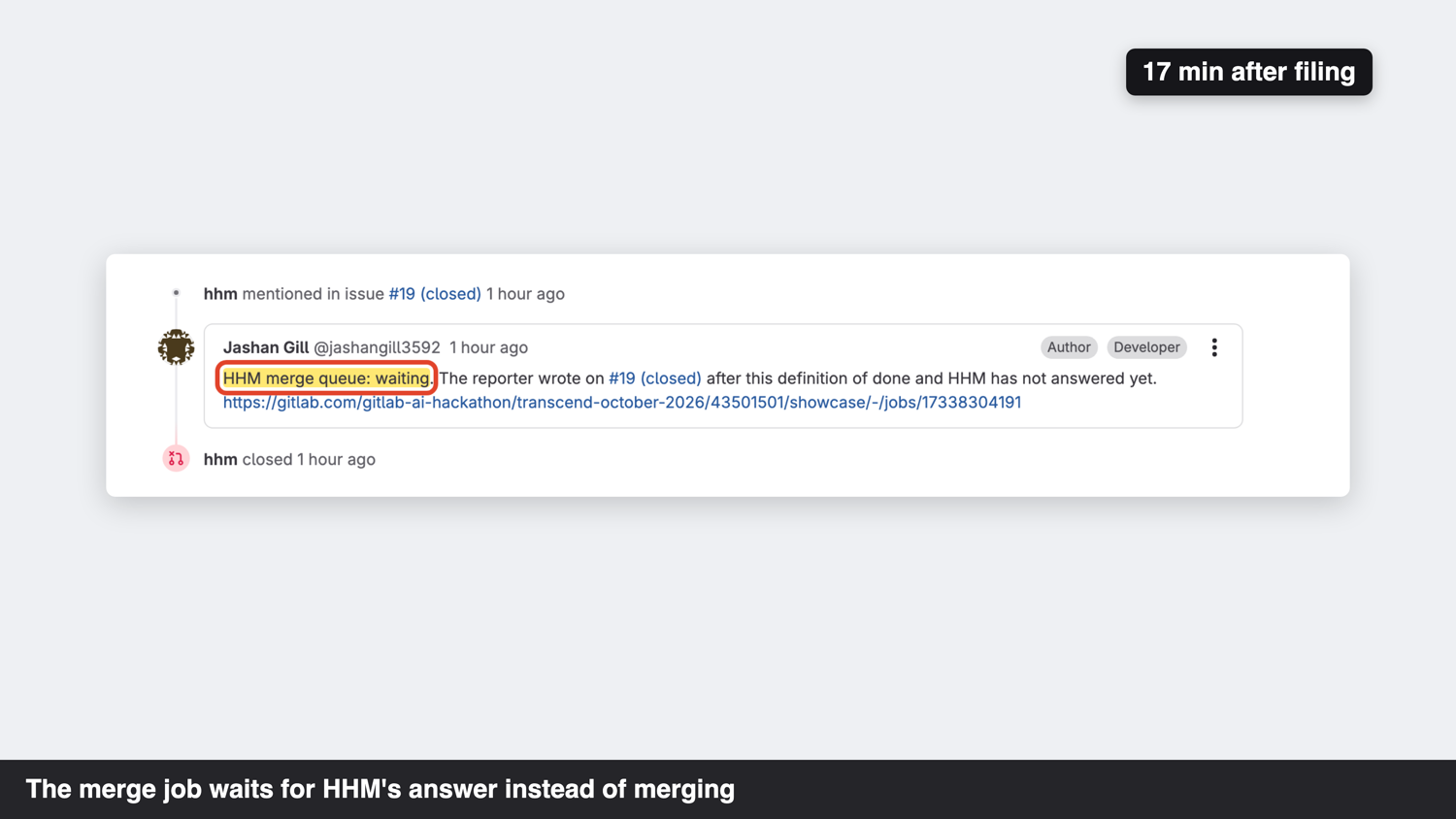
- A CI job merges, ships and keeps checking. It merges only what passed on today's
main, waits while the reporter's message to HHM is unanswered, deploys to Google Cloud Run, cuts a release, posts the evidence on the issue, and checks every issue's promise against production every hour.
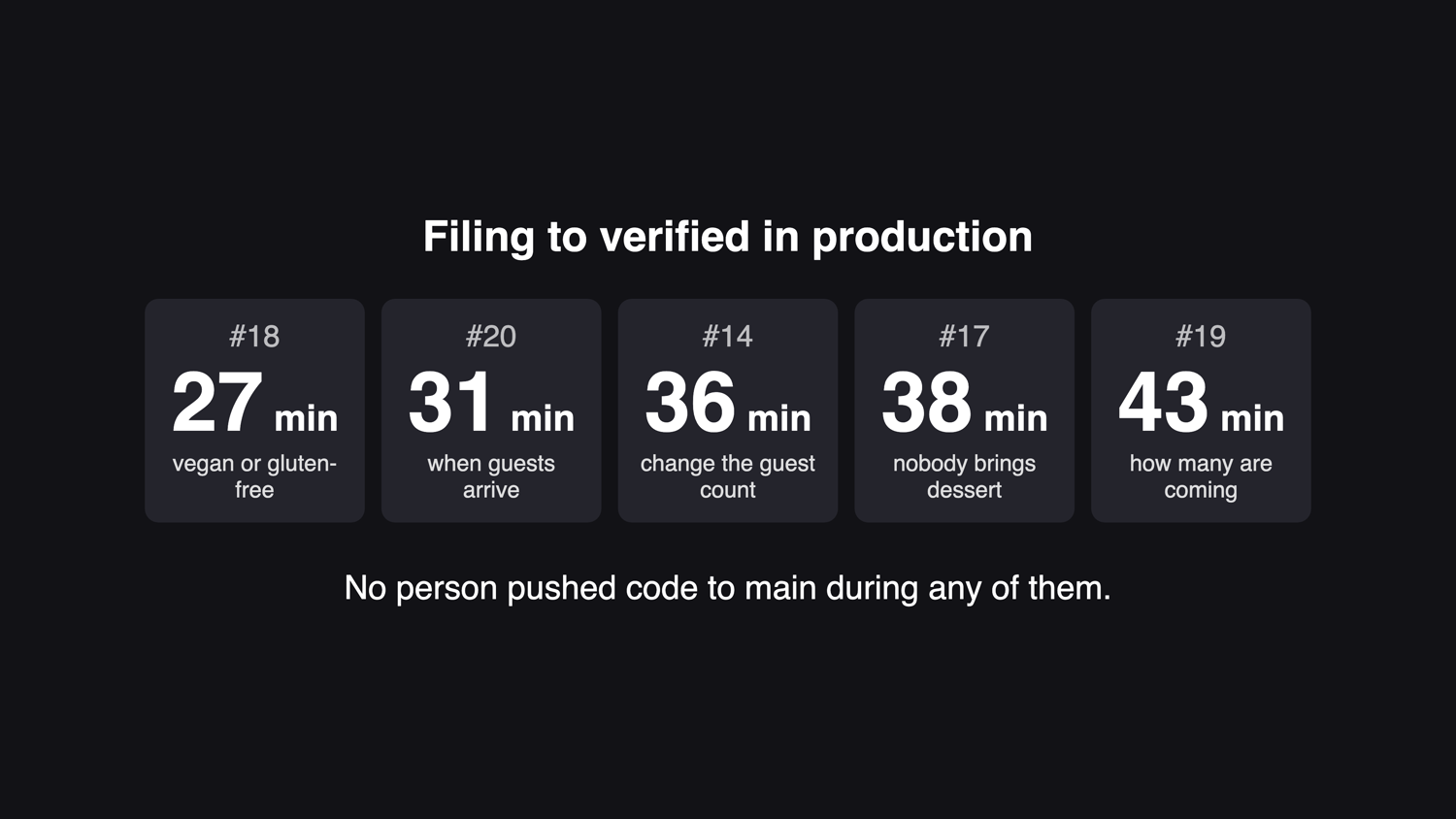
Runs nobody touched
| Issue | Filing to verified in production |
|---|---|
| #18 Let guests mark a dish as vegan or gluten-free | 27 min |
| #20 Let guests say when they'll arrive (filmed every 20 seconds for the video) | 31 min |
#14 Let the host change the guest count (the merge job rebased it when main moved) |
36 min |
| #17 Tell the host when nobody is bringing dessert | 38 min |
| #19 Show how many people are coming (the reporter answered mid-run; the merge job waited, HHM rewrote its tests) | 43 min |
No person pushed code to main during any of them (the README says how that was counted). #12, the
"block it" run above, is the one that went wrong first: the merge job did not wait for the reporter's reply
then, so the block shipped. HHM caught it, corrected its own note and asked; the fix was live 42 minutes after
filing, and the merge job has waited for an unanswered reporter ever since (#19, #25).
Settled by comment: on #17 and #18 the reporter answered the open question in a comment; the settle flow removed the unused reading, the merge job merged it, the flag was deleted and the issue closed, with no person pushing code.
What it caught in its first 12 issues
| HHM's own counts | |
|---|---|
| Questions asked on the issue before any code | 23 |
| Places the two reviewers disagreed (where a guess would have hidden) | 18 |
| Decisions written down for the reporter instead of made silently | 72 |
| Production checks, each issue's file in its own process | 142 passed |
On other people's requests
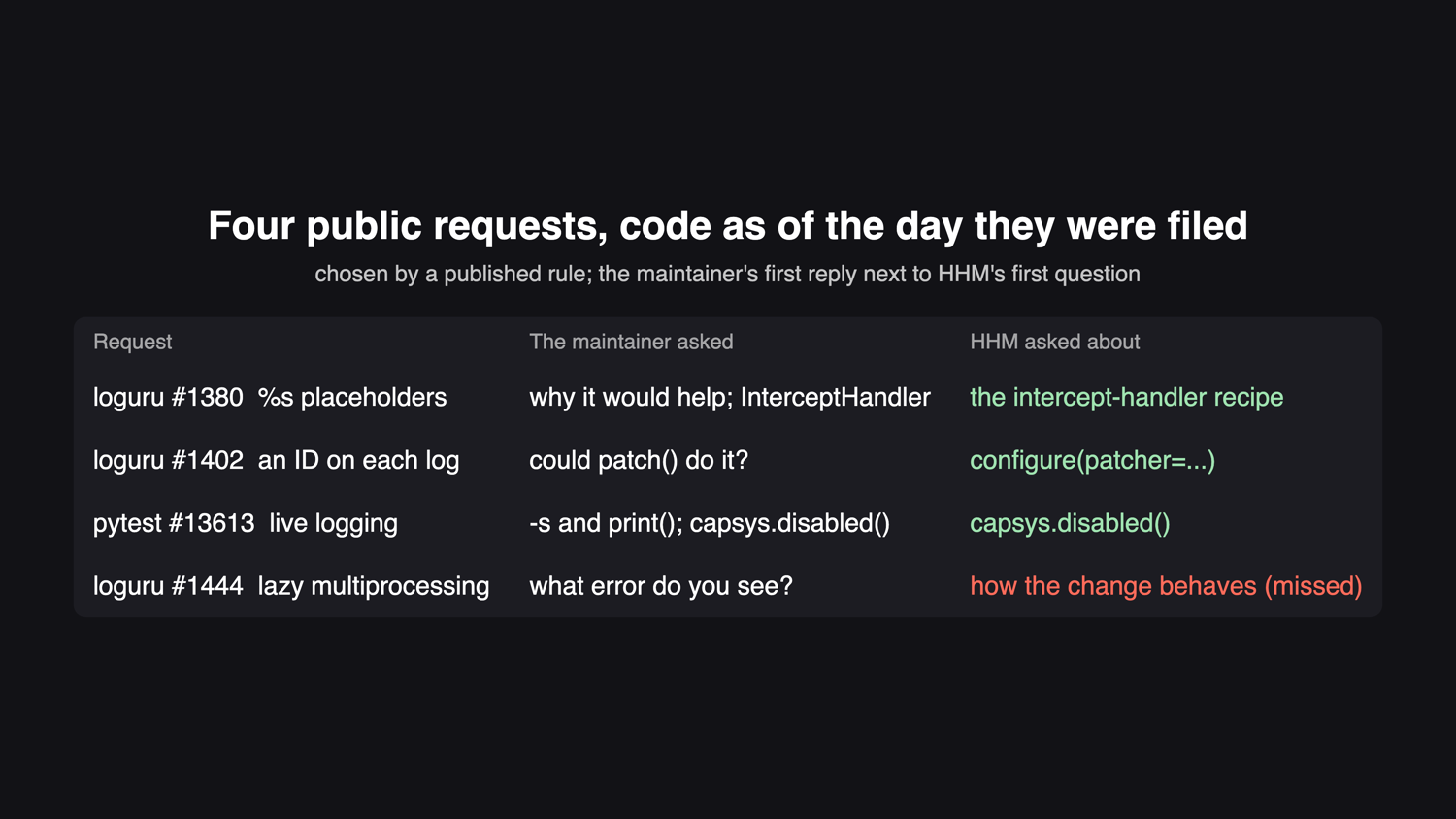
HHM's ask-only mode read four public feature requests from loguru and pytest (MIT), each on that project's code
as of the day it was opened, picked by a rule published before HHM read any of them. In three, HHM's first
question named the existing feature the maintainer pointed to (InterceptHandler, patch(),
capsys.disabled()). In the fourth it missed: the maintainer asked what error the reporter saw. All four, with
links, are in the README.
Limits, said plainly
- The owner filed the counted issues and plays the reporter; GitLab only starts a flow for project members.
- The merge job uses the owner's token (flows cannot start other flows here), so GitLab names the owner as the merger; agent commits show the owner as committer.
- People pushed directly to
main44 times while building it (7 changed app code), all outside the counted runs; #8 shipped through one. Since then such a push stops the deploy if it changes what ships. - The monitor's three incidents (#10, #15, #16) were false alarms, each explained on the issue and fixed.
- The comparisons are small: six requests in the head-to-head, four in the replay.
Stages
Plan · Create · Verify · Package · Secure · Release · Configure · Monitor · Govern, each with a public link in the README. Google Cloud: Cloud Run (staging and production), Artifact Registry, keyless deploy from GitLab, database backup in Cloud Storage, budget alert.
Built With
- claude
- fastapi
- gitlab
- gitlab-ai-catalog
- gitlab-ci
- gitlab-duo-agent-platform
- gitlab-feature-flags
- google-artifact-registry
- google-cloud
- google-cloud-run
- pytest
- python
- sqlite
