-
-
Deployed App
About the project
🕯️ Inspiration
Earlier this year, I built a grade calculator in Streamlit for my CS class. Seeing 300+ students use it immediately taught me that developers crave tools that just work.
But at hackathons, there is a recurring heartbreak. You spend 36 hours coding, the demo doesn't go as planned, and you walk away wondering: "What actually went wrong?" Most projects just sit in a "GitHub Graveyard" because the path to fixing them feels too steep.
We built Project Ghost to be the noir detective that performs a post-mortem on your weekend's work, not just to tell you why it died, but to provide the "Resurrection Plan" to bring it back stronger for the next win.
🕵️ What it does
Project Ghost acts as an automated "Post-Mortem" mentor for developers. It analyzes your repository to identify the gap between a "hack" and a polished "product."
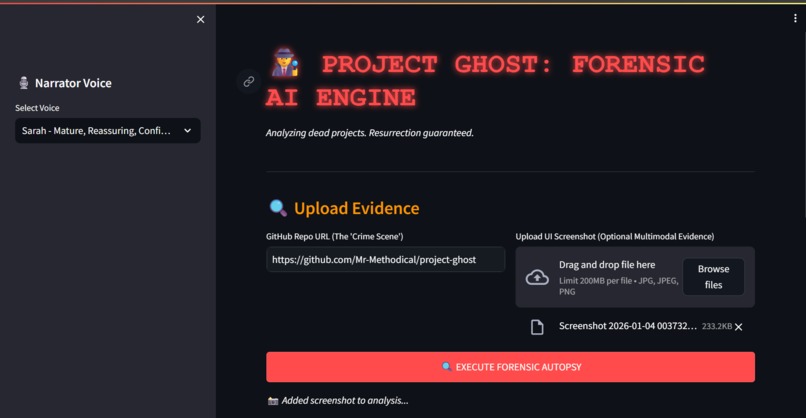
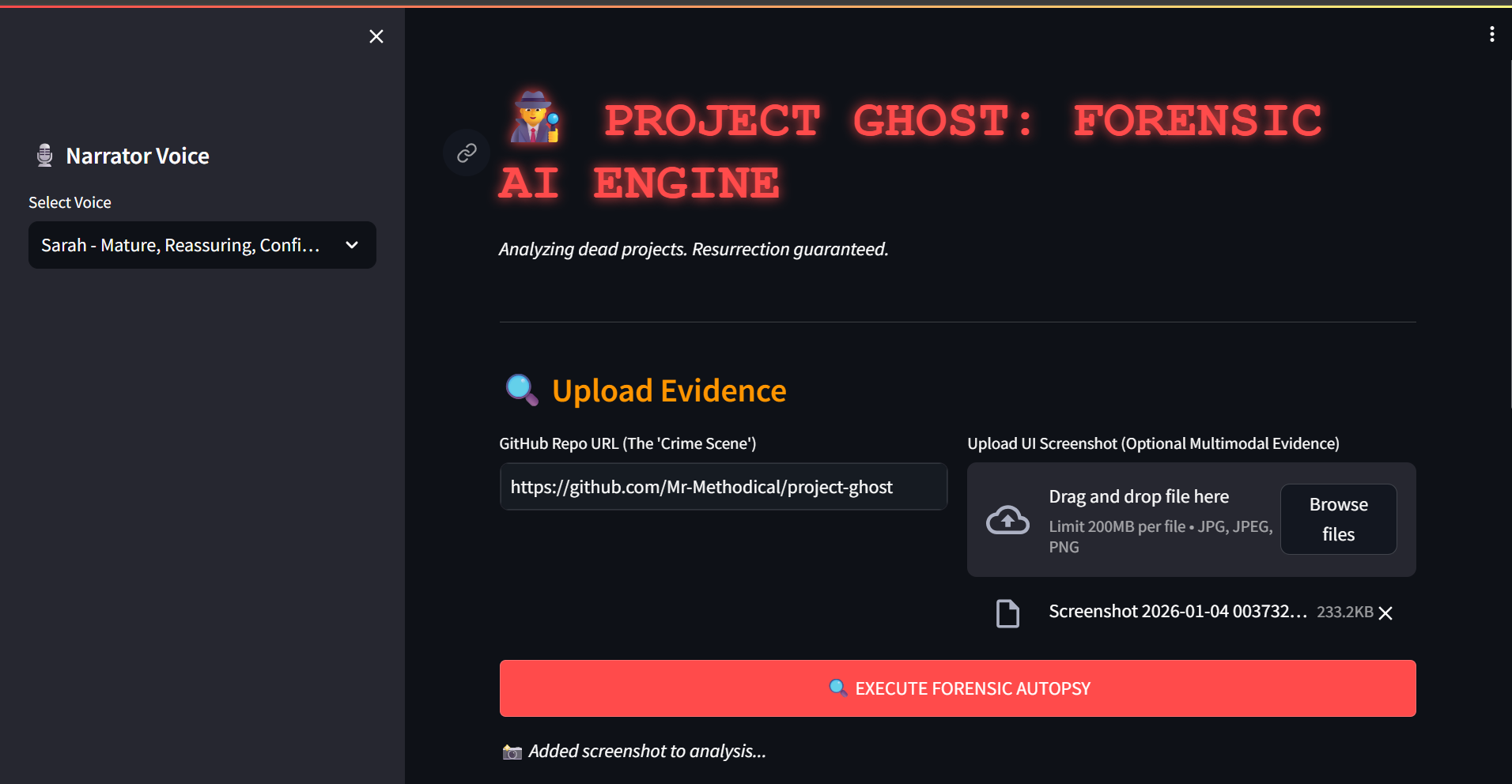
- The Investigation: Paste your project’s GitHub URL and upload a screenshot of your final demo.
- The Forensic Autopsy: Gemini 2.5 Flash cross-references your source code against your UI, looking for tech debt, missing logic, or architectural bottlenecks.
- The Coroner’s Report:
- Cause of Death: A breakdown of why the project didn't meet production standards.
- The Smoking Gun: The exact file or decision that acted as the bottleneck.
- The Resurrection Plan: A tailored, step-by-step roadmap to fix the bugs and polish the project.
- Voice Narration: A gritty, noir detective voice (via ElevenLabs) narrates the findings for a cinematic, immersive experience (You get to choose).
🛠️ How we built it
Because of university travel constraints, we had to execute an extremely high-velocity development cycle, taking the project from initial setup to production deployment in under 24 hours.
The Tech Stack:
- Frontend: Streamlit (Chosen for rapid UI deployment and session state stability).
- Multimodal AI: Gemini 2.5 Flash (Processing code and screenshots simultaneously).
- Voice API: ElevenLabs v0.2.15 (Legacy API used for stable noir narration).
- Infrastructure: Vultr (Live production deployment on Ubuntu).
The Forensic Process (Git History):
- The Foundation: Initialized the forensic engine with security best practices, ensuring
.envand environment variables were locked down from commit #1 shared during the live sessions (as this is our first hackathon, we made sure to be very careful with this). - The Brain: Integrated the Gemini multimodal engine to handle simultaneous code and image analysis.
- The Voice: Implemented a dynamic voice UI, limiting selection to the most "noir-appropriate" voices and building a pre-processor to strip Markdown formatting before narration.
- The Deployment: Moved from localhost to a Vultr production environment, pinning requirements and fixing environment-specific venv issues.
🚧 Challenges we ran into
- Dependency Conflicts: We hit a major conflict between the ElevenLabs SDK and Pydantic v2. Solution: We reverted to the legacy ElevenLabs API (v0.2.15) and used Streamlit session state to bridge the data gap.
- Audio "Reading" Markdown: The voice engine would literally say "asterisk" when reading the AI's report. Solution: We built a custom regex scrubber to clean the text into "detective-speak" before it hits the TTS engine.
- Production Parity: Deploying to Vultr revealed missing dependencies on the fresh Ubuntu server (like
python3.10-venv). We had to manually configure the production environment to mirror our local dev-locks.
🏆 Accomplishments that we're proud of
- ✅ Zero to Production: Despite travel and time constraints, we shipped a live, functional app on Vultr.
- ✅ Multimodal Integration: Successfully used Gemini to "see" a UI and "read" the code at the same time.
- ✅ Clean Architecture: Maintained a professional Git history with intentional commits and security-first environment management.
- ✅ Immersive UX: Created a technical tool that feels more like a movie than a dashboard.
🧠 What we learned
- High-Velocity Workflow: We learned how to leverage AI-augmented development to build a full-stack app in a fraction of the usual time.
- Deployment reveals truth: Nothing beats the "Vultr test" for finding bugs that localhost hides.
- The "Mentor" Value: We realized that the most valuable part of the tool isn't finding bugs, it's the Resurrection Plan that gives developers hope for their "failed" projects.
🚀 What's next for Project Ghost
- MongoDB Atlas: To store a public "Wall of Ghosts", tracking common tech debt trends across all analyzed repos.
- GitHub OAuth: For one-click forensic analysis of private repositories.
- Snowflake Analytics: To analyze which tech stacks statistically lead to the most "successful" project outcomes.
Vision: The go-to platform for the "Monday Morning" after a hackathon, helping teams turn their "failed" demos into a learning opportunity.


Log in or sign up for Devpost to join the conversation.