-
-
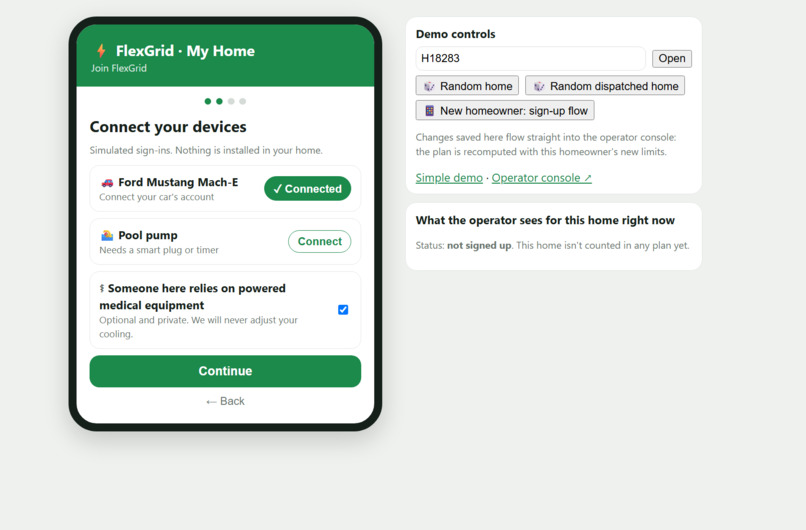
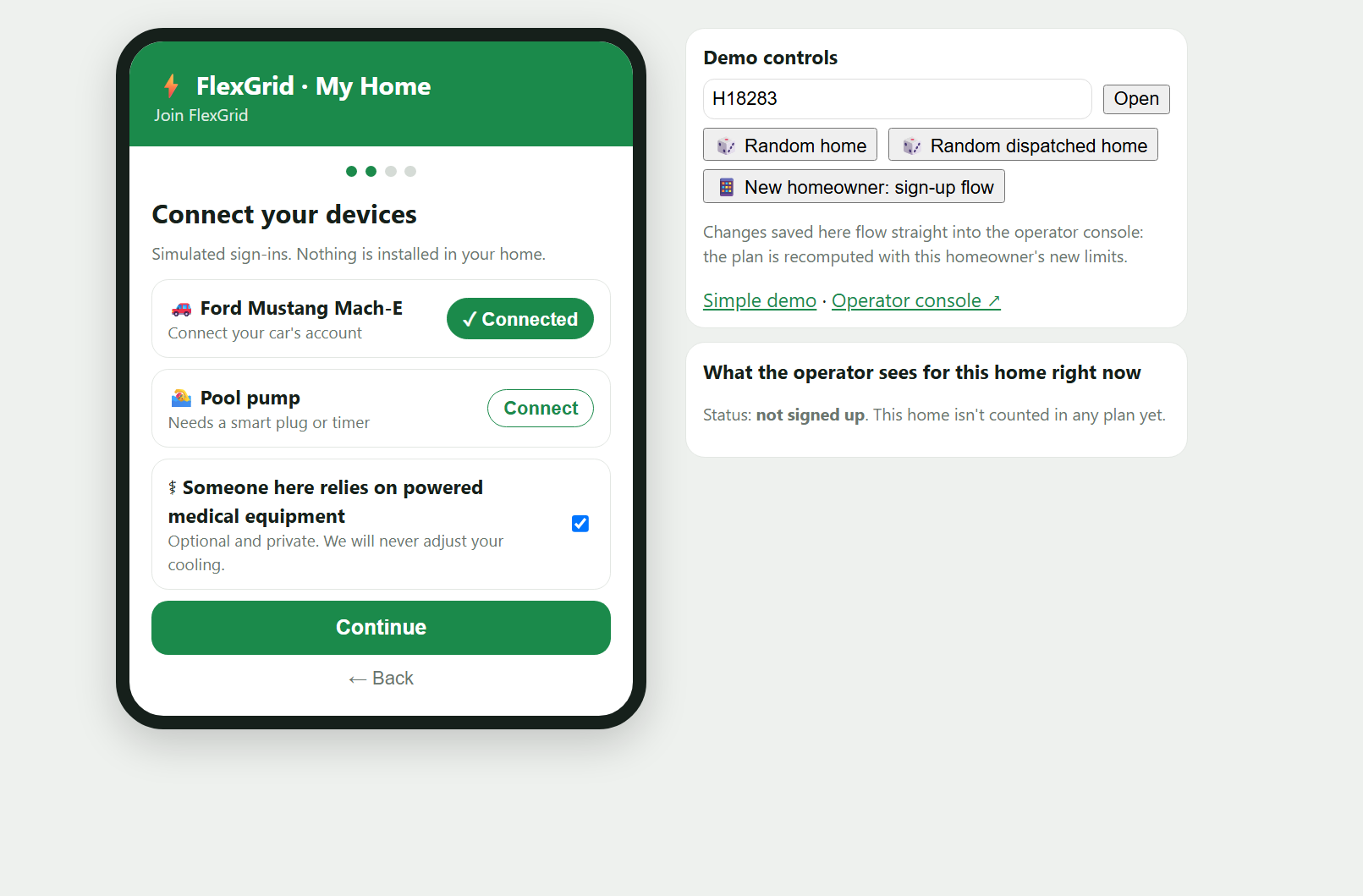
Initial Device Sign Up Page
-
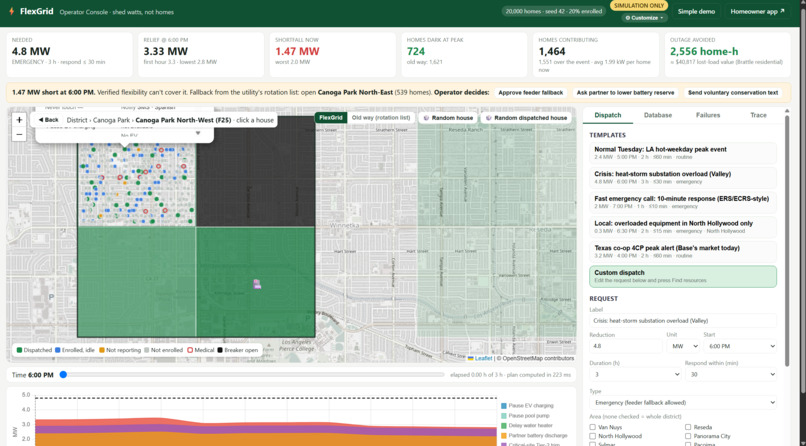
Custom Load Shaving Dispatch
-
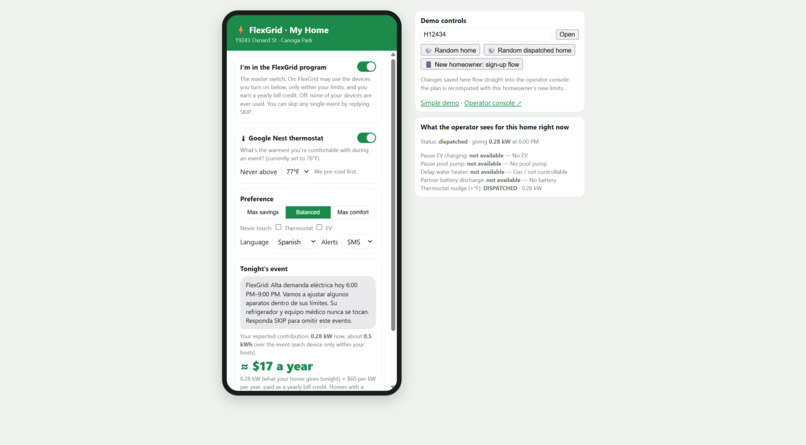
Consumer/Homeowner facing app
-
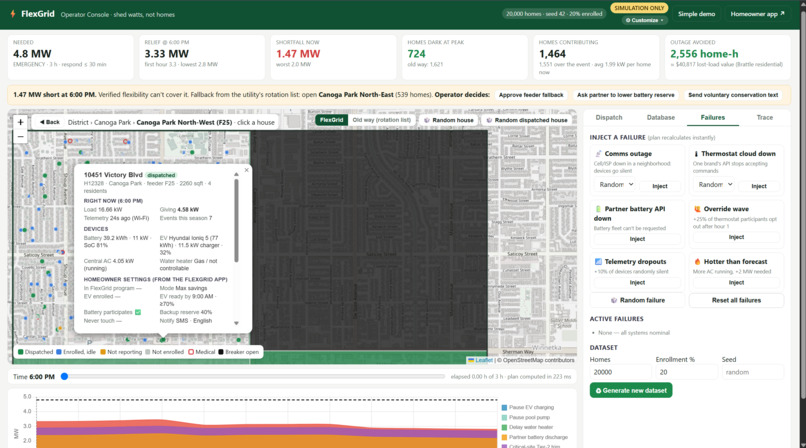
Simulatable failure modes
-
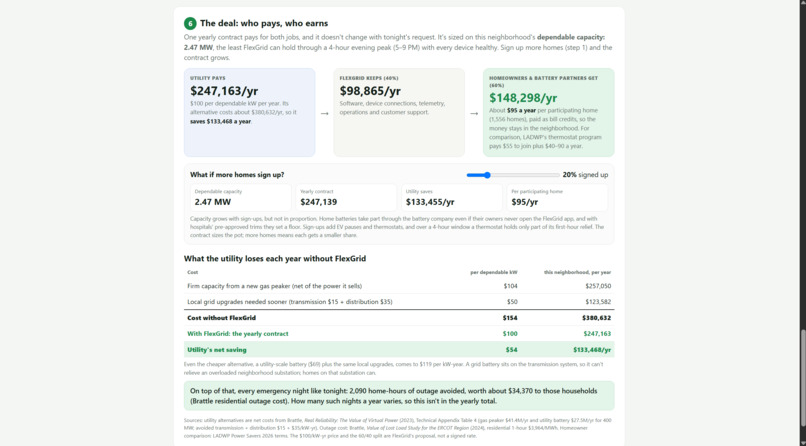
Unit economics / Business model
-
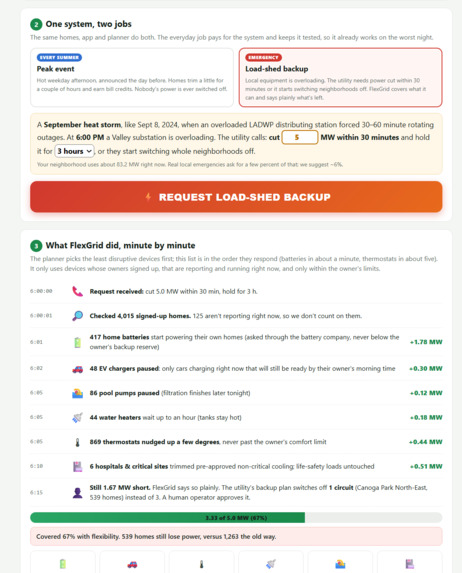
FlexGrid Optimizer Workflow
-
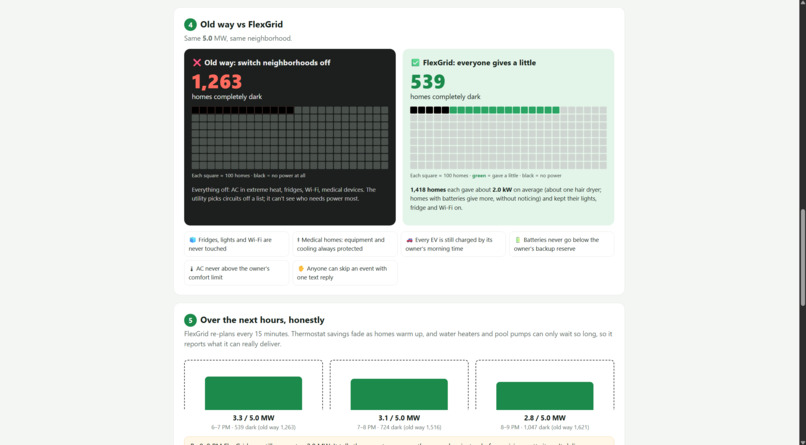
FlexGrid Benefit
Inspiration
When the grid runs short, utilities really only have one tool: open a breaker and switch off a whole circuit, usually 800 to 2,000 homes at a time. Nobody gets picked by need. During Winter Storm Uri in Texas, 4.5 million people lost power and 246 died. The homes that stayed on were mostly the lucky ones sharing a line with a hospital. Here in LA, the September 2024 heat storm overloaded cables and transformers across the Valley.
What troubled us is that those same neighborhoods were full of stuff that could have waited: EVs charging, pool pumps running, water heaters, thermostats at 72, home batteries sitting at 90%. The grid didn't need anyone to lose everything. It needed a lot of people to give up a little, and it had no way to ask. The prompt asked, "What sits between normal and shed?" That's what we wanted to build.
What it does
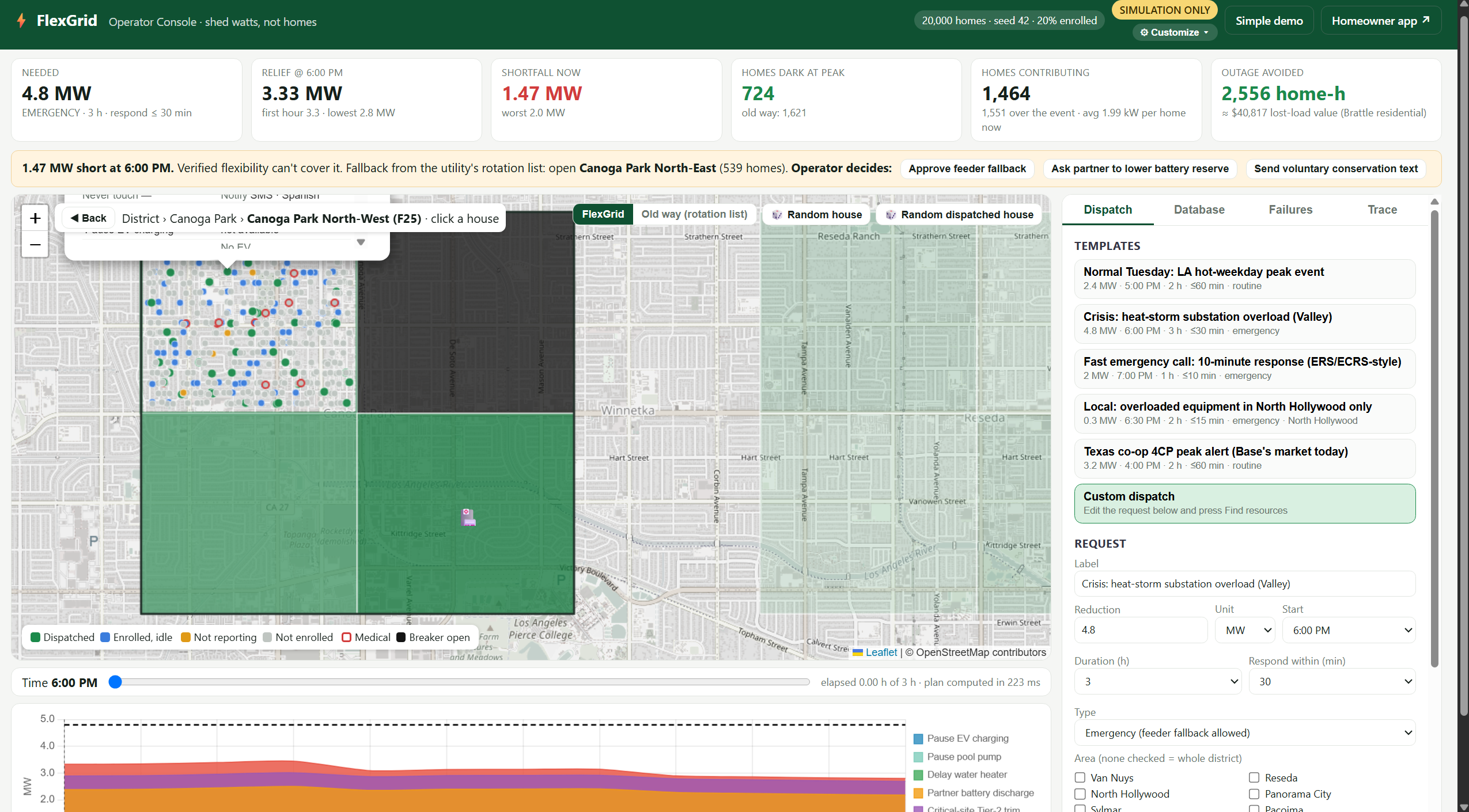
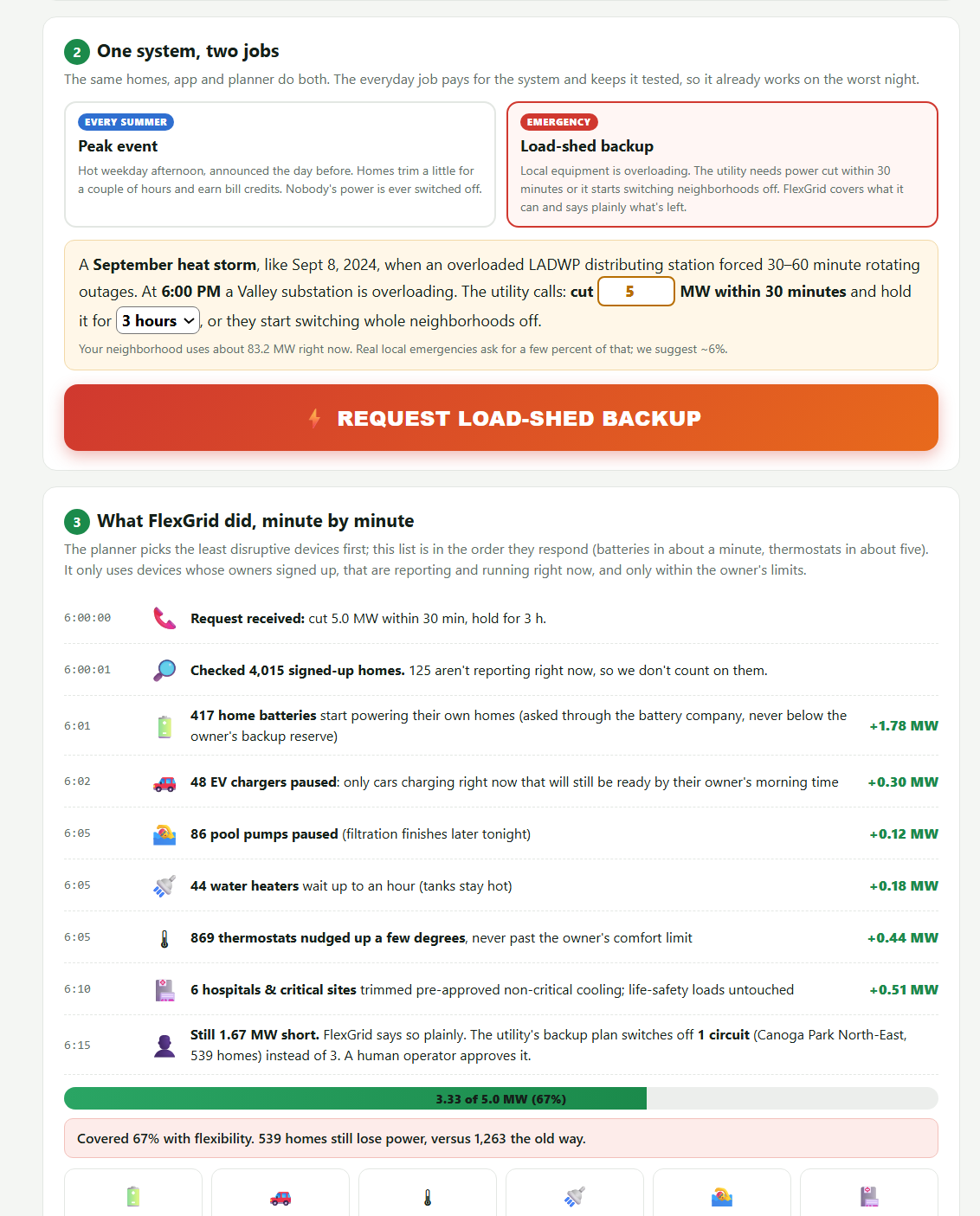
FlexGrid sheds watts instead of homes. An operator at a utility or a battery fleet like Base Power types in a real request, something like "cut 5 MW within 30 minutes for 3 hours," and hits Request Load-Shed Backup. In under a second, it puts together a plan, house by house, starting with whatever people will notice least:
- Home batteries cover their own homes (requested through the battery company, never below the owner's backup reserve)
- EV charging pauses, but only for cars that will still be charged by the owner's morning
- Pool pumps and water heaters wait a bit
- Thermostats go up 1–3°F, never past what each owner allowed
- Hospitals trim non-critical cooling, and the homes on their circuit can still pitch in
If that isn't enough, FlexGrid says exactly how short it is and hands the rest to the utility's normal outage list, where a person approves it. It never fakes the numbers.
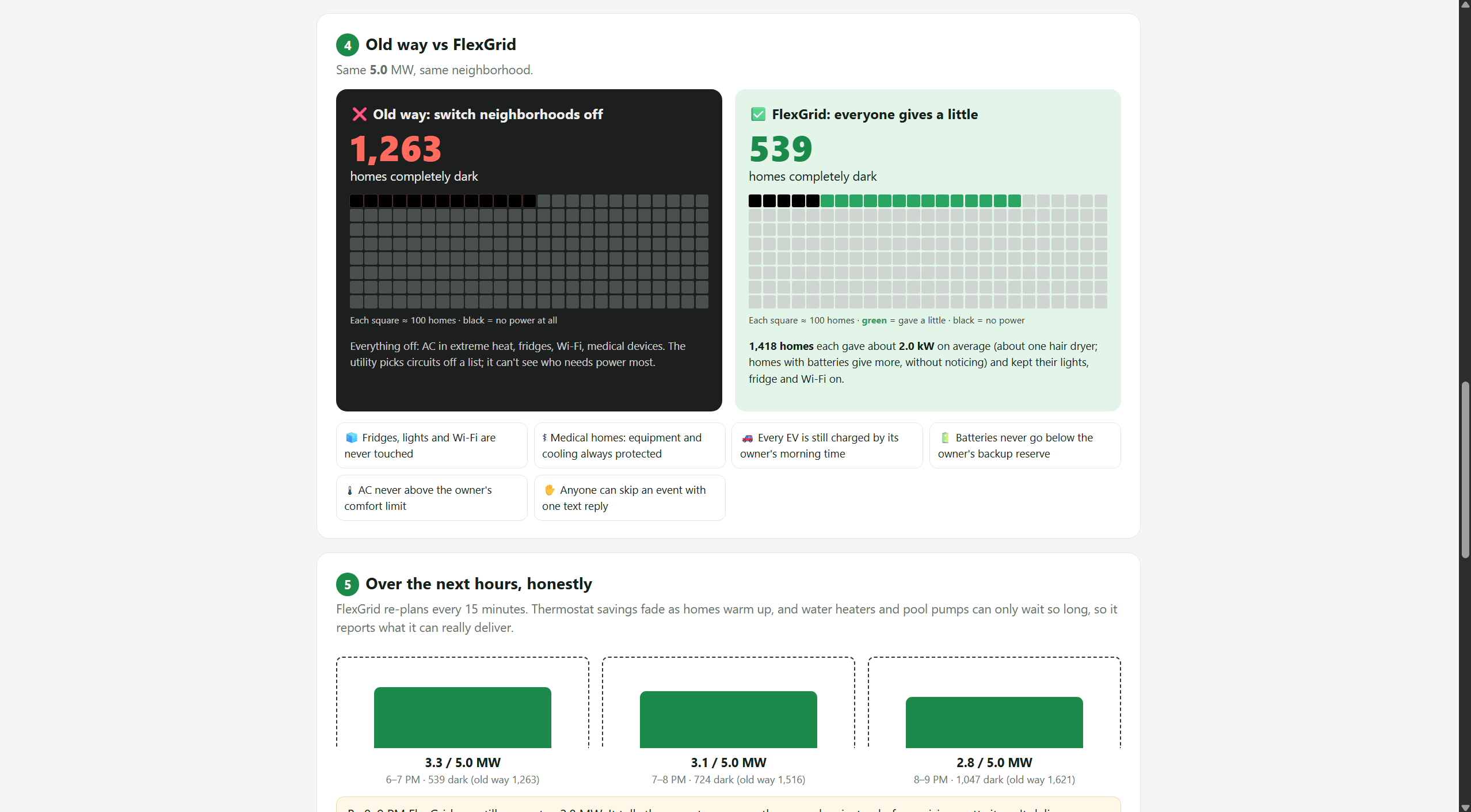
In our simulation of 20,000 Valley homes with 20% signed up, the old way blacks out 1,263 homes for a 5 MW cut. With FlexGrid, about 1,400 homes each give around 2 kW and only 539 go dark. At 50% sign-up, nobody goes dark.
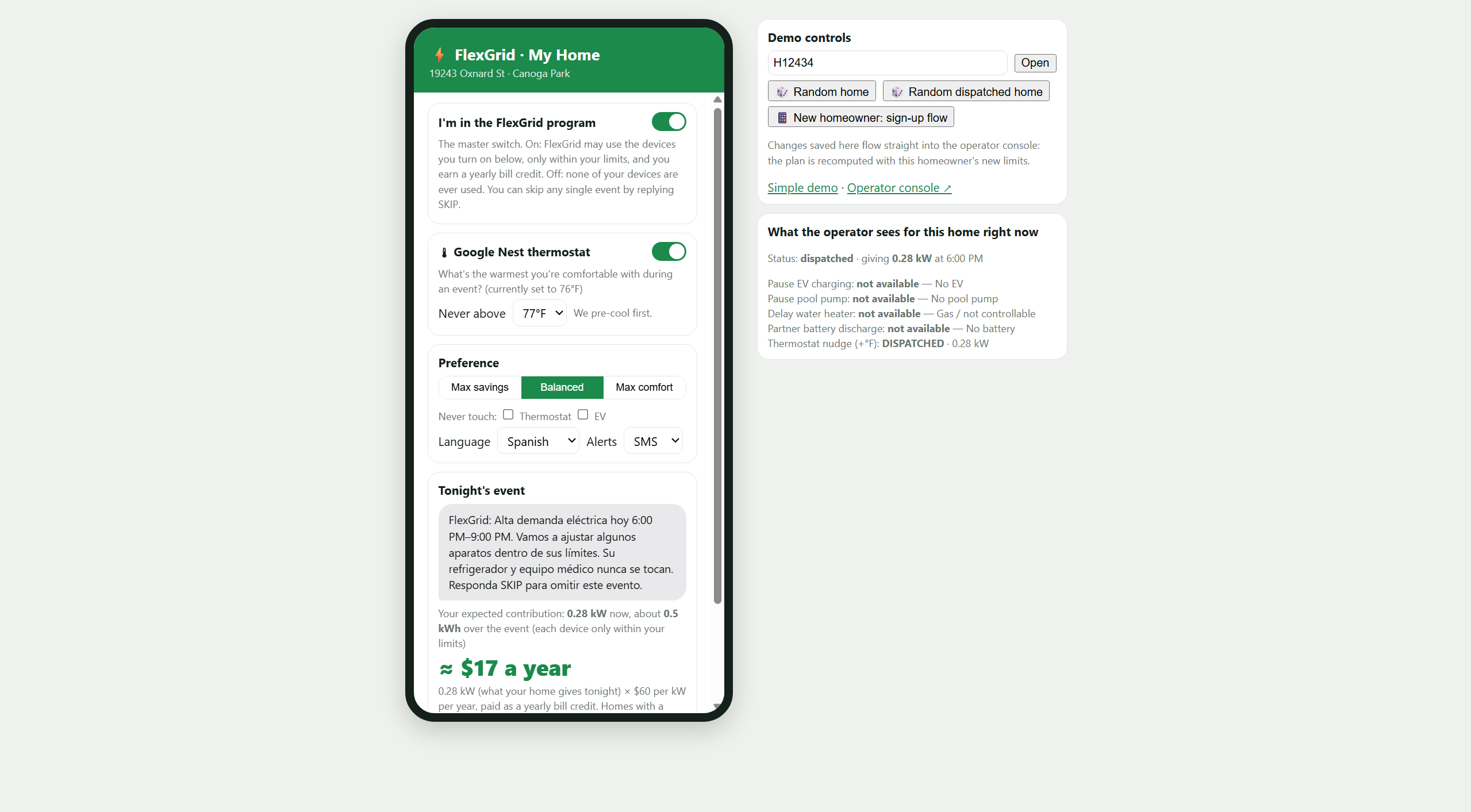
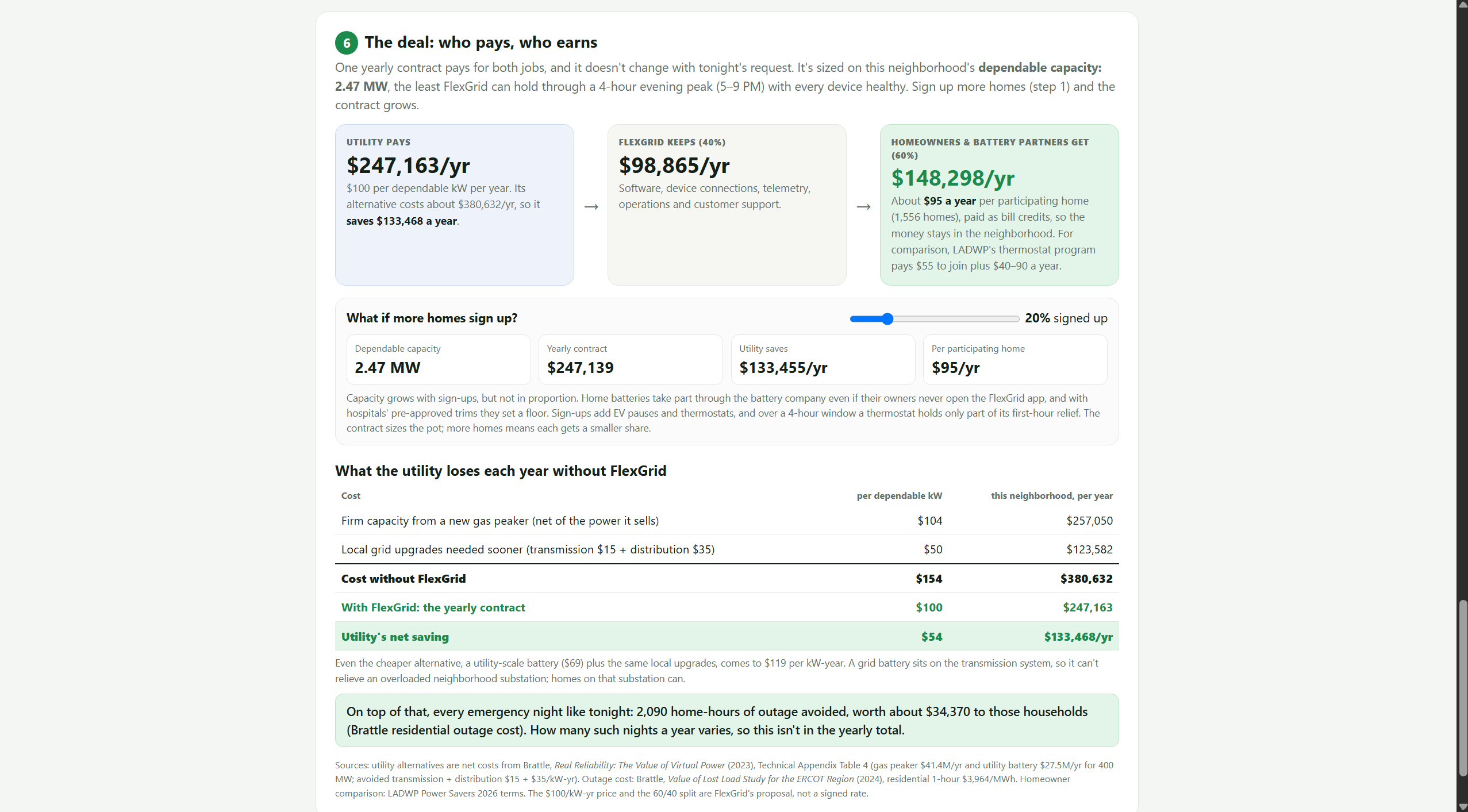
On a normal summer day, the same system runs the paid peak events California already calls a few times a season. People earn bill credits, the utility avoids expensive peak power, and everything is already set up and trusted before a real emergency hits. Homeowners don't install anything. They opt in once, set their limits ("car ready by 7 AM," "never above 78°F"), and can skip any event by replying to a text. Medical homes are always protected.
How we built it
We wrote a Python simulator that generates a San Fernando Valley district of up to 50,000 homes across 40 circuits. Each home has its own devices and owner settings, based on published numbers (ERCOT's ~250 homes per MW at peak, measured thermostat savings and how they fade over a few hours, Base's battery sizes). Every 15 minutes it checks which devices are signed up, online, and actually running, splits the target across every circuit, fills it starting with the least disruptive actions, and logs every decision so an operator can audit it.
On top of a FastAPI backend, we built three views:
- a simple step-by-step demo
- a full operator console with a map you can zoom from neighborhood down to a single house
- a homeowner app where changing a setting immediately changes the operator's plan
Tests make sure the safety rules hold: medical homes untouched, batteries above reserve, EVs ready on time.
Challenges we ran into
Our first idea was to switch off individual rooms. Then we learned the power is in a few big appliances, not rooms, and that utilities can't and shouldn't control breakers inside people's houses. We also learned a mandatory outage order can't be delayed while software tries something else, so FlexGrid works before and alongside the utility, not instead of it.
Accomplishments that we're proud of
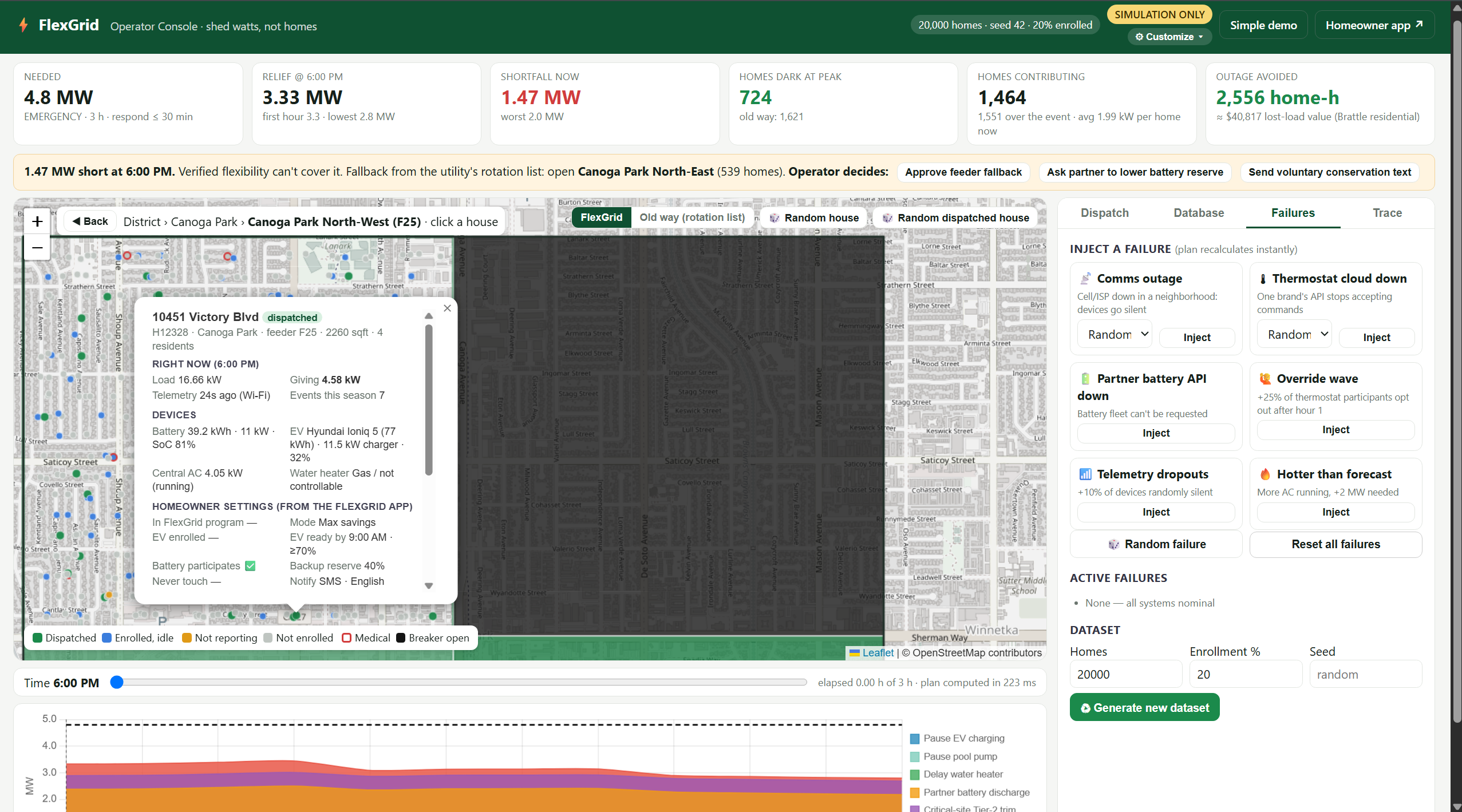
It works end to end, from data to planner to operator console to homeowner app. We're especially proud of the hospital-circuit idea: those circuits usually sit out entirely, which is part of why rotating outages collapsed during Uri. We can also break things live (a cell tower outage, the battery company's system going down, people skipping the event) and watch the plan rebuild in real time.
What's next for FlexGrid
We'd like to pilot with a battery fleet like Base Power and one utility peak program, starting in read-only mode before controlling anything. For funding, we see DOE SBIR/STTR for the core software, DOE GRIP grants through a utility partner, and DoD installation-resilience programs, where the same idea keeps critical base operations running through long outages. It travels internationally too: the core logic stays the same, and only the grid signal, the devices, and the way people opt in change (load-shedding stages in South Africa, smart meters in India).
Responsible use: this data could reveal empty homes or be used to deprioritize people, so FlexGrid is opt-in, protects medical loads, only shares data at the neighborhood level, and keeps a human in charge of every outage decision.

Log in or sign up for Devpost to join the conversation.