-
-
-
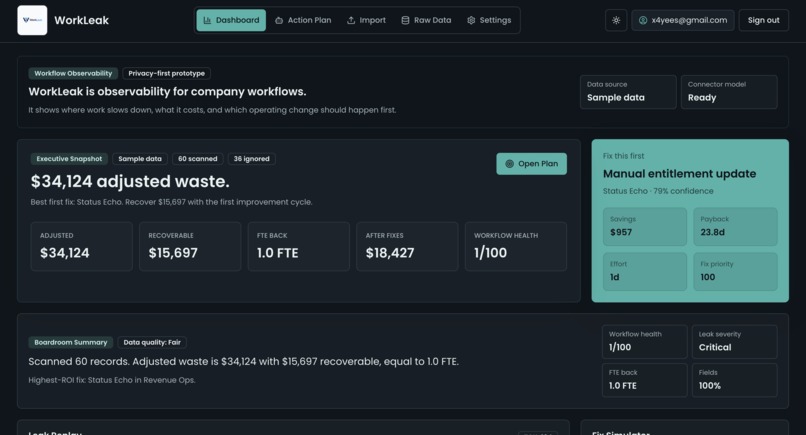
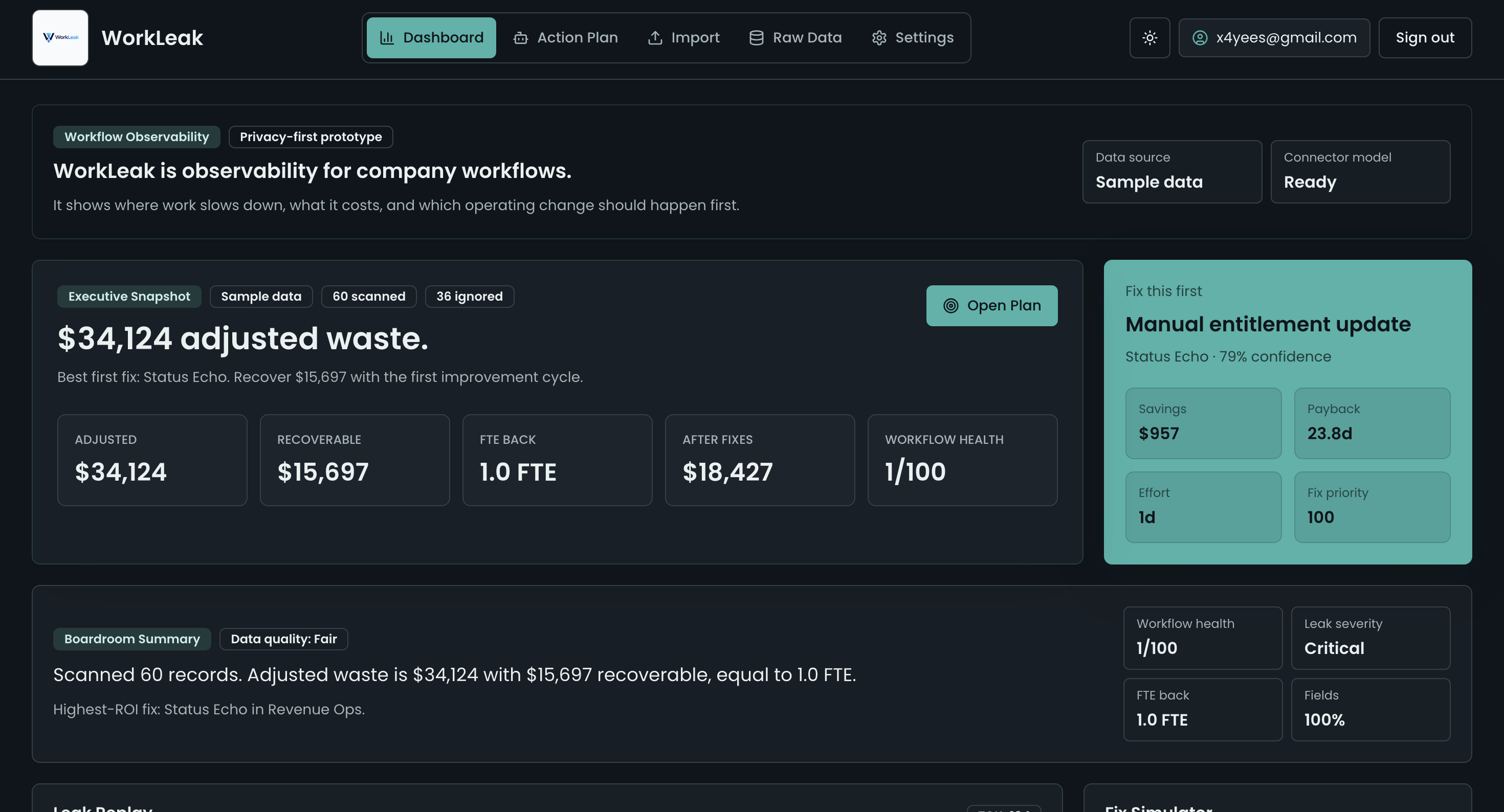
Dashboard - Workflow Health, Leak Severity, FTE recovered, adjusted waste, recoverable savings
-
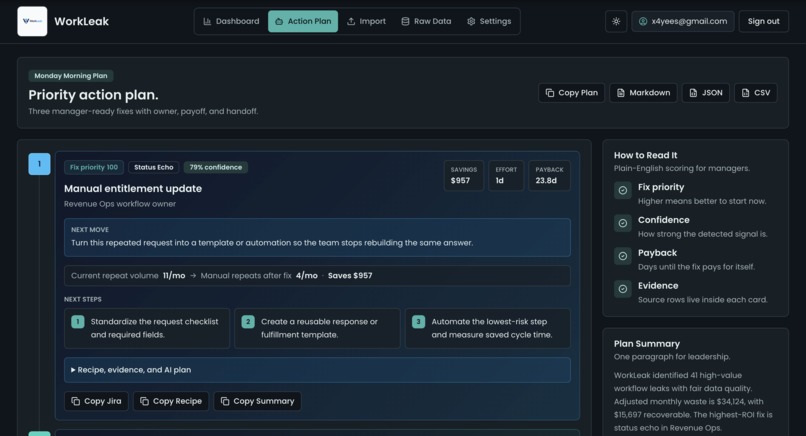
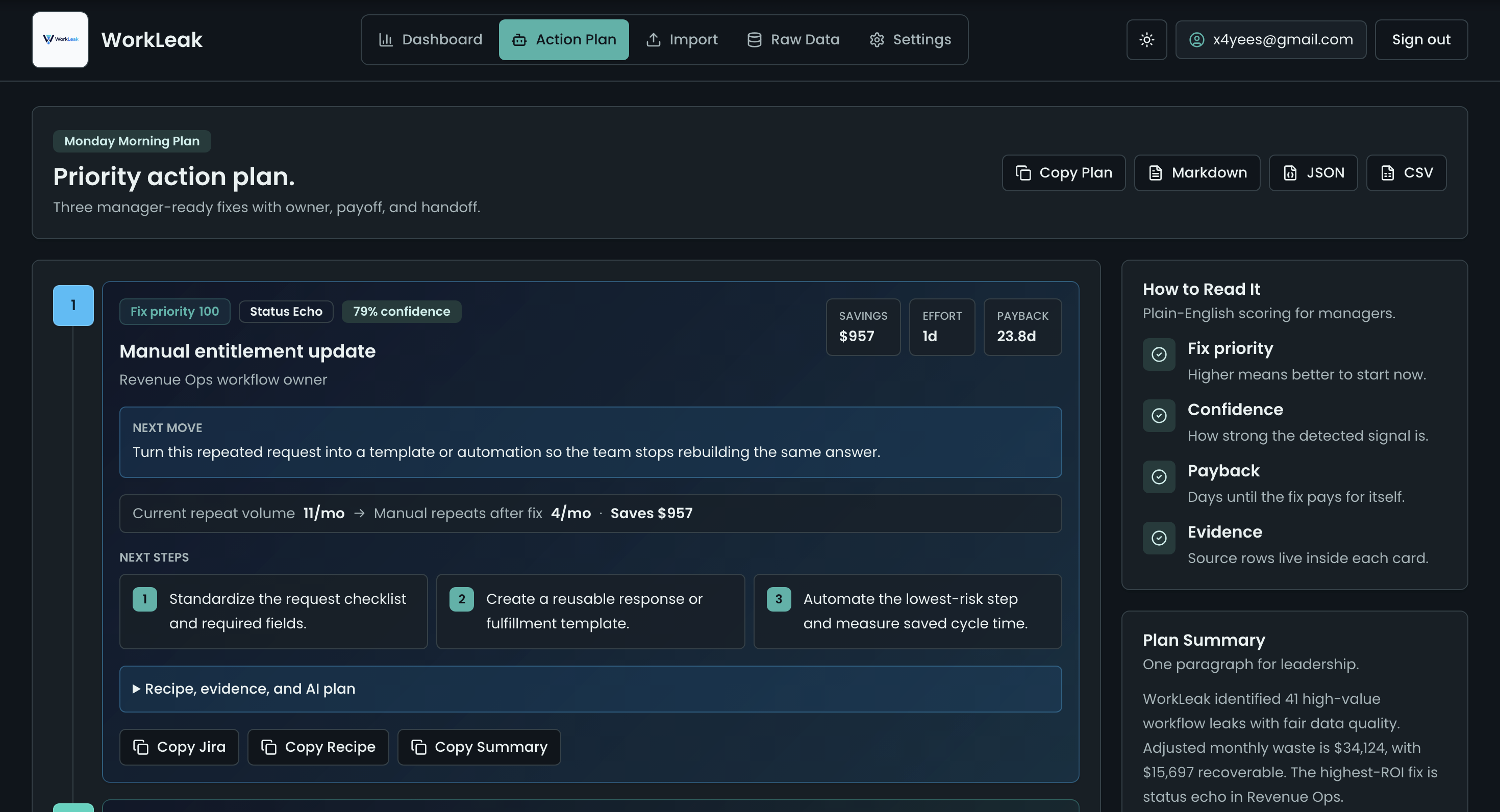
Action Plan with Gemini - AI summary, implementation steps, automation recipe, copy Jira
-
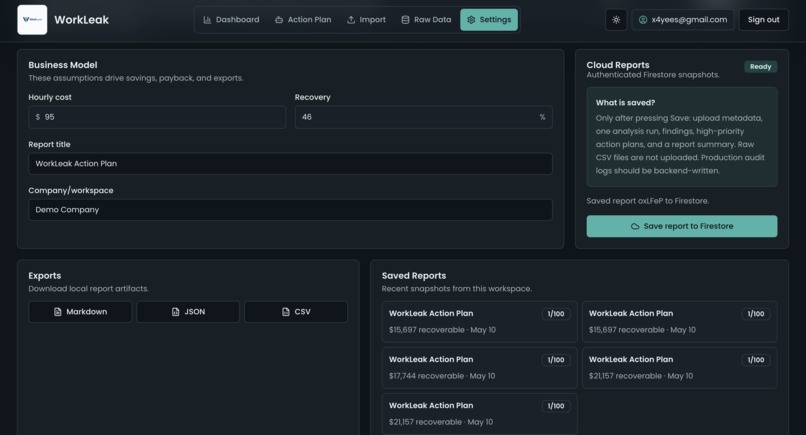
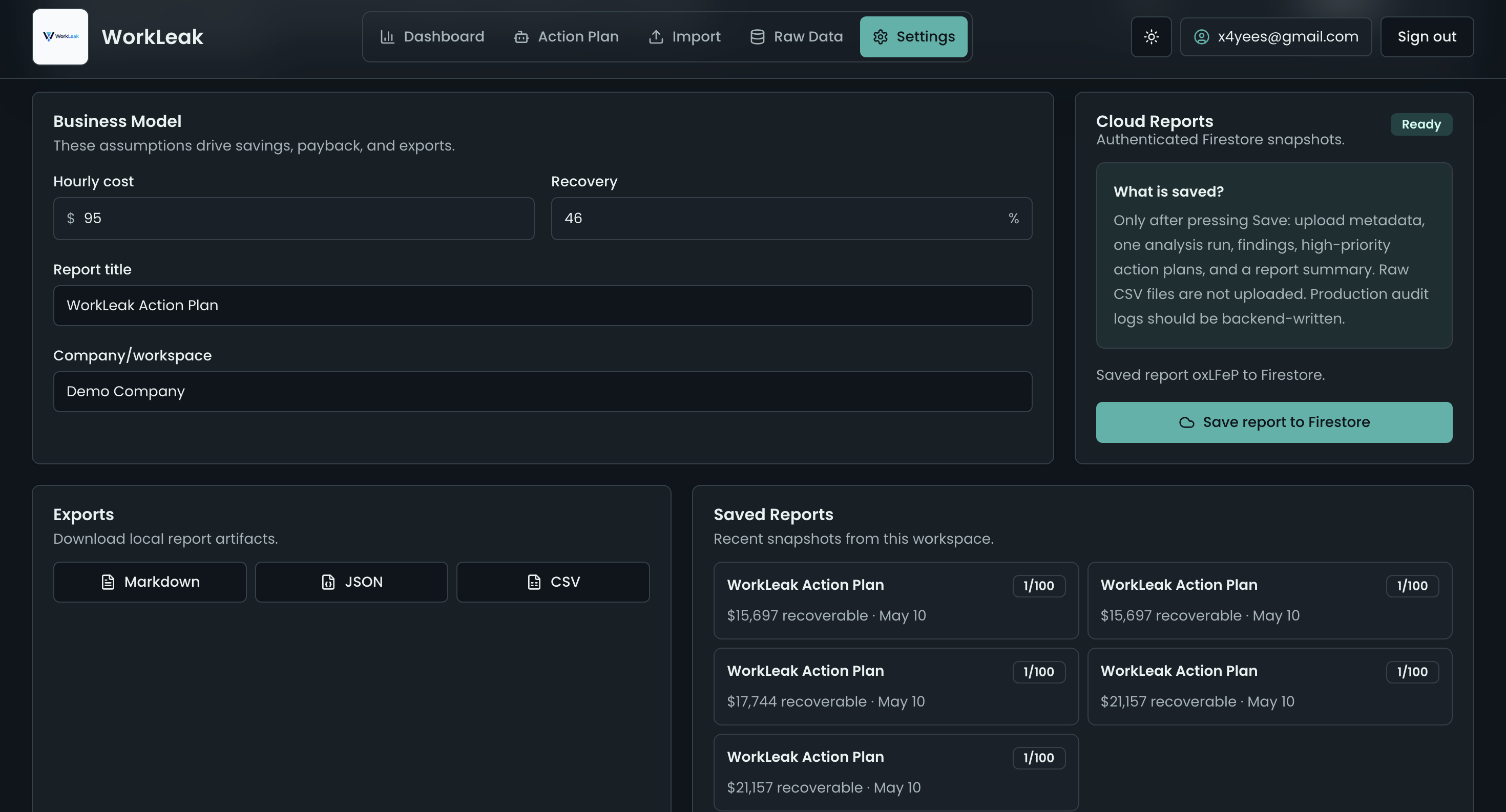
Cloud Reports / Firebase Save
Inspiration
WorkLeak was inspired by a simple but expensive question:
Why do we keep doing this manually?
In my past work experiences, I noticed that many teams were not losing time because people were careless. They were losing time because work was quietly leaking across tools, approvals, meetings, tickets, and review processes.
A delayed approval here, a repeated report there, a blocked pull request, or a recurring meeting with no outcome may not look expensive on its own. But when those patterns repeat every week across multiple teams, they create real operational drag.
The problem is that these leaks are usually scattered across different systems, so nobody sees the full cost. WorkLeak was built to make that hidden waste visible, measurable, and actionable.
What It Does
WorkLeak is a workflow observability tool for internal teams.
It helps companies find where work is leaking time and money by analyzing workflow data such as tickets, meetings, pull requests, approvals, and manual process logs.
WorkLeak detects high-friction patterns including:
- Long wait times
- Repeated manual work
- Too many handoffs
- Blocked work
- Stuck pull request reviews
- Duplicate reports
- Meetings with no clear outcomes
- Approval delays
- Recurring operational bottlenecks
For each leak, WorkLeak estimates the business cost using:
Monthly Cost = Hours Lost Per Month x Average Hourly Cost
It then ranks the highest-impact problems and recommends practical fixes, such as:
- Automating approval routing
- Reducing handoffs
- Creating reusable templates
- Clarifying ownership
- Replacing recurring meetings with async workflows
- Adding escalation rules
- Improving review SLAs
The goal is simple: help teams know what to fix first.
How I Built It
I built WorkLeak as a React and TypeScript web application with a manager-focused workflow intelligence dashboard.
The prototype includes:
- CSV upload for workflow data
- Sample datasets for tickets, meetings, and pull requests
- A rules-based leak detection engine
- Adjusted waste calculations to avoid inflated double-counting
- A business impact calculator for hours lost, cost, savings, and FTE recovery
- A dashboard that ranks the highest-value opportunities
- Leak Fingerprints such as Approval Black Hole, Ticket Ping-Pong, PR Waiting Room, and Manual Report Tax
- Fix Priority scoring based on savings, confidence, effort, and payback
- Gemini-powered action plan generation
- Jira-ready ticket text
- Automation recipes
- Exportable Markdown, JSON, and CSV reports
- Firebase Authentication
- Firestore saved reports
- Privacy-first local CSV processing, where raw CSV files are not uploaded
The detection engine looks for measurable signals such as wait time, review delays, repetition frequency, ownership changes, blocker hours, missing meeting outcomes, and duplicated work patterns. These signals are converted into business impact so the results are easy for managers and leaders to understand.
Challenges I Ran Into
The hardest part was turning vague workplace frustration into something measurable.
It is easy to say, "This process feels slow." It is much harder to show that a process costs 40 hours per month, delays customer onboarding, or creates avoidable review bottlenecks.
Another challenge was making the numbers credible. Early versions could count multiple leak signals from the same workflow item, which made the totals feel inflated. I added adjusted waste to reduce overlap and make the business case more honest.
I also wanted WorkLeak to go beyond pointing at problems. A lot of dashboards stop at insight. WorkLeak needed to recommend what to do next, who should own it, how hard it would be, and whether it could realistically pay off quickly.
Accomplishments That I’m Proud Of
I am proud that WorkLeak turns messy operational data into a clear business story.
Instead of showing another generic dashboard, WorkLeak answers questions teams actually care about:
- Where are we losing time?
- How much is it costing us?
- Which issue should we fix first?
- What action would save the most effort?
- Who should own the fix?
- Can this realistically improve next week?
I am also proud of making the prototype practical. Teams do not need perfect integrations to get started. They can upload CSV exports or use sample data and immediately see useful insights.
The part I’m happiest with is that WorkLeak does not stop at diagnosis. It does not just say, "There is a problem." It says, "This is the leak, this is the cost, this is the recommended fix, and here is the Jira ticket to start."
What I Learned
I learned that internal waste often hides in plain sight.
A delayed approval, repeated status meeting, or stuck pull request may seem small in isolation. But when those patterns repeat across departments, the cost becomes meaningful.
I also learned that the best internal tools do not just add more information. They reduce uncertainty. WorkLeak helps teams move from "something feels inefficient" to "this is the leak, this is the cost, and this is the fix."
Finally, I learned that credibility matters as much as insight. For an operations tool to be trusted, it needs to explain why something was flagged, show the evidence, and be transparent about its assumptions.
What’s Next For WorkLeak
Next, I would expand WorkLeak from a prototype into a production-ready workflow observability platform.
Future improvements include:
- Direct integrations with Slack, Jira, GitHub, Google Calendar, and email
- Multi-company and team workspaces
- Department-level dashboards
- Historical trend tracking
- Automatic weekly leak reports
- One-click Jira ticket creation
- Real-time Slack alerts for new workflow leaks
- Backend-owned audit logs
- Role-based views for executives, managers, and team leads
- Data retention controls for sensitive company data
- Benchmarking across teams and departments
- Tracking whether recommended fixes actually reduced waste over time
Long term, WorkLeak could become a continuous improvement layer for companies: watching for operational drag, ranking the highest-impact fixes, and helping teams recover time before it disappears.
Built With
- csv
- firebase
- gemini
- react
- recharts
- tailwind
- typescript
- vercel

Log in or sign up for Devpost to join the conversation.