-
-
We hope to make documentation easy for all developers in any enterprise
-
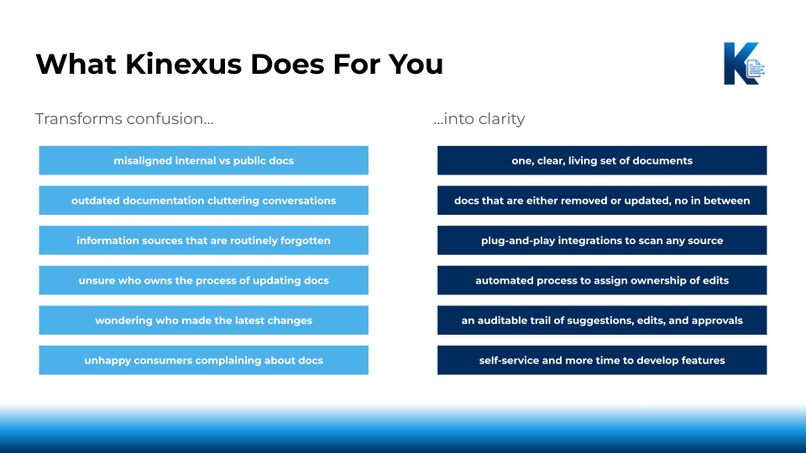
Kinexus changes the game of documentation
-
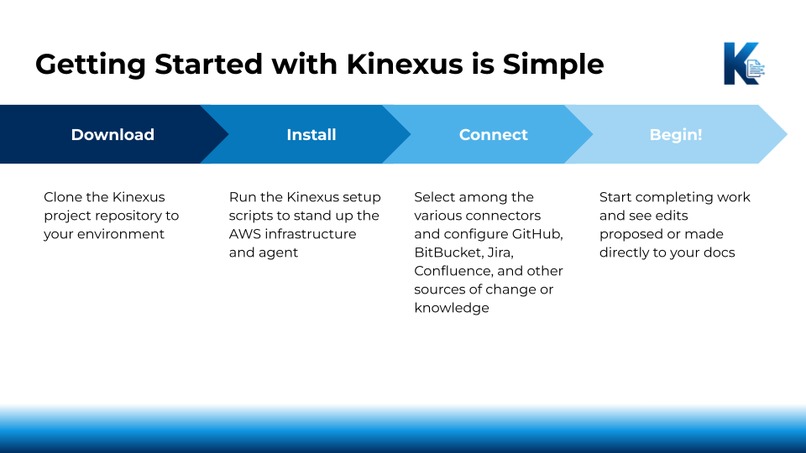
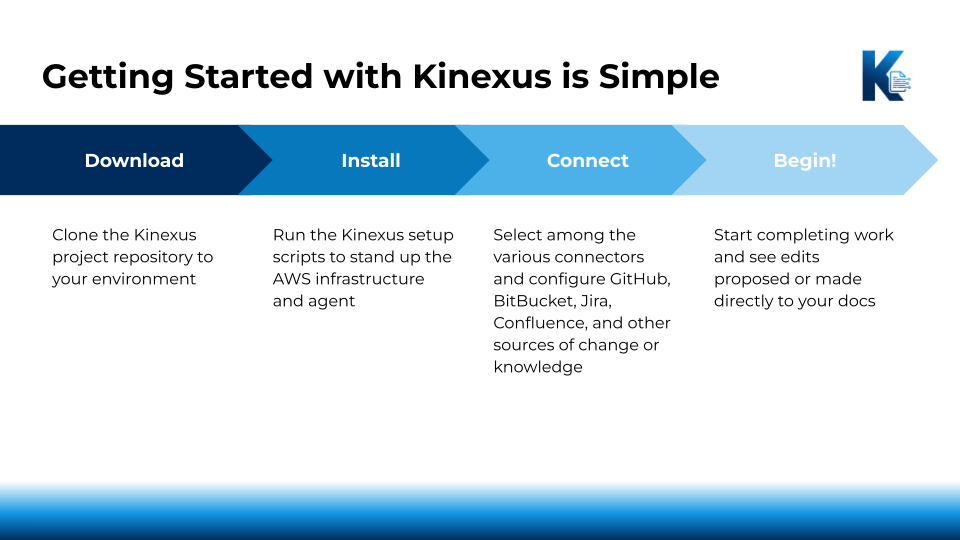
Installation of Kinexus is easy
-
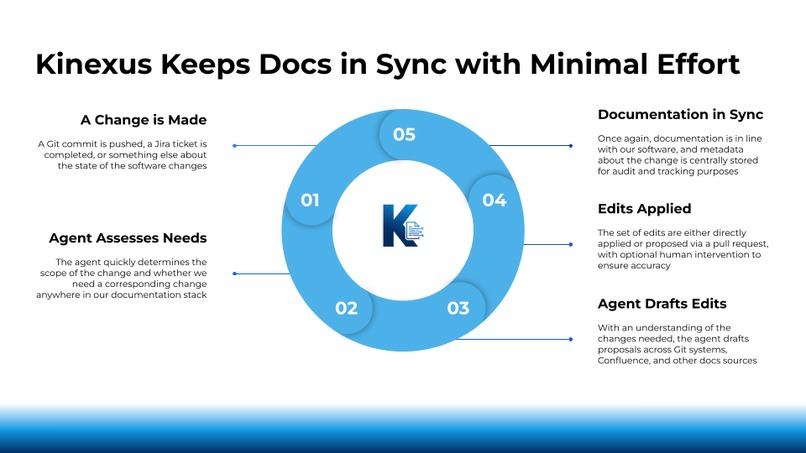
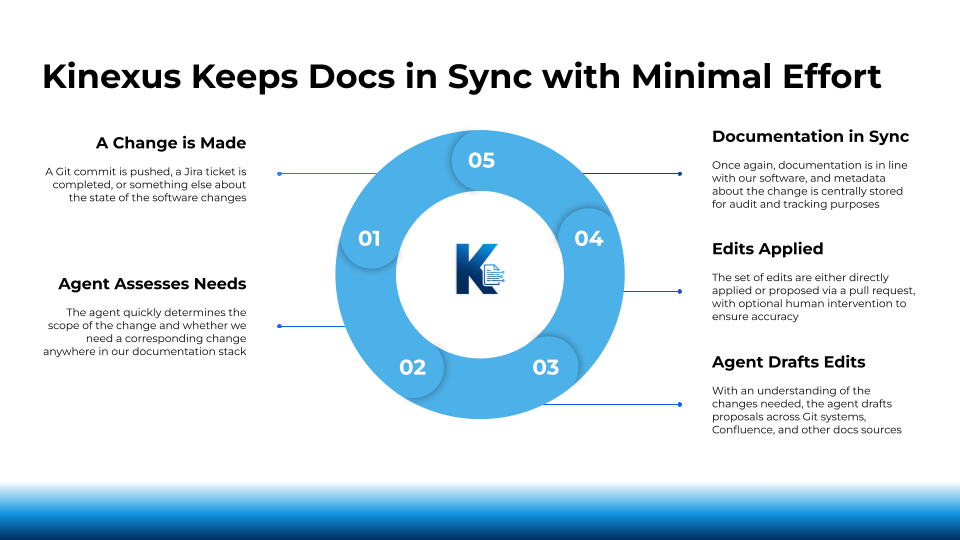
The flow of Kinexus always brings us back to a verified up-to-date state
-
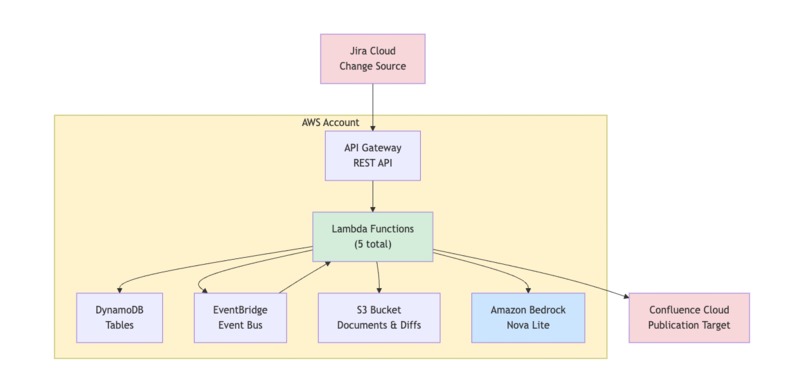
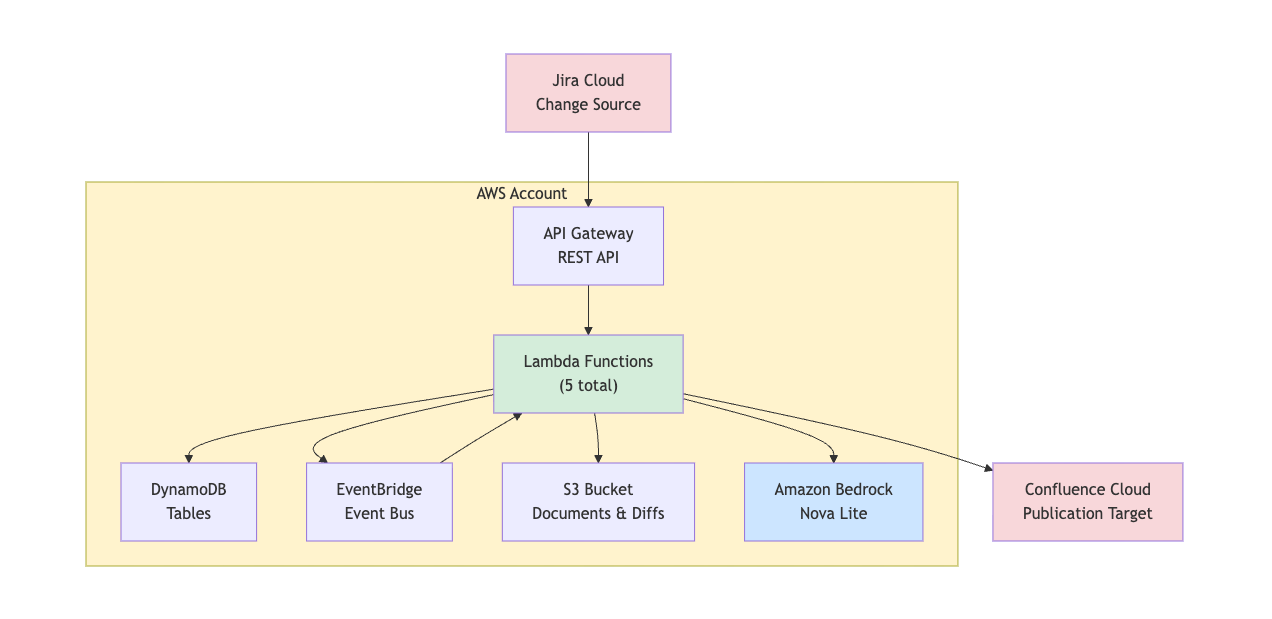
Our high-level architecture (see more at docs/deployment.md)
-
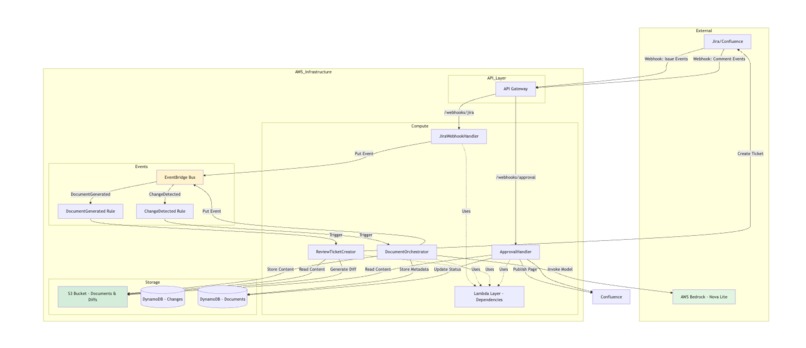
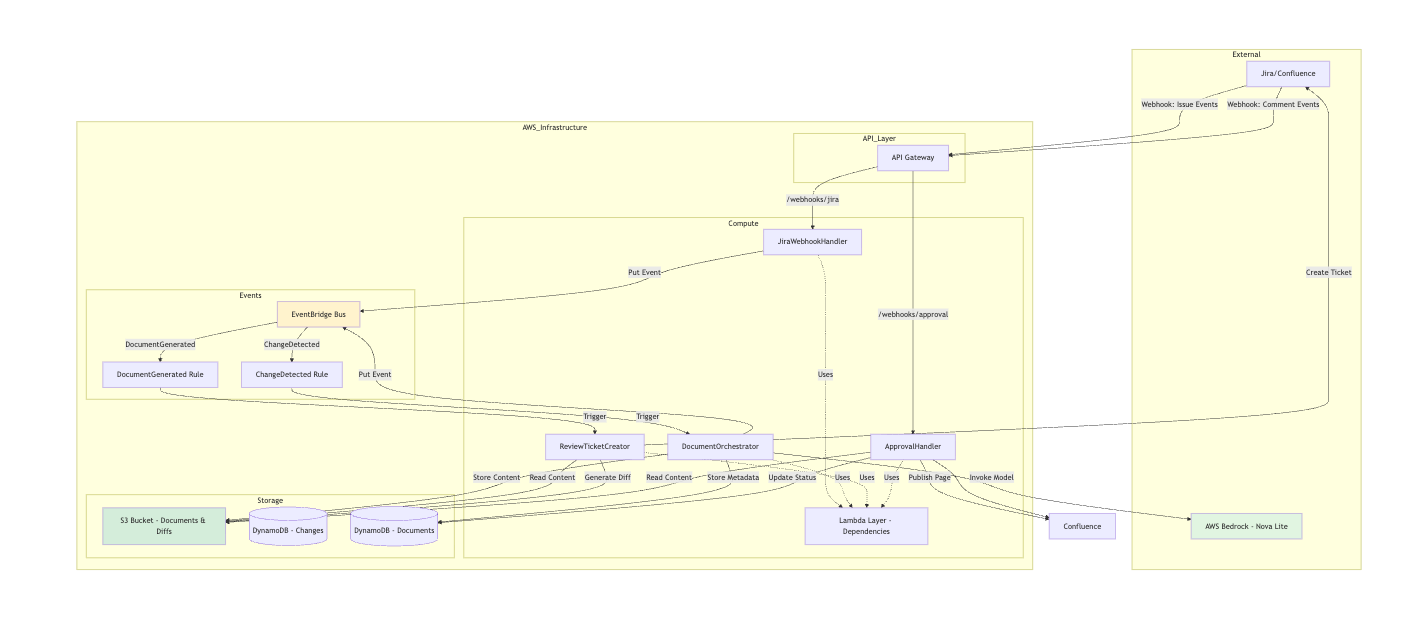
A more detailed architecture with our services and APIs (see more at docs/architecture.md)
Inspiration
Engineers struggle to keep documentation current as code evolves, so we built an agent that updates documentation where it already lives, triggered by real changes.
The creators of this project have combined decades of experience in software, and the problem of keeping documentation up-to-date has never had an easy solution. When working with a new package, we have had to navigate outdated documentation and support pages. It is endlessly frustrating to contend with scarce examples and tutorials that no longer work. In our own software, we try our best to change documentation, knowing that it will never be prioritized and is always slowly becoming obsolete.
What it does
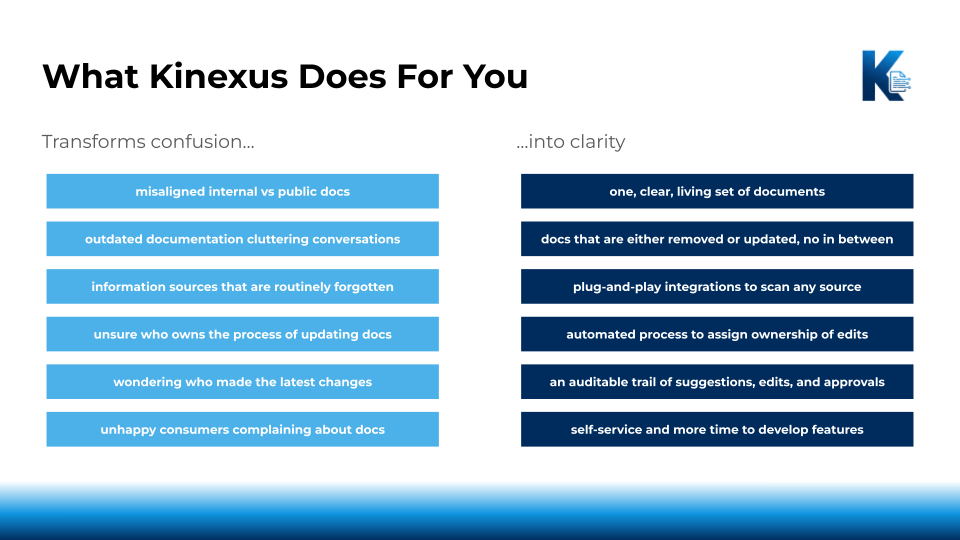
Our vision of the solution is a thin agentic layer, aware of all your code changes, completed tickets, and the documentation you have for your internal team and the public. Any change is assessed via a simple API call to a Bedrock LLM, and the agent determines (a) whether a change should be made to documentation and (b) what that change should be. Everything is posed as a suggestion for human review. This is exactly the support that developers need: not a bot that will hallucinate functionality, but a straightforward approve/deny workflow to keep developers focused on new functionality and keep users in the know.
How we built it
We implemented an AWS CDK stack (see infrastructure/app.py) that deploys API Gateway, Lambda handlers in src/lambdas/, DynamoDB tables, an S3 bucket, and EventBridge. The webhook Lambdas persist change events, and an orchestrator Lambda calls Bedrock to generate or modify documentation, storing content in S3 and metadata in DynamoDB. While AgentCore is a valuable new tool in the AWS toolbox, the lower-level control of direct Bedrock connections was more valuable for this agentic process. Clarity and simplicity were goals of this effort.
Challenges we ran into
The following were some of the challenges that we ran into:
- Integration with Atlassian can be tricky to debug
- We had many ideas, but scoping down to a minimal viable product took some effort
- Other webhooks to additional services had bugs, leading us to save those for future efforts
Accomplishments that we're proud of
We believe that this product has a future. Documentation is critically important in the era of GenAI, where public docs are what both humans and machines need to use your software. We're proud of our idea and initial execution, which results in a simple workflow using tools developers know that can make their lives easier.
What we learned
Executing on our vision meant learning several things. After considering several designs and running experiments, we determined that:
- Human-in-the-Loop is Essential. AI accelerates drafting, but reviewer checkpoints and clear approval signals are critical for accuracy, adoption, and trust.
- Integrations Create Leverage. Connecting Jira, repos, and Confluence unlocks context-aware generation and automation that standalone tools can’t match.
- Nova Models Performed Well. We experimented with Claude models, but decided on Nova models in the end because of superior performance for this use case.
What's next for Kinexus AI
This project is modular and extensible, allowing for new webhooks and other integrations to expand the scope of what Kinexus will review. Some of the prioritized backlog items are:
- Multi-Source Ingestion. Connect GitHub Issues, Linear, Asana, and PRs/commits to enrich context beyond Jira.
- Grounded Generation (RAG). Use retrieval-augmented generation over internal KBs to improve accuracy and reduce hallucinations.
- Doc Quality Score. Add rubric-based validators (structure, clarity, coverage) with pass/fail gates before publishing.
- Active Learning Loop. Learn from reviewer edits to adapt prompts/templates and improve future drafts automatically.
- Smart Reviewer Routing. Assign reviewers by expertise and load, with SLAs, reminders, and escalation paths.
- Drift Detection Dashboard. Track aging/stale pages, broken links, and doc-to-implementation drift with prioritized fixes.
- PR Doc Gating. GitHub/GitLab checks that block merges for high-risk code changes without doc updates.
- Inline Confluence Suggestions. App extension that proposes edits in-place with one-click apply and audit trail.
- Multi-Tenant & SSO. Enterprise-ready org isolation with Okta/Azure AD, RBAC, and audit logs.
- Cost-Aware Model Routing. Route tasks to the smallest effective model, batch generations, and cache to control spend.
No matter the improvements we add, the goal will be the same: allow developers to give themselves a break from the stress of documentation and let Kinexus step in as your documentation concierge.
Built With
- amazon-dynamodb
- amazon-web-services
- api-gateway
- bedrock
- confluence
- jira
- lambda
- nova-lite
- python
- sagemaker


Log in or sign up for Devpost to join the conversation.