-
-
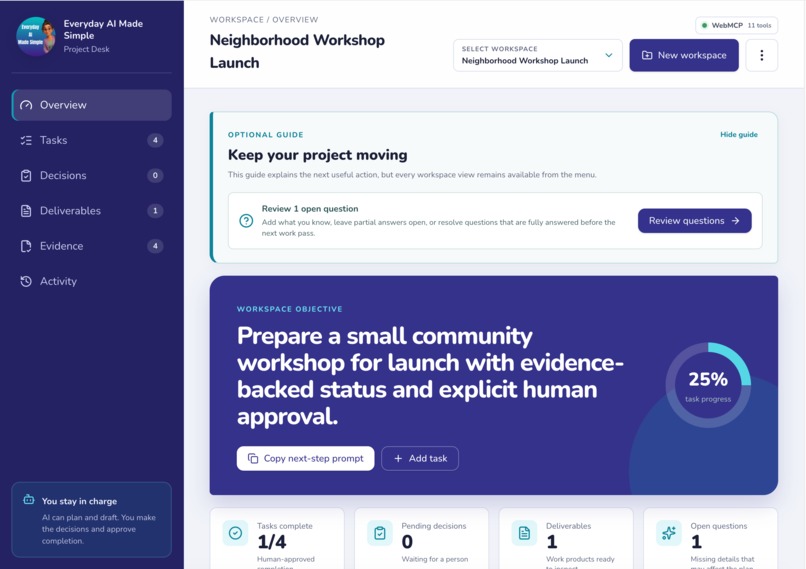
The Project Desk Dashboard
-
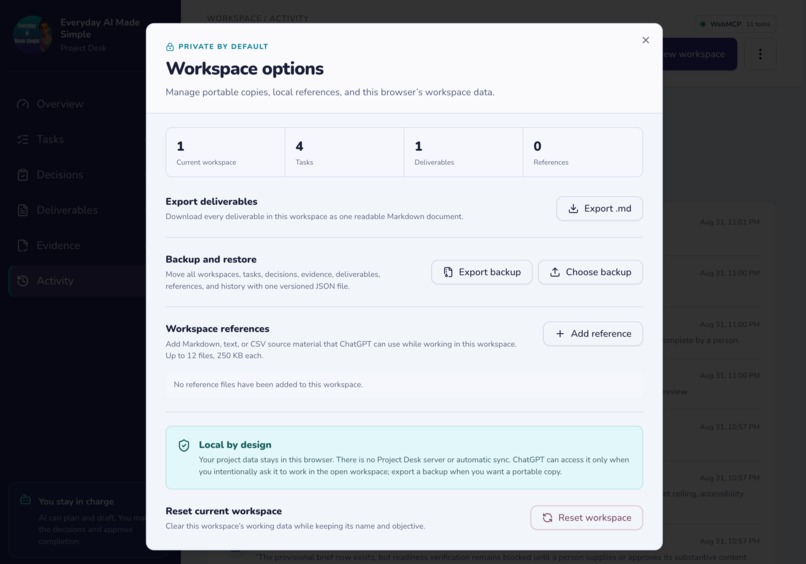
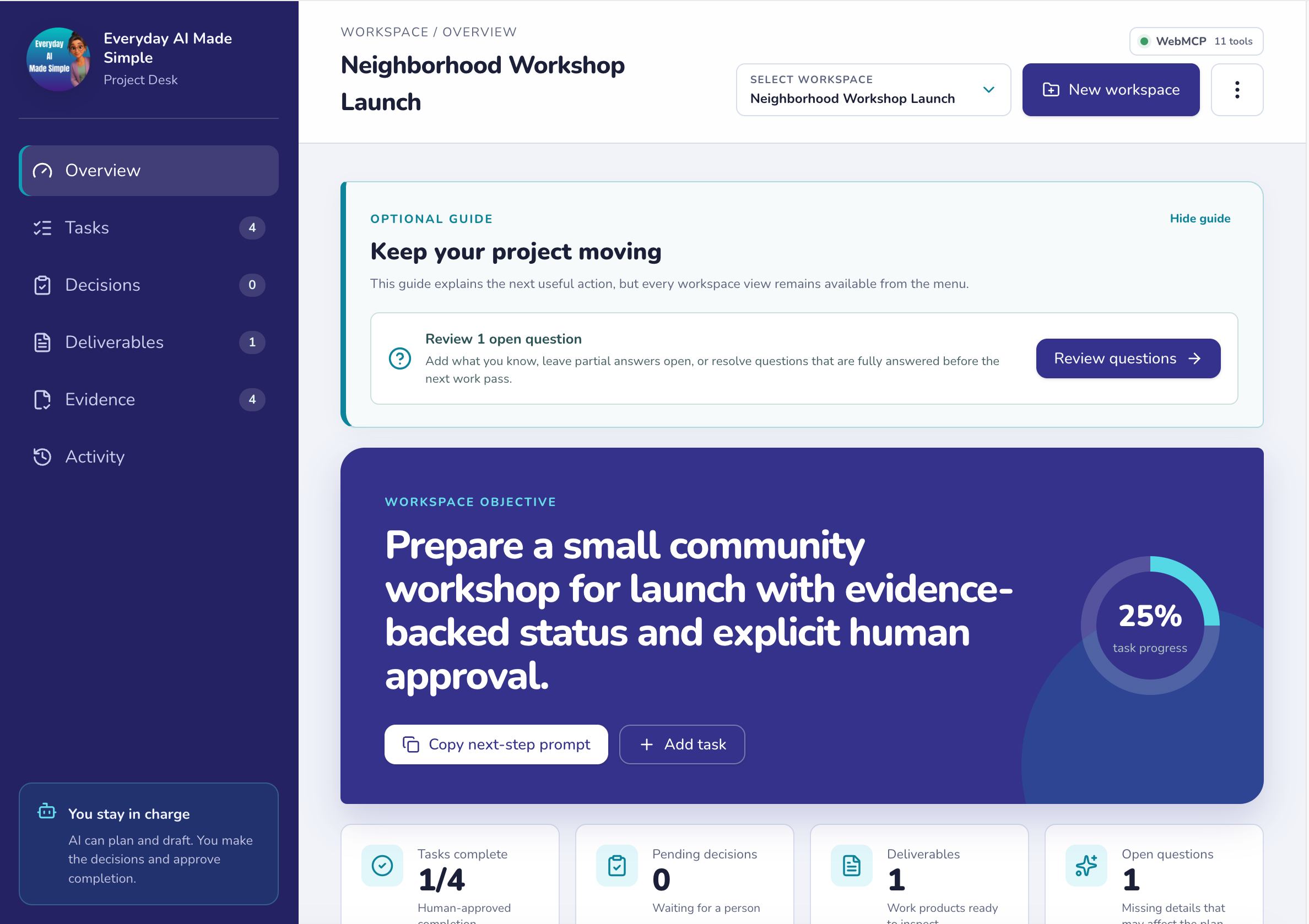
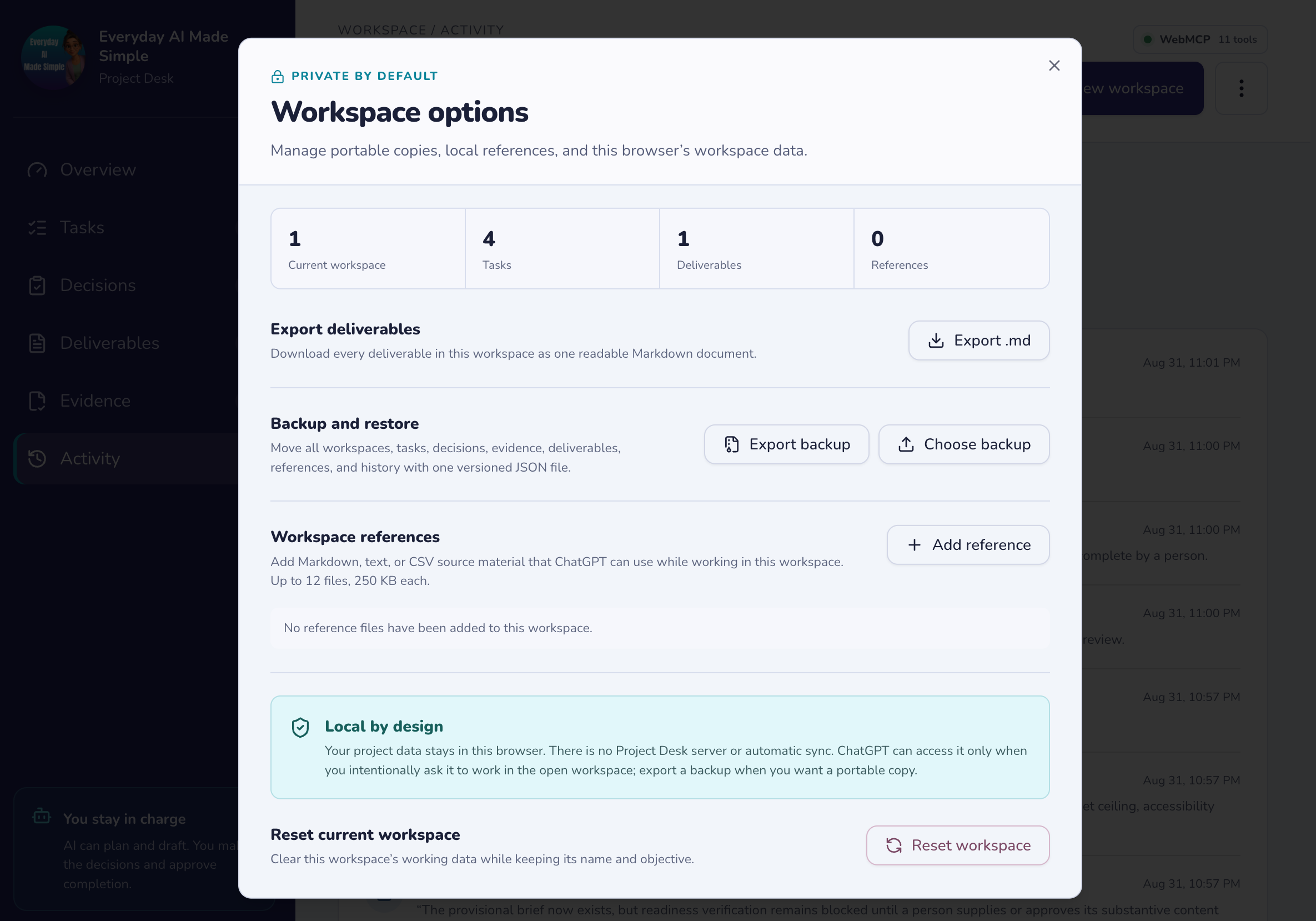
Workspace Options: manage portable copies, local references, and this browser's workspace data.
-
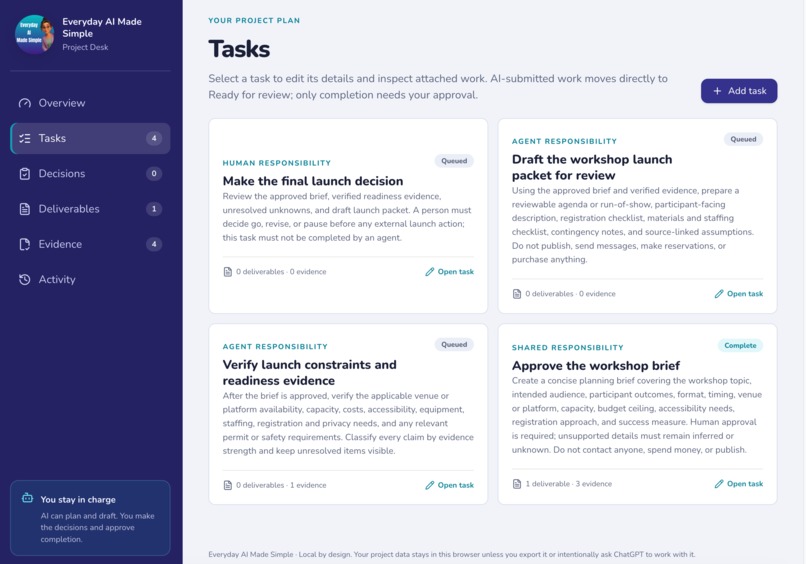
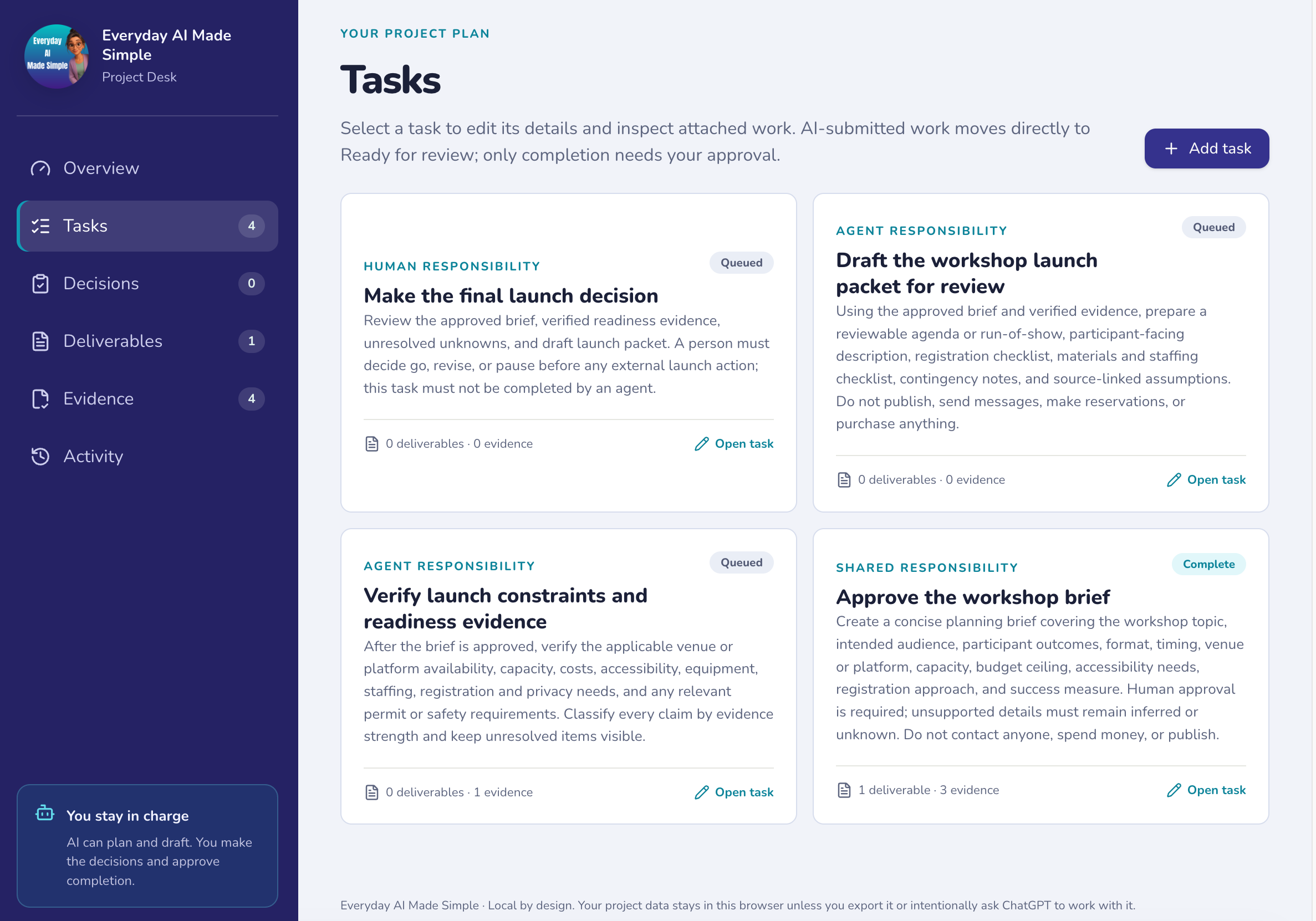
Tasks the agent and human have added to the project
-
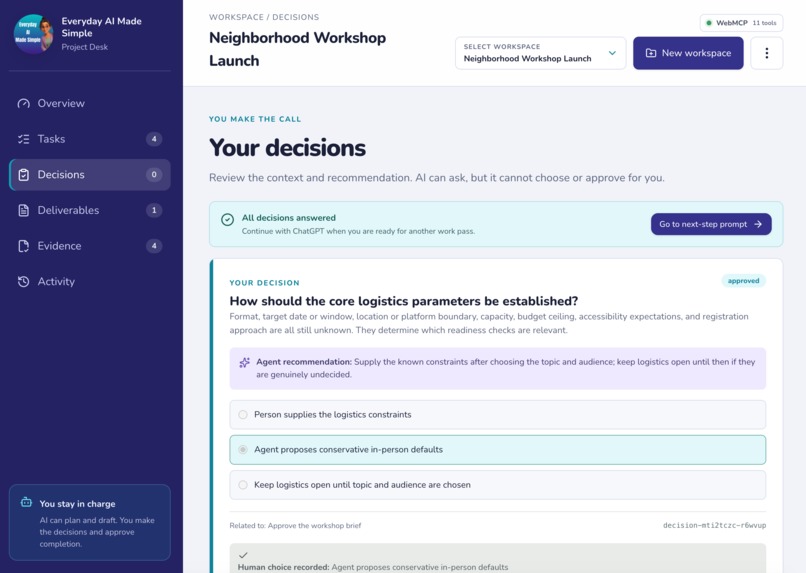
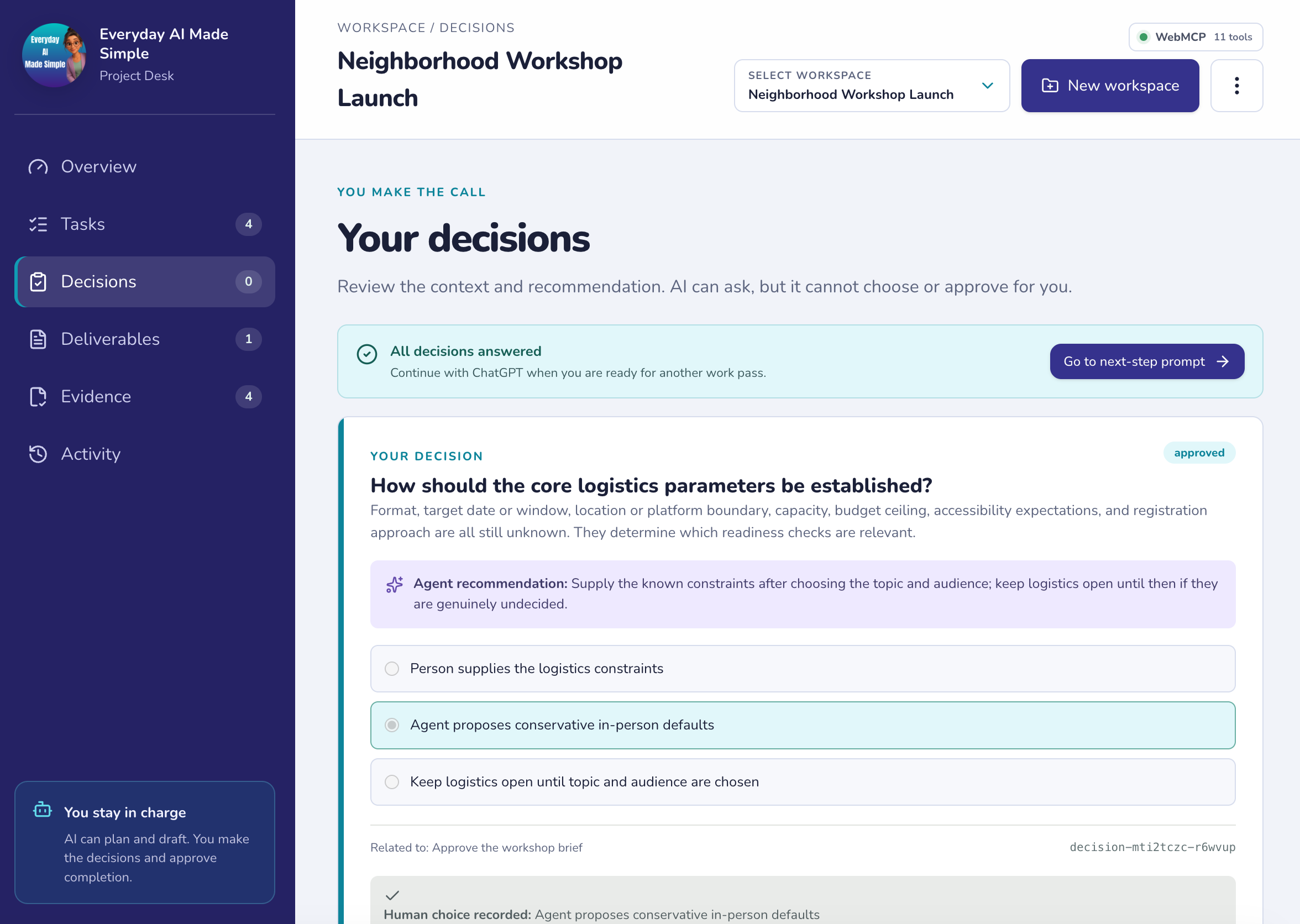
Decisions the agent identified the human needs to make
-
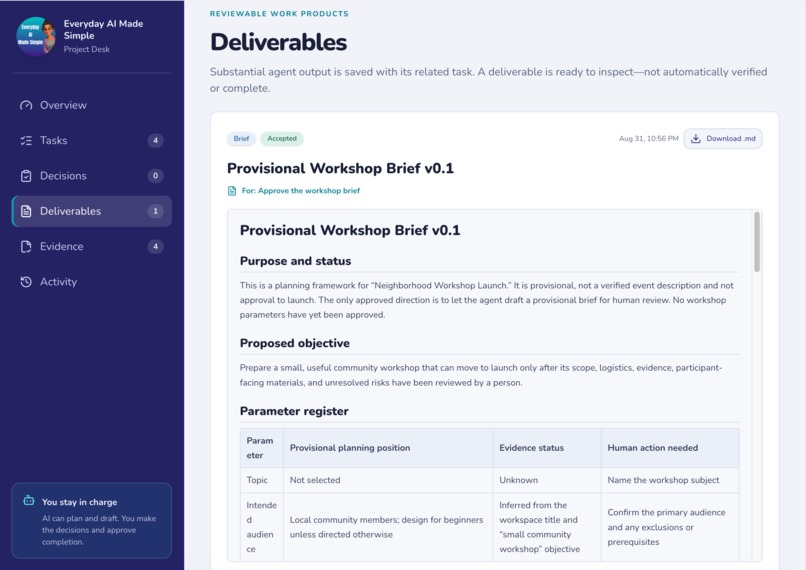
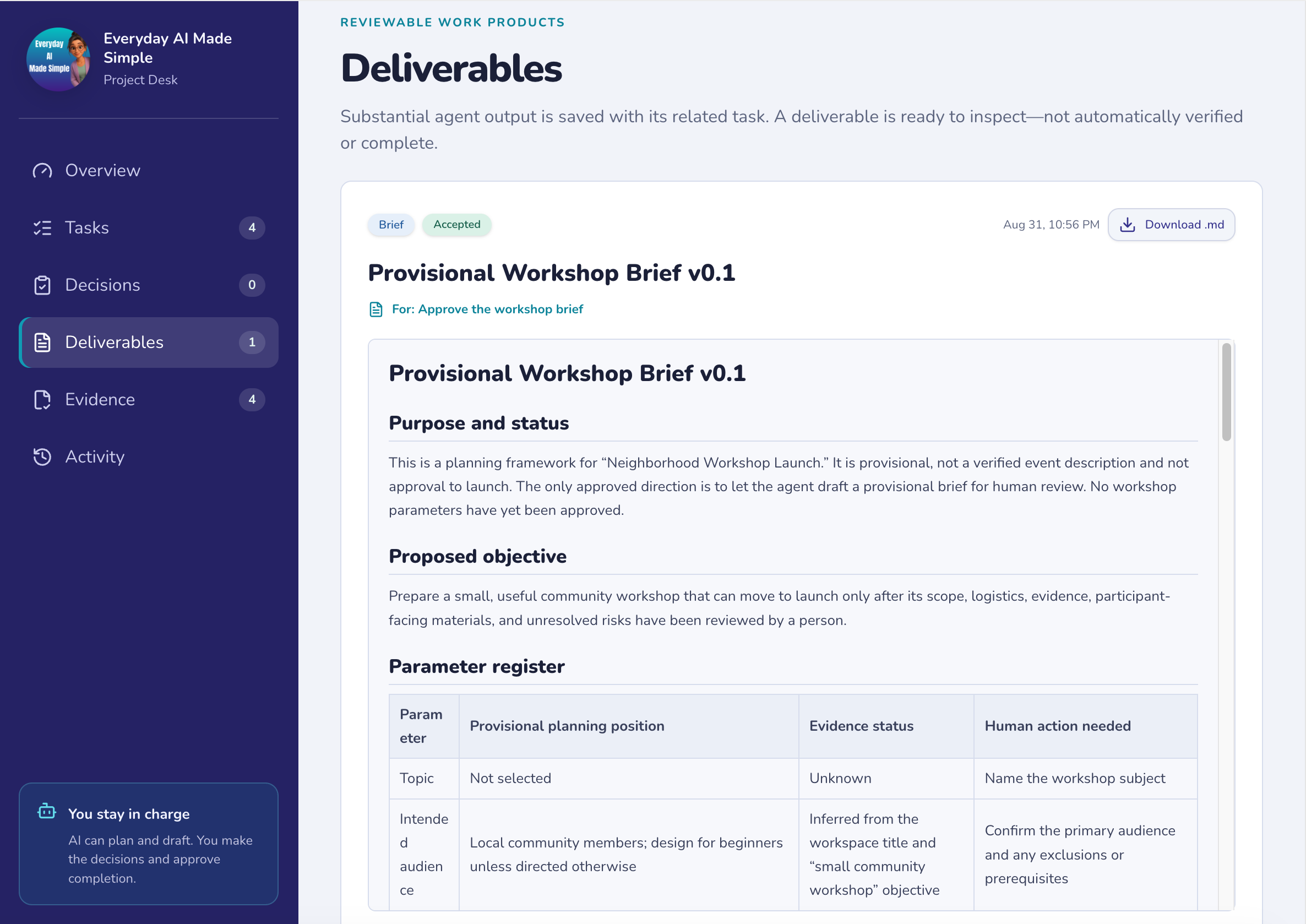
Deliverables the agent created based on the tasks and decisions
-
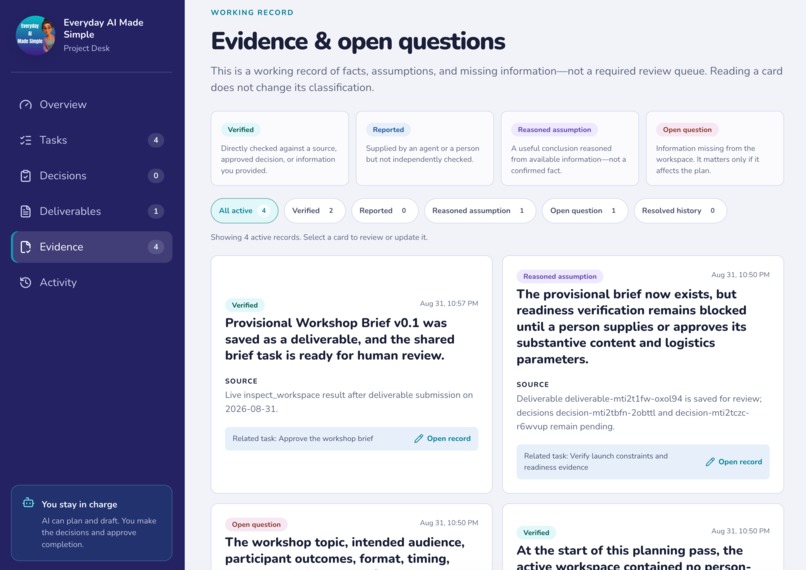
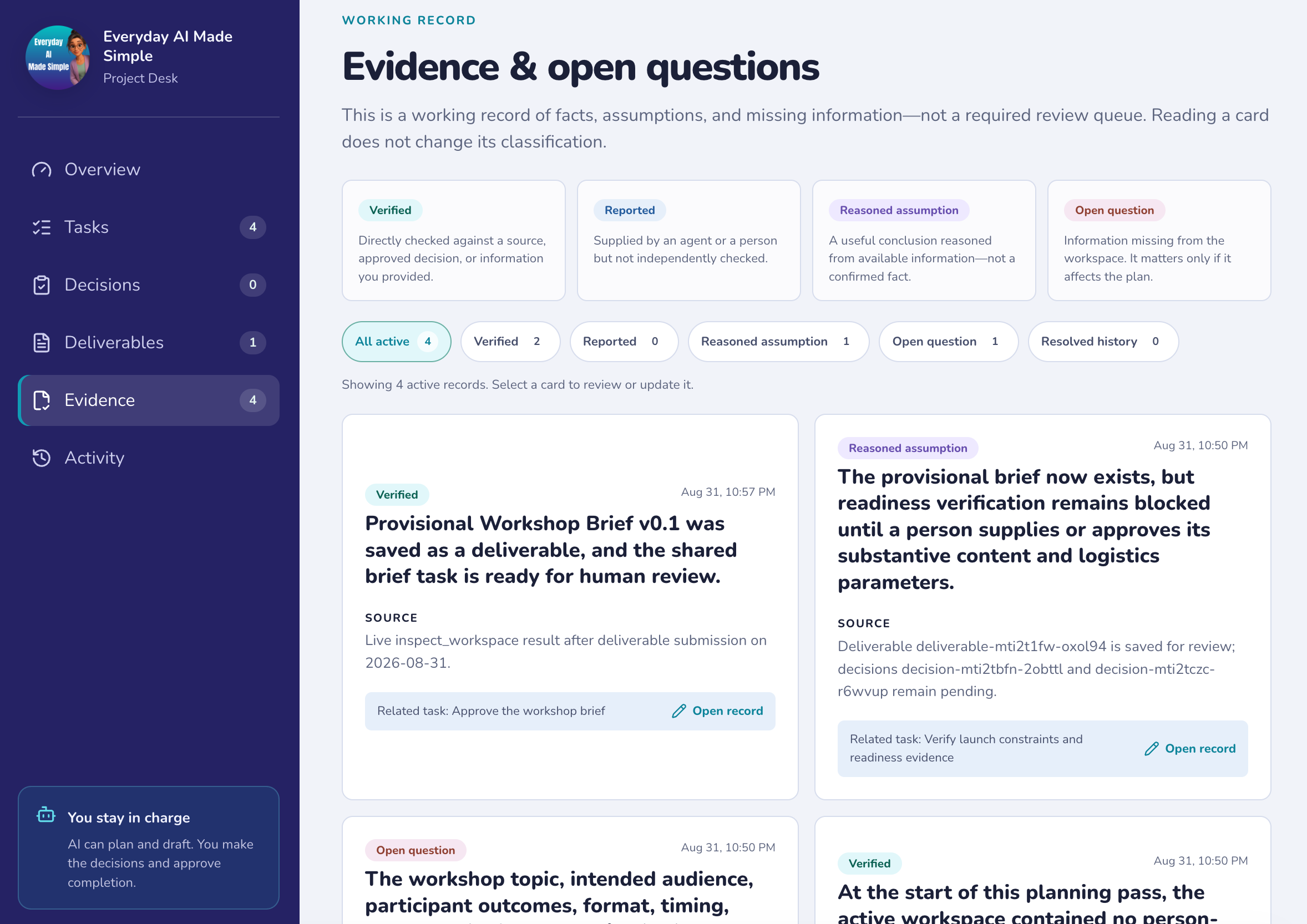
A working record of facts, assumptions, and missing information.
-
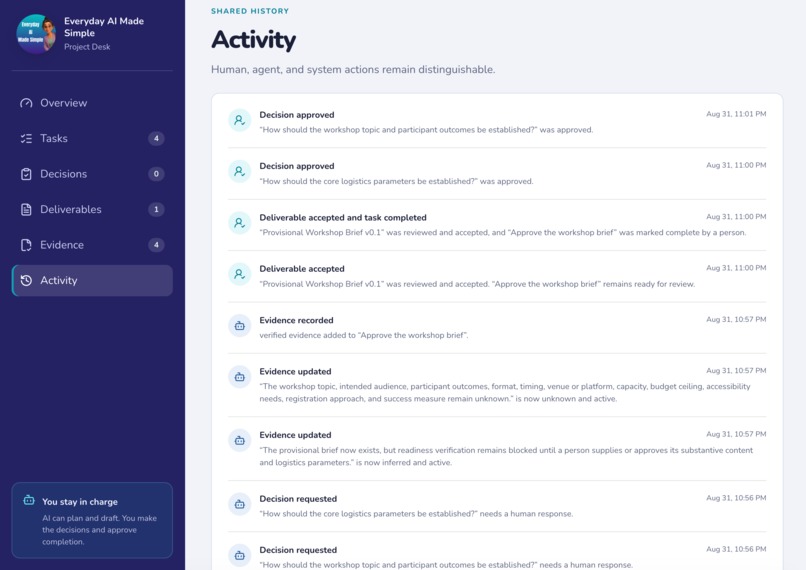
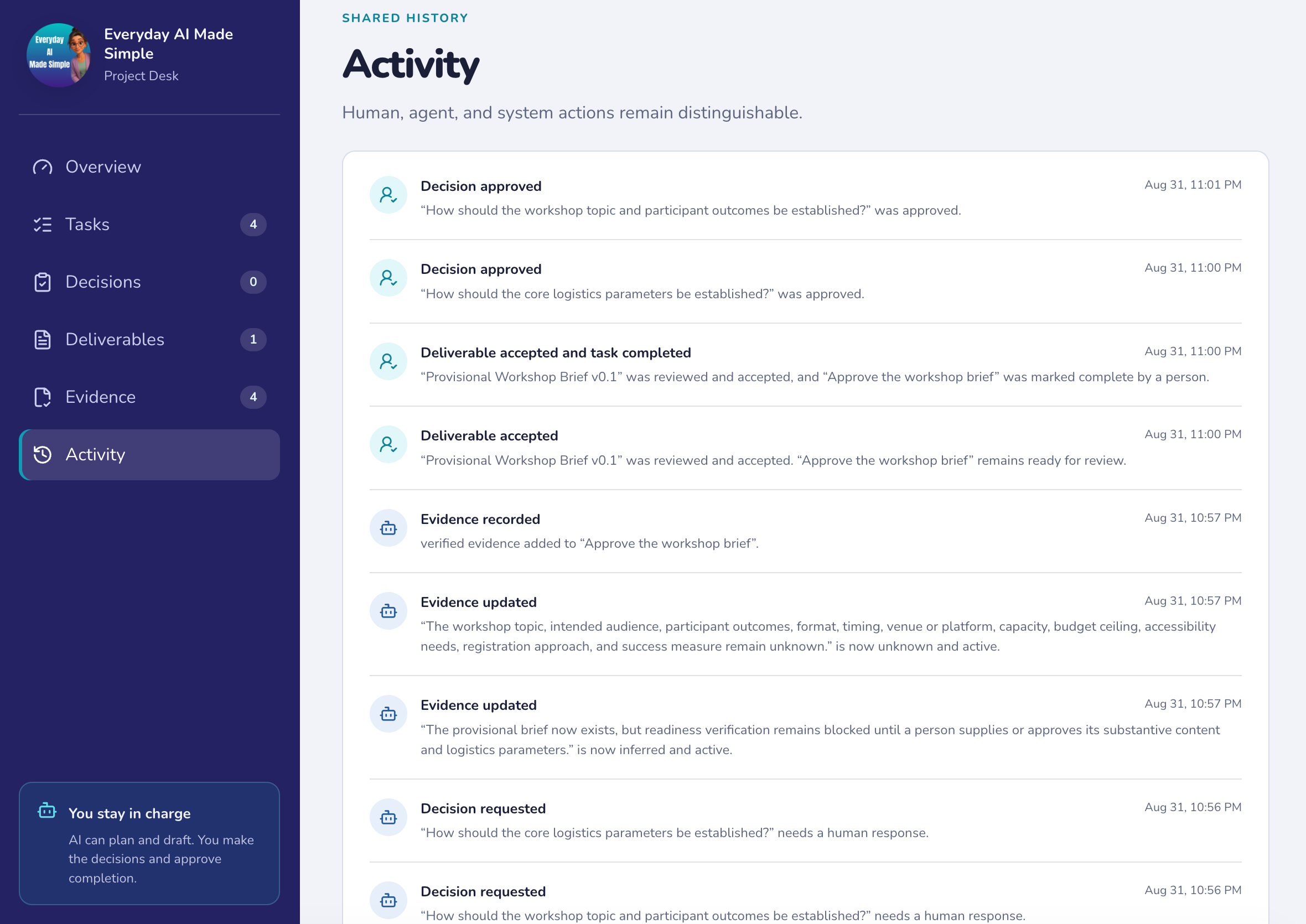
Human, agent, and system actions in a shared history.
About Project Desk
AI agents can create plans, recommendations, and drafts quickly, but the work often remains scattered across chat. People have no durable shared surface for seeing what is verified, what is inferred, what is still unknown, what needs their judgment, and what has actually been approved.
Project Desk was built to make that collaboration legible. It gives a person and an agent one project workspace with tasks, decisions, evidence, deliverables, and activity history.
What it does
A person creates a browser-local workspace and describes an objective. They may add tasks or references themselves, then ask ChatGPT to plan through the open app. The agent inspects the workspace, creates only necessary tasks, records clearly classified evidence, and requests human decisions where judgment is required.
After the person answers, the same reusable handoff starts another work pass. The agent reads the latest decisions and references, reconciles stale or answered evidence, and saves substantial plans, briefs, checklists, drafts, or other work products directly into the relevant tasks. The person can request changes, accept a deliverable while keeping the task open, or accept and complete it.
Project Desk is local by design. Workspace data stays in the current browser unless the person deliberately exports it, restores a backup, uploads a bounded reference, or asks ChatGPT to work with the open page.
Why WebMCP
Without WebMCP, the agent would have to guess at page meaning from buttons and layout, rely on coordinate clicks, or return work to chat where it becomes detached from project state.
Project Desk exposes eleven typed domain actions against the same live workspace the person is reviewing. The agent can inspect state, read references and approved decisions, add necessary work, submit deliverables, record and reconcile evidence, and request judgment. The tool boundary deliberately withholds workspace selection, deliverable acceptance, unrestricted task editing, and human completion.
The linked GitHub repository includes the WebMCP tool reference, implementation details, and testing documentation.
Instead of repeatedly copying plans, decisions, and revisions between ChatGPT and a separate project tracker, the person and agent can keep the work in one shared workspace. After the person supplies decisions or references, the agent can inspect the updated project, reconcile outdated evidence, advance multiple tasks, and save reviewable deliverables, while the person retains control over acceptance and completion throughout repeated work-and-review rounds.
That creates a safer and more useful human-agent loop: the agent can contribute work to a structured application, while evidence, uncertainty, decisions, and final authority remain visible to the person.
How it was built
Project Desk is a React and TypeScript application packaged for ChatGPT Sites. It uses imperative document.modelContext.registerTool registration for eleven WebMCP tools, explicit JSON schemas for tool inputs, and browser-local storage for project state. Vitest covers workspace isolation, prompt behavior, evidence reconciliation, deliverable review, stale approvals, backup validation, and progress calculation.
Challenges
The hardest design problem was defining where the agent power should stop. The workflow went through repeated usability tests to remove circular approval steps, distinguish task review from completion, make unanswered evidence actionable, reconcile stale claims after a person supplies information, and explain how repeated work passes are started.
Accomplishments
- Eleven discoverable WebMCP tools with meaningful project-level actions.
- A complete planning, decision, work, reconciliation, review, and completion loop.
- Substantial agent deliverables saved in the app rather than stranded in chat.
- Evidence classifications and history that distinguish verified facts, reports, assumptions, and open questions.
- Explicit human control over workspace selection, acceptance, and completion.
- Local backup, restore, export, reset, and bounded reference-file support.
What I learned
I learned that effective WebMCP tools require more than connecting an agent to an app. The tools need clear descriptions, predictable state changes, visible feedback, and thoughtful approval boundaries so people understand what the agent did and what still needs their judgment.
The importance testing by humans still plays in this world where AI can do much of the coding and testing themselves. Testing Project Desk also showed me how important guided onboarding and shared, reviewable work products are for making agent-assisted workflows feel trustworthy and useful. I would not have gotten there without human testing being in the process.
What's next for Project Desk
After the challenge, Project Desk will become a free Everyday AI Made Simple resource. I have a free resources hub where I provide thoughtful resources to people learning how to use AI tools. Future work may include a version with optional account-based synchronization and templates while retaining the current local-first mode and human-approval boundaries.
Built With
- chatgpt-sites
- radix-ui
- react
- tailwind-css
- typescript
- vinext
- vite
- vitest
- webmcp

Log in or sign up for Devpost to join the conversation.