Inspiration
As humanity sets its sights on Mars and beyond, the logistical tether to Earth becomes impossible to maintain. We realized that for interplanetary civilization to thrive, we can't just bring our food—we must bring our ecosystems. Project D.O.T. (Dynamic Orbital Terra-synthesis) was inspired by the need for a closed-loop, self-sustaining agriculture system capable of generating and maintaining nutrient-dense soil in microgravity environments.
What it does
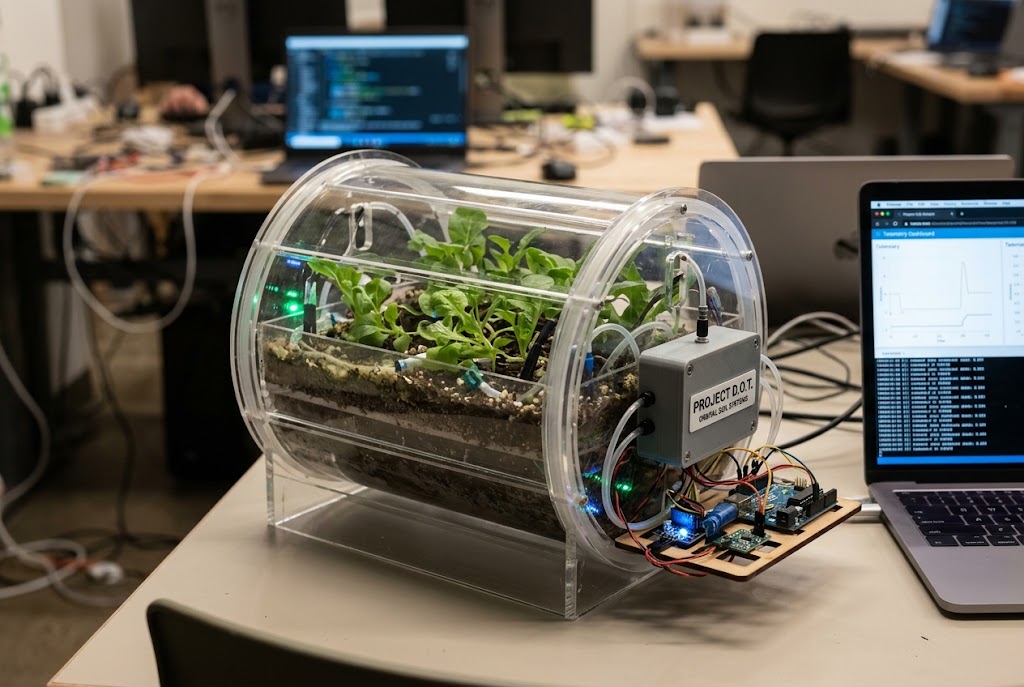
Project D.O.T. is an autonomous, IoT-driven biodome system that synthesizes artificial soil from organic waste and regulates environmental parameters for optimal crop yield in space. It uses a machine-learning backend to constantly monitor soil health, hydration levels, and ambient radiation, dynamically adjusting the biome to ensure plant survivability.
On the software side, we developed a Python-based backend utilizing a predictive Machine Learning model (built with TensorFlow). This model calculates the precise rate of nutrient degradation and autonomous replenishment. We used the following decay-replenishment model to balance the soil's nitrogen levels:
How we built it
The hardware prototype was built using modular acrylic pods, rigged with Arduino-controlled environmental sensors (humidity, NPK levels, temperature, and pH).
Challenges we ran into
Simulating microgravity fluid dynamics was incredibly difficult. Watering soil in space often leads to water pooling or floating away, which causes root rot or dehydration. We had to design and 3D-print a custom capillary-action drip system that forces water directly into the root mesh, bypassing the need for gravity. Additionally, calibrating the NPK sensors to avoid false positives from our synthetic fertilizer mix took over 20 hours of troubleshooting.
Accomplishments that we're proud of
Did this less than an hour
What we learned
We learned how to integrate hardware sensors with a cloud-based predictive algorithm and gained massive respect for astrobotanists. We also learned that handling state management in React is remarkably similar to managing the equilibrium of a delicate biome!
What's next for Project D.O.T. - Orbital Soil Systems
We plan to scale our single-pod prototype into a multi-pod network, introducing mycelium networks into our artificial soil to better break down complex organic waste. We are also aiming to open-source our telemetry dashboard for other space-agri researchers.
Built With
- 3d-printing
- arduino
- autodesk-fusion-360
- c++
- flask
- hardware
- iot
- machine-learning
- node.js
- pandas
- python
- raspberry-pi
- react
- tensorflow

Log in or sign up for Devpost to join the conversation.