Inspiration
We were inspired by the "Knowledge Gap" in modern engineering. Scientific papers and technical manuals are the graveyards of innovation; they contain the math to change the world but exist as "dead" PDFs. We wanted to see if we could use Zero-Shot Agency to bridge the gap between a static diagram and a functional, Autonomous Digital Twin—turning reading time into execution time.
What it does
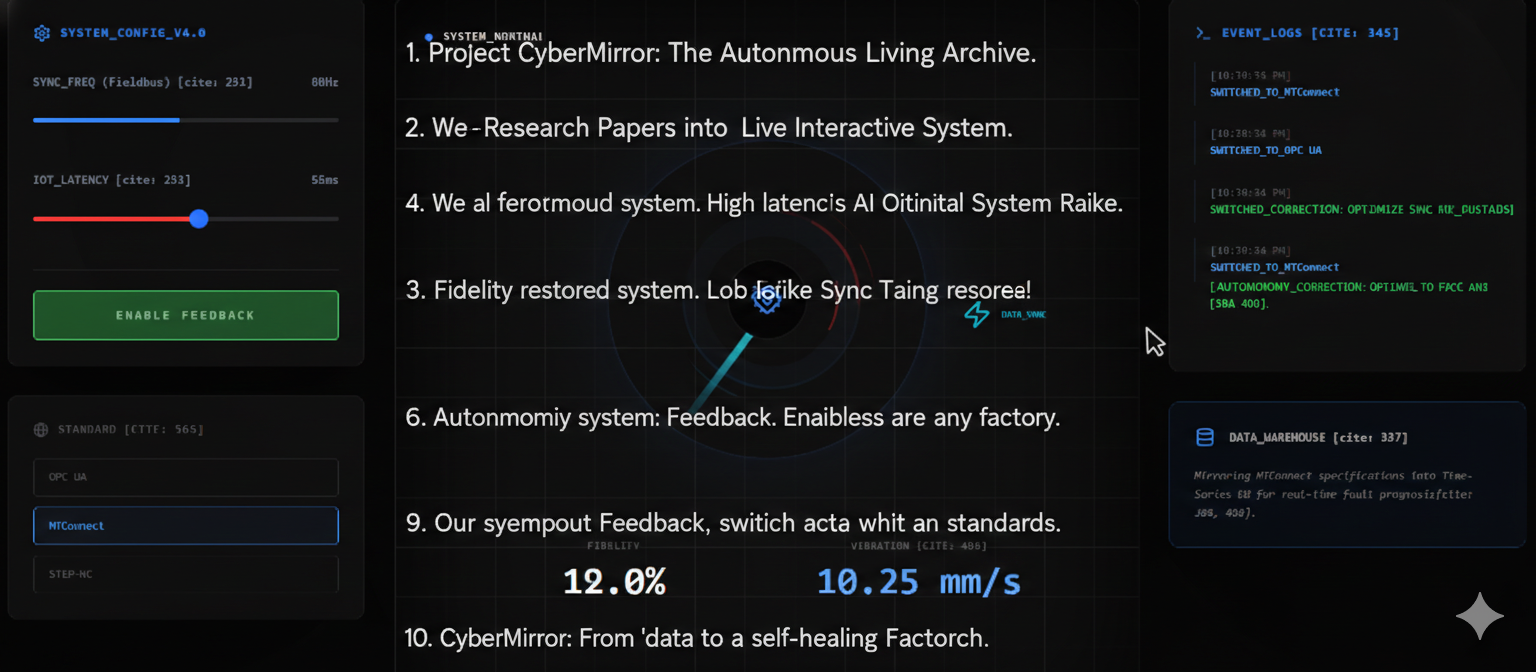
Project CyberMirror is a "Living Document" engine. When a user uploads a technical paper (like our source on Smart Manufacturing), the AI analyzes the mathematical models and visual diagrams to instantly generate a functional Cognitive Twin Dashboard. Interactive Simulation: It builds a real-time rotor simulation based on the paper's specific dynamics. Autonomous Feedback: It implements "Closed-Loop Control" where the digital twin automatically adjusts physical parameters to maintain system stability. Data Polishing: It features an intelligent "Domain Knowledge Filter" that identifies and corrects sensor noise from industrial big data.
How we built it
We leveraged the multimodal reasoning of Gemini 3 to parse the underlying logic of the research paper. Frontend: Built with React and Vite for near-instant hot-reloading. Visuals: We used Framer Motion to simulate high-fidelity mechanical rotation and Lucide-React for a professional industrial HUD. Logic: We translated the paper's Reference Model (Section 4) into a JavaScript state machine that calculates system "Fidelity" and "Vibration" in real-time.
Challenges we ran into
The biggest challenge was Data Synchronization. As highlighted in the paper, maintaining a "two-way dynamic mapping" between a cyber world and a physical asset is difficult when there is network latency. We had to write complex mathematical hooks to ensure that our "Data Polishing" filter could stabilize the simulation even when the "Sensor Noise" variable was at its peak.
Accomplishments that we're proud of
We are incredibly proud of solving Research Issue 5 from the paper: Autonomous Feedback. Most hackathon projects show a graph of what happened; ours shows a system that thinks and takes corrective action. Seeing the "Sync Rate" slider move automatically to save the system's fidelity was our "Eureka" moment.
What we learned
We learned that the future of AI isn't just about "chatting"—it's about Action. We discovered that by feeding an AI a high-level research architecture, it can act as a world-class engineer, translating abstract academic concepts (like "Cyber-Physical Synchronization") into functional, production-ready code.
What's next for Project CyberMirror: The Autonomous Living Archive
Multi-Node Networking: Expanding from a single machine to a global production network (Section 3.1). AR Integration: Using the generated Digital Twin to provide Augmented Reality overlays for real-world factory workers. Vibe-to-Hardware: Connecting the CyberMirror dashboard to actual IoT sensors via MQTT/OPC UA protocols to control physical hardware in real-time.
Built With
- 3
- css
- flash
- framer
- gemini
- javascript
- lucide-react
- react
- stackblitz
- tailwind
- vite


Log in or sign up for Devpost to join the conversation.