Project Cortex
Inspiration
The rapid growth of AI is driving an unprecedented wave of data centre construction around the world, especially in India. Industry forecasts project India's data centre capacity to grow from approximately 900 MW in 2024 to more than 2,700 MW by 2027, representing over $15 billion in infrastructure investment. At the same time, we've seen increasing news coverage of data centre outages, commissioning issues, and operational disruptions, highlighting how critical reliable project delivery has become.
As we explored these incidents, one question kept coming back:
*What happens before a data centre goes live? *
Behind every hyperscale facility are thousands of engineering documents, vendor notices, RFIs, specifications, schedules, inspection reports, commissioning procedures, and emails. The information already exists—but it lives in disconnected documents that engineers manually connect to understand dependencies and project risks.
We realized the problem wasn't a lack of information.
*The information is fragmented. *
That inspired us to build Project Cortex.
The name comes from the cerebral cortex—the part of the brain responsible for integrating information, reasoning, and decision-making. Project Cortex applies the same principle to EPC projects by bringing fragmented project knowledge into a single intelligent model capable of reasoning over the entire project instead of isolated documents.
What it does
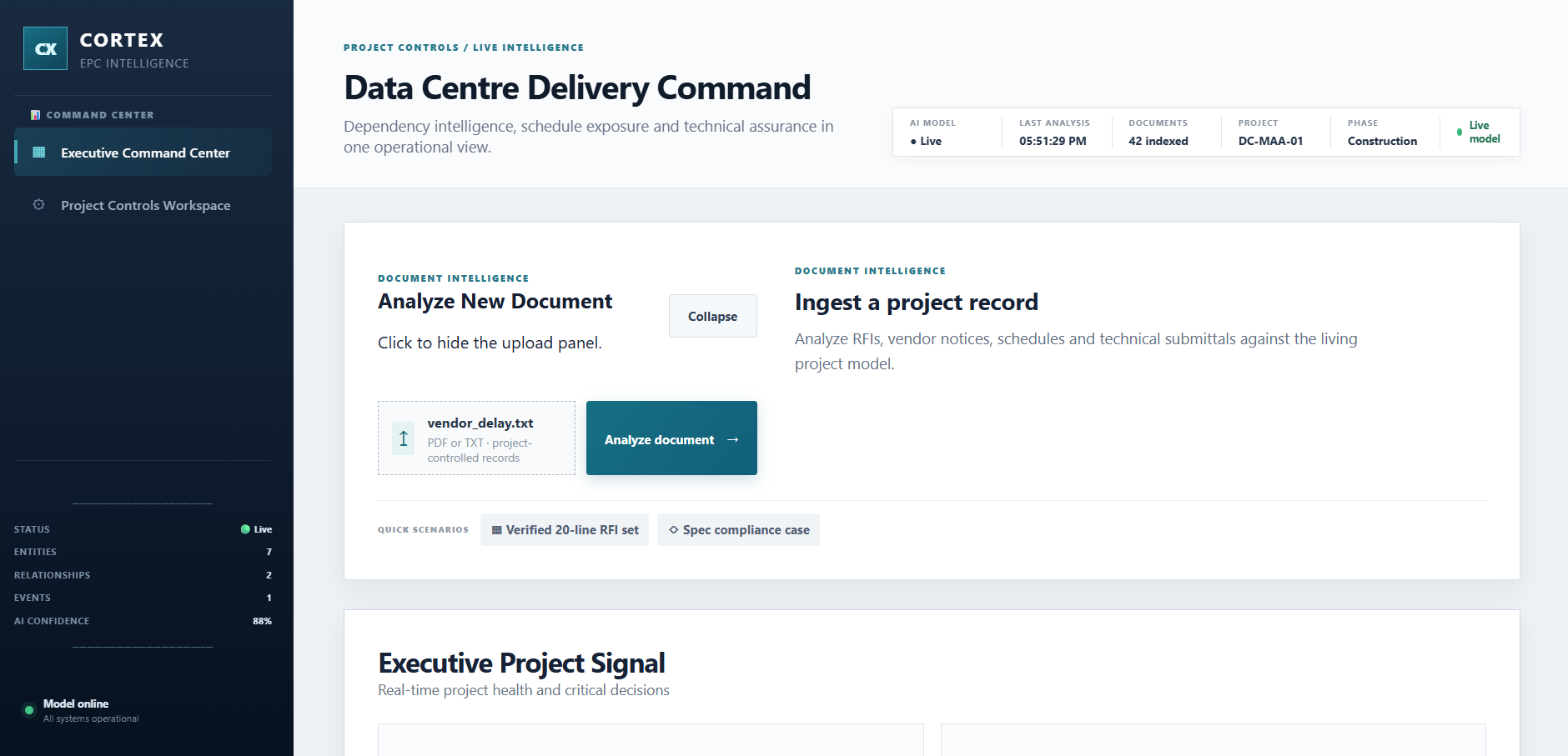
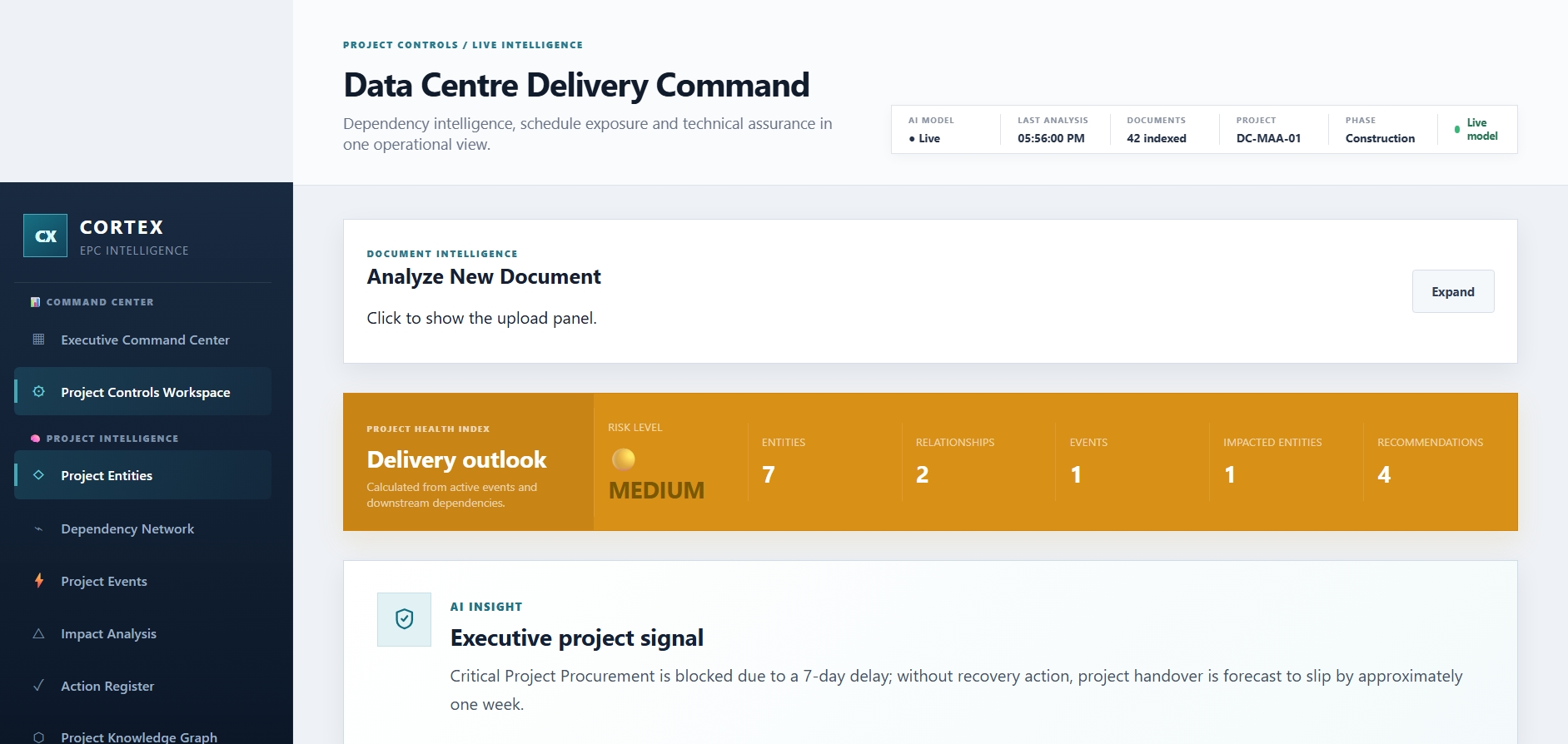
Project Cortex is an AI-powered project intelligence platform for Engineering, Procurement and Construction (EPC) projects, initially focused on data centre delivery.
Instead of summarizing one document at a time, it builds a persistent understanding of the entire project.
Every uploaded document is transformed into:
- Structured entities
- Relationships
- Project events
- A connected Knowledge Graph
- A continuously evolving Living Project Model
From this foundation, Project Cortex can:
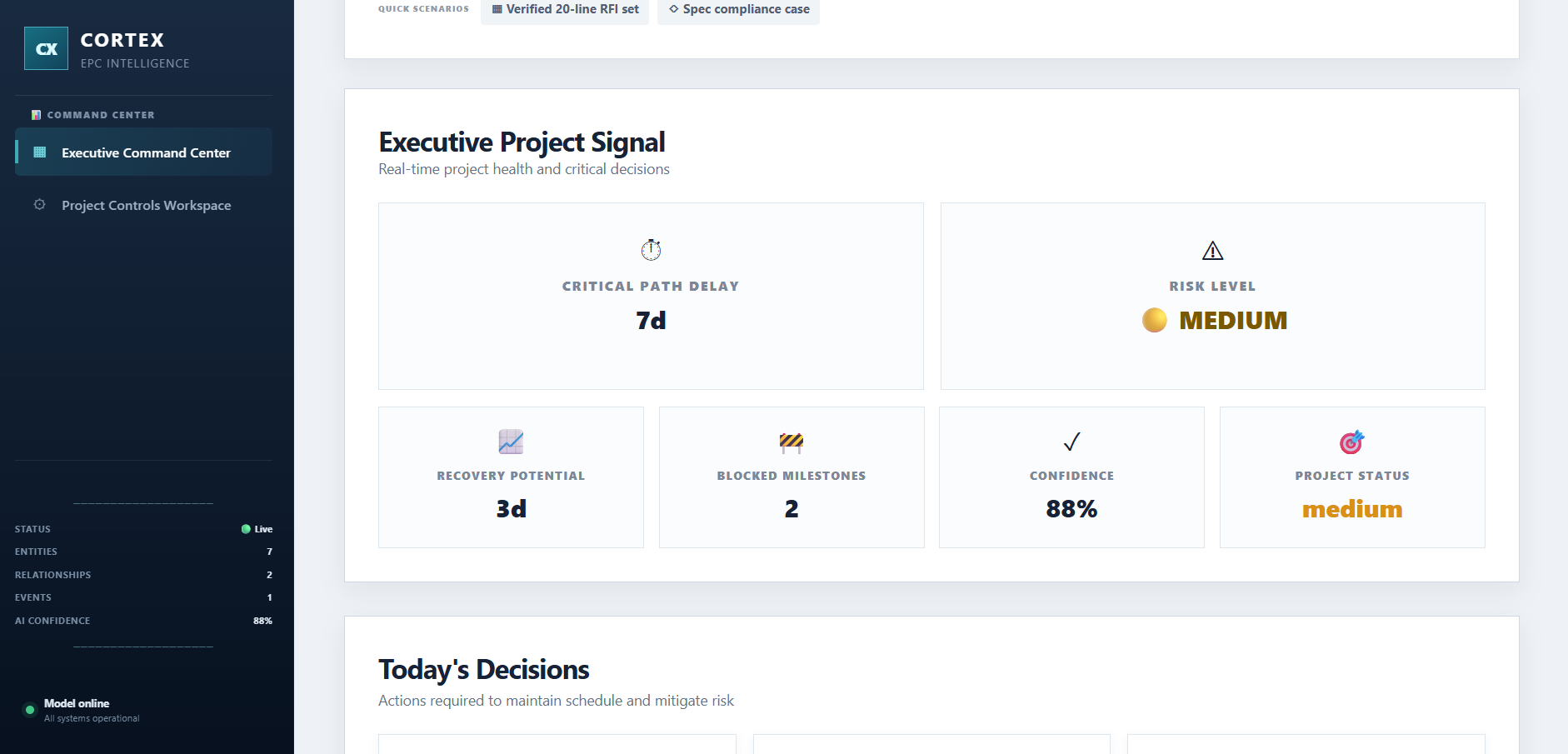
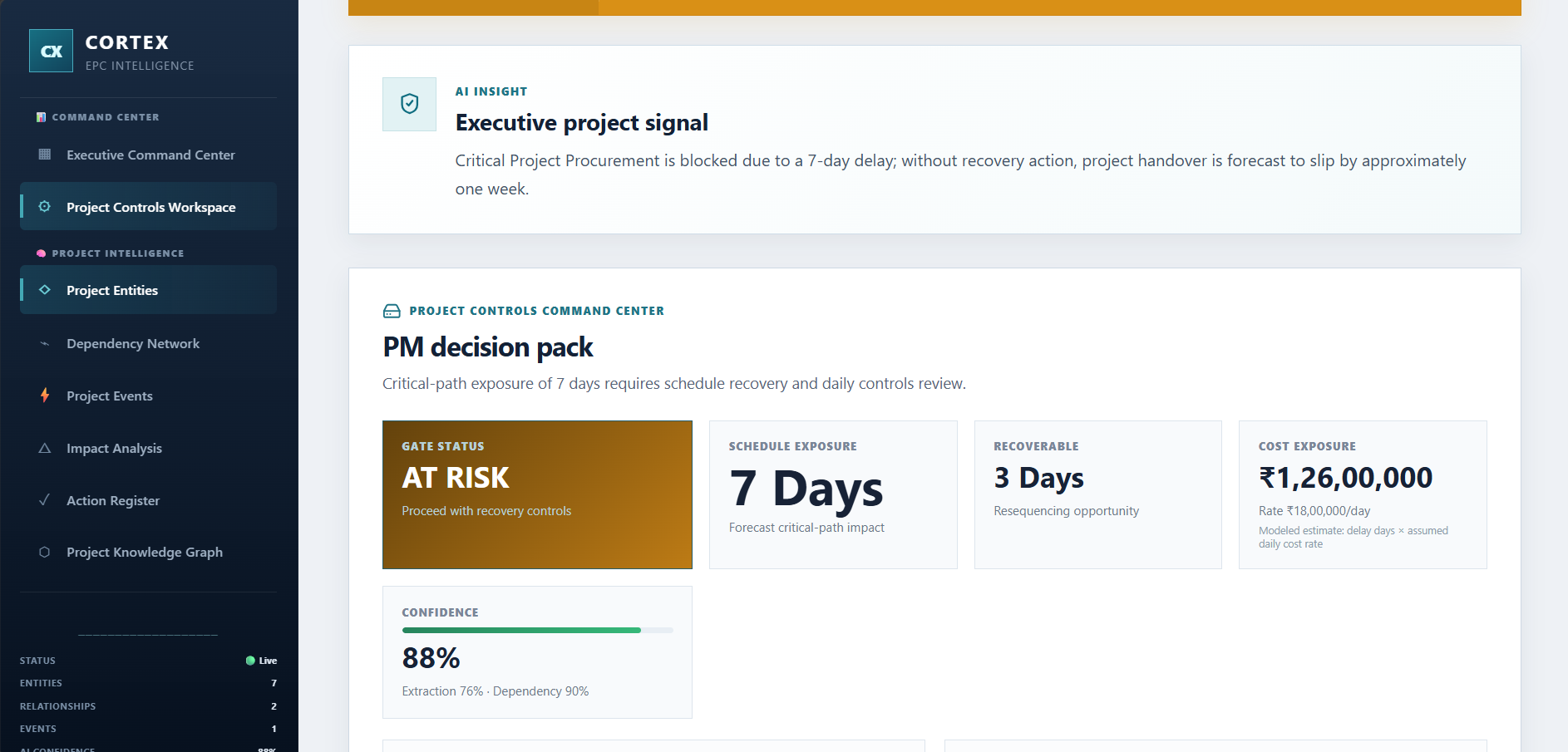
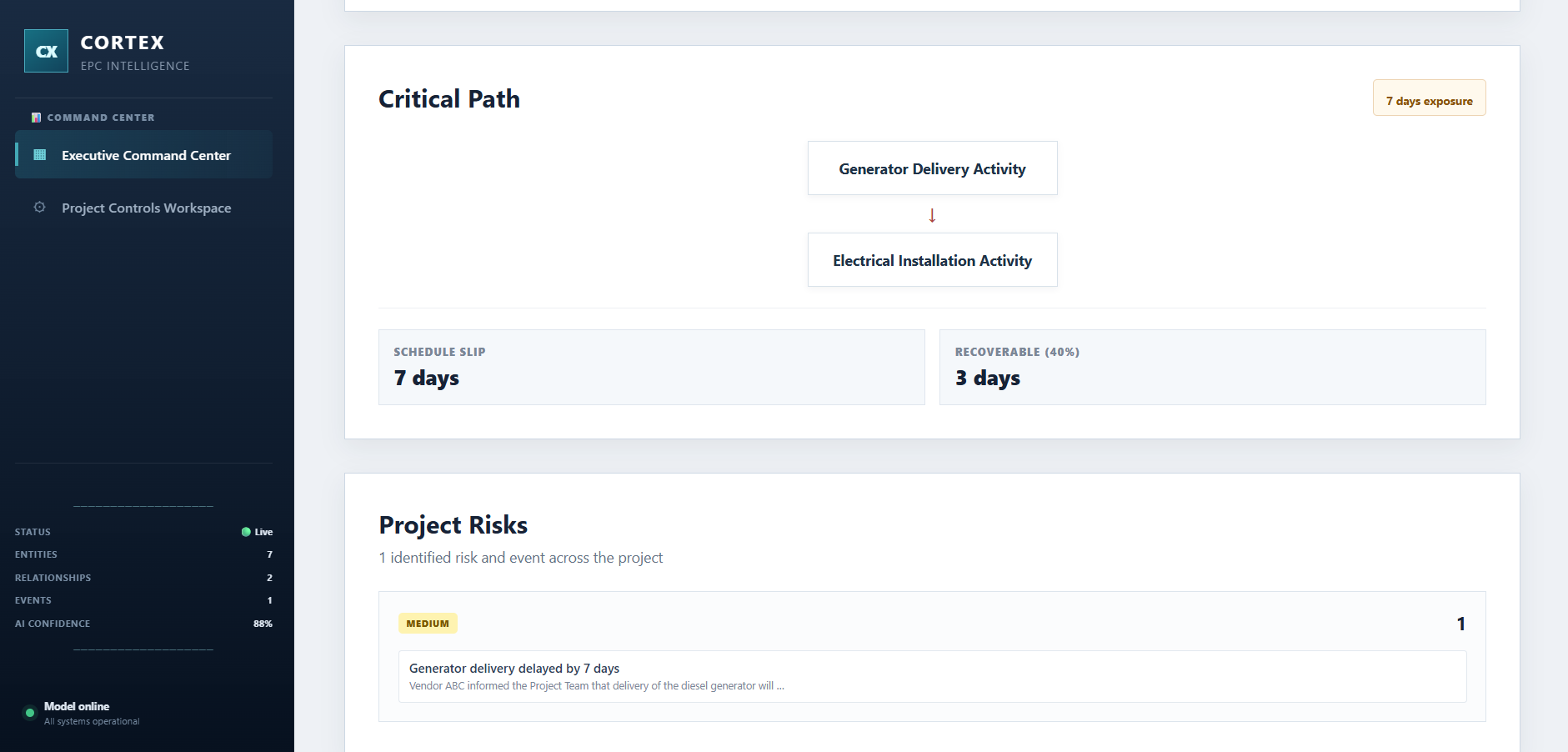
- Detect downstream schedule impacts
- Analyse dependency chains
- Perform specification compliance checks
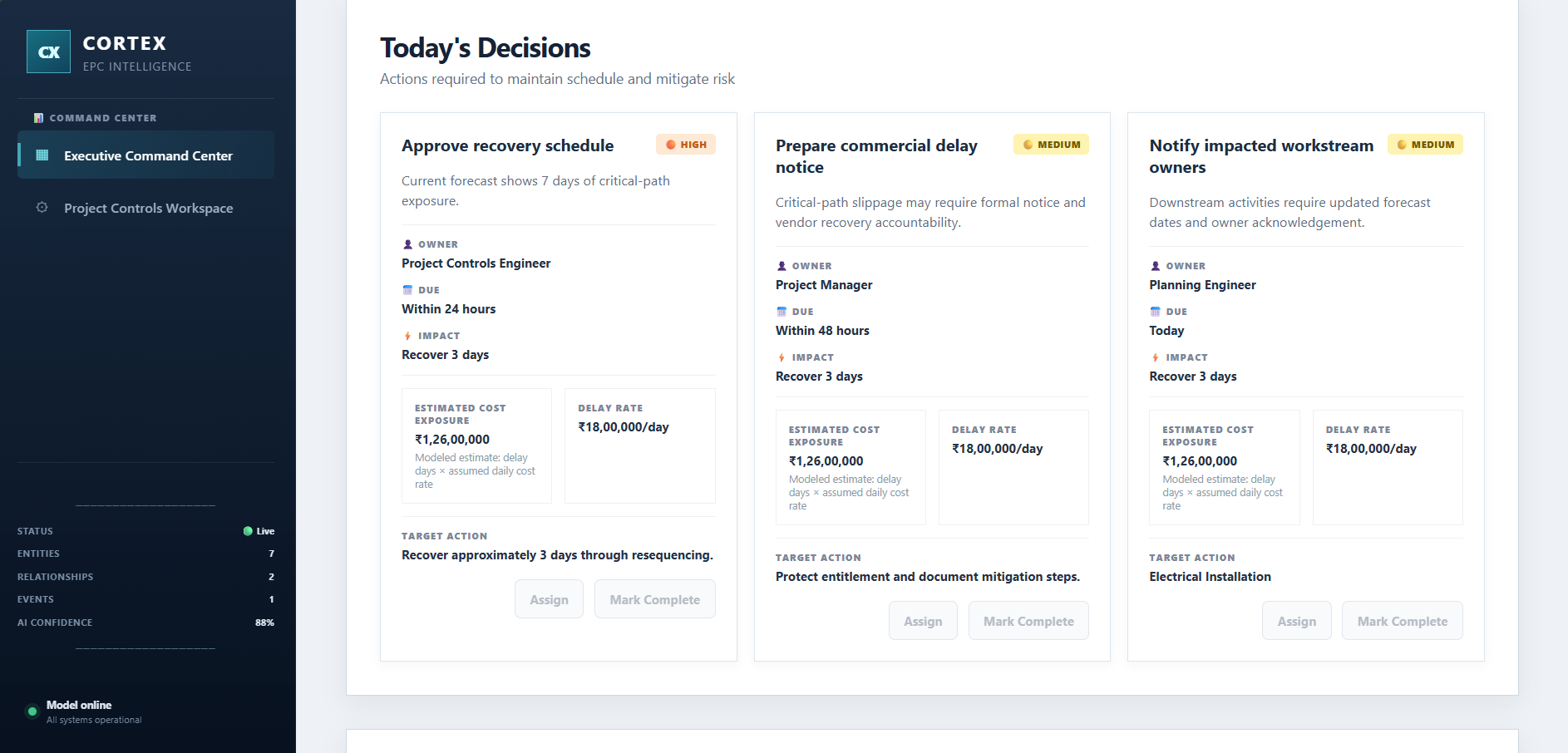
- Generate explainable recommendations
- Produce executive-ready decision support
Rather than another AI chatbot, Project Cortex becomes a continuously updated digital understanding of the project.
How we built it
Project Cortex combines Large Language Models with deterministic software engineering.
Frontend
- React
- Vite
Backend
- Python
- FastAPI
AI
- OpenAI GPT-5 (Responses API)
GPT-5 is used only for one responsibility:
*Converting unstructured engineering documents into structured project knowledge. *
It extracts:
- Entities
- Relationships
- Events
using constrained JSON outputs.
Knowledge Layer
The extracted information is compiled into:
- Typed domain models
- A directed dependency graph using Network
- A Living Project Model that evolves as new project events occur
Reasoning Engine
Unlike many AI applications, GPT-5 does not calculate project risks or make business decisions.
Everything after extraction—including:
- dependency propagation
- schedule analysis
- compliance checking
- impact assessment
- recommendations
is performed using deterministic algorithms.
This architecture ensures every recommendation is explainable, reproducible, and auditable.
Challenges we ran into
The biggest challenge was finding the right balance between AI flexibility and engineering reliability.
Initially, it was tempting to let the language model answer every project question directly. However, that approach produced outputs that were difficult to verify and unsuitable for engineering workflows.
Instead, we separated responsibilities:
- GPT-5 understands documents.
- Deterministic software understands projects.
Another challenge was designing a graph representation capable of modelling real engineering dependencies while remaining efficient enough for reasoning across thousands of connected entities.
Building the Living Project Model required multiple iterations before it accurately represented both static project structure and continuously changing project state.
What we learned
Building Project Cortex changed how we think about enterprise AI.
The most valuable role for an LLM isn't making every decision—it's transforming messy, unstructured information into structured knowledge.
Once information becomes structured, traditional software engineering techniques such as graphs, state models, and deterministic algorithms become incredibly powerful.
We also learned that explainability is essential in engineering environments. Project teams need to understand why a recommendation exists, not simply receive one.
What's next
Project Cortex is only the beginning.
Our roadmap includes:
- Primavera P6 integration
- Microsoft Project integration
- Neo4j graph persistence
- Multi-project reasoning
- Portfolio-level risk intelligence
- Computer vision for engineering drawings
- Specification verification
- Enterprise-scale digital twins
Although the current prototype focuses on data centre EPC delivery, the underlying architecture can be extended to other complex infrastructure domains including semiconductor fabrication plants, metro rail systems, airports, renewable energy, and power infrastructure.
Our long-term vision is simple:
*Build an AI system that continuously understands, reasons about, and supports the delivery of the world's most complex engineering projects. *

Log in or sign up for Devpost to join the conversation.