-
-
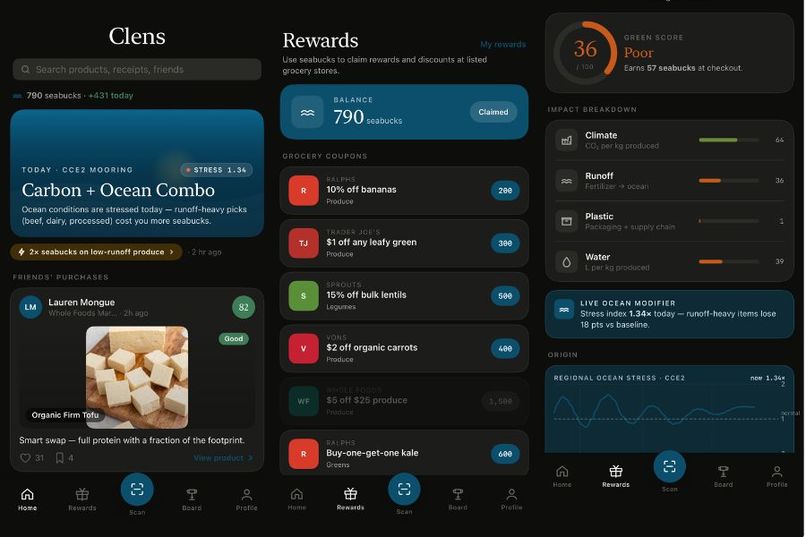
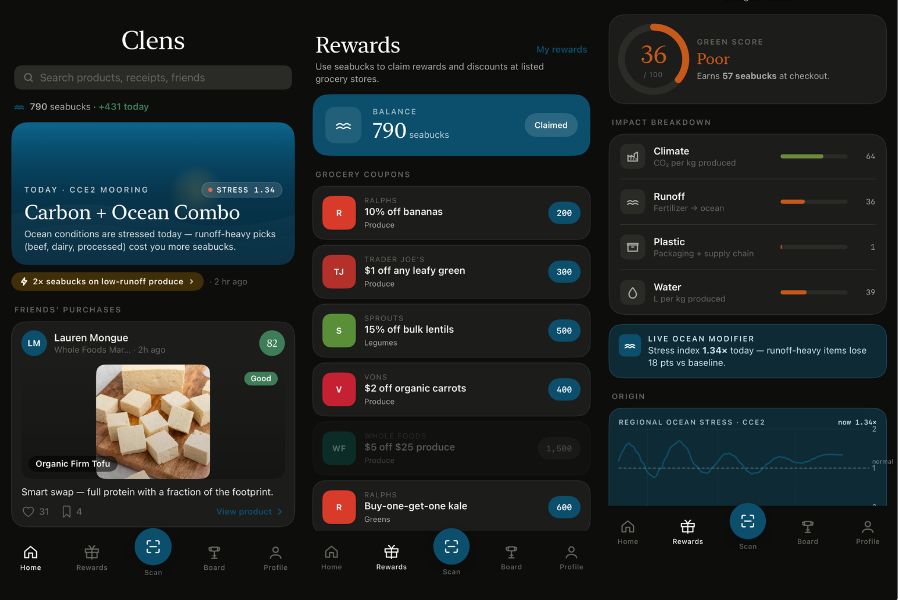
Screenshots of different screens inside of our app
Inspiration
We wanted to make an app that allowed users to make environmentally healthy decisions when buying food. There are tons of apps that scan barcodes and tell you how good they are for you but what about one that tells you how good it is for the environment? The environment is often overlooked in scenarios like these and giving people a tool to be more environmentally conscious on a daily basis is something our world needs.
What it does
Our app allows users to be more environmentally conscious when buying things like groceries at the supermarket. Upon login, the users can go to the scanning feature where they can scan any barcode and using our machine learning algorithm we calculate a numeric value for how environmentally friendly it is based on 4 categories. The 4 categories are: carbon pollution, runoff risk, water usage, and plastic usage. When a user takes a picture of a receipt, we evaluate it via a model we trained and an LLM for assistance since our dataset wasn't large enough and award points depending on how environmentally friendly the sum of everything on that receipt is. Users can see their points on their profiles and ideally redeem rewards at actual stores such as 10% of x type of food and can compete with friends to see who scored the most points.
How we built it
We established the system with a database made by Supabase that holds all user information and points. The points for both barcode scanning and receipt reading were calculated using a machine learning algorithm created with the following datasets: C- CCE Mooring (Scripps)-ocean stress multiplier CalCOFI-Secondary Scripps context OpenFoodFacts-(barcode) Agribalyse-(CO₂) We also included a demo using different coupons for various stores to show how users could redeem coupons via their points.
Challenges we ran into
Our model for getting the scores kept breaking when we changed the name of the product we fed into the algorithm. This was hard to figure out why it did that but we figured it was because part of our analysis involved an LLM call and it reacts differently with variation depending on different input parameters.
Accomplishments that we're proud of
We have the pipeline done. Camera to receipt to per-item classification to scored basket to sea bucks credited to redeemable rewards, all on a real phone. We have an explainable scoring engine. Every OceanScore breaks down into water / climate / plastic components, and the runoff component moves with the Scripps-derived stress index shown on the home screen.
What we learned
Don't trust a remote dependency you can't debug. Local-first with eventual sync would have saved us hours if we'd defaulted to it from day one. Explainability is a product feature and everyone on your team should be able to demonstrate this feature.
What's next for King Warren and the 3 Hackers
A shopping-list agent that builds a basket maximizing sea bucks under dietary + budget constraints, not just scoring what a user already bought. Live event modifiers like 2× sea bucks on specific categories during an active algal bloom or hypoxic event on the CCE2 mooring. Partnerships with local grocers so sea bucks redeem for actual in-store discounts, turning the demo's reward screen into a real consumer behavior loop.


Log in or sign up for Devpost to join the conversation.