
Inspiration
We are computer engineering students. Together, we have worked on multiple ideas and spent hours building and designing software projects. Whether it be personal ideas we have come up with or class assignments, we have thoughtfully worked with AI-assisted development and have extensively written AI tool prompts, using AI tools in every project we worked on and that led us to a common point where we as a team analyzed a problem we faced which is getting lost when working on a project and always feeling overwhelmed by the scattered data across thousands of sources and databases. We discussed how we can solve this issue to make our working process smoother.
While working, we have experienced consistent misunderstanding and difficulty incorporating AI into the processing of new projects. AI agents sometimes hallucinate and cause distortions while entering a new organization or a new project that is already in process. The result is distortion and deviation in the decisions, documents, MD files, plans, multiple chats with AI, new features, and code changes. It seems as though AI agents get confused and forget the central commands it was given. If the developer takes a break for a while and returns to the project, all the data and commands will get lost and they will have to start over.
What is even worse is that when we used multiple AI tools, most important decisions remained locked inside the old chats, documentation became outdated, and completed work was difficult to verify. It is worth noting that every new AI session required us to re-explain from scratch and reteach the model every bit, and that kept us in a vicious circle, squandering our precious time and efforts. Working with such models did not guarantee the result we aspired for, so we had to stop a little bit and brainstorm. We then decided to establish The Brain, the assistant for the new generation of software engineers. It is reliable and memory-resilient and can understand the repository, preserve its context, connect tasks to evidence, and, with that knowledge, keep the developers and the AI tools aligned.
What it does
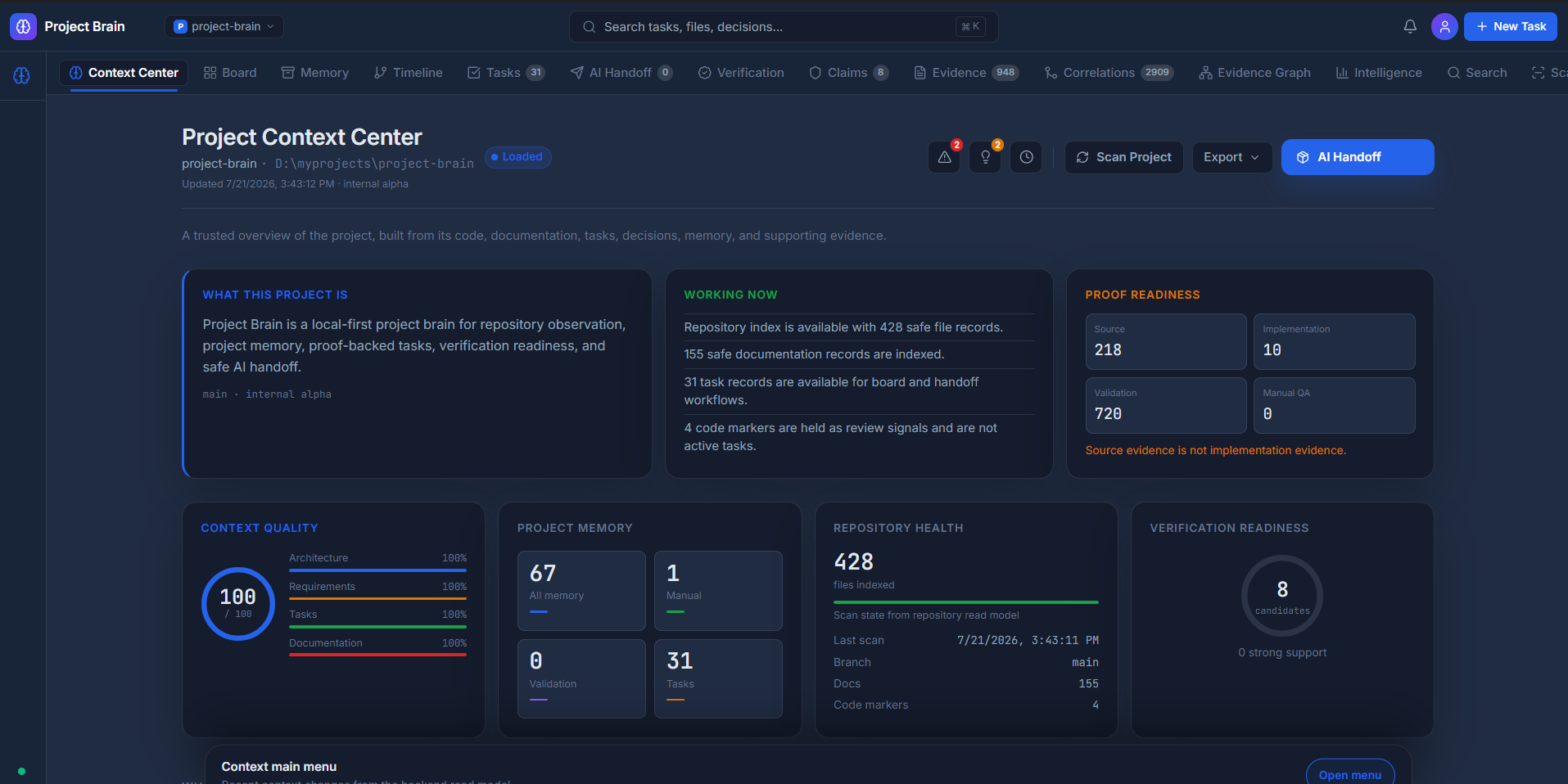
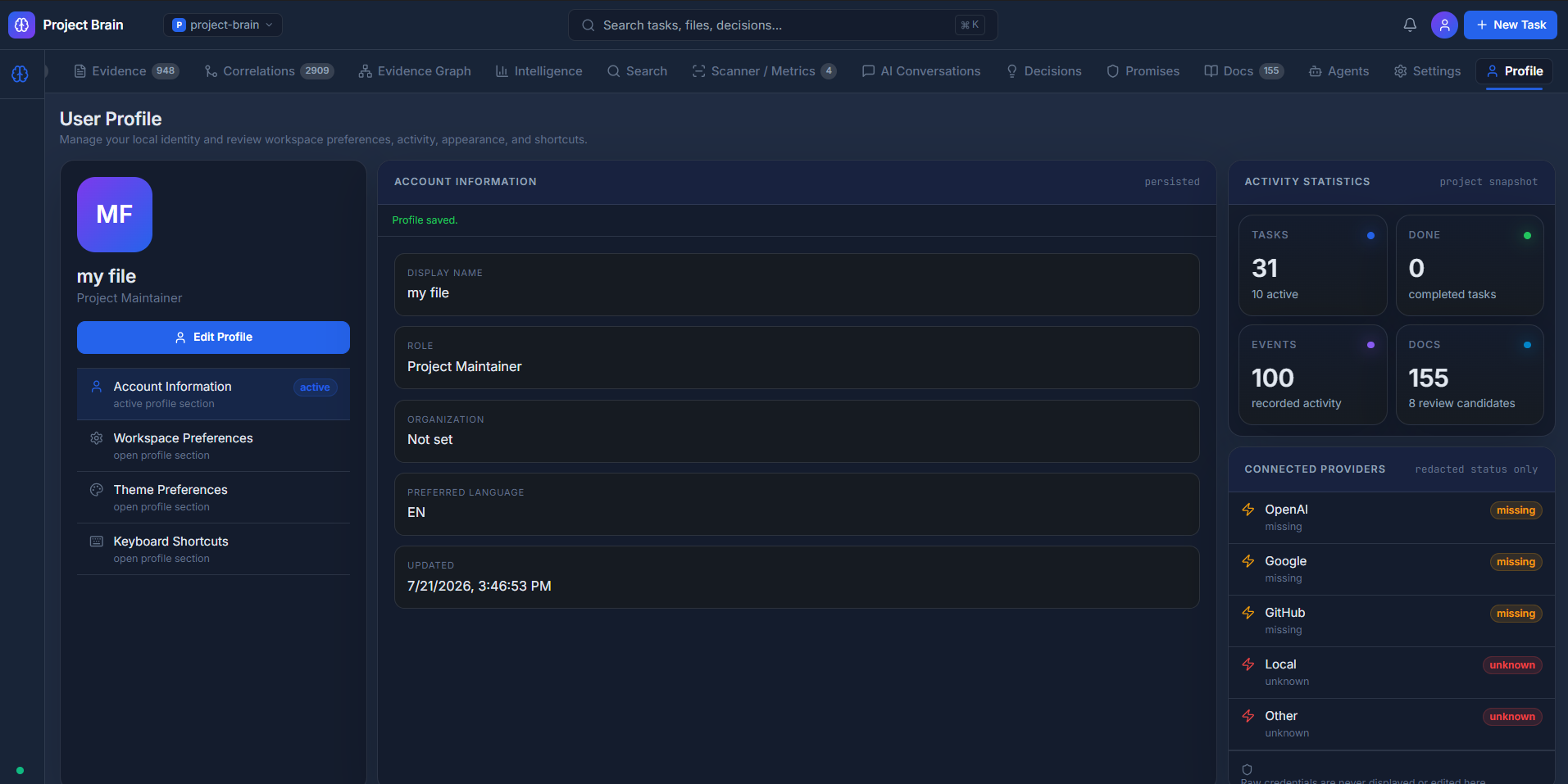
The Brain is a local desktop tool that is memory-resilient and creates evidence-backed context for projects.
It scans a selected repository, reads project files and documents, and organizes the discovered information into useful, memorable, and easy-to-reach data.
You can use The Brain to:
- Understand the project and its structure.
- Understand which requirements, decisions, promises, and tasks have been documented.
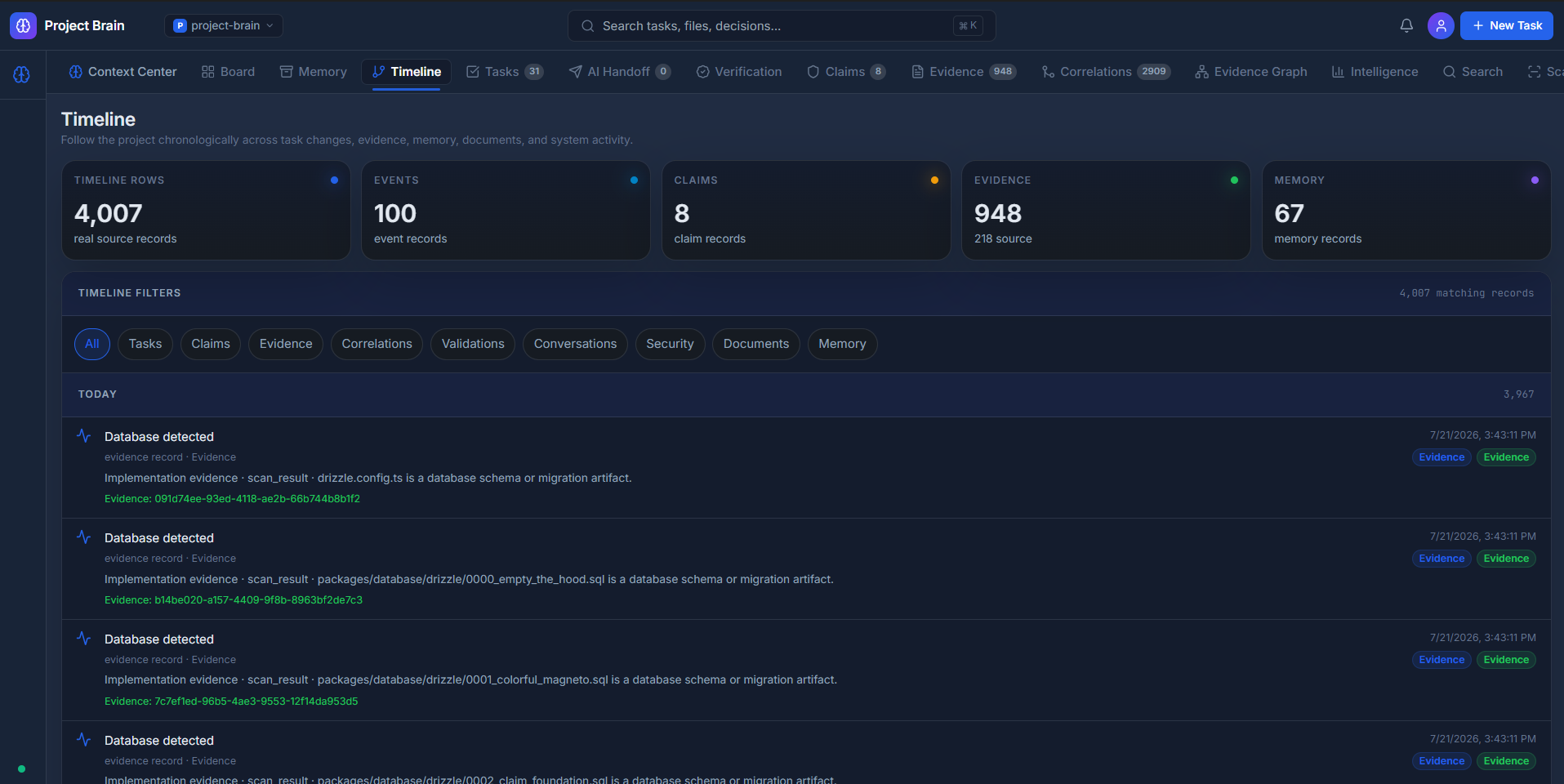
- Get to know the changes throughout the project timeline.
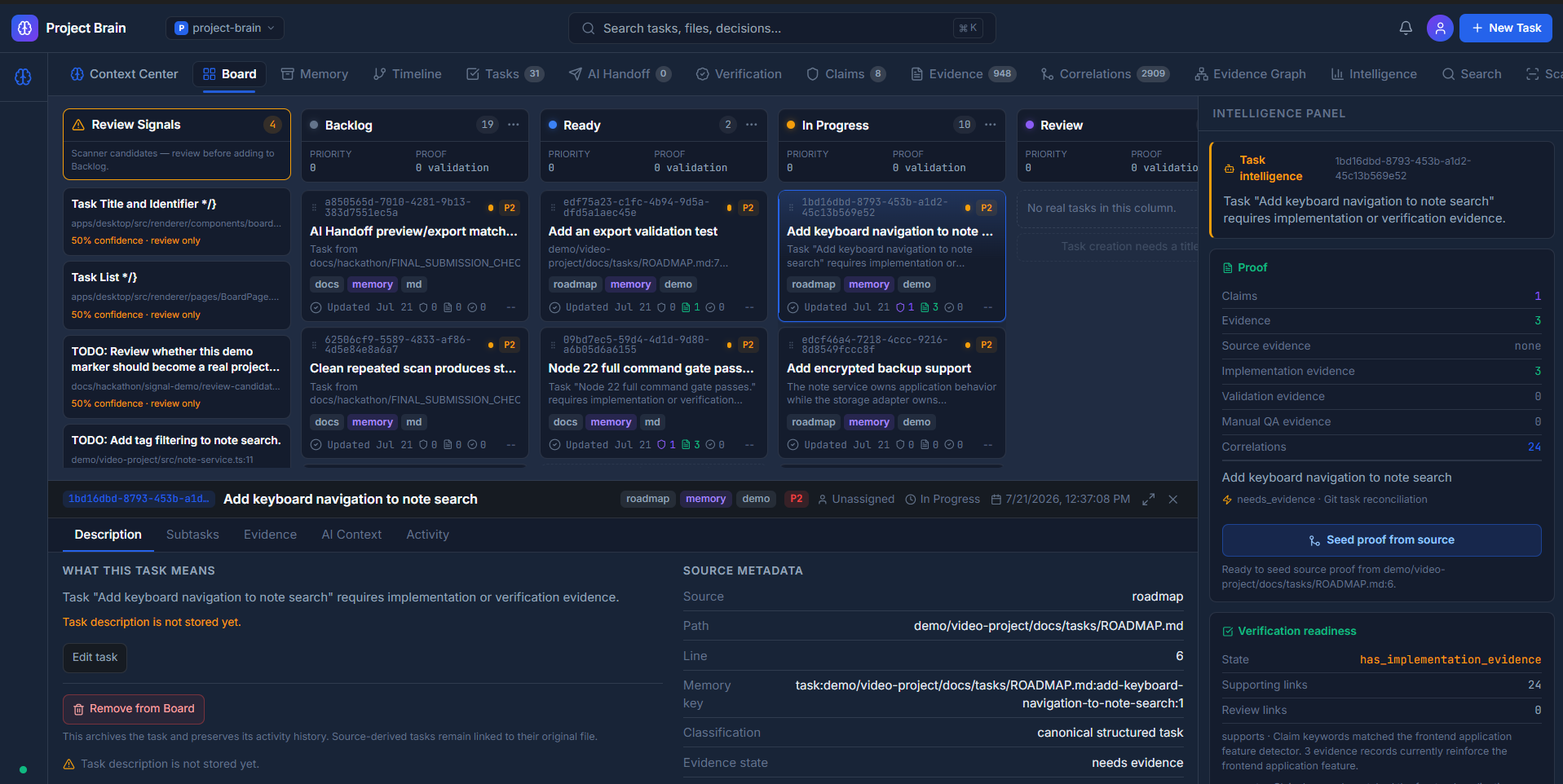
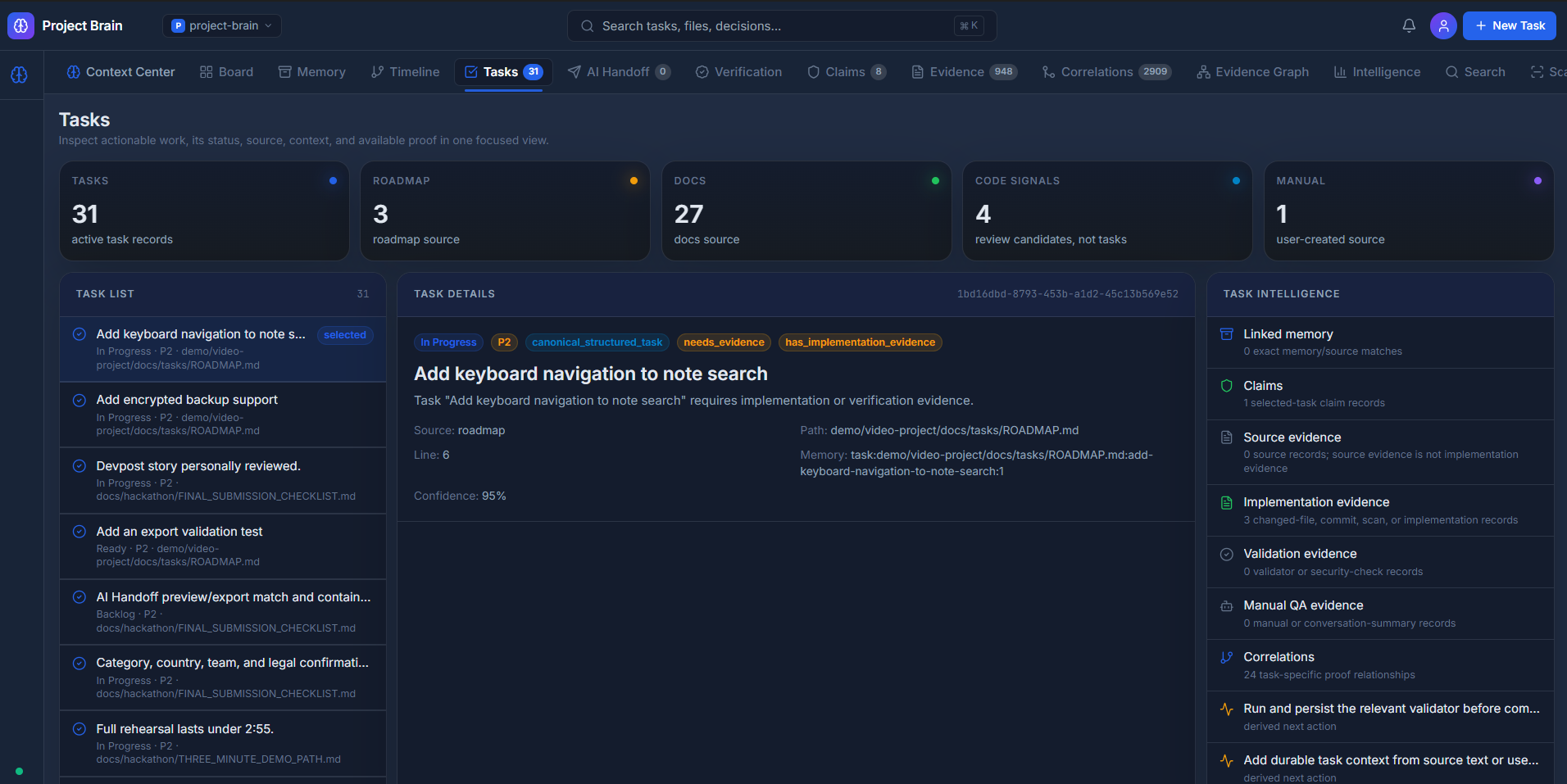
- Get to know what tasks are planned, active, under review, or completed.
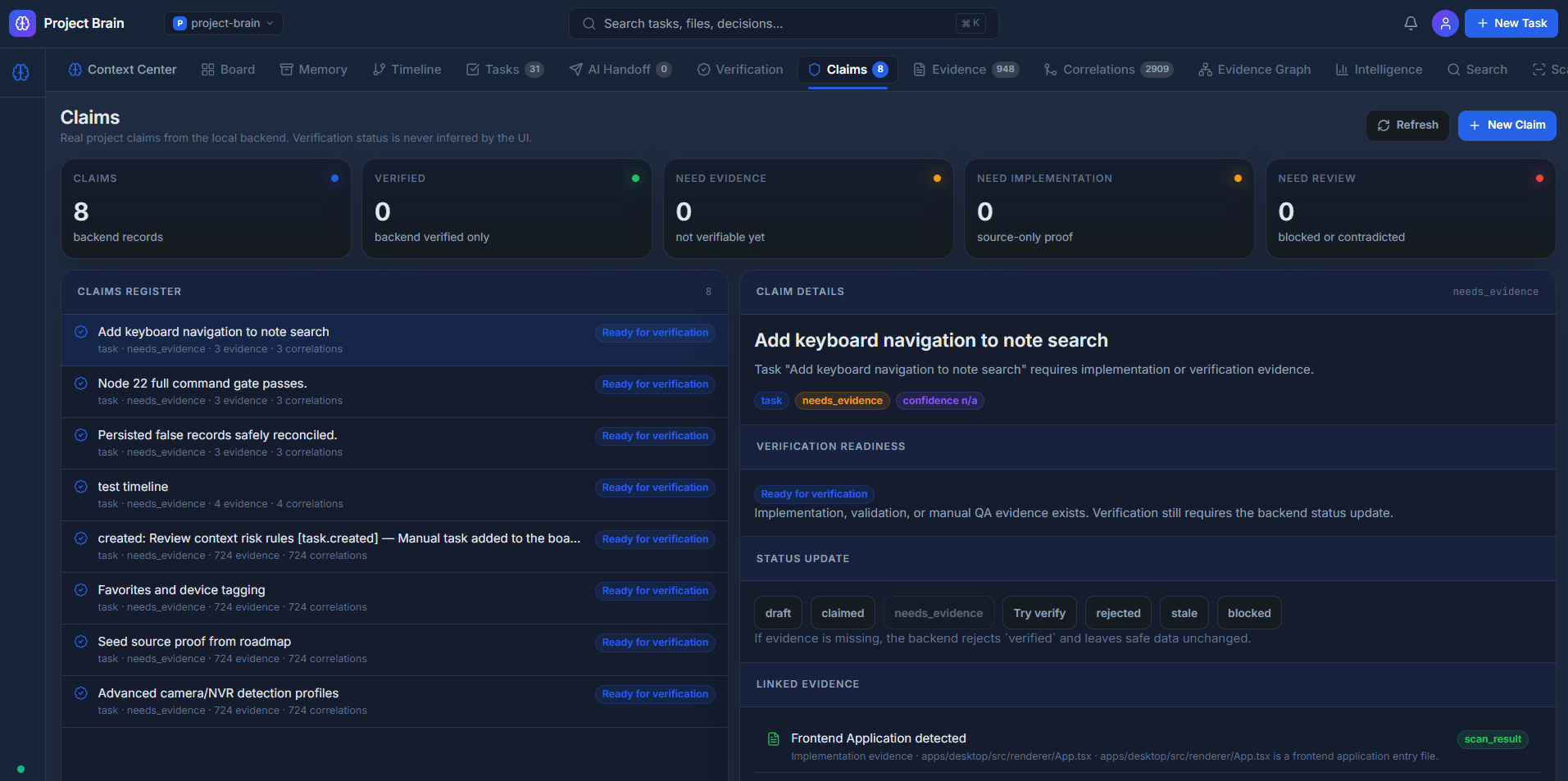
- Get to know which claims are really supported by actual evidence.
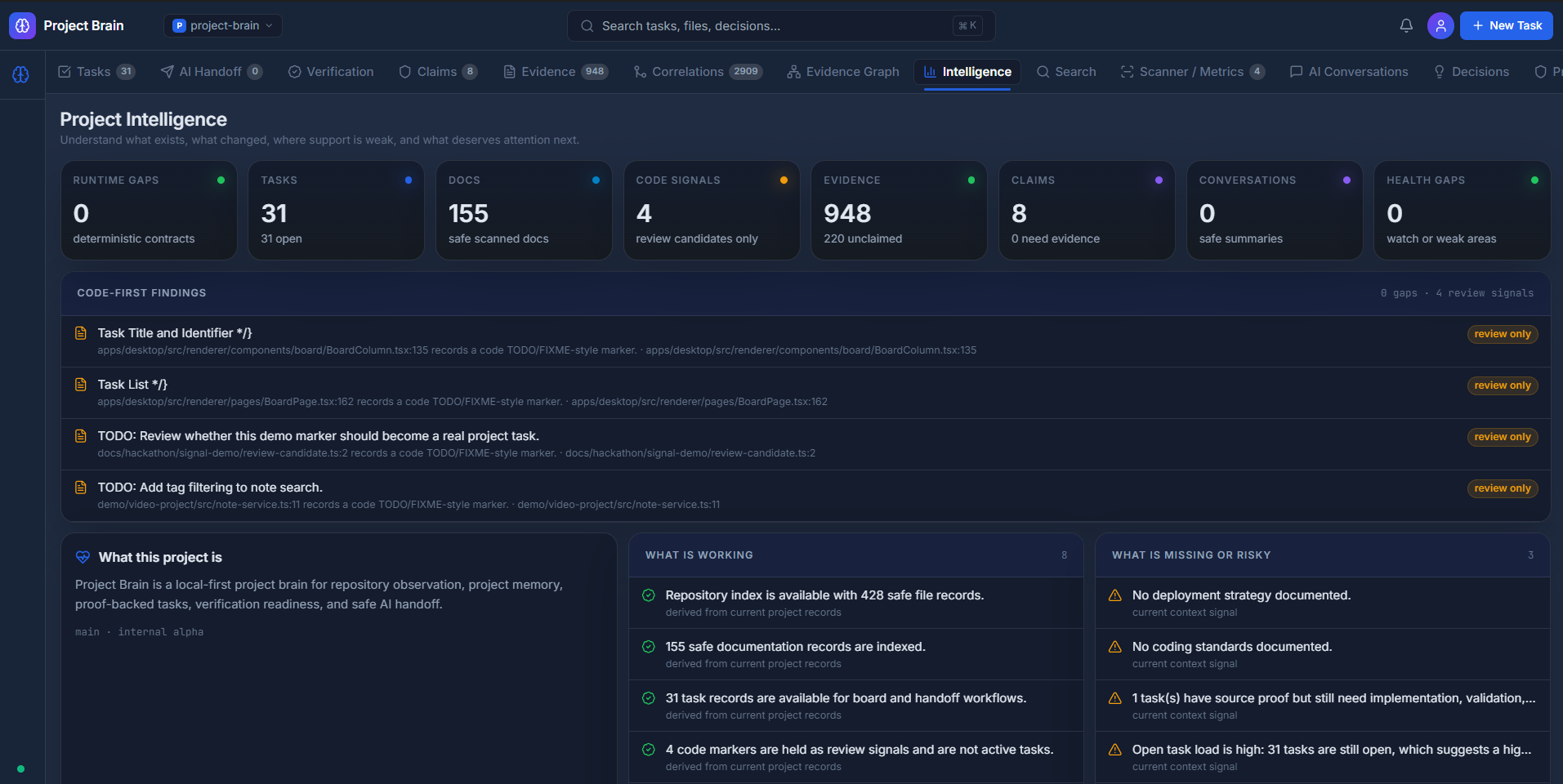
- Become aware of what information is missing or required for verification.
- Get to know what context should be handed to the next developer or AI assistant.
And the most important is that you will find all of this information and more stored in one place so you do not end up overwhelmed and confused.
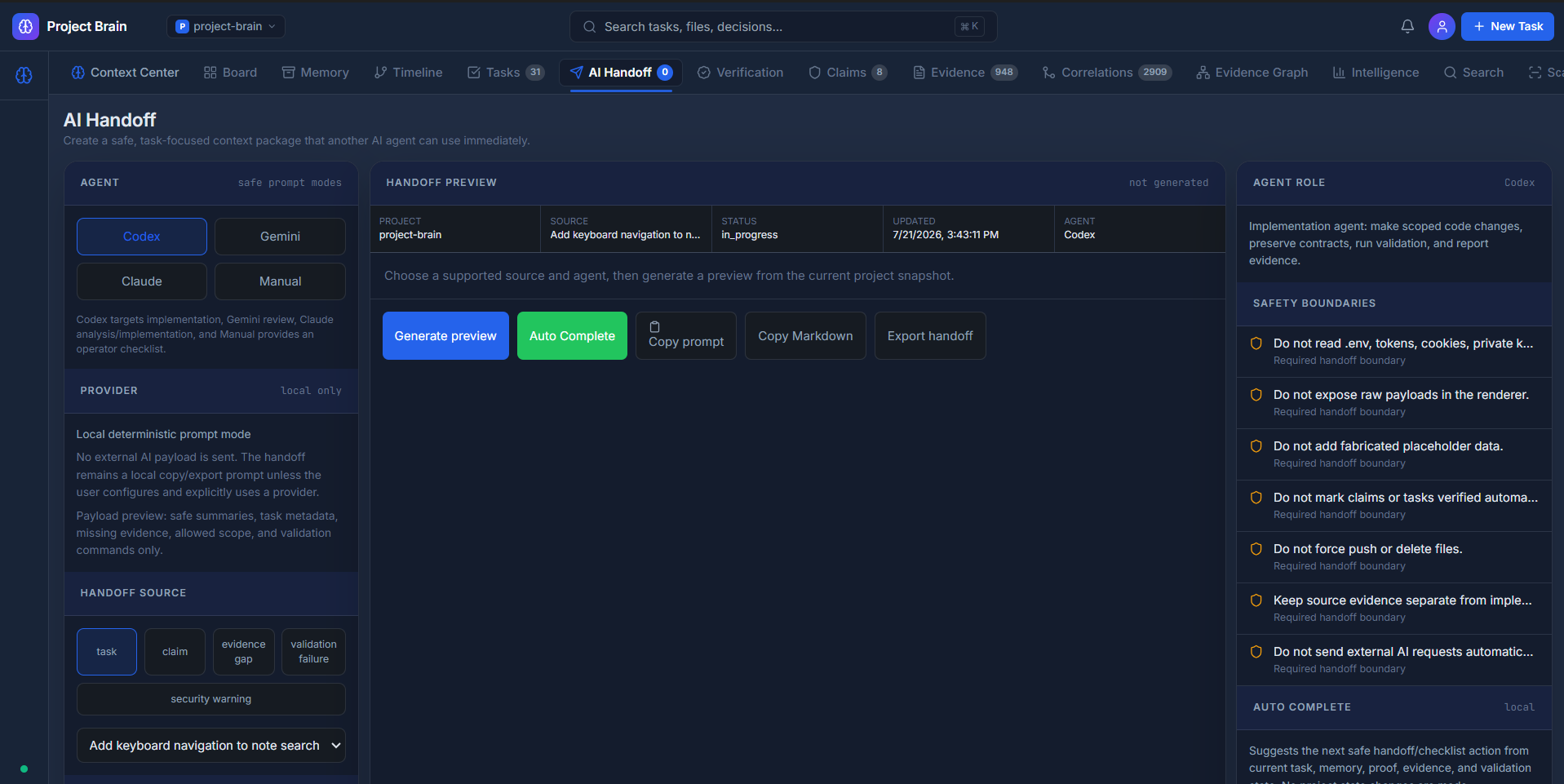
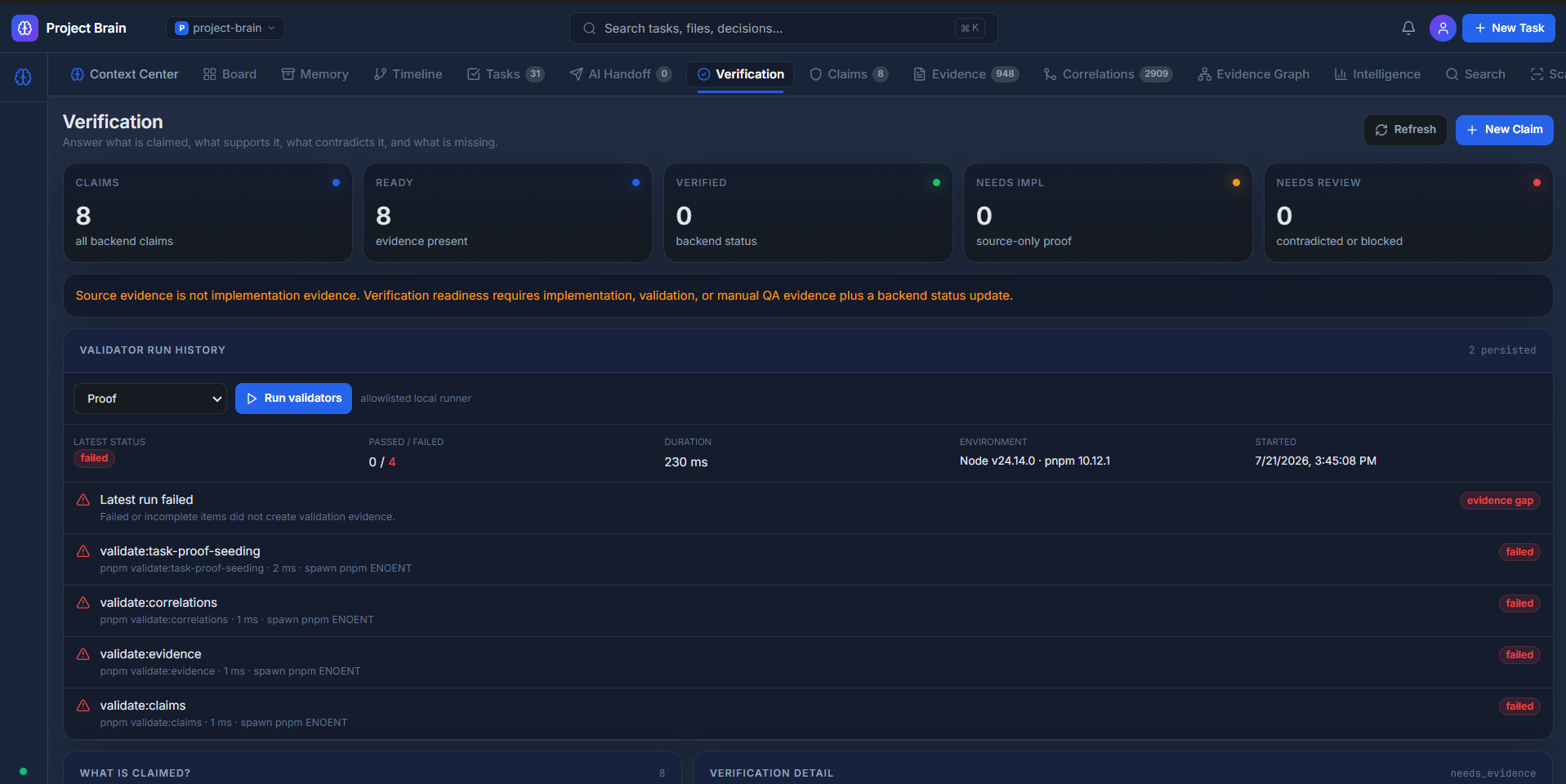
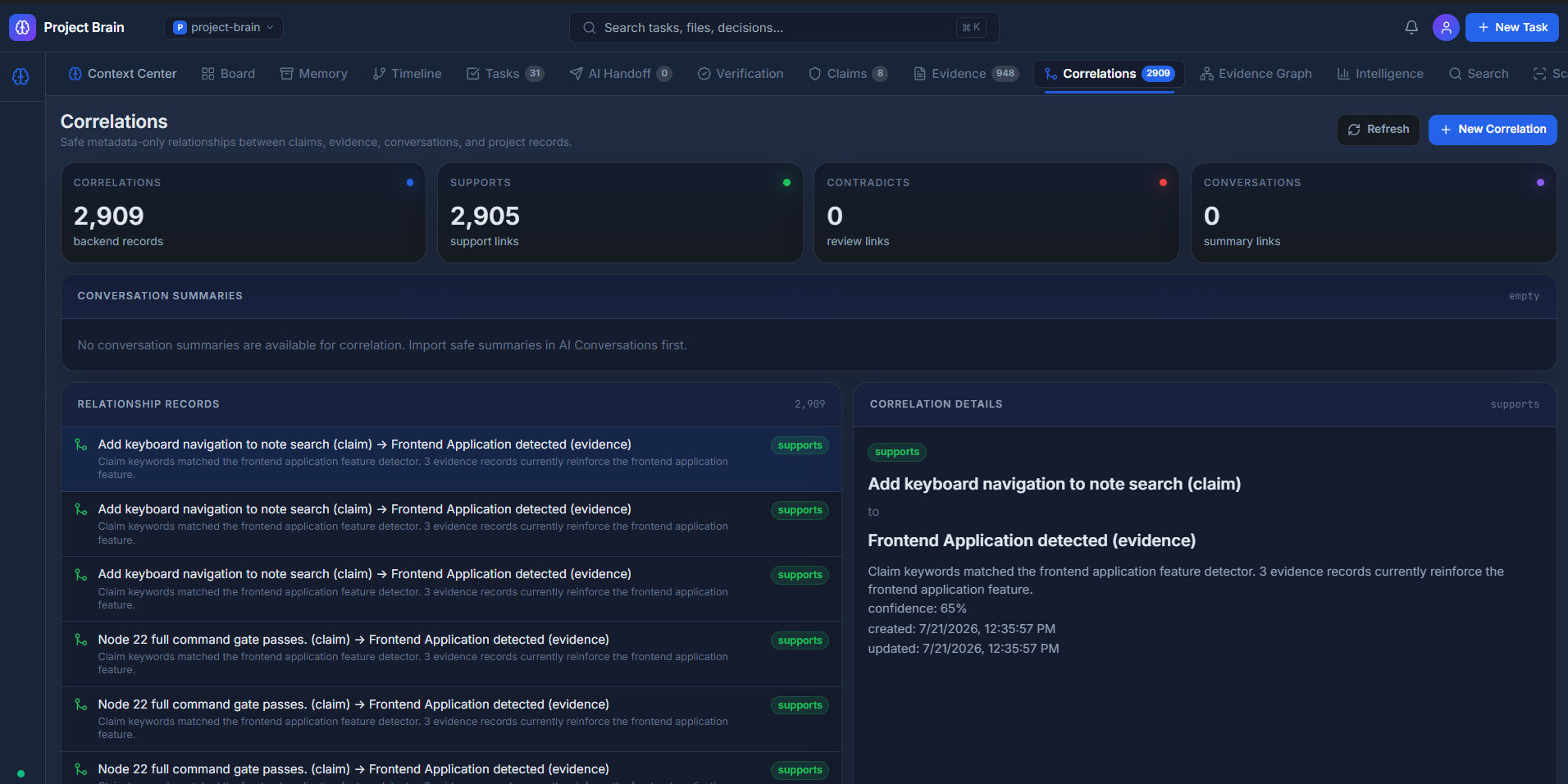
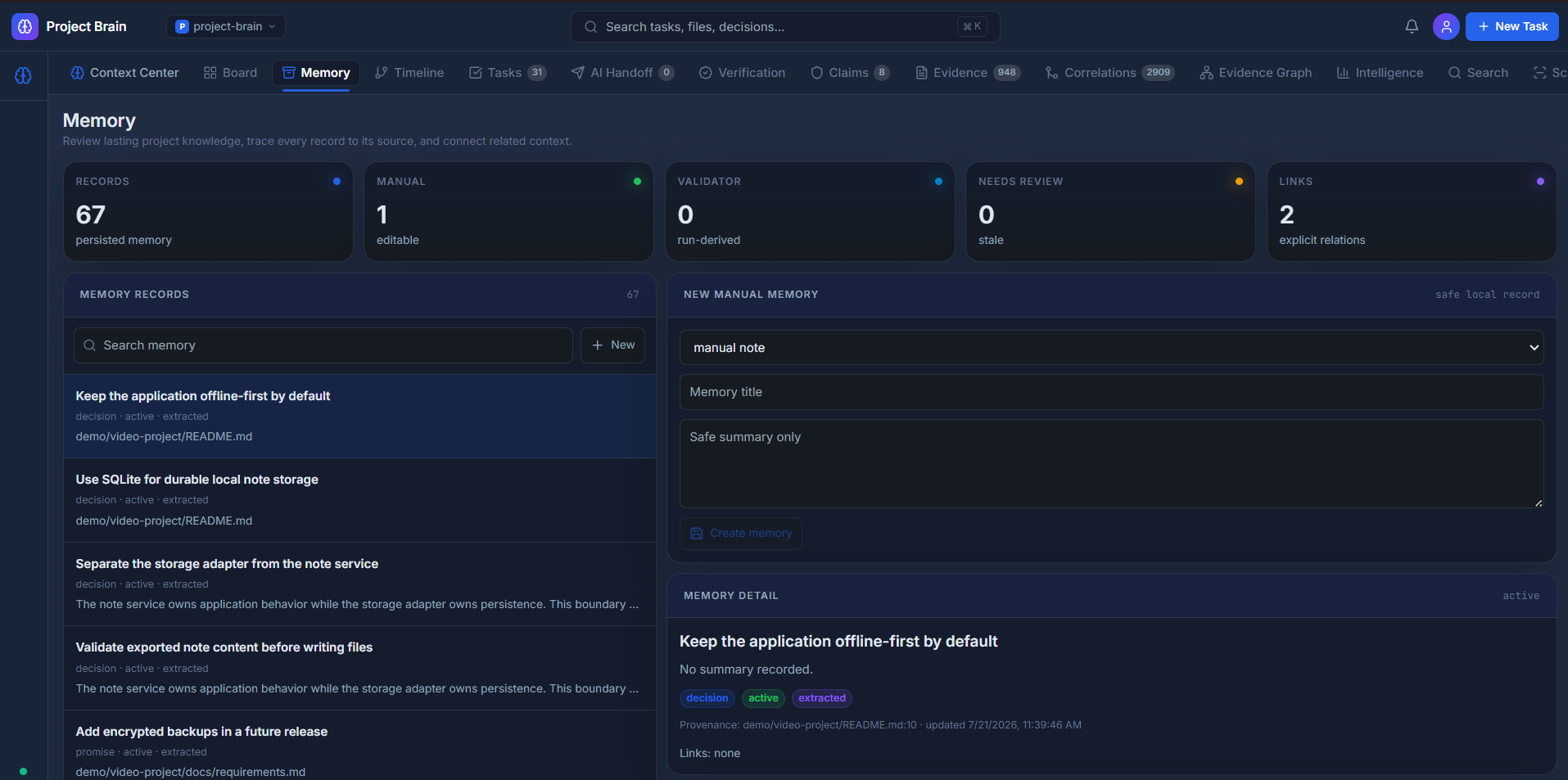
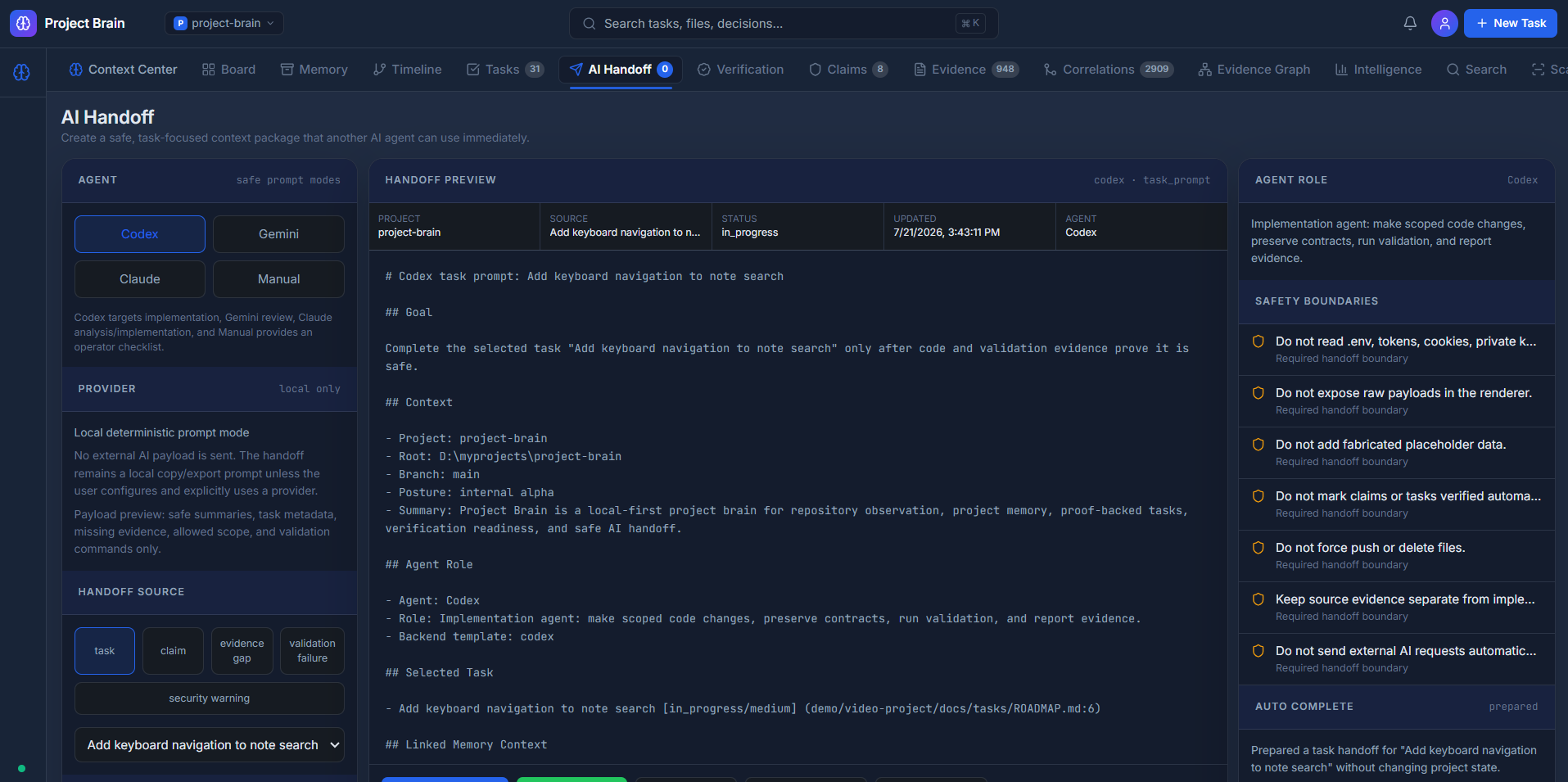
It includes a task board, project memory, timeline, claims, evidence, correlations, verification readiness, evidence graph, and AI Handoff. One of the most important features in this project is the AI Handoff, because it prepares a structured project-context package that can be copied or exported for use with AI tools; this is crafted to reduce redundant AI answers, repeated explanations, and helps the next AI session start with clear, safe, and more reliable context.
How we built it
We built The Brain as a local Electron desktop application using:
- Electron and React for the desktop experience.
- TypeScript for safe development across the application.
- SQLite and Drizzle ORM for persistent local project data.
- Zustand for frontend state management.
- Vite and pnpm for development and build workflow.
The Brain uses a safe repository scanning policy to avoid sensitive and generated paths such as .env, .git, node_modules, build outputs, caches, and our own generated files. We created logic for documented requirements, decisions, promises, and structured tasks. Extracted information retains source metadata, including its file path and line number, so users can understand where it came from.
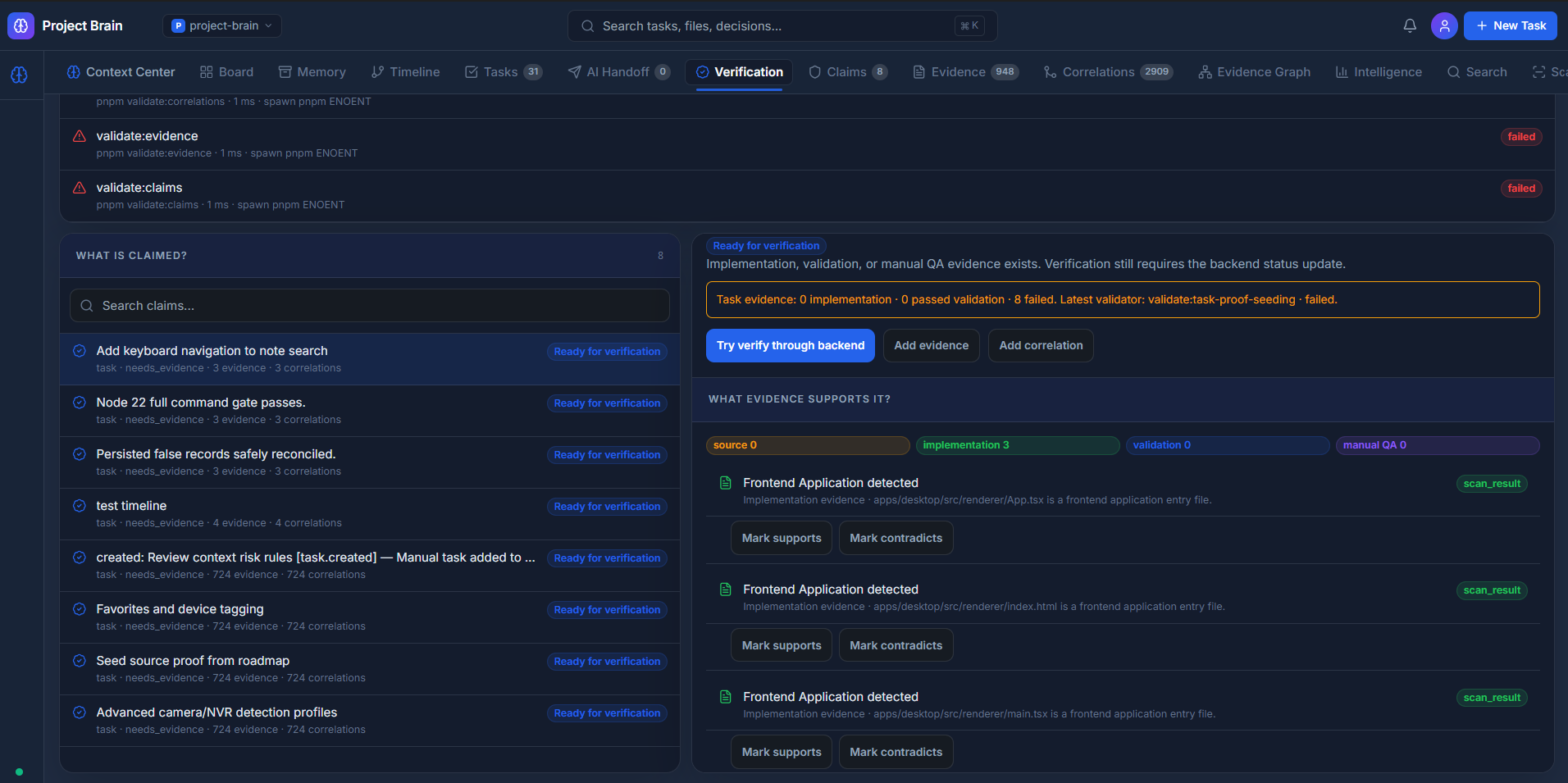
We also completed a proof-oriented workflow connecting tasks, claims, evidence, correlations, Git activity, and verification readiness. AI Handoff preview, copy, and export uses the same artifact and applies safety checks before context leaves the application.
Our loyal friend GPT-5.6 and Codex helped us write this program with almost 91% code writing. It also helped us inspect the codebase, reason about architecture, decide what technologies we must use and what we must avoid, show missing workflows, suggest improvements, create validators, and audit the prototype so we can honestly say we are three teammates, not two, with this loyal friend.
It was used throughout the validation workflow and engineering phases.
Challenges we ran into
One of the biggest challenges we stumbled upon was scraping real project knowledge from ordinary text. A repository may contain documentation, generated reports, activity logs, cached output, and sentences containing words such as task or priority. Early extraction could interpret some of this content as real backlog tasks, and this is one of the challenges we have been developing until now and trying to find an easier, time-saving, and fit-for-purpose solution. We addressed this by introducing strict extraction rules, blocking internal and generated paths, preserving source metadata, preventing activity events from becoming tasks, and making repeated scans idempotent.
Another challenge was maintaining trust. A task appearing in Git does not automatically mean it is complete, and a source document is not the same as implementation evidence. We designed The Brain to keep claims, source evidence, implementation evidence, validation results, and manual QA separate.
And the most important challenge we faced is the one we primarily decided to create The Brain to solve, which is the huge amount of scattered data across thousands of sources that causes confusion and error.
Accomplishments that we're proud of
We are proud that we founded a system that helps other developers in the field navigate AI tools. It will be a smoother, easier process that will save them time and headaches. We managed to turn a problem we personally experienced into a tool that could help other student developer teams and AI-assisted engineering workflows.
We are also very proud that we made it here and got to pitch our idea before one of the absolute AI-developing giants and OGs and get feedback in return.
What we learned
All in all, it has been an enriching experience that enabled us to widen our horizons and explore the theoretical realm, and get a deeper grasp of it whilst also applying it to our work. We came up with an original idea and solved a persistent issue we faced.
We learned that AI-assisted development is not only a model-quality problem, but also a wider context and trust problem.
AI can generate code quickly, but useful collaboration requires reliable answers to various questions such as:
- Where did this requirement come from?
- Was this task actually implemented?
- Is there validation evidence?
- Which information is current?
- What context is safe to share?
- Can the next AI session continue without starting over?
Finally, we learned the importance of honest product boundaries. The Brain does not automatically declare that software is correct. It organizes context and evidence so humans and AI tools can make better-informed decisions.
What's next for The Brain
Our next goal is to make The Brain UI/UX simpler and its installation easier, and make it useful across a wide range of real software projects.
We also plan to work more and more on the scanning and find more useful solutions. We have some features already existing to be implemented in the next prototype, including:
- A packaged desktop installer.
- Improved extraction accuracy for different documentation styles.
- Support for repository-specific ignore rules.
- More configurable task priority and assignment workflows.
- Stronger Git and test-framework integrations.
- Better manual QA and verification workflows.
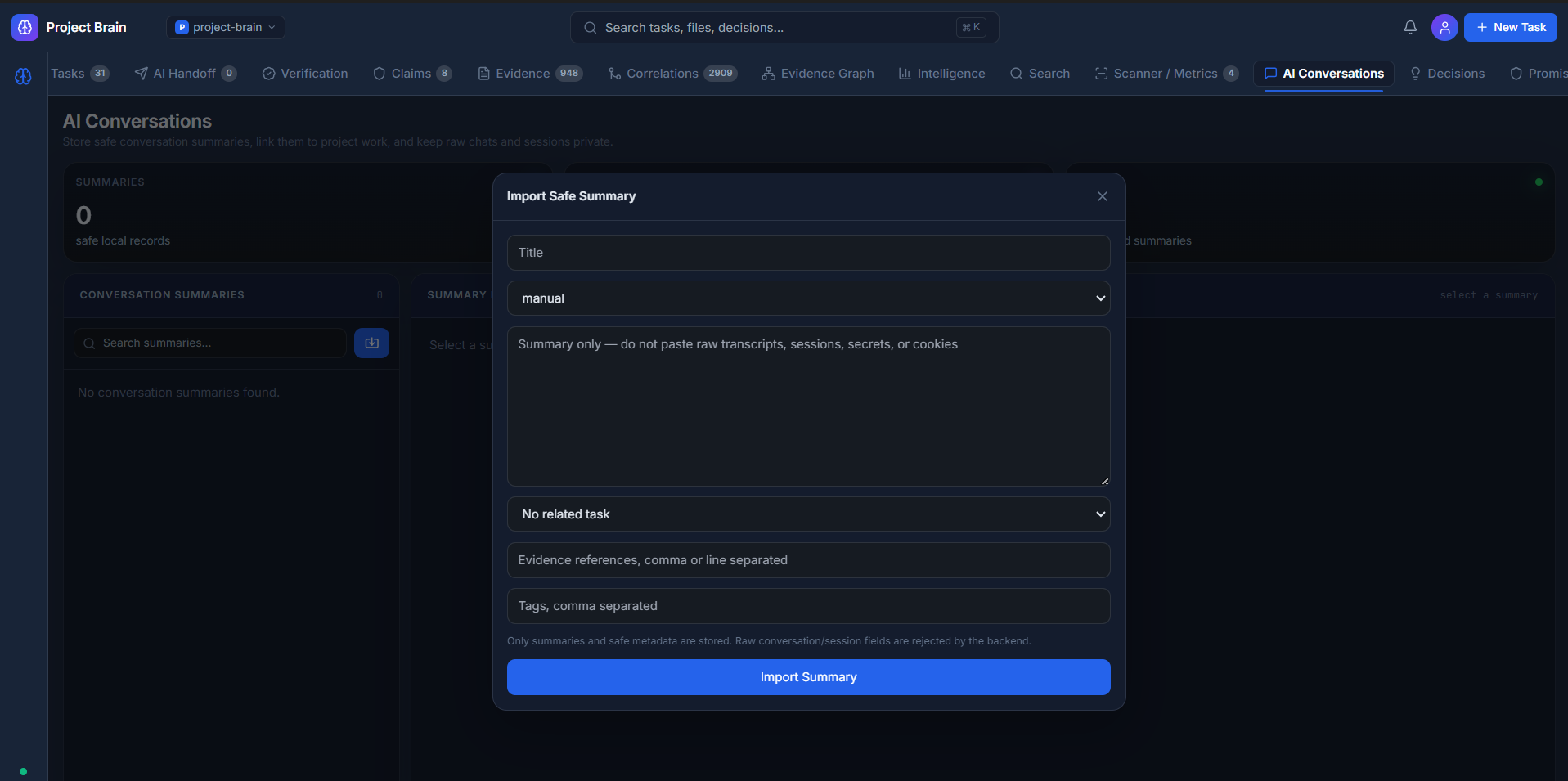
- Importing safe summaries from additional development tools.
- Team collaboration and optional encrypted synchronization.
- More advanced AI-assisted analysis while preserving user control and privacy.
- Additional integrations for Codex and other developer tools.
Our long-term vision for The Brain is to make it a shared memory and evidence layer for the new software engineering generation, helping human developers and AI assistants stay aligned not only on the code phase, but also on the decisions, progress, and proof behind it.


Log in or sign up for Devpost to join the conversation.