-
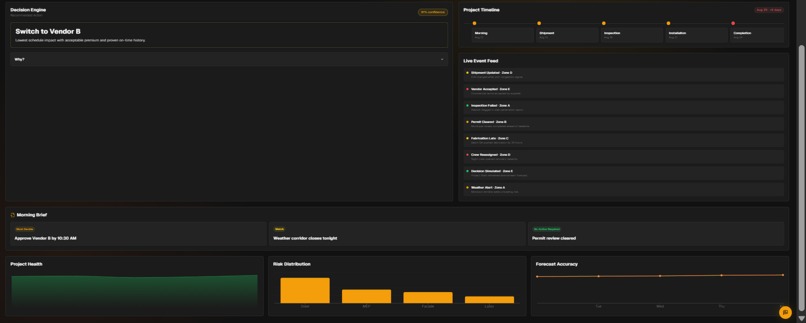
UI (frontend)
-
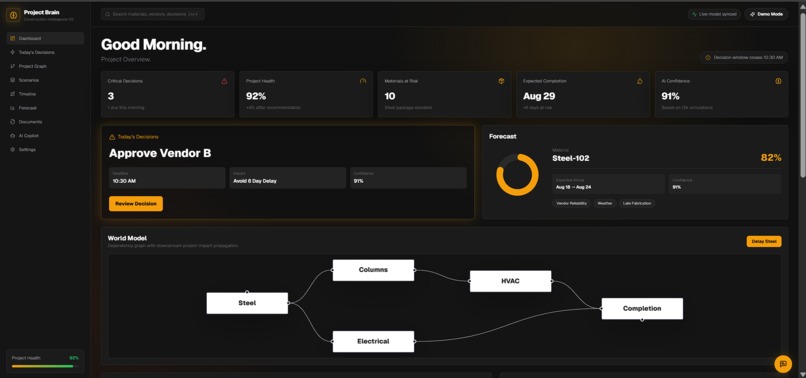
UI (frontend)
Inspiration
The cash prize and the oppurtunit to work with KAYA AI definitely helped us open the laptop—but the technical challenge is what kept it open
Construction doesn't suffer from a lack of data—it suffers from a lack of decision intelligence
A single delayed shipment can trigger a cascade of downstream delays across multiple dependent activities. Today, project managers manually piece together information scattered across ERP systems, spreadsheets, emails, WhatsApp conversations, purchase orders, and vendor updates to answer a simple question:
"What should we do now to keep this project on schedule?"
Existing construction software excels at tracking materials but stops short of helping teams make decisions. We wanted to build an AI system that goes beyond reporting status and instead continuously understands project state, predicts future risks, simulates downstream consequences, and recommends the best recovery strategy.
That idea became Project Brain.
What it does
Project Brain is an AI-powered Decision Intelligence Platform for construction supply chains.
Instead of simply tracking where materials are, it continuously answers:
- Will this material arrive on time?
- What downstream tasks will it delay?
- How much schedule and cost impact will it create?
- What are the best recovery options?
- Which option should the project manager choose?
At the core of Project Brain are four AI engines working together:
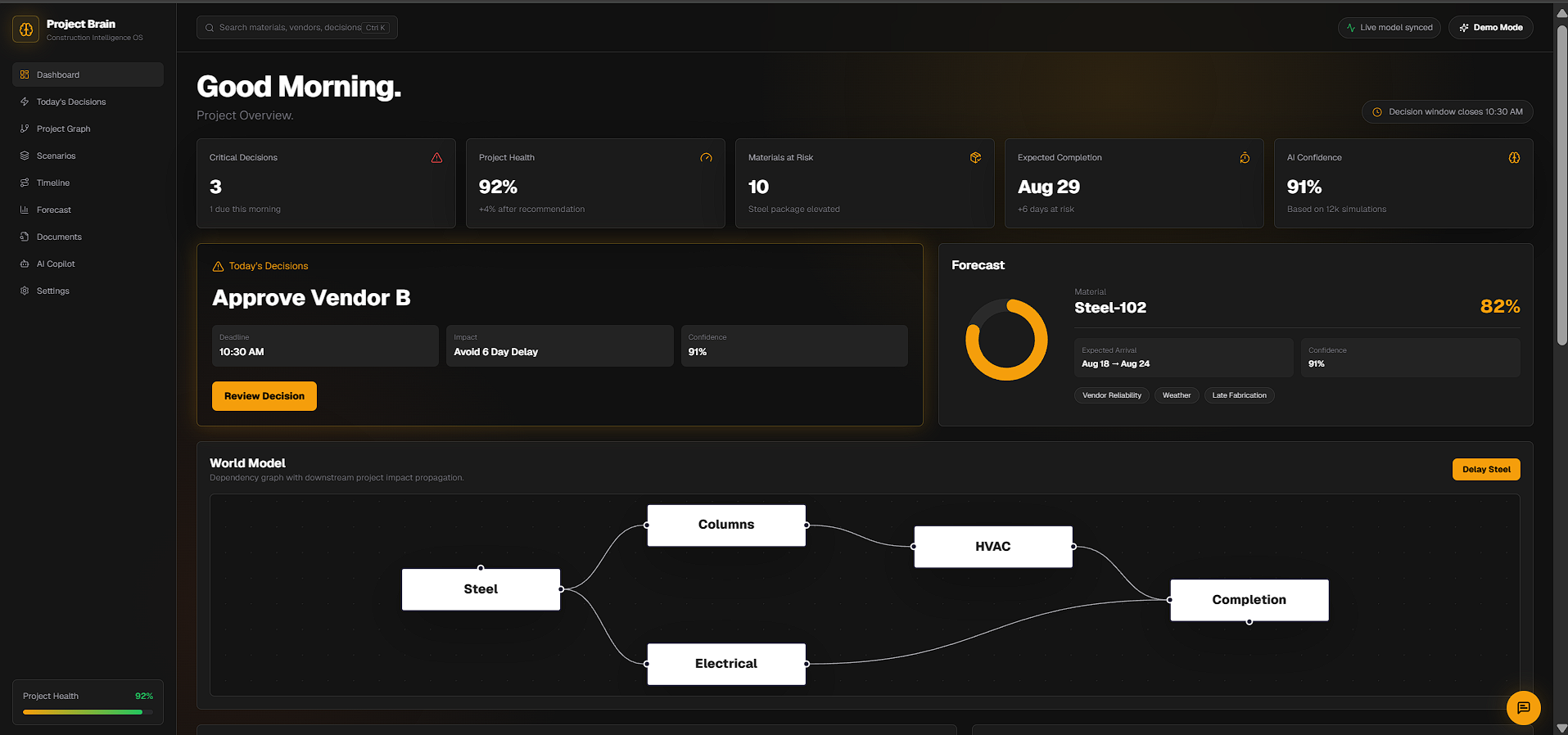
- Project World Model – maintains a living digital twin of the project using a knowledge graph.
- Forecast Engine – predicts ETAs, delay probability, confidence, and contributing risk factors.
- Impact Engine – simulates how disruptions propagate through project dependencies and evaluates multiple recovery scenarios.
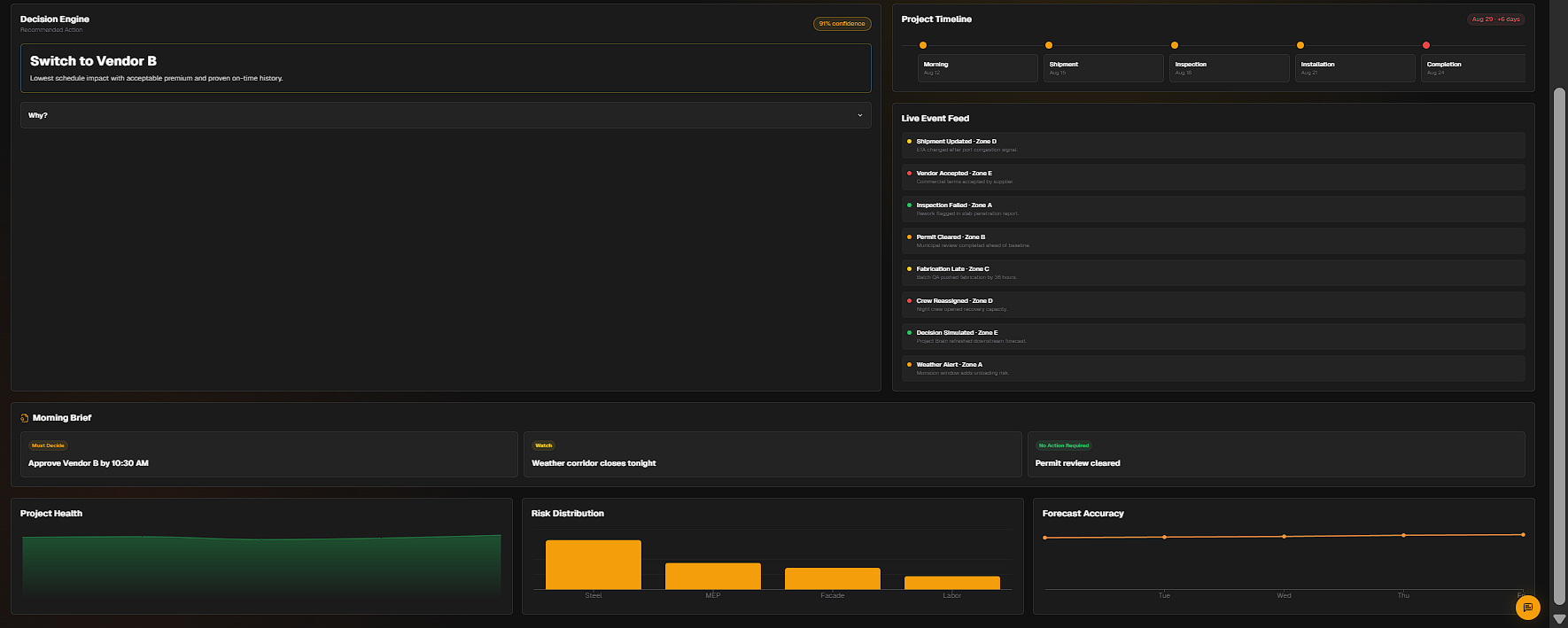
- Decision Engine – ranks recovery options using explainable AI reasoning and proactively recommends the next best action.
Rather than reacting to delays after they happen, Project Brain helps teams prevent them before schedules slip.
## How we built it
Project Brain combines several AI and systems techniques into a single decision-making pipeline.
Our architecture is centered around a living project model, implemented as a typed knowledge graph representing materials, shipments, vendors, project tasks, milestones, inspections, and their dependencies.
Whenever a project event occurs (for example, a shipment delay, inspection failure, weather update, or vendor change), a single orchestration pipeline updates the graph and triggers:
- Machine learning–based delivery forecasting using gradient-boosted models (LightGBM/CatBoost)
- Explainable AI using feature importance (SHAP)
- Graph-based impact propagation to determine downstream schedule and cost implications
- Scenario simulation to compare alternative recovery strategies
- LLM-powered decision reasoning that explains recommendations in natural language
The system also supports intelligent ingestion of unstructured construction data—including PDFs, spreadsheets, WhatsApp updates, emails, delivery documents, and images—converting fragmented project information into structured events that continuously update the project model.
## Challenges we addressed
One of the biggest challenges wasn't predicting delays—it was modeling how delays affect an entire construction project.
Unlike traditional supply chains, construction activities are highly dependent on one another. A delayed shipment doesn't just arrive late—it can delay inspections, block downstream work, idle crews, increase costs, and push project completion.
Designing an architecture capable of simulating these cascading effects while keeping the system explainable and scalable required separating prediction, simulation, and decision-making into independent but connected AI engines.
Another challenge was handling fragmented, real-world construction data. Instead of assuming perfectly structured ERP data, Project Brain is designed to integrate information from multiple unstructured sources and continuously build a unified project model.
## What makes Project Brain different
Most existing tools answer:
"Where is my shipment?"
Project Brain answers:
"Will this project finish on time? If not, why, what will it affect, and what is the best action to take?"
Instead of functioning as another tracking dashboard, Project Brain acts as an AI-powered decision intelligence system that continuously transforms construction data into actionable decisions.
Future roadmap
Our long-term vision is to evolve Project Brain into an always-on construction operations platform capable of:
- Live integration with ERP and project management systems
- Continuous multimodal document ingestion
- Real-time vendor and logistics monitoring
- Multi-project portfolio optimization
- AI-assisted procurement and planning
- Predictive scheduling across entire construction programs
Ultimately, we envision Project Brain becoming the operating system that helps construction teams make faster, better, and more confident decisions.

Log in or sign up for Devpost to join the conversation.