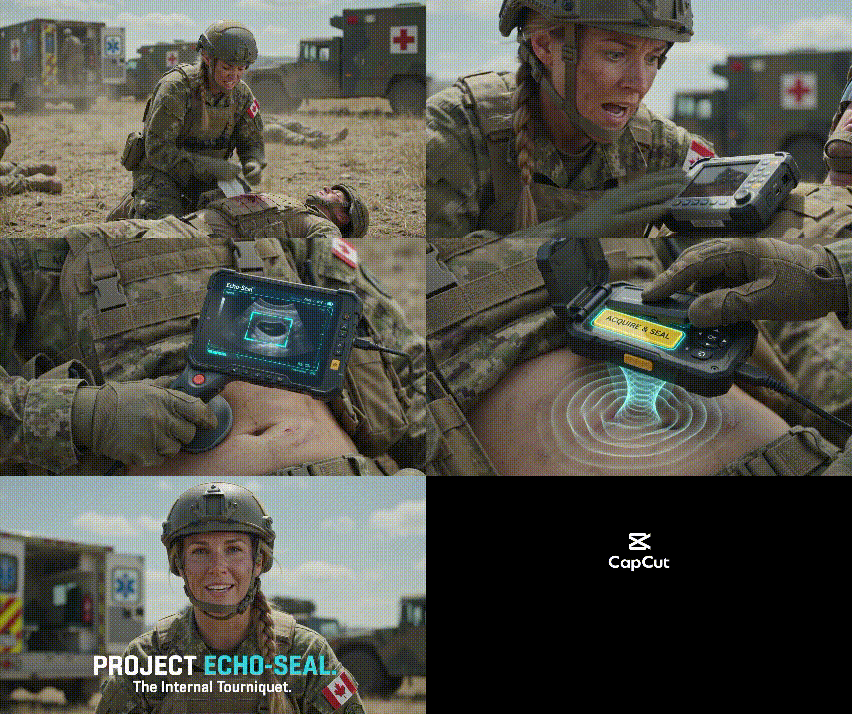
Inspiration: On the battlefield and in civilian trauma scenarios, if a victim is bleeding externally, a first responder can apply a tourniquet. But if they are bleeding internally—from a blast wave, a gunshot, or a severe car crash—there is no tourniquet. They have a stopwatch on their life. Non-Compressible Torso Hemorrhage (NCTH) is the leading cause of preventable trauma death worldwide. First responders currently have no way to stop it in the field; their only option is to drive or fly faster. I was inspired to end the stopwatch and build the "internal tourniquet.
What it does: Project ATO (The Acoustic Tourniquet) is a prototype for a portable, AI-guided acoustic trauma device. It brings the physics of High-Intensity Focused Ultrasound (HIFU) out of the operating room and onto the battlefield. Our software utilizes a state-of-the-art computer vision model to analyze live FAST (Focused Assessment with Sonography for Trauma) ultrasound feeds. It instantly detects the irregular pooling of free fluid (internal hemorrhage), calculates the coordinates, and locks onto the ruptured artery. In my simulated hardware deployment, this targeting AI guides a micro-burst of focused acoustic energy that passes harmlessly through the skin and generates pinpoint heat to instantly coagulate the blood, sealing the bleed in 15 seconds without a single incision.
How I built it: I built the ATO targeting brain and the medic's interactive dashboard over the course of the hackathon: The AI Backend: I used Roboflow to train an object detection and segmentation model on open-source, de-identified medical ultrasound datasets (specifically positive FAST exams from point-of-care ultrasound repositories).
The Logic: I used Python and OpenCV to process video frames in real-time, sending them to my live AI endpoint to generate dynamic bounding boxes and crosshairs over the hemorrhage. The Dashboard UI: I designed a high-contrast, tactical front-end using HTML, Tailwind CSS, and JavaScript. This acts as the combat medic's heads-up display, featuring simulated vitals telemetry, real-time target locking, and the HIFU firing trigger.
Challenges I ran into: One of the biggest clinical challenges was teaching the AI to avoid "false positives" in the human anatomy. For example, in a suprapubic FAST ultrasound view, a full bladder looks like a massive, dark pool of fluid. I had to ensure my model was trained specifically to ignore normal anatomical fluid and solely lock onto the jagged, irregular pockets of free fluid that indicate active internal bleeding.
Accomplishments that I'm proud of: I am incredibly proud of successfully getting my AI endpoint to track bleeding in raw, messy, real-world ultrasound clips. When I first saw the cyan targeting box successfully snap onto a hemorrhage and ignore the surrounding organs, I knew I had a viable proof of concept. I am also proud of the UI/UX design—I built a dashboard that doesn't just look like a hackathon project, but looks like a piece of classified, standard-issue military hardware.
What I learned: I learned a massive amount about trauma medicine, specifically how first responders use FAST exams to triage patients in the "golden hour." I also learned about the incredible real-world physics behind acoustic levitation and HIFU, and how modern AI object detection (like YOLO and SAM) can be deployed rapidly to solve problems that used to require massive mainframes.
Challenges I ran into: One of the biggest clinical challenges was teaching the AI to avoid "false positives" in the human anatomy. For example, in a suprapubic FAST ultrasound view, a full bladder looks like a massive, dark pool of fluid. I had to ensure our model was trained specifically to ignore normal anatomical fluid and solely lock onto the jagged, irregular pockets of free fluid that indicate active internal bleeding.
Accomplishments that I am proud of: I am incredibly proud of successfully getting our AI endpoint to track bleeding in raw, messy, real-world ultrasound clips. When I first saw the cyan targeting box successfully snap onto a hemorrhage and ignore the surrounding organs, I knew I had a viable proof of concept. I am also proud of the UI/UX design, I built a dashboard that doesn't just look like a hackathon project, but looks like a piece of classified, standard-issue military hardware.
What I learned: I learned a massive amount about trauma medicine and procedures, specifically how first responders use FAST exams to triage patients in the "golden hour." I also learned about the incredible real-world physics behind acoustic levitation and HIFU, and how modern AI object detection (like YOLO and SAM) can be deployed rapidly to solve problems that used to require massive mainframes.
Built With
- google-cloud
- html
- javascript
- opencv
- roboflow
- tailwind-css
- tensorflow

Log in or sign up for Devpost to join the conversation.