About ProjectAstra
ProjectAstra was developed by Yumnam Harryson Singh for the Celesta India High School Exoplanet Data Challenge. It is an automated, physics-first machine learning pipeline designed to vet exoplanetary candidate signals from NASA's Kepler Space Telescope.
What Inspired Me
I have always been fascinated by the search for habitable worlds, but the sheer volume of data from space telescopes makes manual candidate vetting a massive scientific bottleneck. When exploring the Kepler dataset, I noticed most models achieved a superficial ~99% accuracy by relying on posterior vetting flags (koi_fpflag_*). Because these flags are hand-crafted after extensive human study, utilizing them represents severe data leakage.
I was inspired to build ProjectAstra: a pipeline that rejects these flags entirely, forcing the model to classify targets strictly based on raw transit geometry and stellar physics.
How I Built It
ProjectAstra was built on a Colab T4 GPU using a highly optimized, five-stage pipeline:
- Leakage Filter: Removed all metadata and hand-crafted posterior flags to keep the feature space scientifically authentic.
- Domain Feature Engineering: Injected two physical ratio features:
- Planetary-to-Stellar Radius Ratio: $$ R_{\text{ratio}} = \frac{R_p \times 0.00915}{R_s + 10^{-5}} $$
- Transit Duty Cycle: $$ D_{\text{transit}} = \frac{\text{Duration} / 24.0}{\text{Period} + 10^{-5}} $$
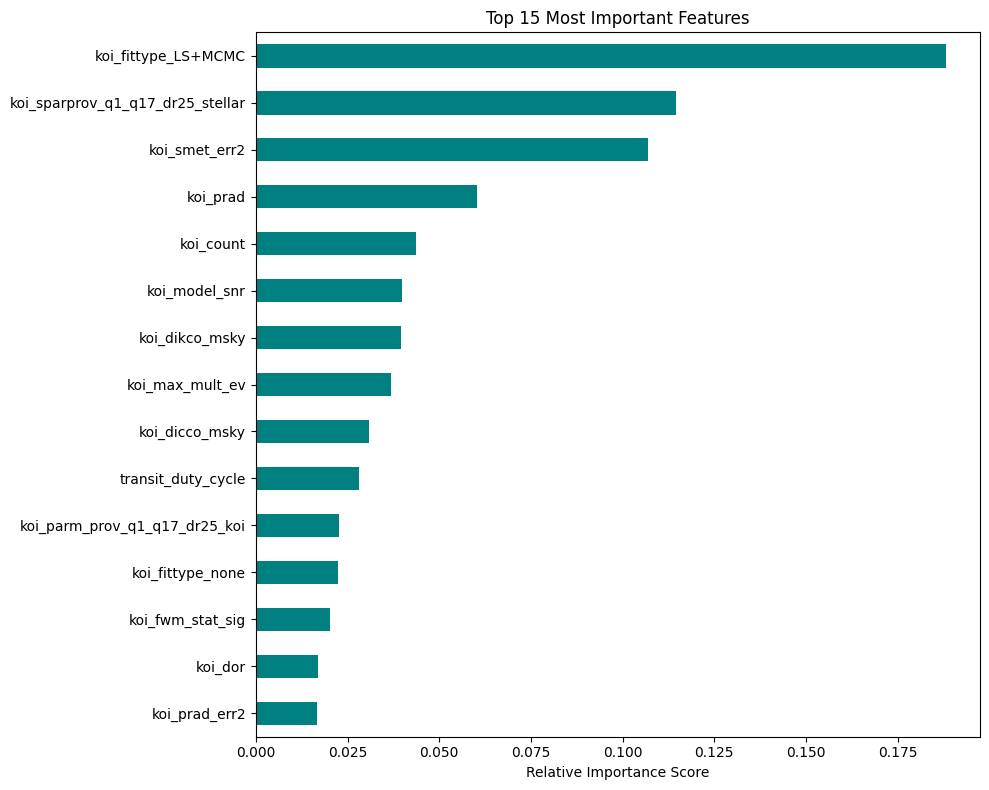
- Feature Pruning: Filtered features using baseline XGBoost importances, shrinking the active feature space from over 100 features down to the 33 most physically informative parameters.
- Bayesian Tuning: Conducted a 50-trial Optuna search to optimize the Macro F_1-score of our GPU-accelerated XGBoost model.
- Soft-Voting Ensemble: Blended three structurally distinct tree architectures—XGBoost, LightGBM, and CatBoost—averaging their predicted probabilities for maximum generalization.
Challenges Faced
- The Leakage Temptation: Resisting the urge to keep hand-crafted flags for an easy 99\% score was difficult. Restricting the model to raw physics dropped our baseline performance but ensured the pipeline was genuinely useful for raw data.
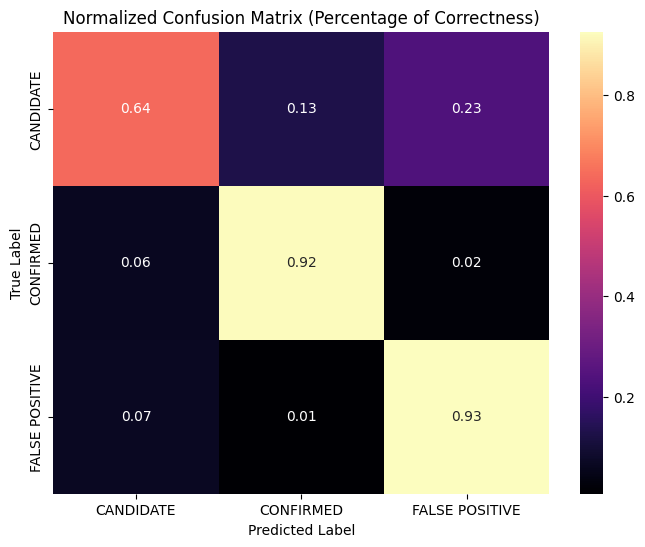
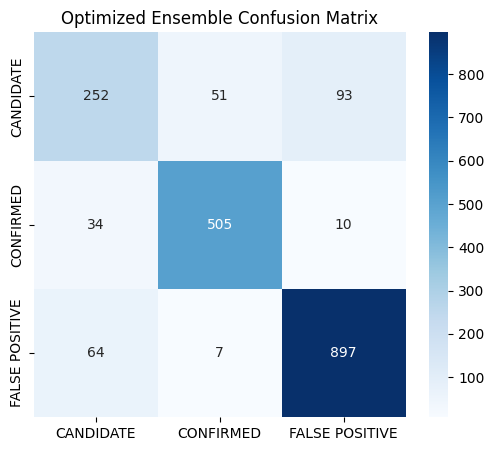
- The Candidate Ambiguity: The CANDIDATE class sits in the physical transition zone between real planets and false positives. Many actual candidates physically mirror noise or binary stars under raw observations, causing significant overlap in our 33-feature space.
What I Learned
- Precision over Recall: I learned that in observational astronomy, raw accuracy is secondary to precision. By tuning our decision boundaries, we achieved a 72% Candidate Precision (with 86.57% test accuracy). In the real world, this conservative approach is highly valued because it reduces false alarms and saves expensive follow-up telescope time.
- Domain Value: Feeding a model raw tables is rarely enough. Engineering structurally sound physical ratios is what ultimately unlocks the potential of tabular machine learning models.
For the testing of the Jupyter notebook, please ensure the dataset is in the local file section in Colab.
Built With
- colab
- gemini

Log in or sign up for Devpost to join the conversation.