-
-
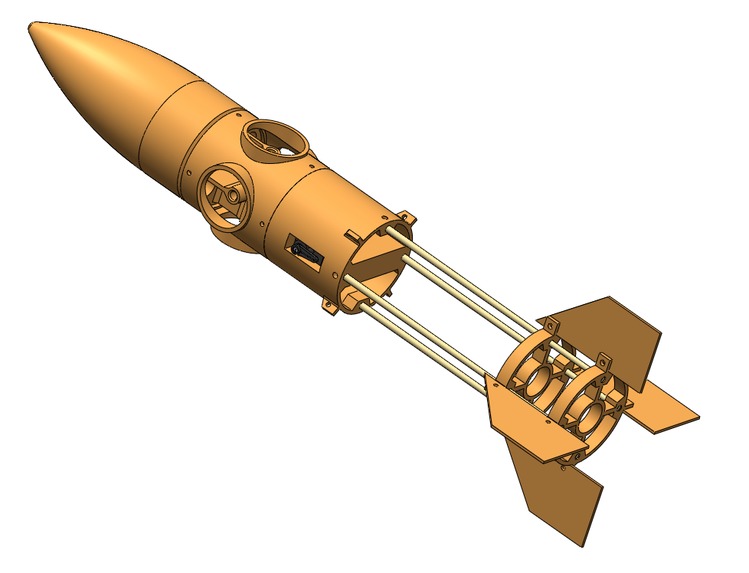
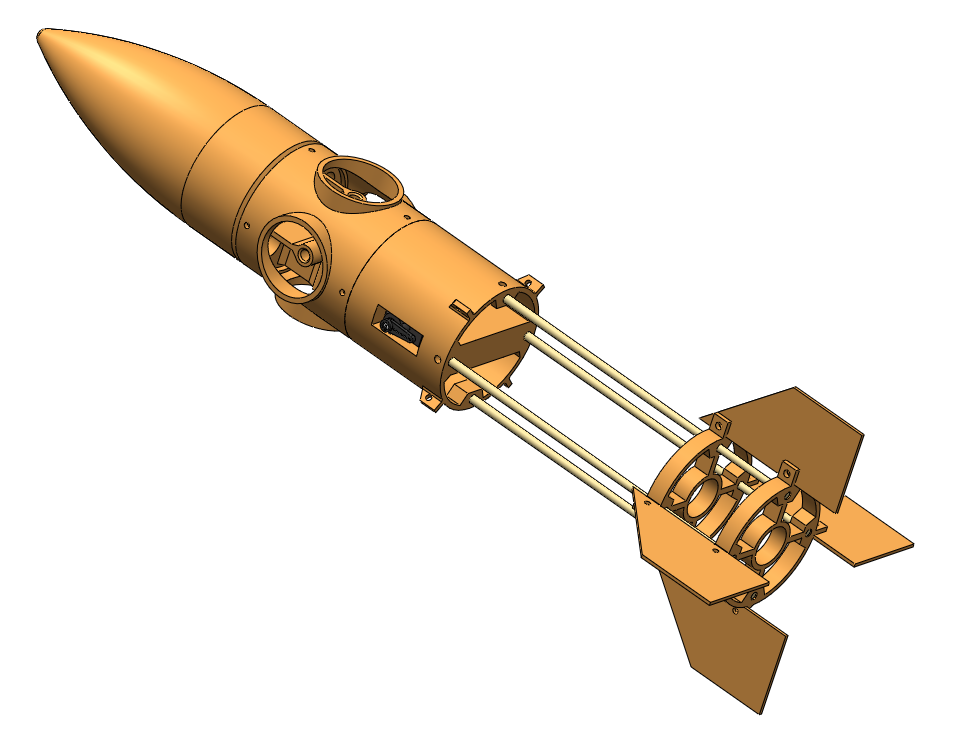
CAD model of rocket demonstrator prototype
-
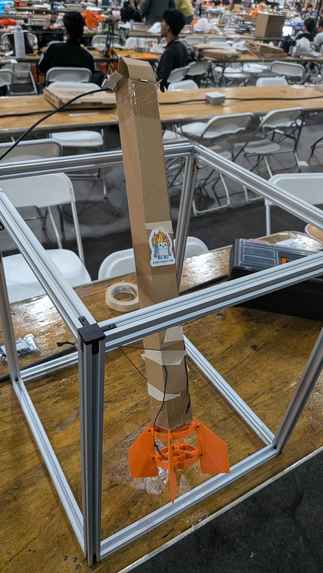
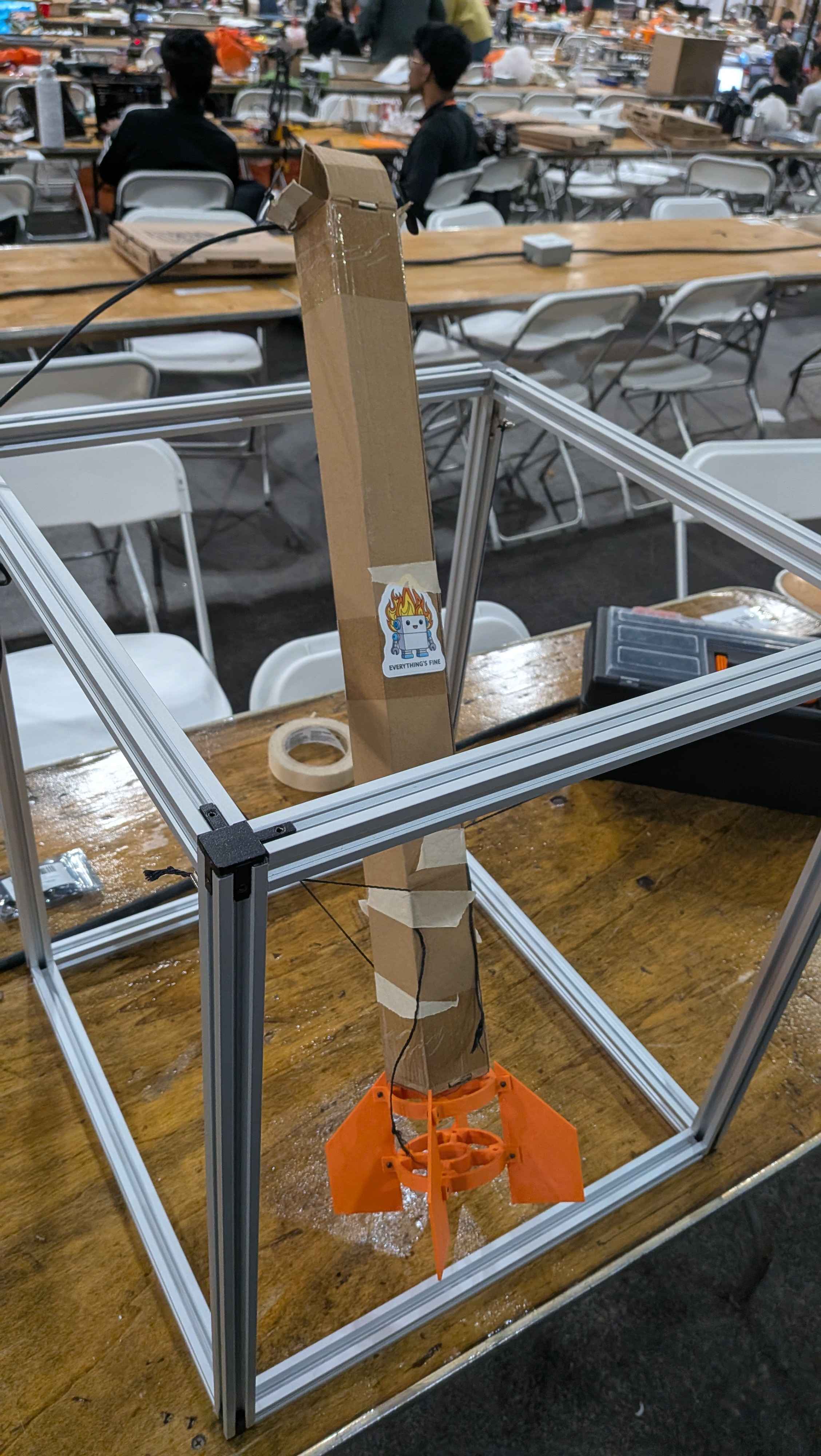
Rocket Pitch and Yaw Orientation Test Stand
Inspiration
About 2 years ago, I went to an amateur rocket launch event. It was a very windy day, so many rockets weathercocked into the wind, pitching over at large angles. What if this could be avoided? By using a simple drone-based system simulating RCS thrusters on real rockets, hobbyists can keep their drones flying straight, increasing the safety of model rocketry, increasing the altitude that a rocket can reach, teaching STEM skills, and reducing the dispersion distance (how far a rocket travels during its flight), which also reduces the time spent walking to recover a rocket, and increasing the time spent launching.
What it does
Should the project be completed, the system will eventually take gyroscope and accelerometer data and fuse them with a Madgwick filter in order to obtain an orientation in quaternions. Next would be finding the difference between the current orientation and a vertical orientation, and using a PID control loop to then convert that into pulses going to 4 drone motors. When the drone motor turns on, this acts as an 'RCS' system, pushing the nose of the rocket back upright. The rocket will also feature 2 MG90S servos (not yet integrated), which serve as roll control, giving the control system some way to mitigate any disturbances the rocket might face.
How I built it
First, I came up with a design concept, creating a few preliminary sketches to see if it was possible to fit together in an aesthetic manner. I cross-referenced this with the parts available on the StarkHacks hardware portal. Then, I made a 3D model, and while that was being printed, I worked on some code and ate lunch. I decided on an ESP32-based flight computer with an LSM6DSO IMU, with data transmitted from the IMU to the microcontroller via I2C. Finally, I assembled a test stand cube out of aluminum extrusions, with 4 kevlar cords holding the rocket in the center, in order to allow me to test the rocket's rotation. The flight control software is a port of dRehmflight to work on an ESP32.
Challenges I ran into
Many challenges faced the project. First, all 3D modeling was completed at the event (and took way too much of the limited time, only for most of it not to be used), and it was difficult to get parts on time, meaning that parts of the rocket had to be substituted with other components. Also, there were limited ways to power something, so I ultimately relied on a single frayed USB to micro-USB cable to power the rocket. The original plan was to put lipo batteries in the rocket, but none were available. Fortunately, several microcontrollers were available, so I theoretically have the option to set up an ESP-NOW based telemetry system in the future. In the limited time I had, I was also unable to find a way to control the drone motors I had, as simply applying 5V power fried them. It would have been very beneficial if I spent more of my hackathon time working on my solo project, but I enjoyed the hackathon's atmosphere and looking at and assisting with other's projects.
Accomplishments that I'm proud of
I started the long process of creating a flight computer suitable for future rocketry projects. A 3D model was created in Solidworks and I worked with aluminum extrusions for the first time.
What I learned
Take advantage of the resources available prior to the hackathon, like submitting 3D printing requests ahead of time, and learning about the hardware and software you want to use! Planning ahead, having an idea of how the components you want to use will be connected together, and having viable backup plans is very important.
What's next for Project Aspera - RCS Rocket Control
Over the summer, I'll be working on a fin-controlled model rocket, which will require a flight computer. I plan on designing my first integrated custom PCB with an ESP32-S3-WROOM1U module, learning CFD, and leveraging that work into my aerospace student organization activities next year. I don't plan on flying a propeller-stabilization augmented drone anytime soon, but now that I have an idea for how to do it, maybe it'll happen!
Built With
- arduino
- cad
- engineering
- esp32
- solidworks

Log in or sign up for Devpost to join the conversation.