-
-
landing page
-
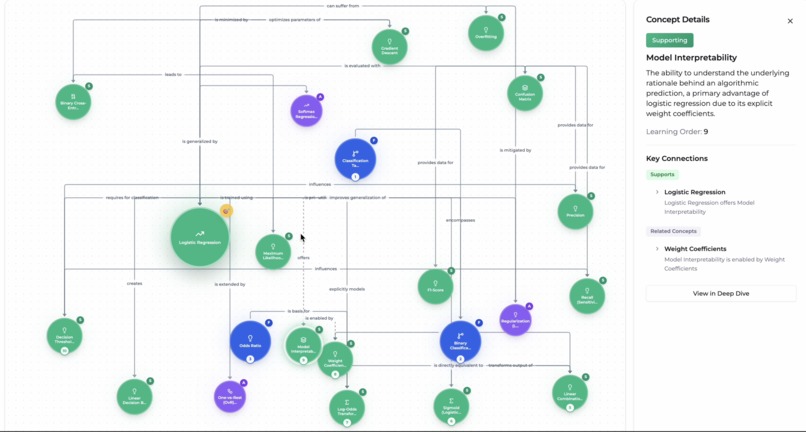
mind map generated from a user-upload content
-
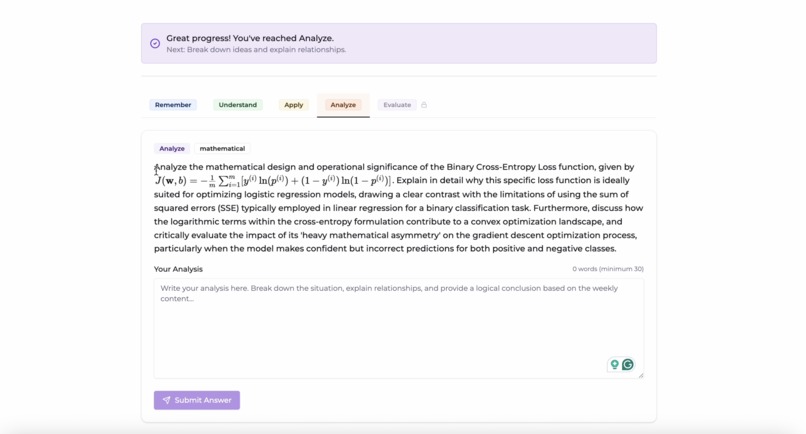
high-level question derived from a user-upload content
Inspiration
College students today are not lacking access to information. They are overwhelmed by it.
Between long PDFs, lecture slides, reviewers, online resources, and AI-generated summaries, many students struggle to answer the questions that matter most:
What should I focus on first? How do these ideas connect? Do I truly understand the material, or did I only read a summary?
At the same time, many AI learning tools are used mainly as shortcuts. They summarize readings, generate answers, or help students complete requirements faster, but they do not always guide students toward deeper understanding.
As an educator, a software engineer, and a graduate school student, I was inspired to build TwentyWise, an AI-powered learning platform designed not just to generate study materials but to turn academic content into a structured mastery journey.
TwentyWise is not just a summarizer. It is not just a quiz generator. It is a learning system built around focus, conceptual understanding, and pedagogical progression.
Learning Approach
TwentyWise helps students move from information overload to meaningful mastery through two core learning principles:
1. Pareto Principle / 80-20 Learning
TwentyWise applies the Pareto Principle to learning by identifying the most essential concepts from a syllabus or uploaded material.
Instead of overwhelming students with everything at once, it helps them focus first on the high-impact 20% of ideas that unlock deeper understanding of the subject.
This makes TwentyWise different from a basic summarizer. It does not simply shorten content. It prioritizes what matters most, helping students study with focus and intention.
2. Bloom’s Taxonomy-Based Mastery Progression
TwentyWise follows the pedagogical structure of Bloom’s Taxonomy to guide students through progressively deeper levels of thinking:
- Remember – recall key facts and concepts
- Understand – explain ideas and recognize meaning
- Apply – use concepts in practical or scenario-based situations
- Analyze – break down relationships, patterns, and reasoning
- Evaluate – make judgments based on evidence and understanding
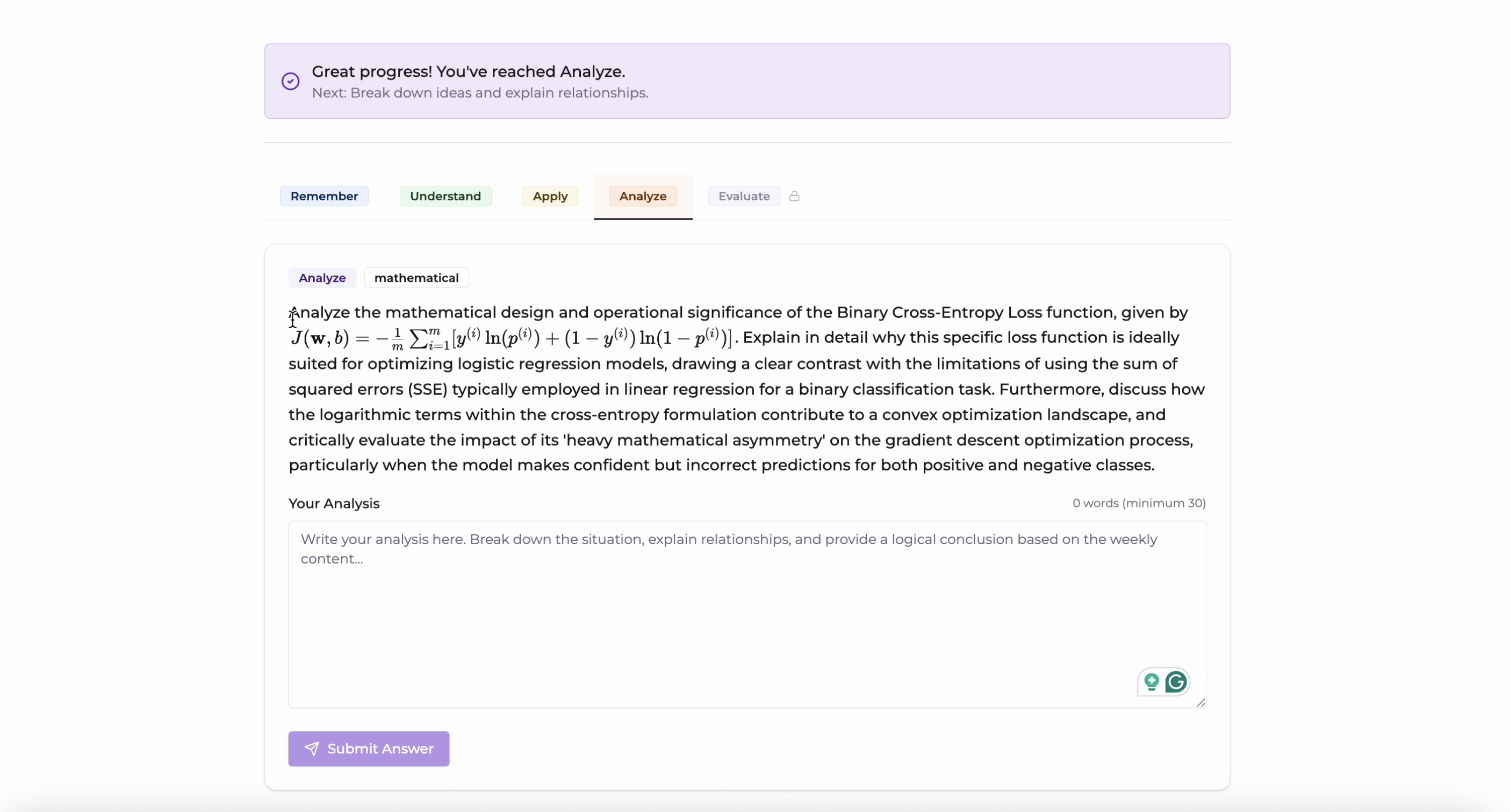
Instead of producing generic quizzes, TwentyWise uses dedicated AI assessment agents for different cognitive levels. These agents generate different types of assessments, including multiple-choice questions and essay-based tasks, depending on the depth of thinking required.
This makes the assessment experience more intentional. Students are not only tested on whether they remember information, but also whether they can understand, apply, analyze, and evaluate ideas.
Core Features
Essential Reading
TwentyWise generates focused essential readings based on the uploaded syllabus or study material. These readings highlight the most important concepts students should understand first, following the 80-20 learning approach.
The goal is not to replace the source material, but to help students enter it with clarity and direction.
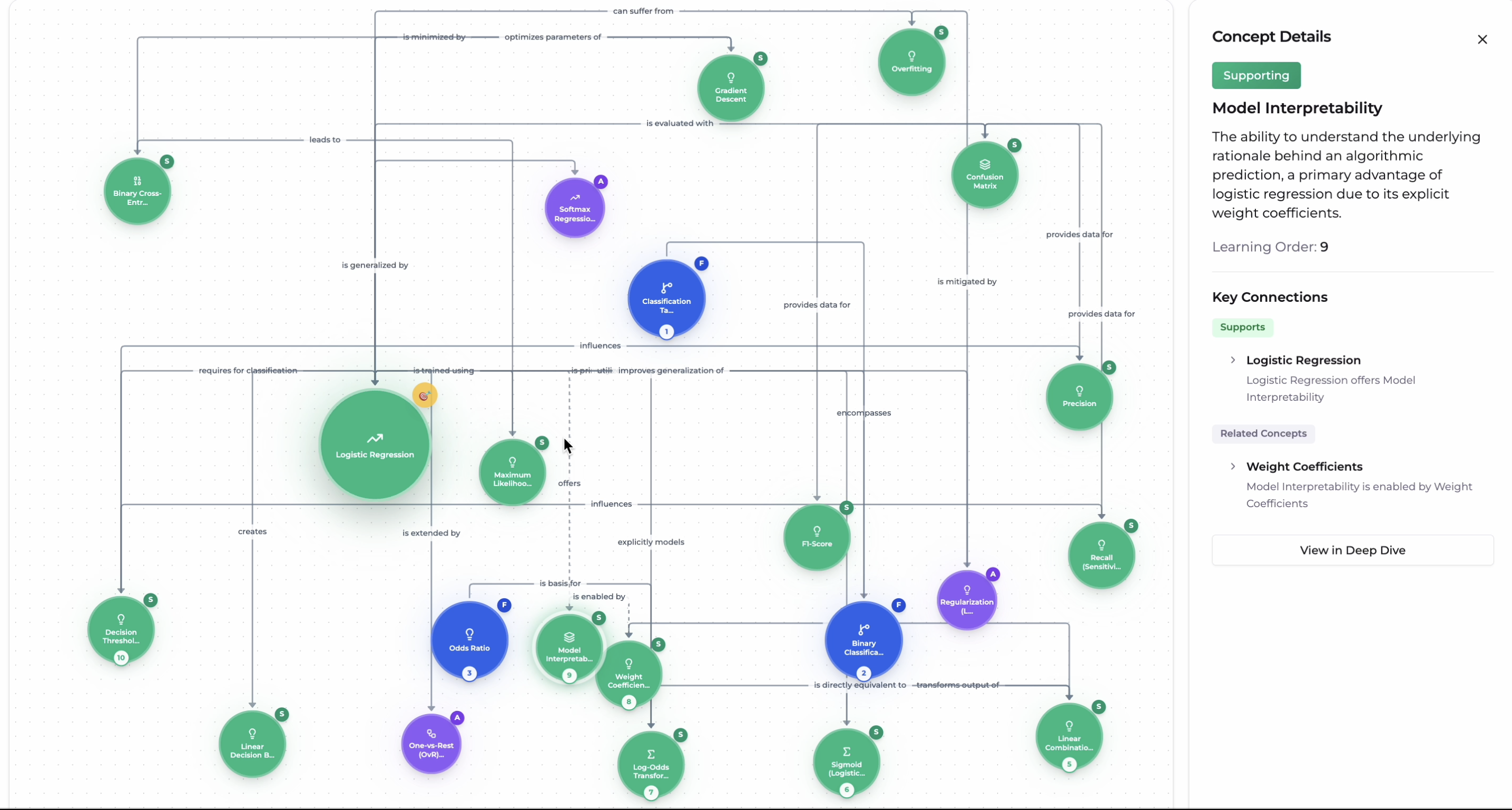
Mind Map
TwentyWise visualizes learning materials as an interactive concept map, where key concepts are represented as nodes and their relationships are shown as edges.
This helps students see how ideas connect instead of studying topics as isolated pieces of information. The mind map supports visual learning and makes the structure of the subject easier to understand.
Deep Dive
TwentyWise includes a Deep Dive feature that expands important topics in more detail.
However, the explanation remains grounded in the uploaded materials. This is important because it reduces the risk of out-of-scope answers and hallucinated content. Students can explore a topic more deeply while staying aligned with the actual course material.
Bloom-Based Assessments
TwentyWise uses multi-agent assessment generation to create learning activities across Bloom’s Taxonomy.
This allows the platform to generate different assessment types for different levels of mastery, from recall-based multiple-choice questions to higher-order essay questions that require analysis and evaluation.
Goal
The goal of TwentyWise is to change how students use AI in learning.
Instead of using AI only to finish tasks faster, TwentyWise uses AI to help students:
- identify what to focus on first;
- understand how key concepts relate to one another;
- review important ideas through organized notes;
- explore topics while staying grounded in their uploaded materials;
- answer assessments matched to different levels of thinking; and
- build confidence that they truly understand the subject.
In short, TwentyWise transforms scattered academic materials into a structured mastery journey.
It helps students learn with focus, depth, and purpose by combining the Pareto Principle, Bloom’s Taxonomy, grounded content generation, visual concept mapping, and multi-agent assessment design.
What it does
TwentyWise transforms syllabi and study materials into structured AI-powered learning journeys.
The platform can:
- Analyze syllabi into weekly learning plans
- Generate Essential Reading summaries
- Create interactive Mind Maps
- Provide Deep Dive topic exploration
- Generate structured notes from highlights
- Guide learners through Bloom’s Taxonomy stages:
- Remember
- Understand
- Apply
- Analyze
- Evaluate
How we built it
TwentyWise was built using MeDo through iterative multi-turn conversations and rapid prototyping.
I used MeDo to:
- Generate and refine UI components
- Design AI-powered learning workflows
- Build structured educational interfaces
- Create adaptive learning progression systems
- Improve user experience and educational flow
Challenges we ran into
One of the biggest challenges was balancing ambitious AI-powered features with stability and usability.
Some challenges included:
- AI response consistency
- JSON parsing reliability
- Rendering structured educational content
- Handling LaTeX equations properly
- Organizing Deep Dive content
- Maintaining smooth learning progression
- Ensuring responsive UI interactions during AI generation
- Creating multi-agents that are responsible for different levels of Bloom's taxonomy
- Using AI to identify the most important concepts in the material and map how they relate to one another through meaningful connections in the Mind Map
I also spent significant time refining prompts to make AI-generated content more coherent, concise and educationally meaningful.
Accomplishments that we're proud of
Some features I am especially proud of include:
- Syllabus-to-mastery learning workflow that combines algorithmic parsing and LLM-based interpretation to accurately organize course materials into a structured, progressive learning path
- Pareto Principle-based Essential Reading that goes beyond typical summarization by identifying the most impactful 20% of concepts that drive meaningful understanding of the material
- Deep Dive Mode for structured topic exploration, expanding concepts only within the scope of the user-uploaded materials to keep learning focused, relevant, and grounded
- Highlight-to-notes functionality that automatically collects a learner’s highlighted content into organized review notes for easier studying and revision
- AI-generated Mind Maps that represent key ideas as nodes and clearly show their relationships, dependencies, and connections through meaningful edges
- AI-powered multiple-choice and essay evaluation with LaTeX support
- Multi-agent Bloom’s Taxonomy assessment engine, where dedicated AI agents generate and evaluate learning activities for each cognitive level: Remember, Understand, Apply, Analyze, and Evaluate
Most importantly, I am proud that TwentyWise encourages deeper understanding instead of shortcut-based learning.
What we learned
Through building TwentyWise, I learned that AI becomes far more powerful when combined with educational structure and intentional learning design.
What's next for TwentyWise
Future plans for TwentyWise include:
- Multi-document learning synthesis
- AI-generated adaptive study plans
- Spaced repetition systems
- Voice-based learning features
- Personalized learning analytics
The long-term vision is to help students move from information overload to structured mastery through intelligent and human-centred learning experiences.
Built With
- medo

Log in or sign up for Devpost to join the conversation.