-
title card
-
your dome
Inspiration
Every plan for people living beyond Earth runs into the same question: where does the air come from? Algae is one of the best answers we found. Spirulina turns CO₂ and light into oxygen, it's edible, and it can help break down waste. We wanted a way for anyone to try growing it on Mars and to feel how hard that really is. We also loved how wplace turns one shared map into something everyone builds together. So Project AL-G puts both ideas on one real-scale Mars.
What it does
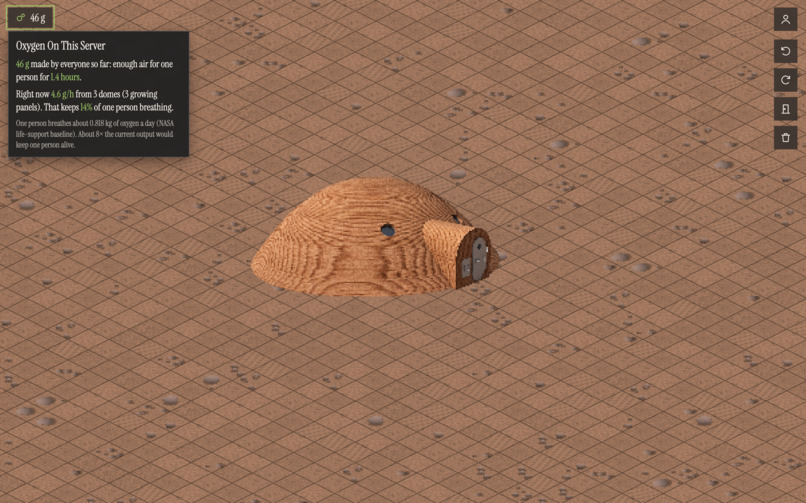
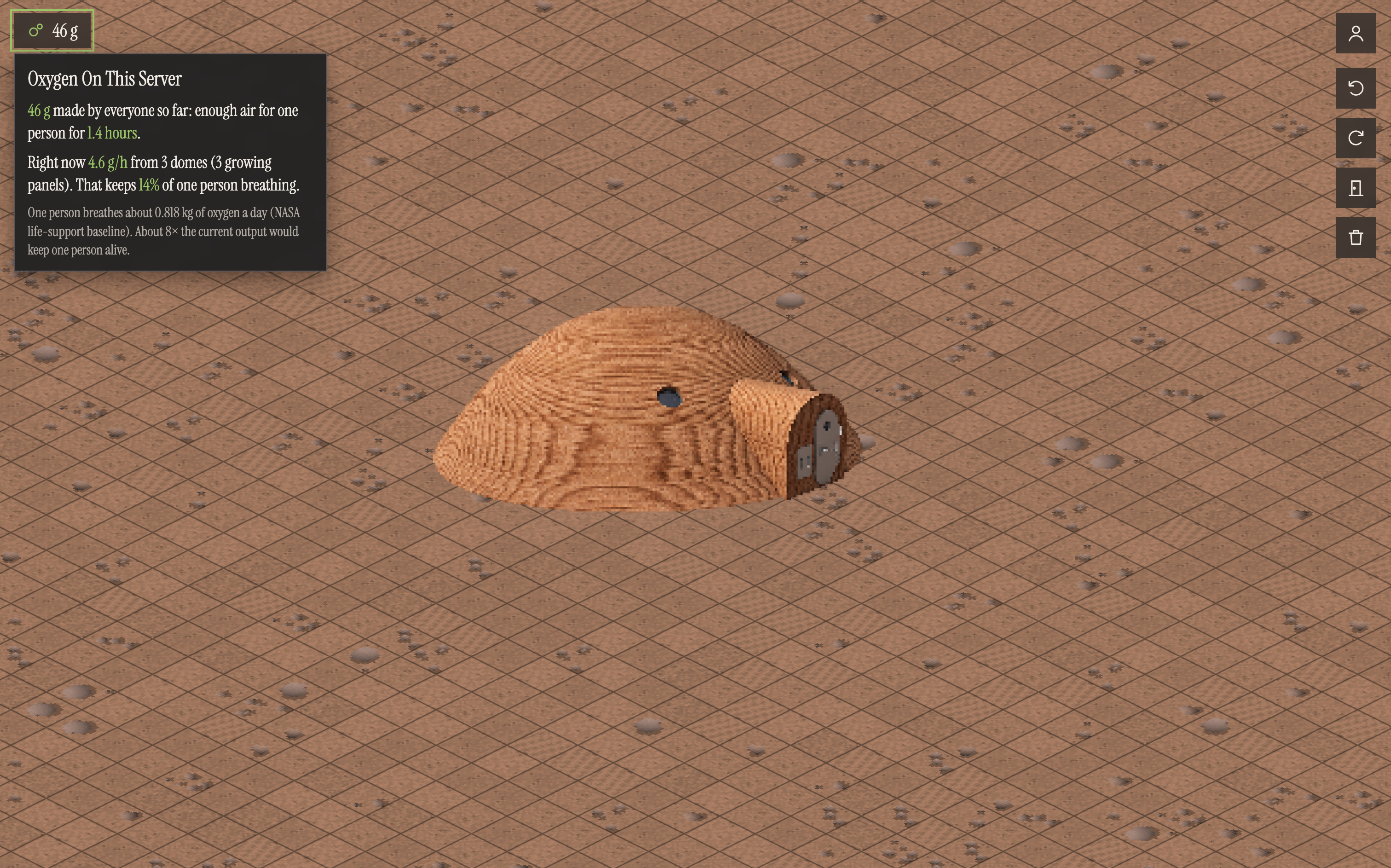
Explore Mars The map is a true-scale globe with NASA terrain imagery. Zoom in far enough and it becomes a grid of 1-meter tiles where players can build. You don’t need an account to explore or click on someone’s dome to check how their farm is doing.
Start a farm After registering, you can build one dome a day. Each dome has four flat-panel photobioreactors, but you start with just one culture. Fill your first panel and let it grow. Over several days, the water becomes cloudier as the Spirulina multiplies. Once it’s dense enough, you can take a starter from that panel to seed another.
Keep it growing The farms run on the server and keep growing while you’re away. The simulation follows Martian time and uses recorded weather from Curiosity to help calculate temperatures inside the farm. It also tracks sunlight, shading as the culture thickens, growth, respiration, nutrients, carbon, pH, battery power, and oxygen production and collection.
Check on your culture The farm panel looks like an old system monitor. You can check oxygen production, CO₂ exchange, water temperature, and growth over time, then adjust the heater and other settings. A simulated microscope lets you watch the Spirulina filaments multiply as the culture gets denser.
Prepare for dust storms Simulated regional storms reduce the sunlight reaching your reactors and solar panels. You may need more artificial light, but that also draws more power from your battery.
Help each other You can donate a starter culture to another player’s empty panel or ask for help by putting a green + on your dome. Owners can add caretakers who can adjust farm settings, while destructive actions remain restricted to the owner.
How we built it
Globe and map: We used WebGL2 to build a true-scale Mars globe that transitions into an isometric tile view as you zoom in. A 2D canvas adds domes, tunnels between neighboring farms, and shadows based on the sun’s position. We created the dome, lab, and UI artwork in Figma.
Server: The backend uses Node.js and its built-in SQLite support, with no additional packages. It manages accounts, securely hashed passwords, session cookies, farms, and caretaker permissions. Farms advance in fixed two-minute simulation steps. We tested that checking a farm more often doesn’t change its results.
Simulation: The server and browser use the same JavaScript model. We labeled every parameter as measured, derived, modeled, assumed, or gameplay so we could keep track of its scientific basis. Our tests cover units, darkness, depleted nutrients, power failures, temperature stress and recovery, mass balance, and dust storms.
Data: We wrote a Python script to prepare one Martian year of Curiosity weather data for the app. It preserves units and sol numbers, leaves missing readings blank, and flags questionable measurements.
Challenges we ran into
Research. Every decision had to have a scientific explanation, and balancing that against a hackathon clock was the hardest part. How big is a panel? How warm does the water need to be? How fast does Spirulina really grow? How much oxygen does that make? What should a greenhouse dome on Mars look like? We had to find a source for each answer or clearly mark it as an assumption. Often one paper gave us a number measured under very different conditions, so we had to work out how to adapt it, for example correcting a growth rate for light and night-time respiration. Weather was its own challenge too: the public feed has gaps and some impossible readings, which we had to flag without inventing data.
On the technical side:
Two scales on one globe: making a whole planet and 1 m tiles work together on the same map. One shared world: keeping every player's farm on the same timeline. Readable numbers: turning a detailed chemistry model into a handful of numbers a first-time player can understand.
Accomplishments that we're proud of
It is grounded in real data and research because the simulation runs on real Mars weather and published Spirulina research, and every value is labelled measured, modelled or assumed.
A real-scale, shared Mars, your dome sits on the real planet next to everyone else's, and anyone can open any dome and see how it's doing.
What we learned
We learned how revolutionary algae could be when humans do head beyond Earth. Oxygen production is only the start. Spirulina is also a protein-rich food, and algae can take part in decomposition and recycling waste, which is what a closed life-support loop needs.

Log in or sign up for Devpost to join the conversation.