-
-
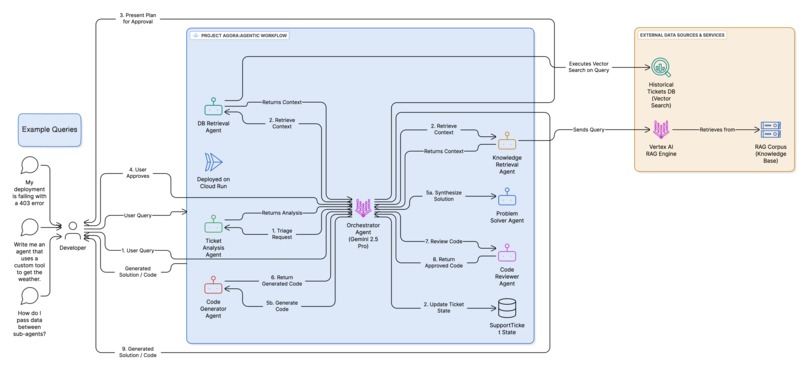
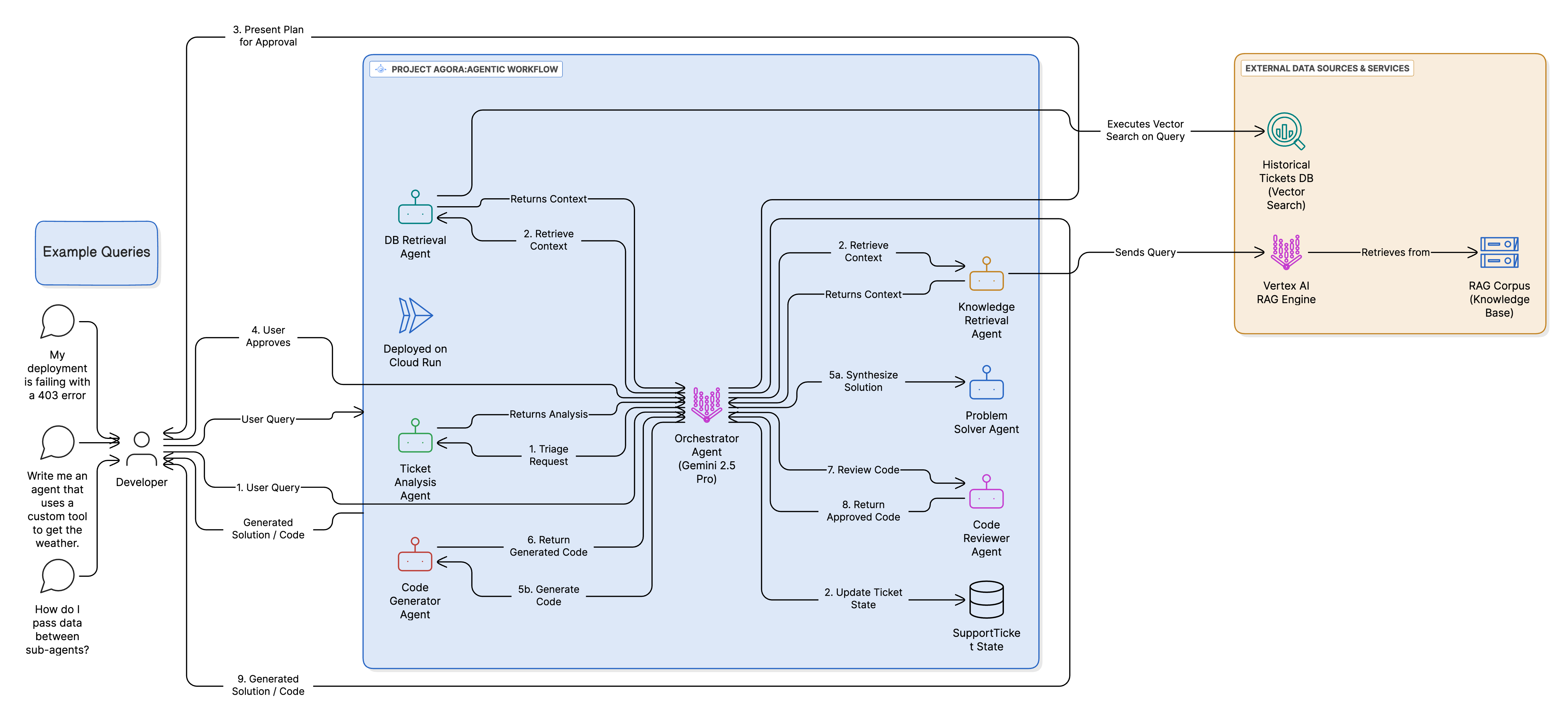
The architecture for Project Agora: A root agent orchestrating specialized sub-agents
-
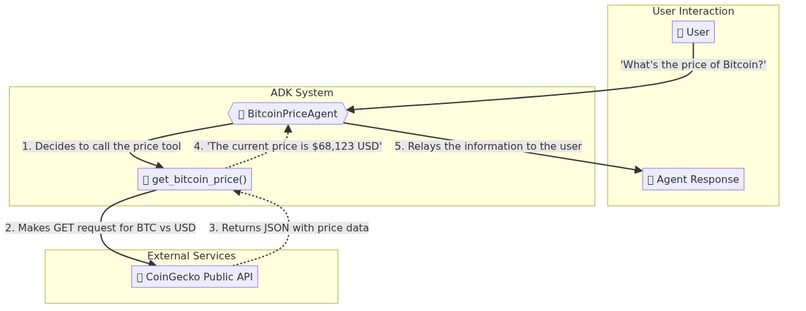
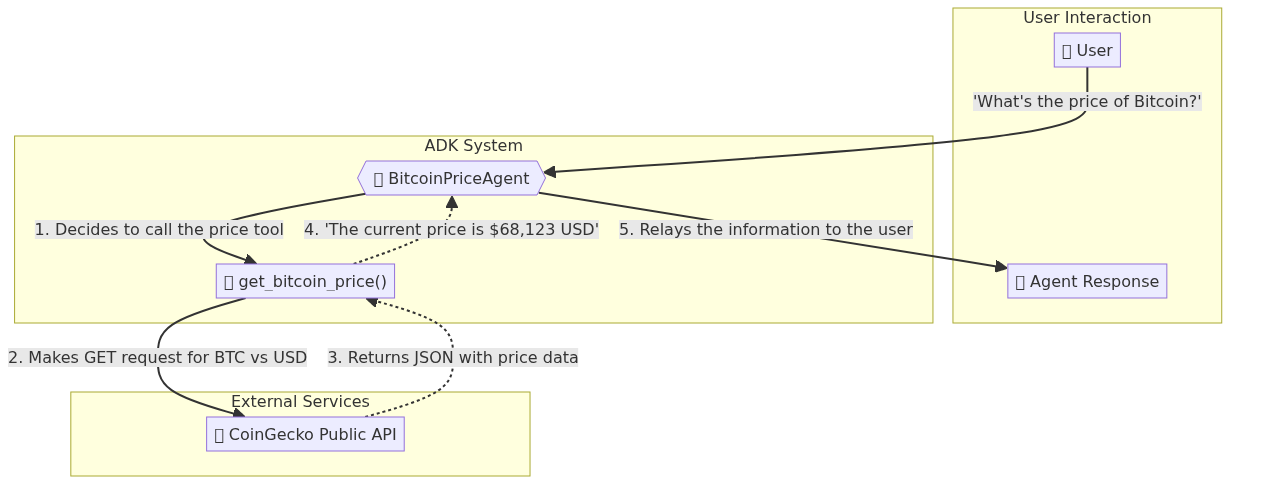
Agent architecture generated by Project Agora for a Bitcoin API-fetching agent.
-
Logo for Project-Agora
Inspiration
When I began the Google Cloud ADK Hackathon, my goal was simple: build a tool to solve my own pain points as a developer learning a new framework. I wanted an AI assistant that could do more than just fetch docs; I wanted a true collaborator.
A real development process isn't a single Q&A session. It's a stateful journey of analysis, research, architectural design, client feedback, code generation, and—most critically—rigorous quality assurance.
The "aha!" moment was realizing I couldn't build a single agent to do all that. I needed to architect a system. This is the story of Project Agora, a framework for creating and orchestrating hierarchical multi-agent systems, built on the Google Agent Development Kit (ADK).
What it does
Project Agora is a multi-agent AI system designed to act as an expert on the Google Agent Development Kit (ADK). It can:
- Answer Complex Questions: Synthesize answers grounded in both official documentation (via Vertex AI RAG) and a historical database of solved problems (via BigQuery Vector Search).
- Generate Complete ADK Projects: Take a single-sentence prompt and generate a fully scaffolded, multi-file agent application.
- Design & Visualize Architectures: Before writing code, the system proposes a formal architecture and generates a visual diagram for user approval, ensuring alignment and preventing wasted effort.
- Perform Automated QA: A dedicated
code_reviewer_agentprogrammatically reviews all generated code against a formal style guide to ensure correctness and adherence to best practices.
How I built it
Project Agora implements a hierarchical agent topology with a central orchestrator_agent managing a team of six specialized sub-agents. Each sub-agent is wrapped in an ADK AgentTool, allowing the orchestrator to delegate complex tasks.
Orchestration & State Management: The entire workflow is governed by a detailed prompt that turns the
orchestrator_agentinto a strict state machine. The application state, represented by a PydanticSupportTicketmodel, is managed across turns to track the process fromNewtoAnalyzingtoResolved.Multi-Source RAG: The system’s knowledge is grounded in two parallel sources for comprehensive context:
-
knowledge_retrieval_agent: Uses the built-inVertexAiRagRetrievaltool on a corpus of the official ADK documentation scraped into Google Cloud Storage. -
db_retrieval_agent: Executes aCOSINE_DISTANCEvector search in BigQuery on a database of historical ticket embeddings.
-
Dynamic Visualization & Code Generation: The
code_generator_agentfirst outputs a plan in JSON, including Mermaid syntax. A custom tool then uses Playwright to render this syntax into a PNG, which is uploaded to a GCS bucket and presented to the user as a public URL.Automated Quality Gates: The
code_reviewer_agentis a statelessLlmAgentwith a strict prompt that includes the project's style guide. It takes the generated code as input and outputs a JSON object with a status of "approved" or "rejected" (with corrected code), creating a reliable quality gate.One-Command Setup: To handle the complex backend, I wrote a master
setup_environment.shscript that automates the provisioning of the GCS bucket, the BigQuery dataset and table, and the Vertex AI RAG Corpus, making the entire system easily reproducible.
Challenges I ran into
- Prompt-Driven State Machine: Engineering the orchestrator's prompt to be a truly robust, multi-state machine that waits for user input was a significant challenge. It required dozens of iterations to prevent the agent from "skipping ahead" and to ensure it handled both the code-generation and problem-solving branches correctly.
- Mixing Tool Types: The Google Cloud API does not allow mixing the built-in
VertexAiRagRetrievaltool with other custom tools in the same agent. I had to architect a solution where the RAG agent was isolated in its own sub-agent, which the orchestrator could then call as part of a larger, multi-tool workflow.
Accomplishments that I'm proud of
I'm incredibly proud of building a system that goes beyond a simple demo and represents a truly useful, end-to-end application. Specifically, the two feedback loops are major accomplishments:
- The User-Approval Loop: Having the agent generate a visual architecture diagram and wait for user sign-off is a huge step toward trustworthy and collaborative AI.
- The QA-Review Loop: The automated code review is the most innovative part of this project. It treats AI-generated code as a first draft that needs verification, making the final output far more reliable and production-ready.
What I learned
This project taught me that the real power of modern AI lies not in a single, monolithic model, but in the orchestration of multiple, specialized agents. The Google ADK proved to be the ideal tool for this, providing the perfect level of abstraction to build complex, stateful, and collaborative agentic systems.
What's next for Project Agora
Project Agora is designed as a domain-agnostic framework. The next step is to create industry-specific implementations. By swapping the knowledge base and agent prompts, it could be retasked to automate financial reporting, legal research, or marketing campaign creation. I'm also excited about adding deeper integrations, particularly with GitHub for automated CI/CD pipeline management.
Built With
- adk
- bigquery
- cloud-run
- gemini
- google-cloud
- python
- vertex-ai

Log in or sign up for Devpost to join the conversation.