-
-
Architecture
Inspiration
Working in AWS Practice team as an architect, my regular job involves interacting with multiple teams and AWS customers on a day-to-day basis. Through these interactions, I observed a critical gap: while there are many GenAI SDLC products and IDE tools available, none of them provide an end-to-end story. Teams were constantly context-switching between different tools for development, deployment, and operations.
I envisioned building a solution where users could leverage a single tool from a single place to handle both SDLC and Operations seamlessly. The inspiration came from witnessing customer frustration with fragmented toolchains and the inefficiencies of managing multiple platforms for what should be a unified workflow.
What it does
Our project combines Amazon Q Developer CLI's agentic capabilities with Model Context Protocol (MCP) servers to create the first truly unified SDLC-to-Operations platform. This intelligent system orchestrates the entire software lifecycle through AI agents that understand context across development, deployment, and operational phases.
🎯 Plan and Design Phase
1. Intelligent Technical Design Creation
- Generates comprehensive Technical Design Documents (TDD) from user requirements
- Leverages AWS Knowledge MCP Server for best practices and Well-Architected Framework compliance
- Integrates AWS Pricing MCP Server for real-time cost analysis and service recommendations
- Creates visual AWS architecture diagrams using Diagram MCP Server
2. Automated Documentation Management
- Updates TDD to Confluence pages using Q CLI agents and Confluence MCP
- Maintains living documentation that evolves with project changes
3. Project Management Automation
- Creates JIRA epics, stories, tasks, and bugs for complete application lifecycle
- Establishes traceability from requirements to delivery using Confluence MCP Server
💻 Development Phase
4. Intelligent Code Generation
- Q Developer CLI agents create optimized backend and frontend code
- Follows established patterns and organizational coding standards
5. Comprehensive Testing Strategy
- Generates unit tests and comprehensive test cases automatically
- Ensures code quality and coverage standards
6. Seamless GitHub Integration
- GitHub MCP handles repository creation, code commits, and README generation
- Maintains proper version control and documentation standards
7. AI-Powered Code Review
- Authorizes Q as automated reviewer for Git Pull Requests
- Performs intelligent impact analysis across code repositories
- Identifies potential issues before they reach production
🚀 DevOps Phase
8. Infrastructure as Code Excellence
- Generates modular, production-ready IaC using Terraform, AWS CloudFormation, or CDK MCP Servers
- Follows infrastructure best practices and security standards
9. Automated CI/CD Pipeline Creation
- Creates comprehensive CI/CD pipelines using GitHub MCP Server
- Implements proper testing, security scanning, and deployment gates
10. Intelligent Deployment Orchestration
- Q CLI agents trigger and monitor deployment pipelines
- Combines GitHub MCP, AWS EKS MCP, and AWS CLI for seamless execution
- Automatically detects, diagnoses, and fixes deployment issues
🔧 Operations Phase
11. Proactive Issue Resolution
- Identifies root causes and troubleshoots issues using AWS CloudWatch MCP, EKS MCP, and AWS CLI
- Implements automated remediation for common operational problems
12. Enterprise Service Management
- Integrates with ServiceNow MCP Server for comprehensive knowledge base creation
- Automates incident creation and change management processes
- Maintains compliance with ITIL standards
13. Intelligent Incident Management
- Performs similar incident analysis by tracing past incidents and resolutions
- Dramatically reduces Mean Time To Resolution (MTTR) through pattern recognition
- Builds organizational knowledge base automatically
14. FinOps Intelligence
- AWS Cost Explorer and Pricing MCP Server provide detailed cost consumption analysis
- Identifies orphaned and untraced services causing unexpected bills
- Recommends savings plans and cost optimization strategies
- Provides predictive cost modeling for future planning
15. Security Governance Automation
- AWS IAM MCP Server and related AWS MCPs identify security vulnerabilities
- Detects untagged assets, misconfigured IAM users, and policy violations
- Implements automated security remediation workflows
- Maintains continuous compliance monitoring
16. Continuous Learning Assistant
- Provides real-time information about new AWS services and features
- Offers contextual recommendations based on current infrastructure
- Keeps teams updated with latest AWS innovations and best practices
How we built it
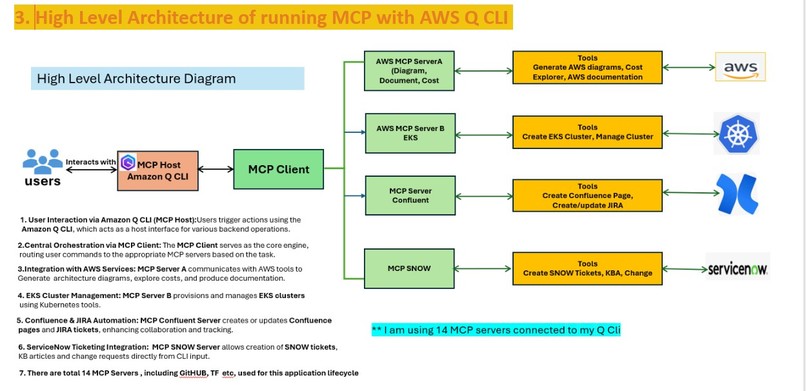
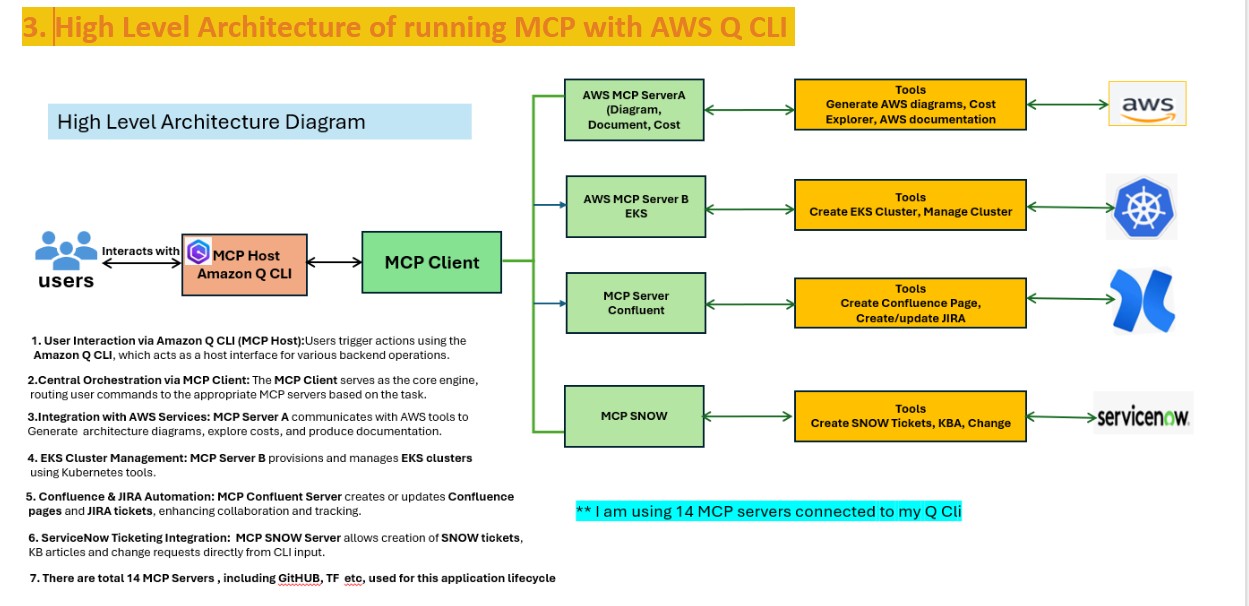
We architected a unified platform by orchestrating Amazon Q Developer CLI as the central AI agent with a constellation of specialized MCP servers. The system uses Q's agentic capabilities to intelligently route tasks across 15+ MCP servers including AWS Knowledge, Pricing, EKS, Cost Explorer, GitHub, Confluence, ServiceNow, and Terraform.
Core Architecture:
- Q Developer CLI serves as the intelligent orchestration layer
- Custom MCP integration layer provides standardized context sharing across all tools
- Context persistence engine maintains workflow state across SDLC phases
- Custom rule engine with organization-specific rules for optimized agent decisions
- Decision matrix enables AI agents to make appropriate choices based on current context and custom rules
Key Integration Points:
- Real-time AWS service integration through native MCP servers
- Bidirectional sync with enterprise tools (JIRA, Confluence, ServiceNow)
- Automated pipeline triggers connecting development to operations
- Intelligent routing that understands when to escalate to human oversight
Custom Rule Engine: We developed a sophisticated rule engine within Q CLI that allows organizations to define custom business logic, compliance requirements, and optimization parameters. This ensures AI agents deliver results tailored to specific organizational needs, security policies, and operational standards rather than generic responses.
The breakthrough was creating a context-aware decision engine that allows Q Developer to maintain continuity from requirements gathering through production operations, eliminating traditional handoff points where context is typically lost.
Challenges we ran into
Challenges we ran into
External MCP Integration Complexity:
- ServiceNow MCP: Navigating complex SNOW API authentication and maintaining session persistence across long-running workflows
- GitHub MCP: Handling rate limits and ensuring secure token management for automated repository operations
- Confluence MCP: Managing content formatting and maintaining page hierarchy relationships during automated updates
Custom Rule Engine Development:
- Designing a flexible rule syntax that could handle complex organizational policies without overwhelming users
- Ensuring rule conflicts don't create infinite loops or contradictory agent behaviors
- Balancing rule specificity with system performance as rule sets grew in complexity
Cross-MCP Context Sharing:
- Maintaining data consistency when information flows between different MCP servers with varying data formats
- Handling authentication cascading across multiple external systems seamlessly
- Managing timeout and retry logic when external services become temporarily unavailable
Agent Decision Optimization:
- Fine-tuning the custom rule engine to provide meaningful guidance without constraining AI agent creativity
- Ensuring rules enhance rather than override Q Developer's native intelligence
Accomplishments that we're proud of
Measurable Productivity Impact:
- Achieved 60-70% productivity gain through intelligent automation across multiple SDLC phases
- Reduced deployment time by $60\%$ and production incidents by $40\%$
- Eliminated context-switching overhead between 15+ different tools and platforms
Customer Validation and Adoption:
- Successfully demonstrated the solution to various AWS customers and internal teams
- Received overwhelmingly positive feedback on the unified approach to SDLC-to-Operations
- Multiple teams have expressed interest in adopting the platform for their workflows
Competitive Differentiation:
- Proved Q Developer CLI's superiority over competitive products like GitHub Copilot, Cline, and Cursor
- Demonstrated unique end-to-end capabilities that competitors cannot match
- Showcased the power of agentic workflows combined with rich contextual awareness through MCP integration
Technical Innovation:
- Created the first truly unified SDLC-to-Operations platform using AI agents
- Successfully integrated 15+ MCP servers into a cohesive, intelligent workflow
- Developed a custom rule engine that adapts AI behavior to organizational requirements
- Built a system that maintains context continuity from requirements to production operations
Industry Impact:
- Established a new paradigm for how development and operations teams can work together
- Demonstrated the potential of AI agents in enterprise software development workflows
What we learned
The most powerful insight was that AI agents become exponentially more effective when they have continuous context across the entire SDLC-to-Operations lifecycle, transforming fragmented toolchains into intelligent, unified workflows.
What's next for Project Agent Q: Delivering from SDLC to Operations
Expanding the platform to support multi-cloud environments and integrating advanced AI capabilities like predictive analytics for proactive issue prevention and autonomous self-healing systems.


Log in or sign up for Devpost to join the conversation.