Inspiration
What it does
How we built it
Challenges we ran into
Accomplishments that we're proud of
What we learned
What's next for Memory Palace 5530
Memory Palace 5530
Inspiration
I'm not a native English speaker.During my preparation for the postgraduate entrance exam, I found that memorizing vocabulary is a challenge for me. While studying, I explored various memory techniques that suited me best, and among them, the method of loci (memory palace) worked most effectively. Therefore, I decided to create a memory palace for the words I needed to learn, with the help of Codex, I successfully brought this idea to life.
Traditional vocabulary learning often relies on repetitive memorization and endless word lists. While studying for graduate entrance exams, I wondered whether vocabulary could be learned in a more intuitive and memorable way.
The ancient Memory Palace technique inspired this project. Instead of presenting thousands of isolated words, I wanted learners to explore vocabulary as if they were walking through a physical space.
What it does
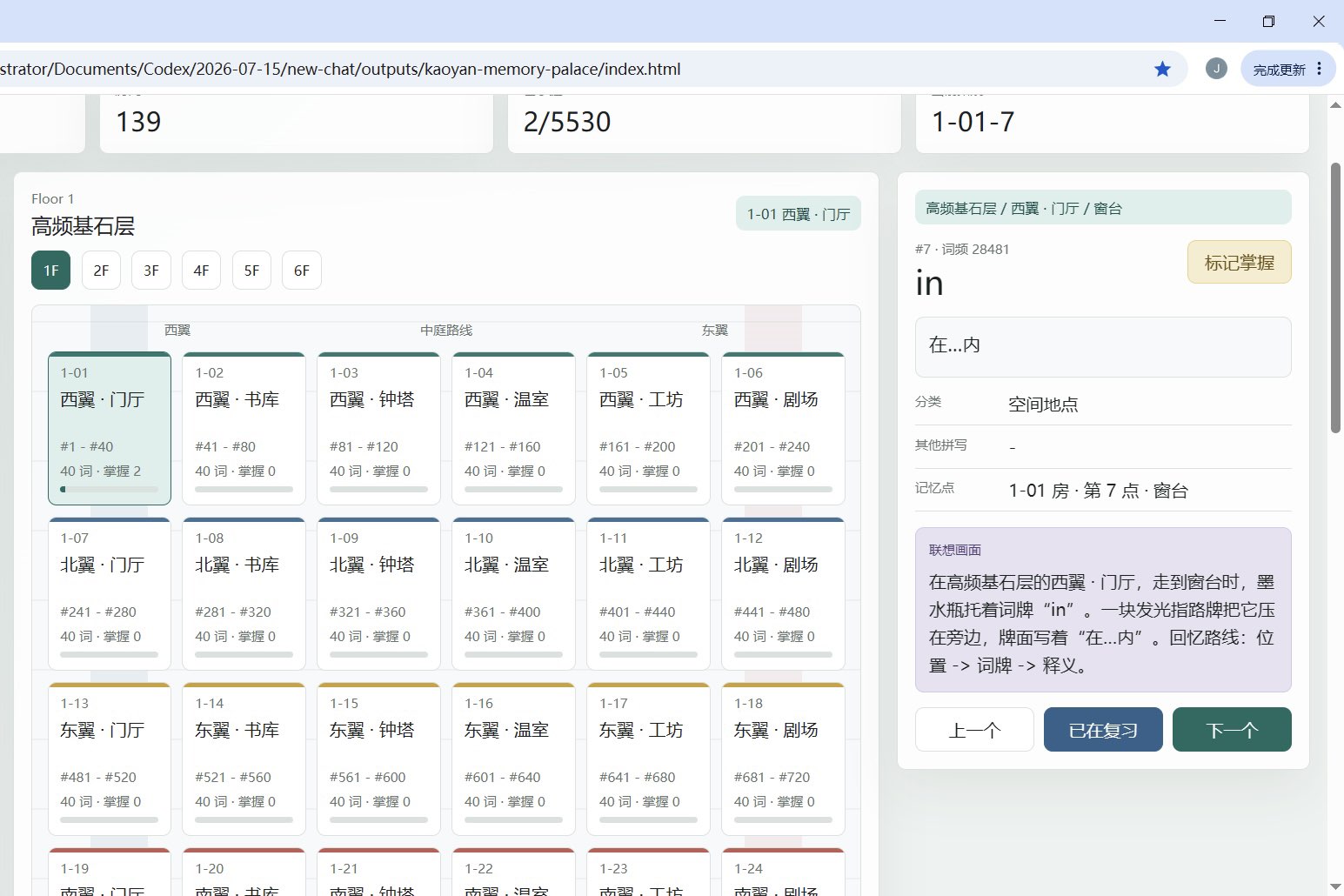
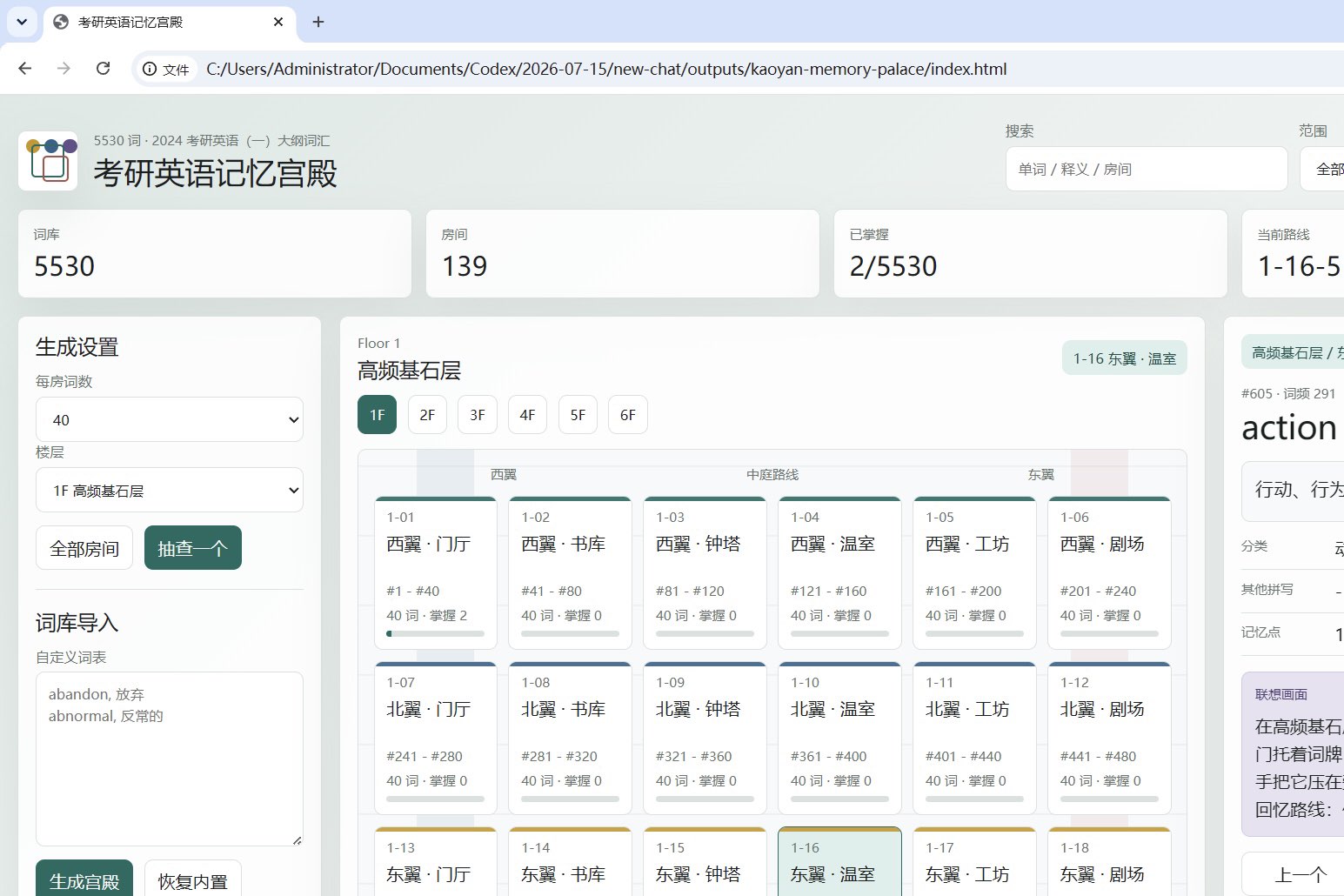
Memory Palace 5530 transforms 5,530 graduate English vocabulary words into an interactive six-level memory palace.
The application includes:
- 139 interconnected rooms
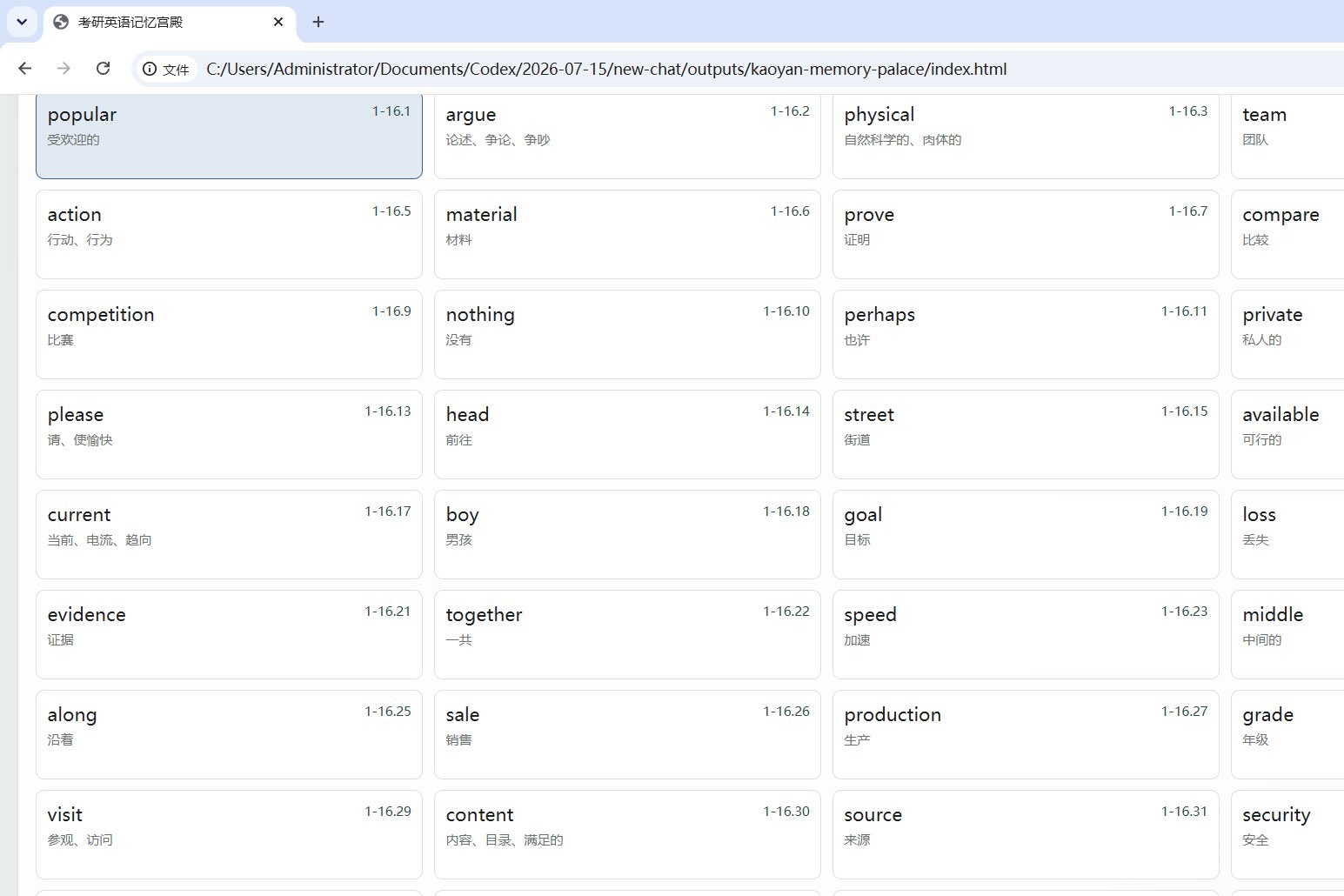
- Instant vocabulary search
- Category and frequency filters
- Memory associations for each word
- Learning progress tracking
- Review queue
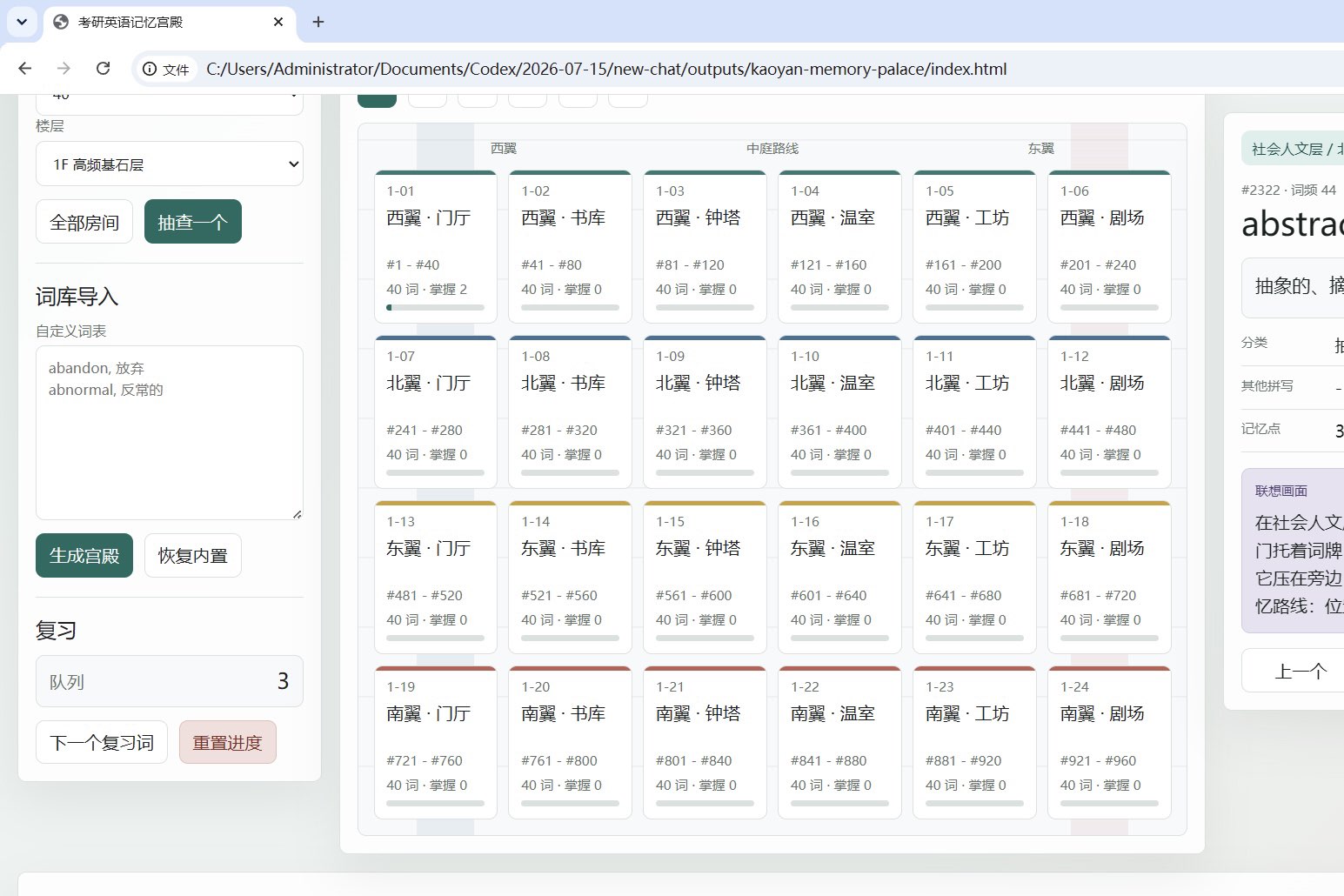
- Custom vocabulary import
- CSV learning route export
- Fully offline support
Instead of scrolling through long vocabulary lists, learners navigate through rooms and build spatial memory while studying.
How I built it
This project was built collaboratively with OpenAI Codex during OpenAI Build Week.
I used Codex throughout the development process to design the application's architecture, implement interactive navigation, build the search system, optimize the responsive interface, and improve code quality through multiple rounds of iteration.
My role focused on defining the product vision, designing the learning experience, refining prompts, testing features, and making product decisions. Codex significantly accelerated development while allowing me to concentrate on usability and interaction design.
The project is a static web application built with HTML, CSS, and JavaScript and runs entirely offline in a browser.
Challenges I ran into
The biggest challenge was transforming a vocabulary list into a meaningful spatial structure.
Instead of organizing words alphabetically, I designed a six-level memory palace with 139 interconnected rooms while keeping navigation intuitive and efficient.
Another challenge was ensuring smooth performance and a complete learning experience without relying on a backend service.
What I learned
This project showed me that AI is more than a code generator—it can become a collaborative development partner.
Working with Codex helped me rapidly prototype ideas, iterate on designs, and focus more on solving real learning problems instead of spending most of my time writing boilerplate code.
I also learned how thoughtful prompt engineering and continuous testing are essential to building a polished AI-assisted product.
How Codex Accelerated Development
Codex was used throughout the entire development process—from planning and implementation to debugging and refinement.
It helped generate the initial project structure, implement core functionality, optimize responsive layouts, refactor code, and accelerate feature development.
Rather than replacing human creativity, Codex enabled me to iterate faster and spend more time on product design, user experience, and testing.
What's next
The next step is to expand Memory Palace beyond graduate English vocabulary.
Future versions will allow users to upload their own learning materials and automatically generate personalized memory palaces with AI.
Additional plans include adaptive review strategies, multilingual support, richer memory associations, and collaborative learning experiences.
Built With
- app
- codex
- css
- design
- education
- gpt-5.6
- html
- javascript
- learning
- memory
- offline
- openai
- palace
- responsive
- static
- vocabulary
- web
- website

Log in or sign up for Devpost to join the conversation.