Advocate
Because navigating a denied claim shouldn't require a law degree.
Inspiration
One of our teammates got hit with a denied health insurance claim. Confusing paperwork, strict deadlines, expensive lawyers, and zero real support. The system felt impossible to navigate alone — so we built something to change that.
Advocate turns a denial into a strategy.
What It Does
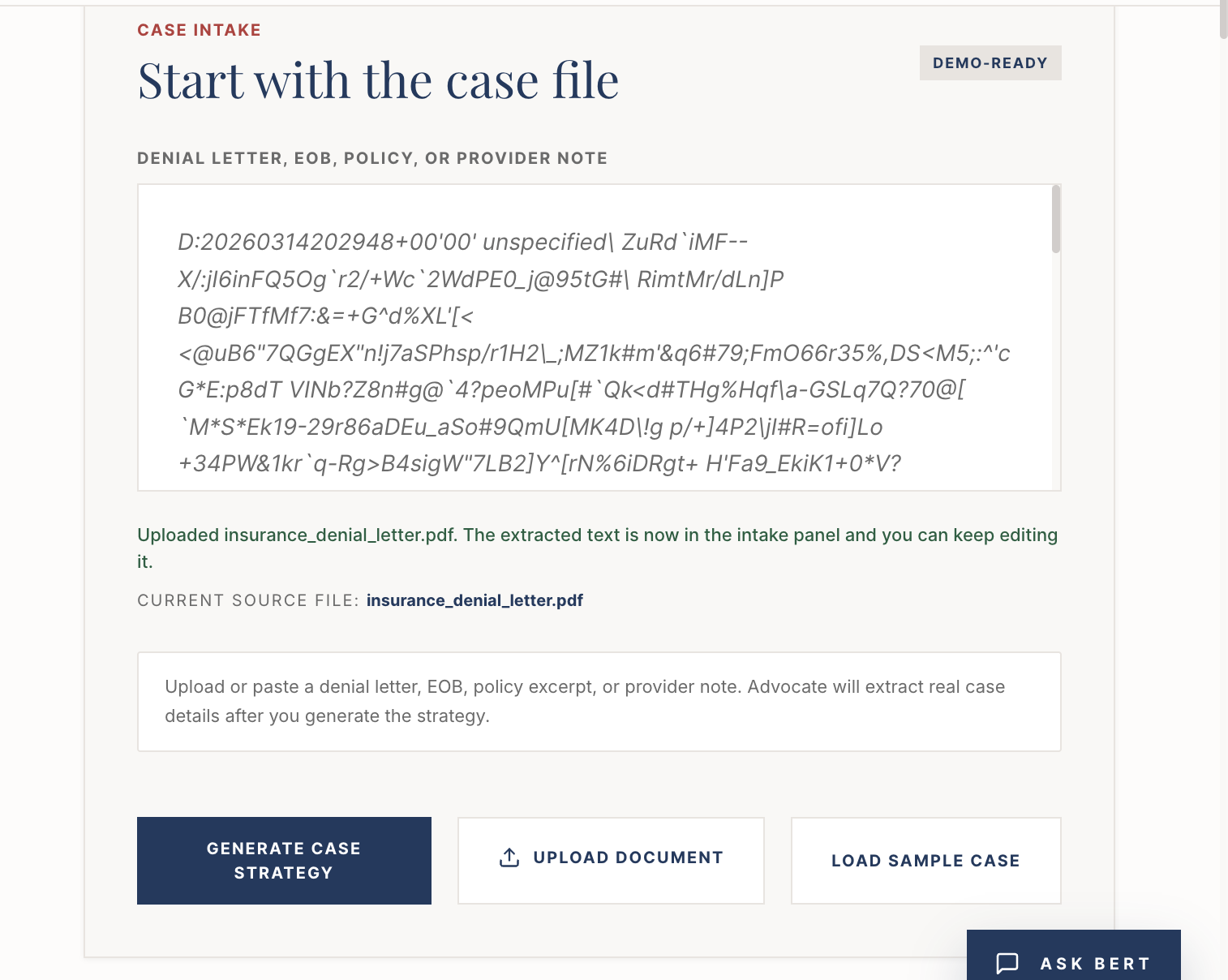
A user uploads or pastes a denial letter, EOB, policy excerpt, or medical bill. Advocate then:
- Extracts the key case details
- Identifies the likely reason for denial
- Detects deadlines and escalation risk
- Builds a visual attack-tree strategy
- Scores evidence by relevance using transformer-based analysis
- Drafts the appeal documents needed to move forward
As new evidence is uploaded, the strategy updates dynamically.
Our in-app assistant BERT keeps users grounded throughout — explaining the case, missing evidence, deadlines, and next steps in plain language.
How We Built It
Frontend
// Next.js + React + TypeScript + Tailwind
const Advocate = () => <ClaimWorkspace strategy={attackTree} />
Backend AI Pipeline
# FastAPI + PyTorch + scikit-learn + BERT
pipeline = ingest → extract → analyze → strategize → score → draft → update
The math behind evidence scoring — each piece of evidence gets a relevance weight:
$$ R(e_i) = \frac{\sum_{j} w_j \cdot \text{sim}(e_i, c_j)}{|C|} $$
Where \( w_j \) is the weight of case feature \( j \) and \( \text{sim} \) is semantic similarity to the denial context.
Tech Stack
| Layer | Tools |
|---|---|
| Frontend | Next.js, React, TypeScript, Tailwind CSS |
| Backend | FastAPI, Next.js API routes |
| AI/ML | OpenAI API, PyTorch, scikit-learn, BERT |
| Auth + DB | Firebase Auth + Firestore |
Challenges
Real PDFs are messy. Image-heavy, badly structured, inconsistent across environments — making reliable document parsing took serious iteration.
Data quality was a wall. Most public datasets were synthetic or too clean to reflect real-world denial reasoning.
And beyond the technical: the product had to feel trustworthy. It wasn't enough to generate a summary — users needed to understand why a branch was recommended and whether a next step was worth their time.
What We Learned
The hardest part of building an AI product isn't model performance — it's turning complex reasoning into something a person can actually trust and act on.
The best AI doesn't just impress. It clarifies.
What's Next
- Expanding into tenant rights, employment disputes, and consumer protection
- Mobile OCR for bills and EOBs
- Expert escalation workflows for cases that need legal review
- Better model-backed explainability and scoring
AI Use
Yes, we used AI heavily during development.
More than 70% of the code was AI-assisted in some form, but the architecture, product direction, integration decisions, debugging, and final product shaping were team-driven.
Built With
- claude
- css3
- fastapi
- firebase
- javascript
- python
- tailwind


Log in or sign up for Devpost to join the conversation.