Inspiration
DeFi offers massive opportunities — but for most users, it’s hard to know when to stake, restake, or exit. Even worse, most “AI trading tools” are black boxes: you can’t verify where their data comes from or whether their insights are trustworthy. We wanted to change that. Project Deep Dive was inspired by the idea of creating a verifiable AI co-pilot for staking decisions one that not only generates intelligent signals but also proves its integrity cryptographically.
What it does
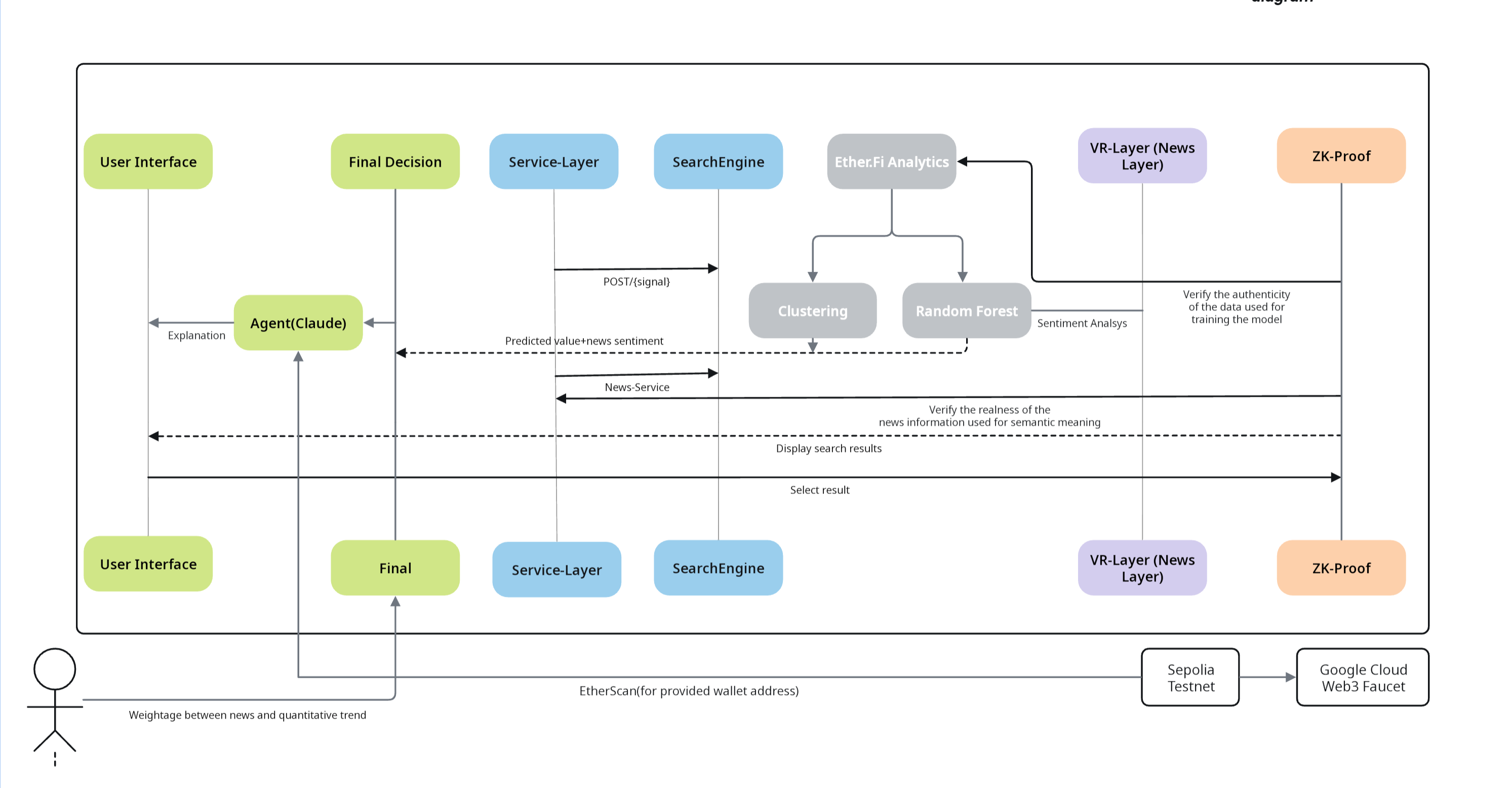
We built an end-to-end intelligent staking advisor that connects your wallet, analyzes both on-chain and off-chain data, and returns real-time recommendations all backed by zero-knowledge trust proofs.
Key features include:
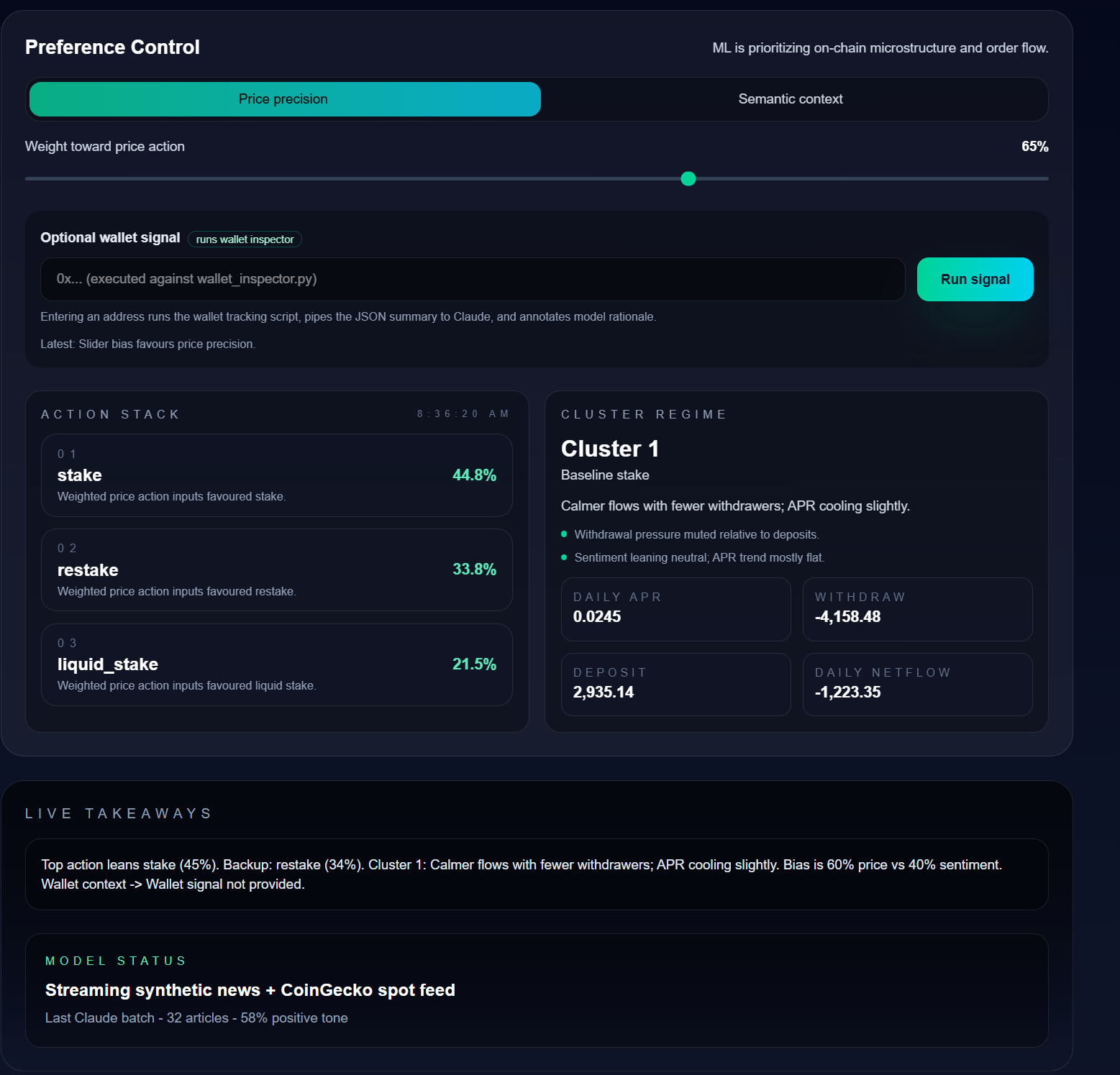
Wallet Inspector Agent an AI microservice that inspects any Ethereum wallet address, analyzes balances, staking history, and token flows, then recommends whether to stake, restake, or liquidate.
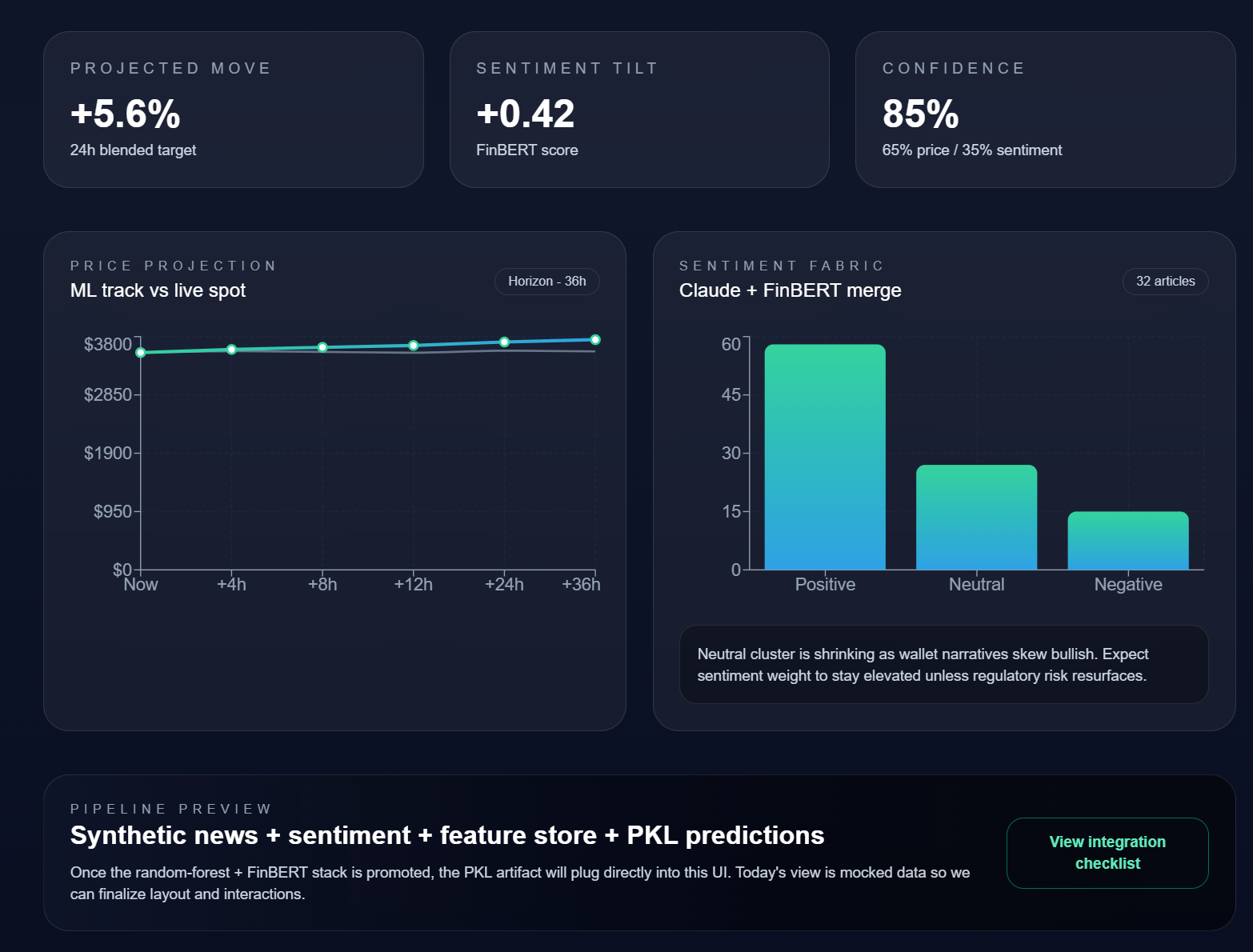
Model Signal Engine, trained RandomForest and XGBoost models that combine FinBERT-based sentiment with ETH price and staking metrics.
Real time news Generator generates fresh, structured CSVs of market news using Claude Sonnet and merges them with price data for contextual training.
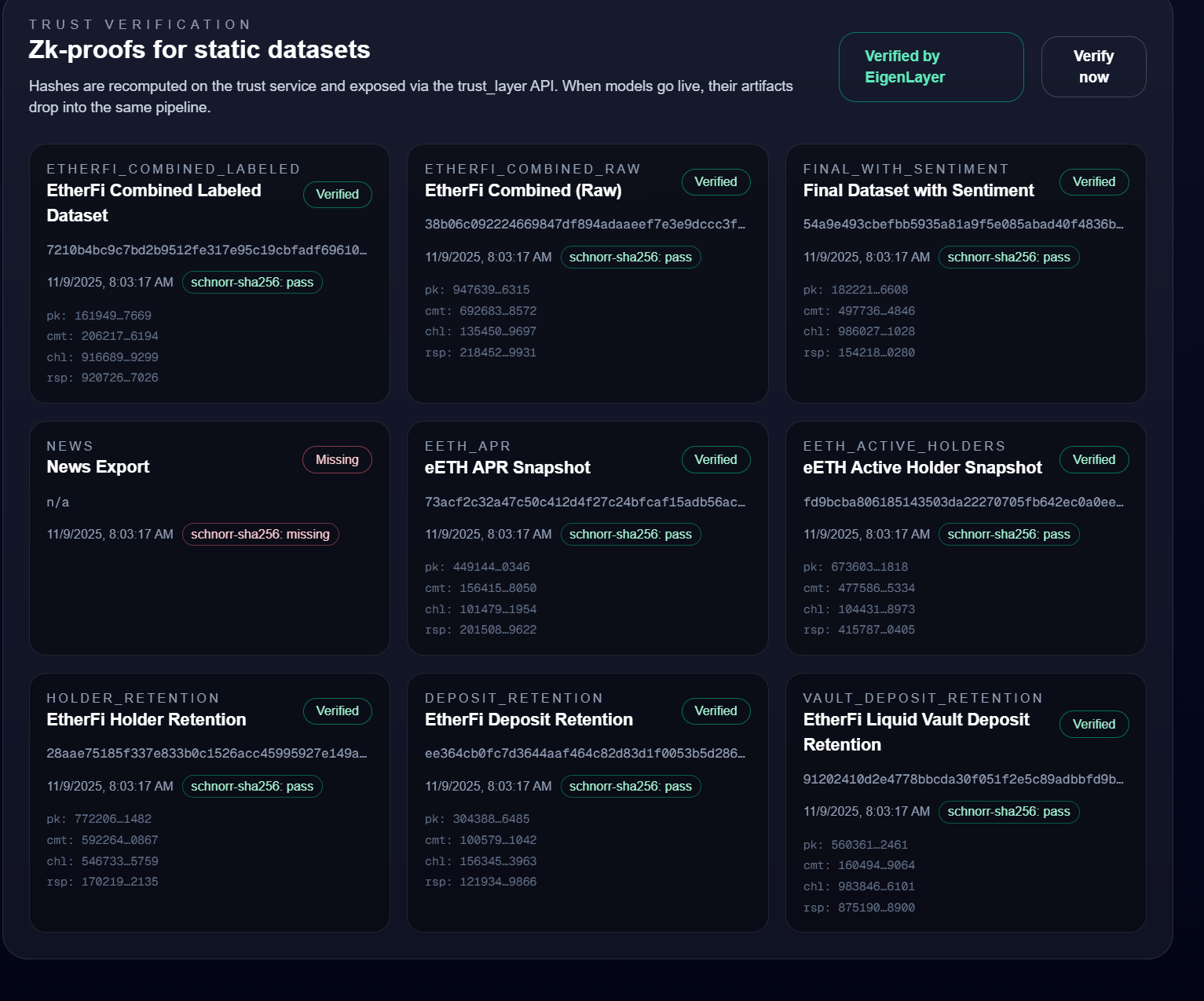
Trust Layer a Schnorr proof system over BN254 that hashes every dataset and artifact, providing cryptographic guarantees of model and data integrity.
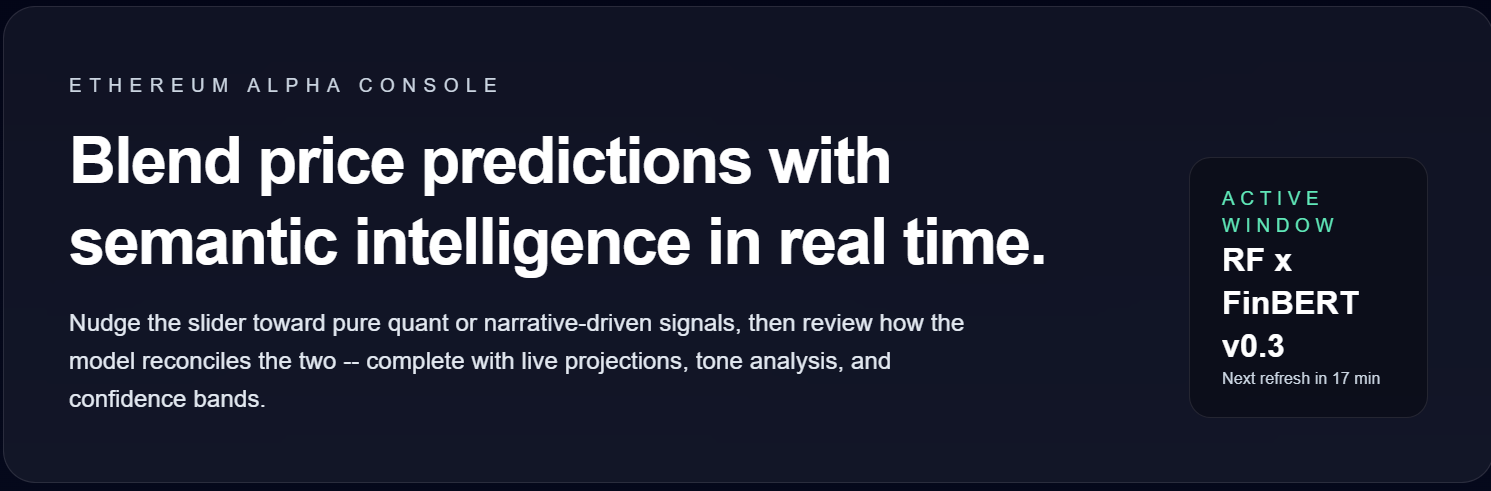
Next.js Dashboard : interactive UI where users can connect their wallet, adjust model focus sliders (price vs sentiment), and view verifiable staking insights in real time.
How we built it
Python FastAPI services for model scoring, wallet inspection, synthetic data, and trust verification.
ML pipeline (Scikit-learn, XGBoost, Transformers) to train and serialize model artifacts.
Wallet Inspector Agent using Web3.py and Etherscan APIs to analyze live wallet activity and summarize it for the model.
Trust verification scripts that compute SHA-256 hashes of all datasets and proofs, generate Schnorr attestations, and store them in a JSON registry consumed by the frontend.
Next.js frontend with animated dashboards, Recharts visualizations, and asynchronous API polling for live signals.
Challenges we ran into
Synchronizing model retraining and trust proof regeneration without breaking inference compatibility.
Scrapping new articles from google is not the easiest :(
Ensuring determinism in synthetic news generation and FinBERT embeddings.
Debugging wallet transaction decoding across multiple token contracts and chains.
Handling CORS and environment isolation between FastAPI services and the Next.js frontend.
Designing Schnorr proofs that validate instantly while remaining lightweight enough for real-time verification.
What we learned
Building AI that’s both interpretable and verifiable requires tight coupling between ML engineering and cryptography.
The wallet-aware AI agent taught us how to merge real-time blockchain data with model inference pipelines.
Creating deterministic synthetic datasets pushed us to rethink reproducibility and proof generation.
We learned how to build a multi-service AI architecture that feels seamless to the end user — from data ingestion to UI interaction.
Generating test-NET coins.
What's next for project-inspector
We’ve proven that AI-driven staking recommendations can be verifiable, explainable, and personalized but this is just the start. Here’s what’s next for Project Deep Dive: Deploy the Wallet Inspector Agent on-chain Turn the wallet analysis microservice into a live autonomous DeFi agent capable of executing stake, restake, or liquidation actions directly on smart contracts (with user consent).
Integrate with major staking pools Connect to Lido, RocketPool, and EtherFi for one-click staking and restaking from within the dashboard, turning insights into real transactions.
Expand the Trust Layer Move beyond simulated proofs by deploying real EigenLayer attestations and zero-knowledge verifiers on-chain to publicly validate model integrity.
Personalized reinforcement learning Train the agent to adapt to each user’s portfolio performance and risk profile, improving signal accuracy over time.
Built With
- claude-api
- etherscan-api
- fastapi
- python
- randomforrest
- typescript


Log in or sign up for Devpost to join the conversation.