-
-
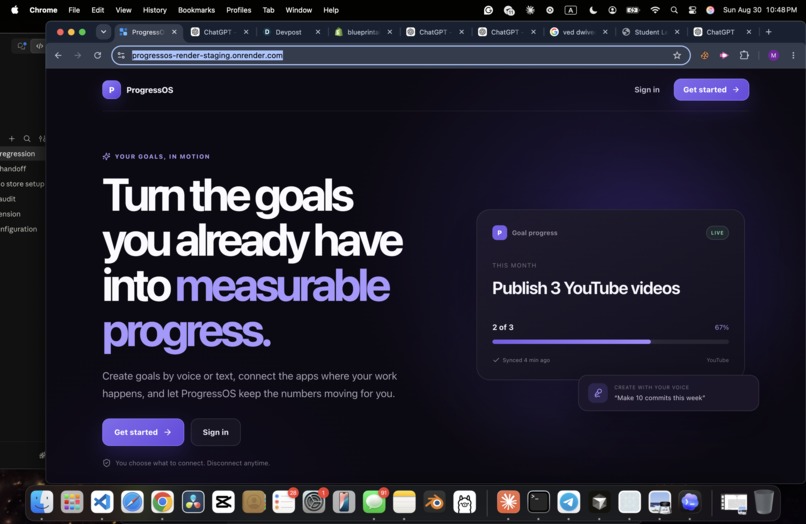
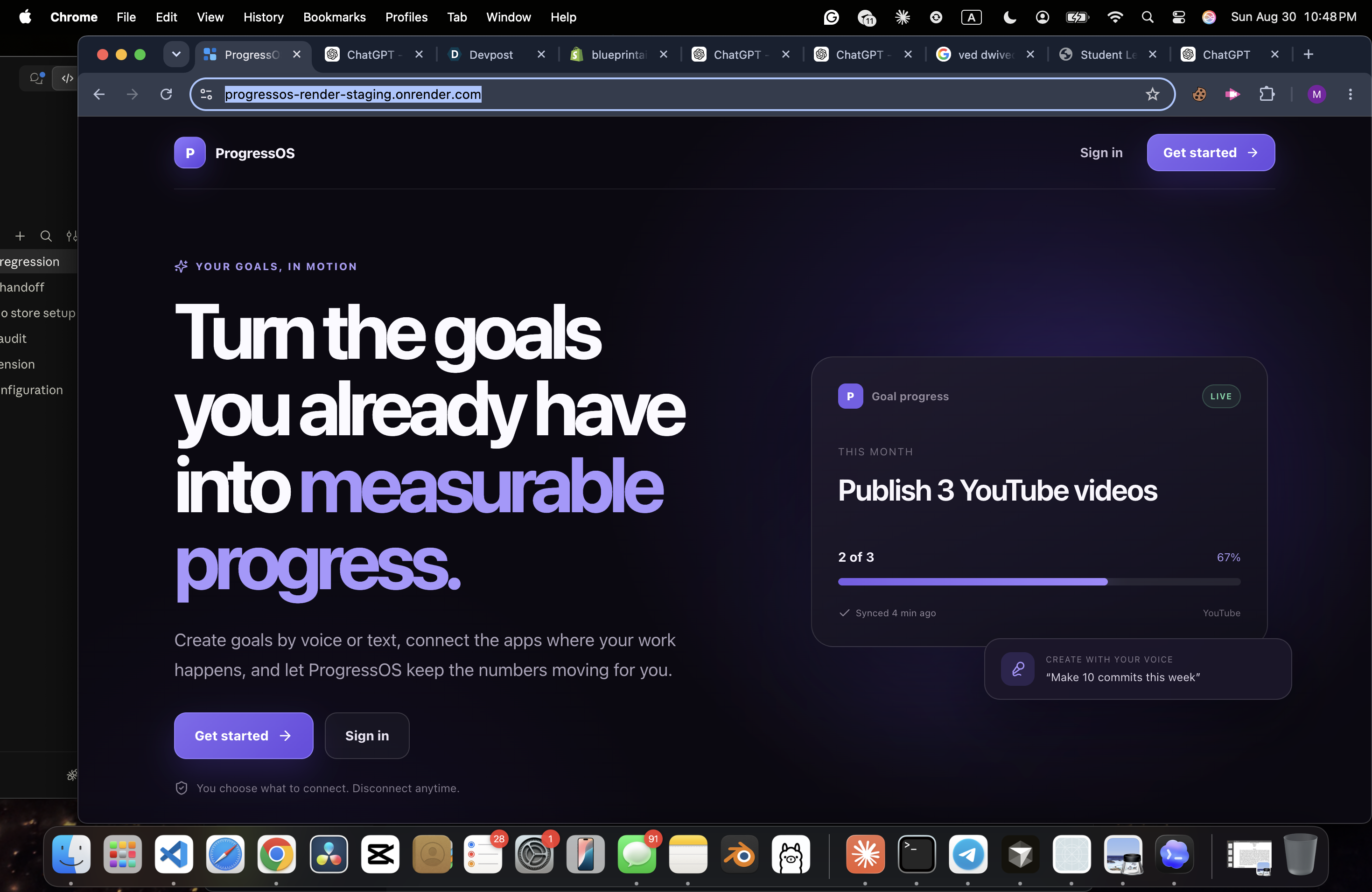
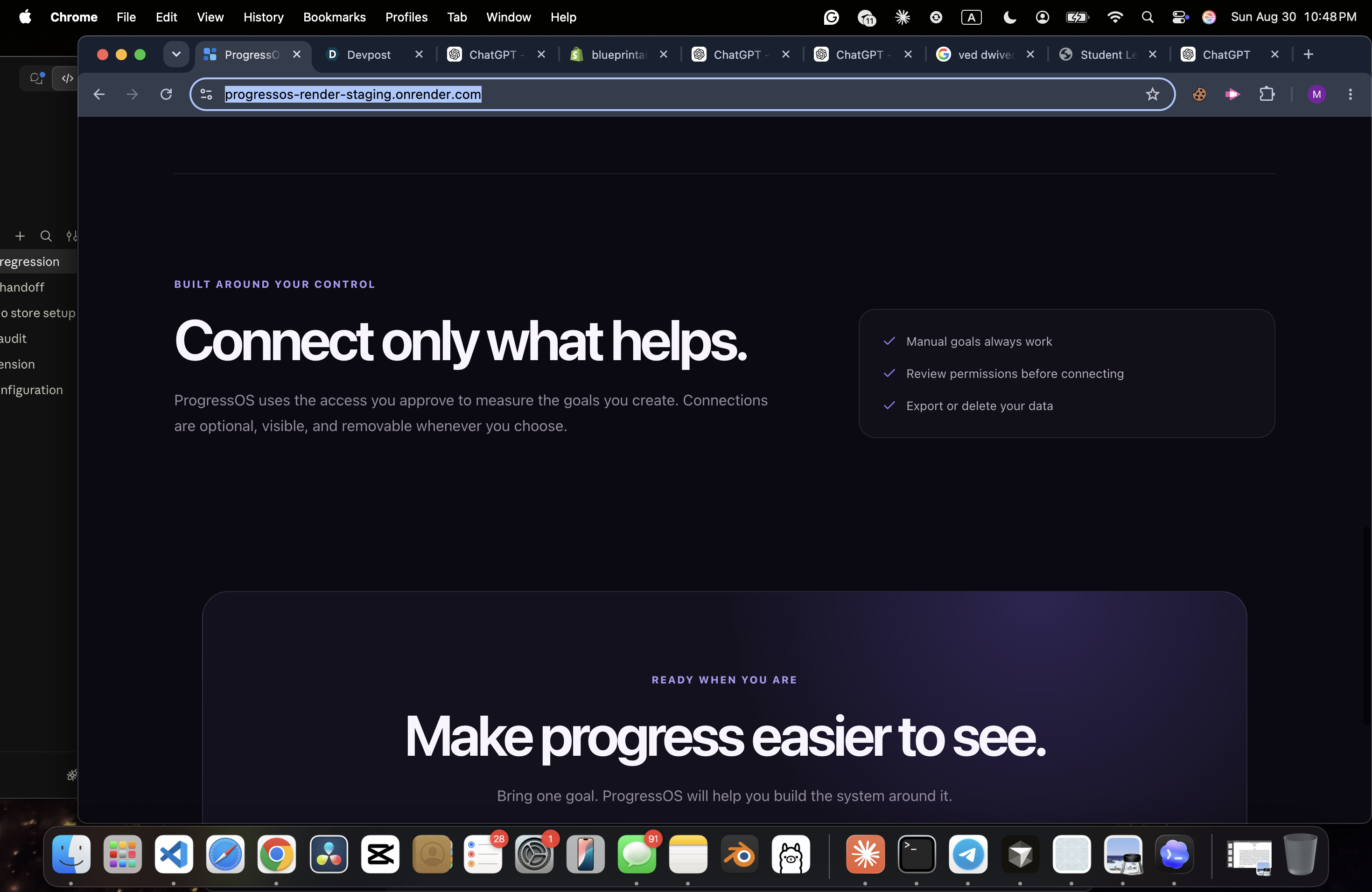
ProgressOS turns the goals you already have into measurable, automatically tracked progress.
-
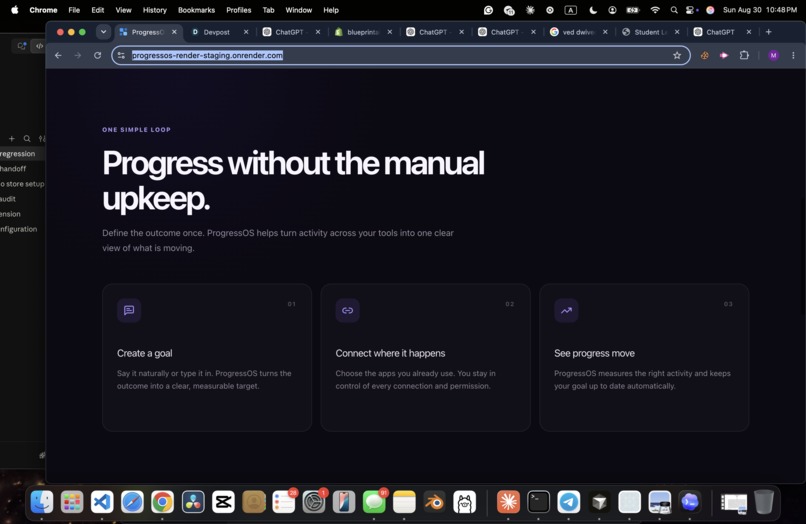
A unified dashboard keeps your goals updated without constant manual check-ins or data entry.
-
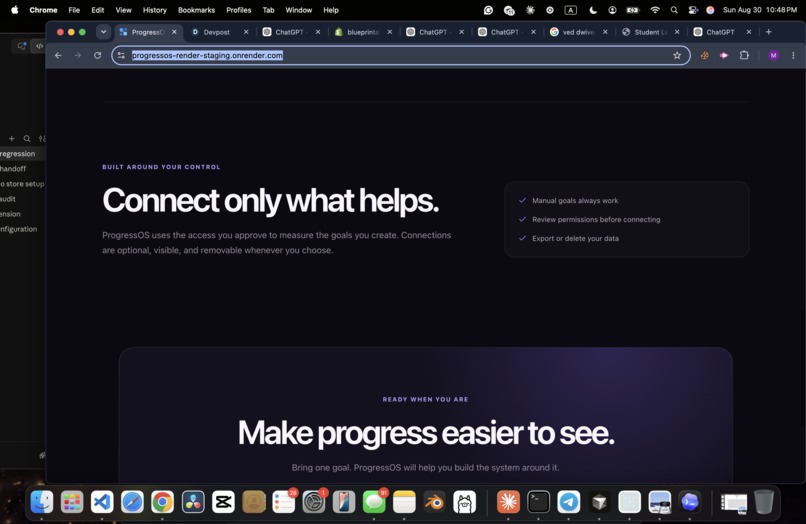
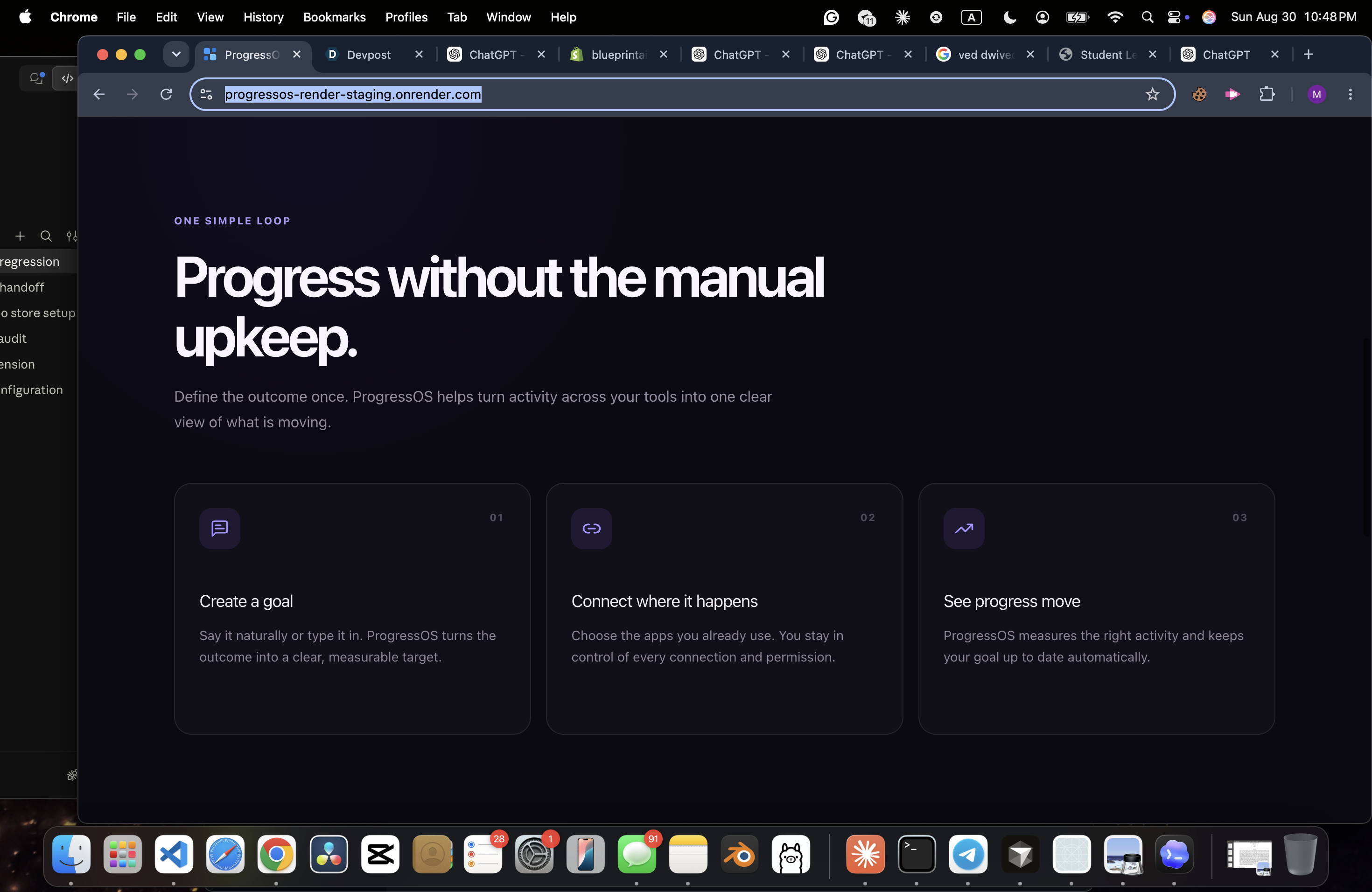
Connect only the apps you need and let ProgressOS use their data to measure your progress.
-
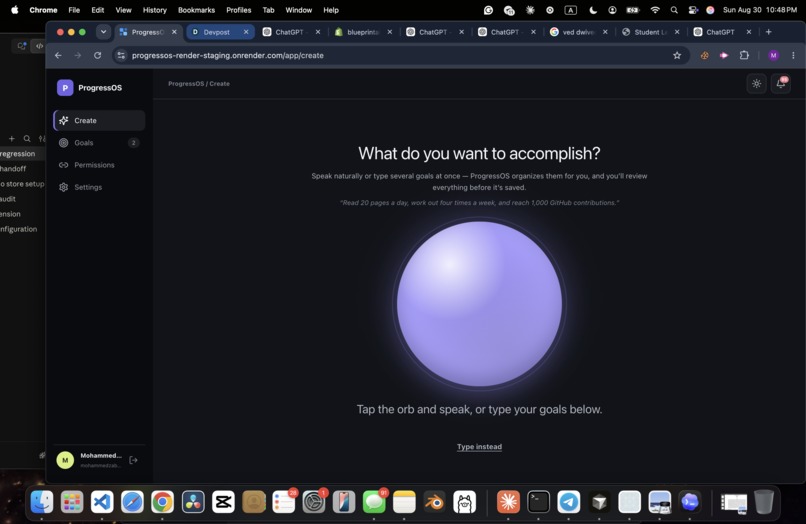
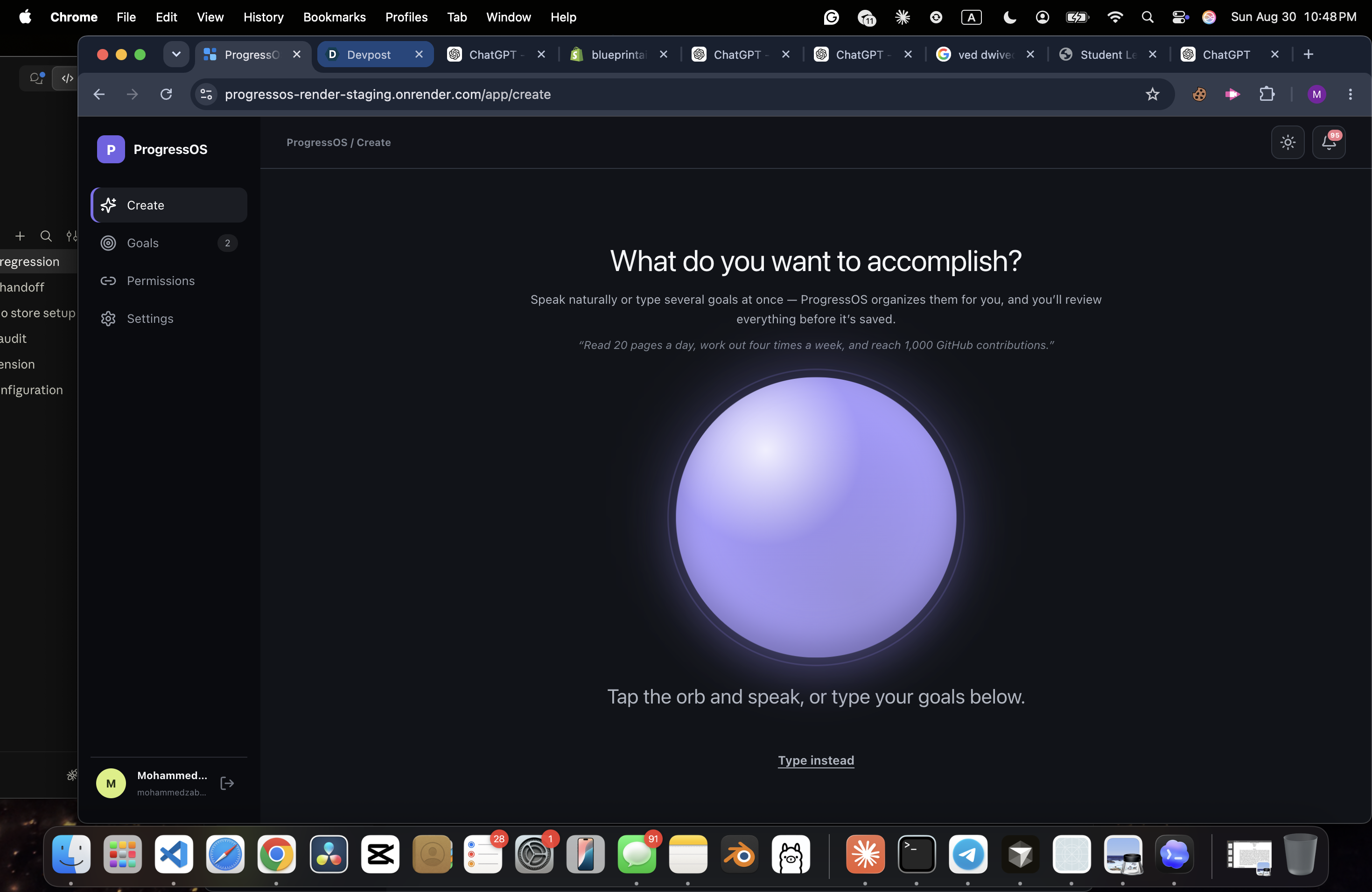
Create goals naturally by speaking or typing what you want to accomplish.View every active goal and its current progress
-
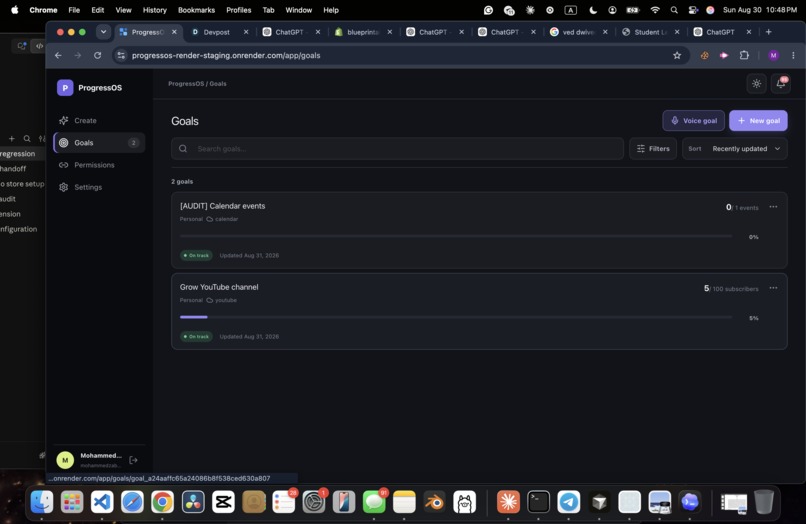
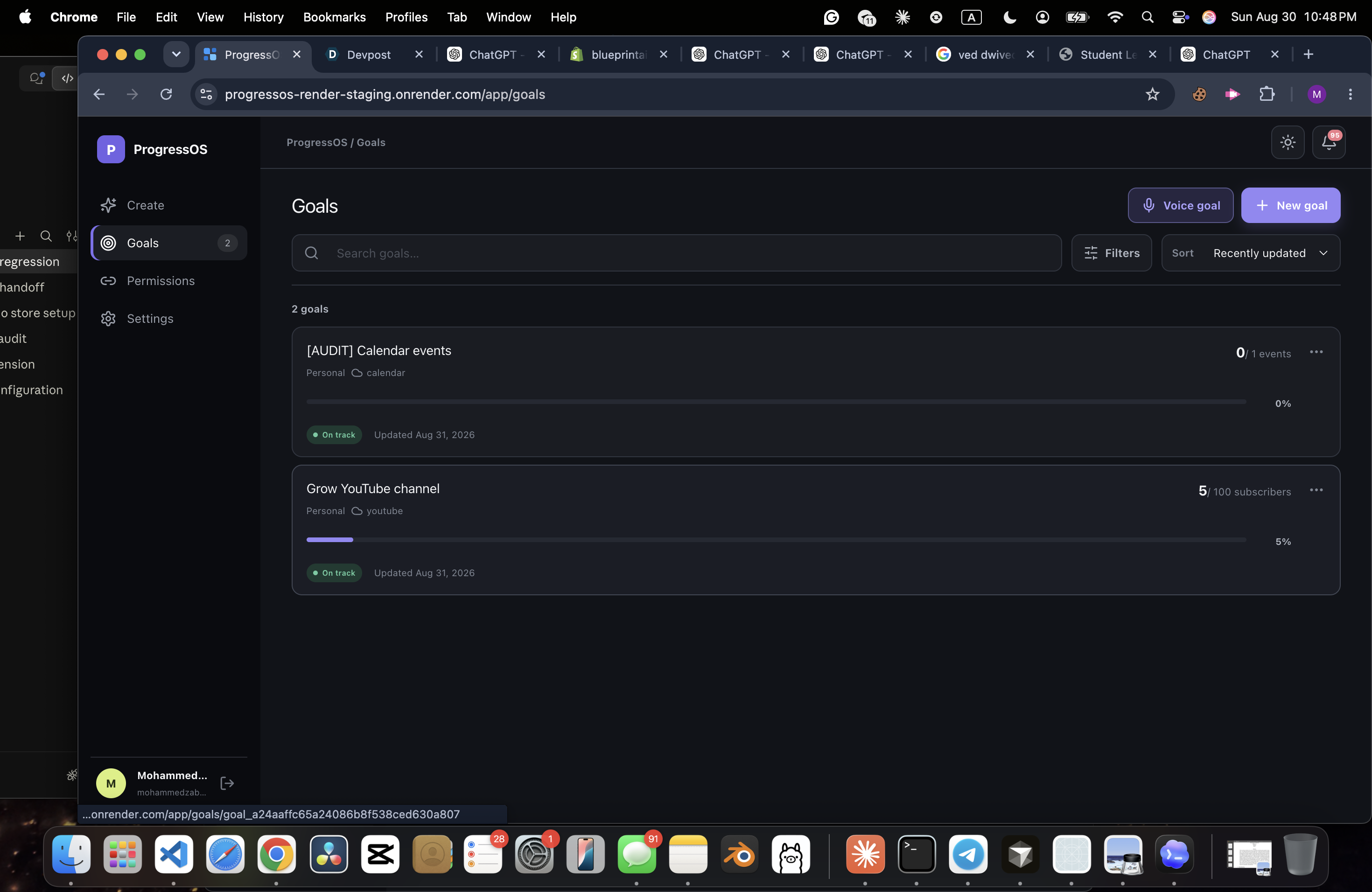
View every active goal, its current progress, target, and connected data source in one place.
-
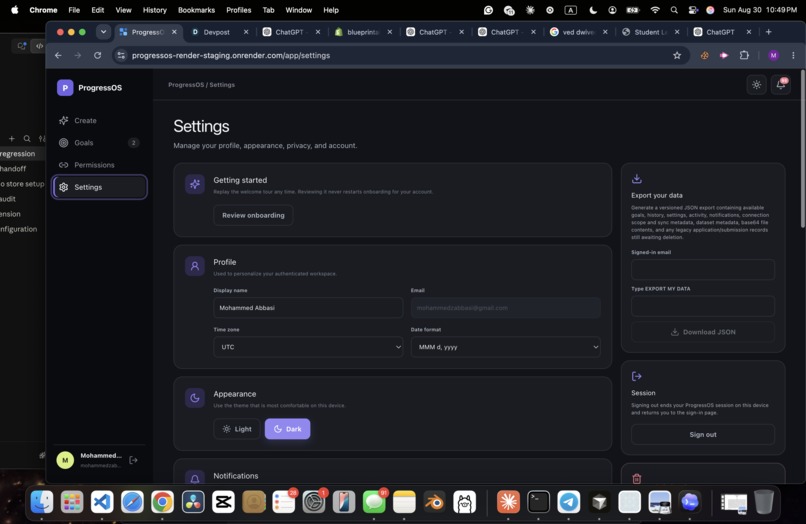
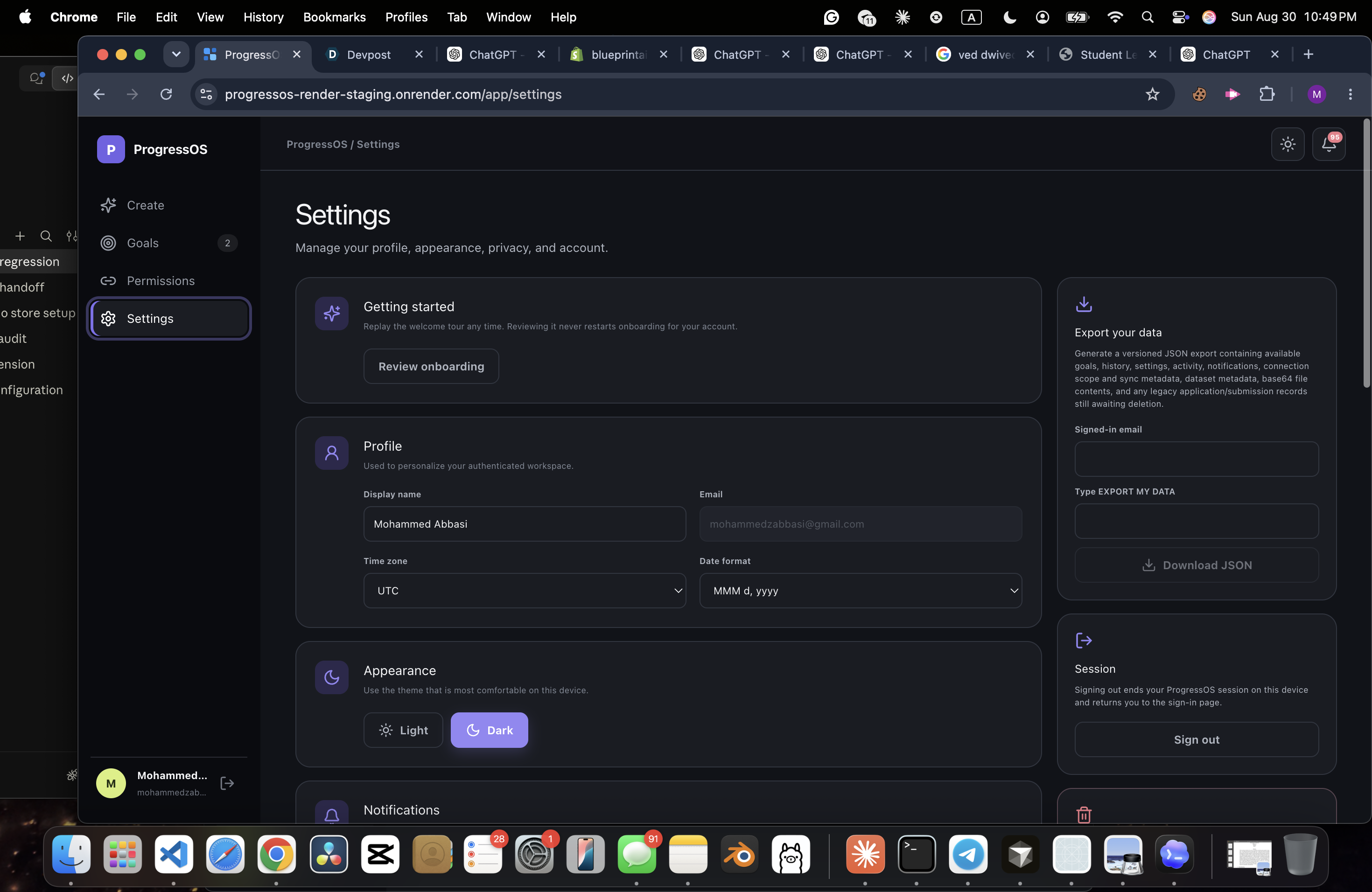
Manage your ProgressOS account, preferences, and connected experience from one settings page.
Inspiration
People set goals across dozens of different apps, but the progress toward those goals is scattered everywhere.
A fitness goal might live in Fitbit, a business goal in Shopify, a productivity goal in Google Calendar, a creator goal on YouTube, and a coding goal on GitHub. Even when those apps already contain the data needed to measure progress, people still have to manually check numbers, update spreadsheets, or remember whether they are actually moving toward what they wanted to accomplish.
We built ProgressOS around a simple idea: what if you could state a goal naturally, connect the apps that already contain your data, and let your progress update itself?
Instead of creating another place where users manually log their lives, ProgressOS turns the services they already use into one unified goal-tracking system.
What it does
ProgressOS is a universal, automatic goal tracker.
A user can type or speak goals such as:
- “Walk 10,000 steps per day.”
- “Reach 1,000 YouTube subscribers.”
- “Schedule 10 meetings this week.”
- “Reach $5,000 in Shopify revenue this month.”
- “Complete 100 Shopify orders.”
- “Reach 100 members in my Discord server.”
ProgressOS interprets the goal, determines which connected service and metric can measure it, and turns it into a trackable goal.
The user then authorizes the relevant integrations with read-only access. ProgressOS retrieves the appropriate data and updates progress automatically instead of requiring the user to continually enter numbers.
The result is one dashboard for goals that would normally be spread across completely different parts of someone's life.
ProgressOS currently connects with services across productivity, commerce, social media, fitness, communication, and more, including Google Calendar, Google Sheets, YouTube, Discord, Slack, Twitch, Shopify, TikTok, Fitbit, FatSecret, and other integrations.
The experience is also designed around natural interaction. Users can create several goals at once through text or voice, review what ProgressOS understood, and then save them together.
How we built it
ProgressOS is built as a full-stack web application with a provider-based architecture.
Each integration exposes measurable resources and metrics that the goal system can understand. Instead of hard-coding every possible sentence a user might say, ProgressOS separates natural-language goal interpretation from the underlying provider data.
For example, a goal about Shopify revenue can be mapped to a Shopify revenue metric, while a goal about daily steps maps to Fitbit. Time windows, numerical targets, provider resources, and other details are then incorporated into the goal configuration.
OAuth-based integrations are used so users can authorize services without giving ProgressOS their passwords. The system is intentionally centered around read-only data wherever possible because ProgressOS should measure a user's life, not silently modify the services connected to it.
We also built synchronization, metric validation, resource selection, goal history, connection management, and automatic progress updates so that the system behaves like more than a static dashboard.
For voice creation, users can speak naturally rather than filling out a long form. ProgressOS processes the request, converts it into structured goals, and presents the interpretation for review before anything is created.
Challenges we ran into
The hardest part was not simply connecting APIs. It was creating a common language between services that represent completely different kinds of information.
A Shopify store measures things like orders and revenue. Fitbit measures steps and activity. YouTube measures subscribers and video performance. Google Calendar measures events and scheduled time.
ProgressOS needed a system capable of treating all of those as measurable progress without pretending that they are fundamentally the same thing.
OAuth was another major challenge. Every provider has slightly different authorization requirements, callback behavior, scopes, token lifetimes, and resource-selection models. Building a consistent user experience on top of inconsistent external APIs required extensive testing and defensive handling.
Natural-language goal creation presented another problem. A sentence that seems obvious to a person can contain several pieces of structured information: a provider, metric, target, time window, resource, and recurrence pattern. We had to make the interpretation flexible while still giving users a review step so the system never silently creates the wrong goal.
We also spent substantial time making synchronization reliable. An automatic goal tracker only works if users can trust that the number they see actually corresponds to the underlying service.
Accomplishments that we're proud of
Our biggest accomplishment is that ProgressOS became an actual cross-platform tracking system rather than just a prototype dashboard.
We built working integrations spanning several very different categories of a user's life and created a shared goal architecture capable of using their data.
We are especially proud that ProgressOS can take goals expressed in normal language and connect them to real measurements.
The system can also handle multiple goals in a single request, voice input, resource-specific metrics, different time windows, automatic synchronization, historical progress, and connection management.
Most importantly, the core experience is extremely simple:
Say what you want to accomplish. ProgressOS figures out how to measure it.
What we learned
Building ProgressOS changed how we thought about goal-tracking software.
Most goal trackers begin by asking the user to constantly provide information. But an enormous amount of useful progress data already exists in the software people use every day.
The more interesting problem is interoperability: figuring out how to convert all of those separate data sources into a consistent representation of progress.
We also learned that automation needs transparency. Automatically interpreting a goal is useful, but users should still be able to see what metric was selected, which account or resource is being measured, and what information ProgressOS has access to.
That principle shaped both our connection system and our review-before-create experience.
What's next for ProgressOS
The long-term goal is for ProgressOS to become a personal progress layer across someone's digital life.
We want to expand the number and depth of integrations, support increasingly specific goals, improve natural-language and voice understanding, and make it possible to identify relationships between progress in different areas.
Eventually, ProgressOS should be able to answer much more useful questions than simply “What is my current number?”
It should be able to help users understand:
What am I trying to accomplish, how am I progressing, and what parts of my life are actually moving me toward it?
Instead of opening ten apps to understand your progress, the goal is to open one.
Built With
- cloudflare
- discord
- drizzle
- fitbit
- github
- next.js
- node.js
- oauth
- orm
- postgresql
- react
- render
- rest
- shopify
- slack
- tiktok
- twitch
- typescript
- web
- youtube


Log in or sign up for Devpost to join the conversation.