Inspiration
Small businesses often receive messy inquiries through email, web forms, chat, and social channels. A customer may ask for pricing, customization, delivery timing, payment options, or export support in one unstructured message. The operator then has to manually classify the request, check risk, draft a quote, ask for missing details, prepare an order record, and decide when delivery should be released.
ProfitPilot Autopilot was inspired by that everyday workflow. The goal is to show how Qwen Cloud can power a practical business autopilot that turns ambiguous customer intent into structured, reviewable operating artifacts.
A useful business agent should maximize:
[ Value = Speed \times Reliability \times Safety ]
So the project focuses not only on generation quality, but also on repeatable workflow structure, compliance checks, and human checkpoints.
What it does
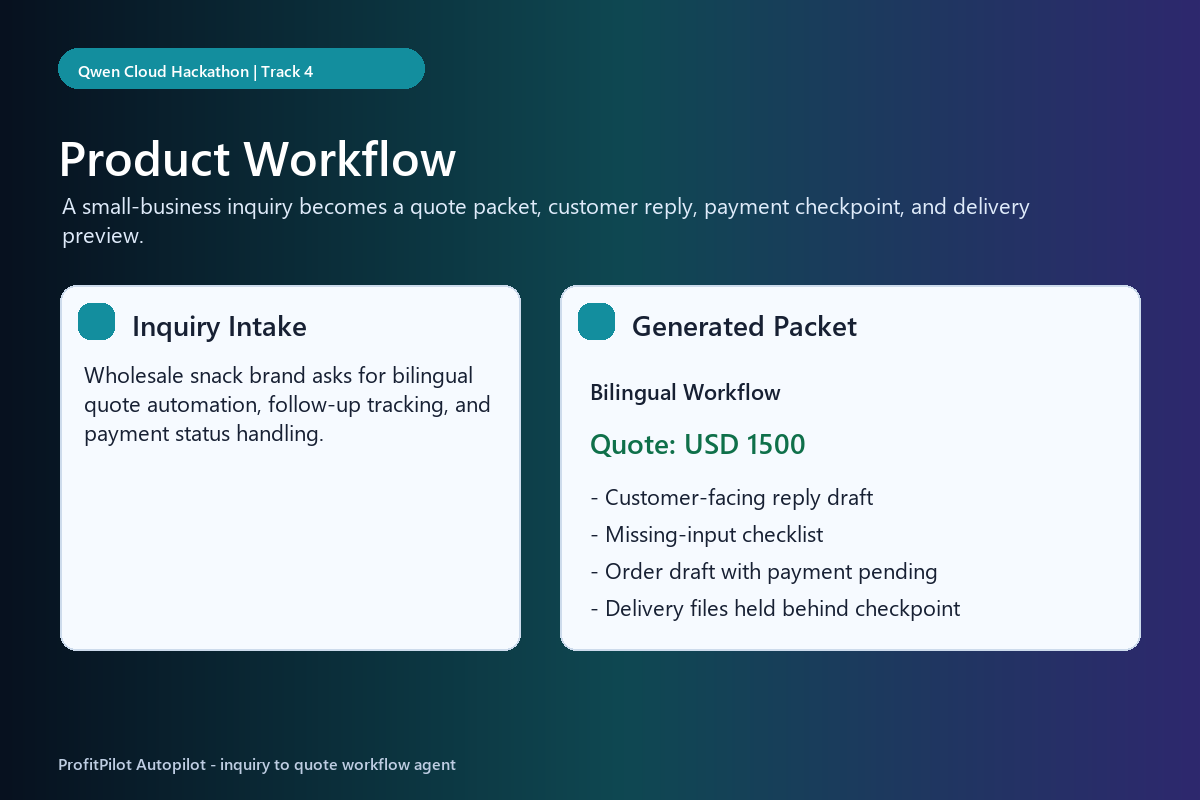
ProfitPilot Autopilot converts a small-business inquiry into a complete quote workflow packet.
It can:
- Classify the customer request
- Check restricted or high-risk topics before quoting
- Generate a scoped quote
- Draft a customer-facing reply
- Identify missing information
- Create an order draft
- Produce a payment checkpoint
- Preview delivery artifacts
- Export a structured JSON packet and Markdown packet
- Support both English and Chinese inquiry workflows
Instead of returning only a chat response, the agent produces practical business outputs that can be inspected, copied, audited, and extended into real operations.
How we built it
The project is built with Node.js, Qwen Cloud, Alibaba Cloud ECS, and an OpenAI-compatible chat completion workflow.
The core design has two execution paths:
Live Qwen Cloud mode
Uses Qwen Cloud's OpenAI-compatible API endpoint to generate structured workflow output.Deterministic demo mode
Keeps judging and local tests reproducible without exposing secrets, while preserving the same schema, guardrails, and workflow contract.
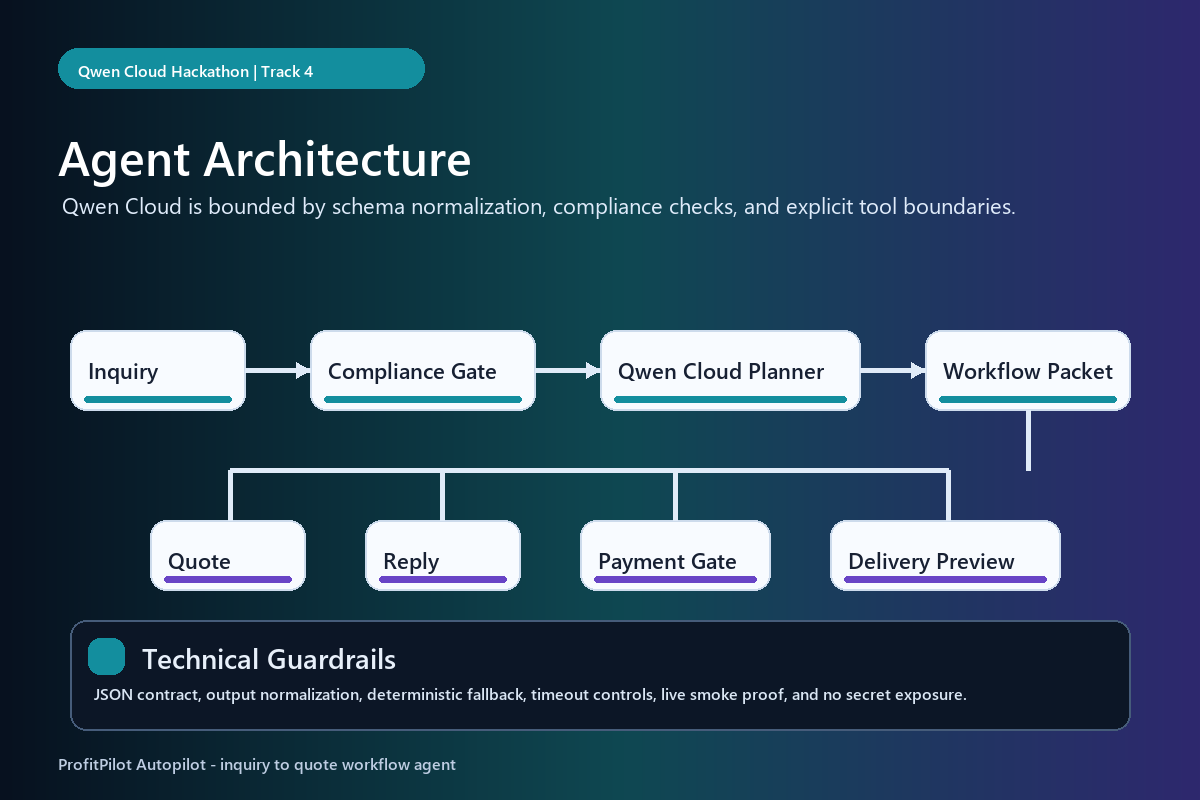
The workflow is organized around a structured JSON contract. Model output is normalized before being used, so the rest of the system can rely on stable fields such as quote, customer reply, missing inputs, compliance result, payment gate, delivery preview, and tool plan.
The agent also includes explicit operational boundaries:
- Compliance gate before quote generation
- Payment checkpoint before delivery release
- Human review checkpoint for restricted or uncertain cases
- Tool plan boundaries for spreadsheet, email, CRM, payment, and delivery packaging
- Timeout and fallback behavior for stable demos
Challenges we ran into
The biggest challenge was making the system feel autonomous without making unsafe claims.
A business autopilot should help move work forward, but it should not blindly approve regulated requests, confirm payments without evidence, or release deliverables without a checkpoint. To solve this, the project separates AI reasoning from operational authorization.
Another challenge was reproducibility. Hackathon judges need to run the project reliably, but live model calls can vary. The deterministic fallback mode solves this by making demos and tests stable while still showing how the same workflow works with Qwen Cloud live mode.
We also needed to avoid treating the project as a generic chatbot. The solution was to design the output as a workflow packet with business artifacts, not just a conversation.
Accomplishments that we're proud of
We are proud that ProfitPilot Autopilot includes:
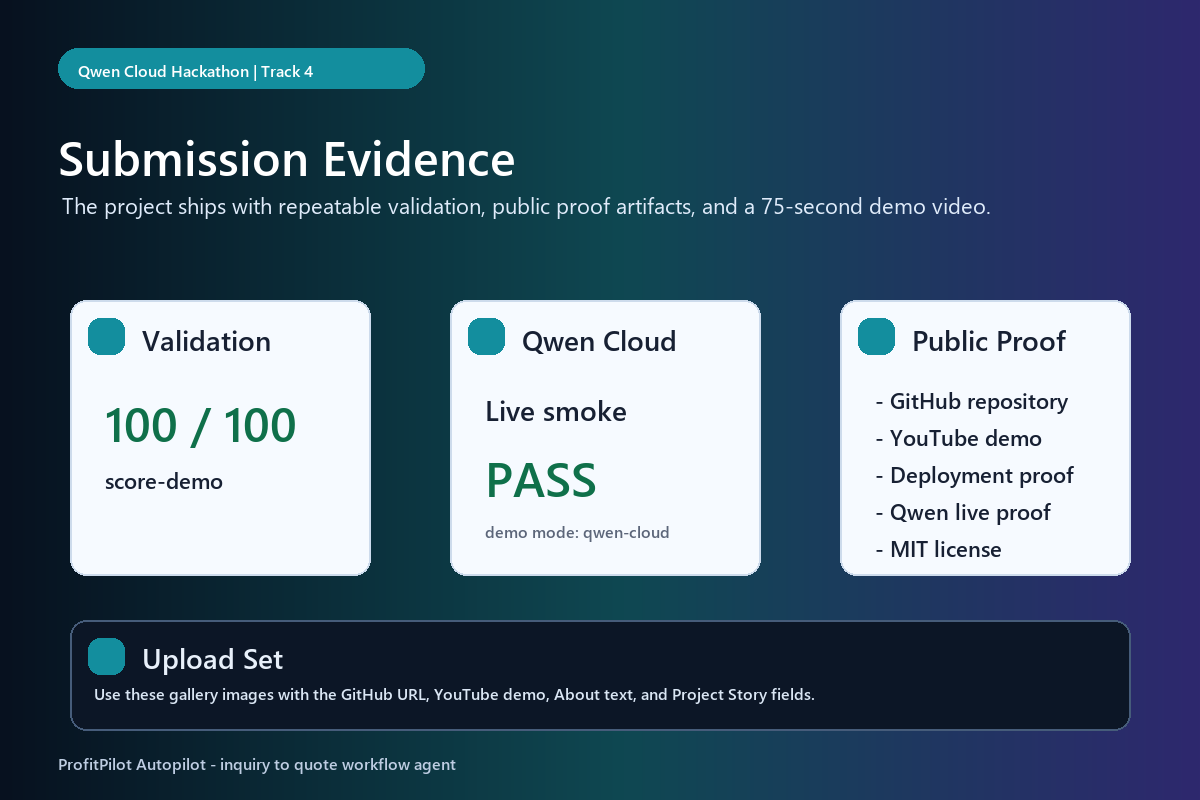
- A working Qwen Cloud integration
- English and Chinese workflow support
- CLI and local web demo
- Unit tests and validation scripts
- Generated quote and delivery packets
- Compliance and payment checkpoints
- Alibaba Cloud deployment proof
- Public technical documentation
- A complete demo video and submission bundle
What we learned
We learned that the strongest AI workflow agents need clear boundaries as much as intelligence.
Qwen Cloud is most valuable when its output is:
- Structured
- Validated
- Normalized
- Connected to real workflow steps
- Protected by deterministic guardrails
- Easy for a human operator to review
The project also reinforced that small-business automation does not need to start as a large SaaS platform. A focused inquiry-to-quote workflow can already save time and create measurable value.
What's next for ProfitPilot Autopilot
Next steps include:
- Spreadsheet and CRM export
- Email draft handoff
- More multilingual templates
- Richer audit logs
- Optional approval queues
- Configurable quote templates for different industries
- Safer integrations for payment confirmation and delivery packaging
The long-term vision is a lightweight, trustworthy autopilot for small-business revenue operations.


Log in or sign up for Devpost to join the conversation.