-
-
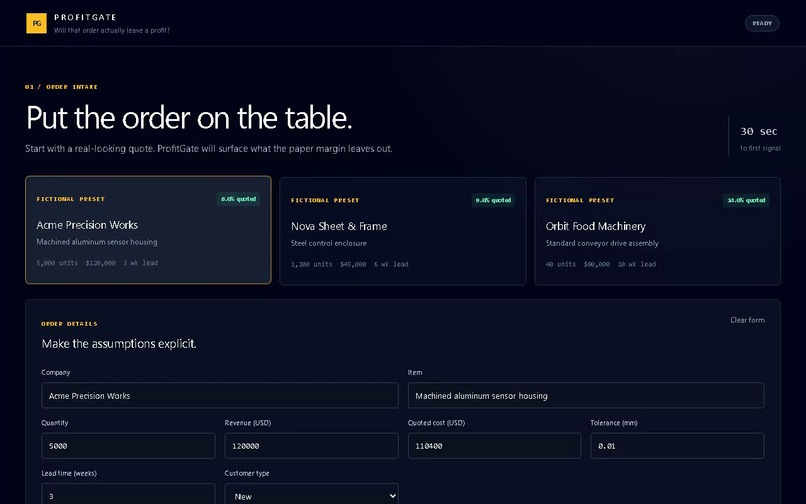
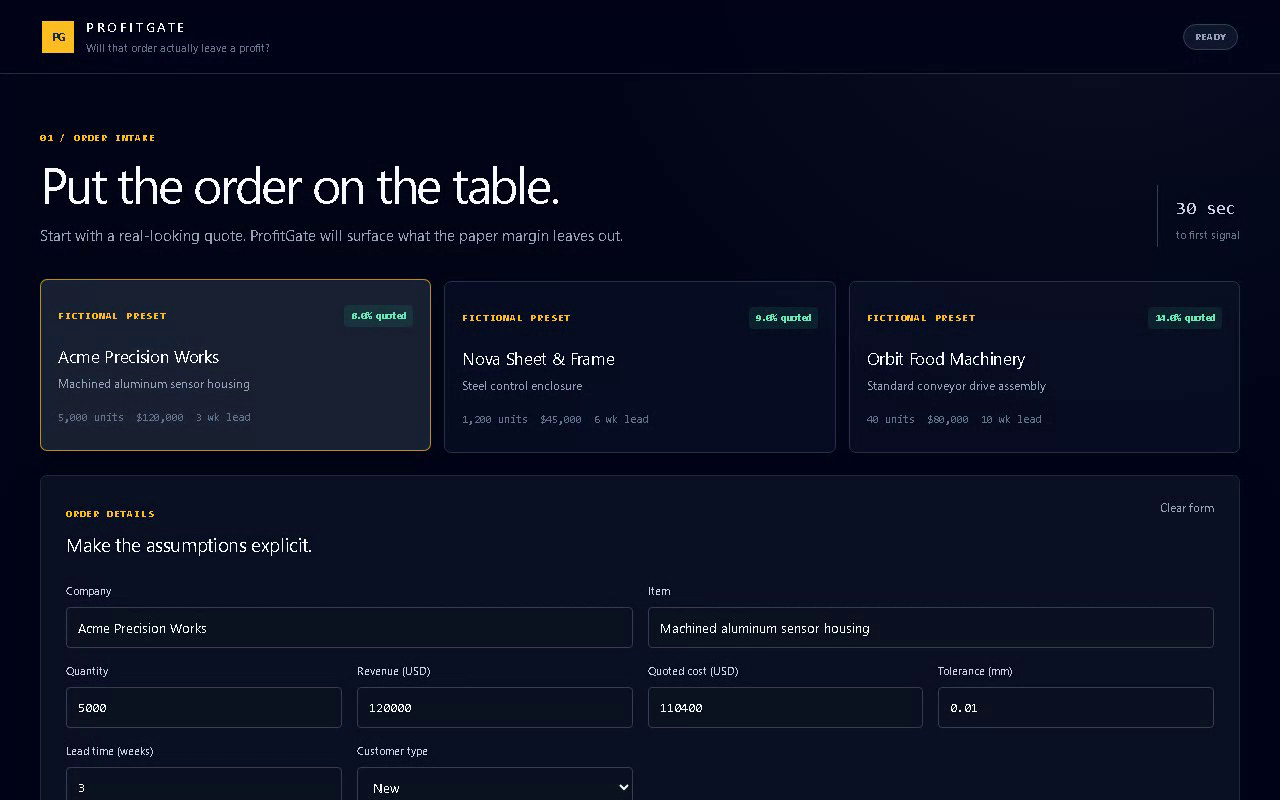
Order intake screen showing the initial 8% estimated margin before hidden manufacturing risks are analyzed.
Inspiration
I work as a manufacturing consultant and SME management consultant in Japan.
Through approximately 15 years of experience in manufacturing, production management, cost management, and business support, I have seen the same problem repeatedly.
Many small and medium-sized manufacturers have excellent products, strong technical capabilities, and hardworking teams. However, they sometimes accept orders that appear profitable during quotation but become unprofitable after production begins.
The problem is not always an incorrect price calculation.
The real problem is that important assumptions remain invisible.
A quotation may not fully reflect rework caused by tight tolerances, additional inspection, expedited freight, setup changes, production disruption, communication costs, or uncertainty associated with a new customer.
The order may show an 8% margin on paper, while the actual result is close to zero or even negative.
I often felt that these companies were very close to making better decisions. Their products were good, but the information needed for the final decision was scattered across sales, manufacturing, quality, and management.
That is why I created ProfitGate.
What it does
ProfitGate is a manufacturing decision-support prototype that helps companies identify hidden costs before accepting an order.
A user enters the basic conditions of an incoming order, such as:
- Quantity
- Price
- Lead time
- Tolerance requirements
- Customer type
- Expected margin
ProfitGate then analyzes risks that may not be included in the initial quotation.
Instead of presenting one artificially precise answer, it shows a possible profitability range, explains the assumptions behind the result, and generates questions that should be verified with the factory team.
It also proposes counter-conditions, such as:
- Increasing the price
- Relaxing non-critical tolerances
- Extending the delivery schedule
- Changing inspection requirements
However, ProfitGate does not make the final decision.
A human reviews the analysis, selects the conditions, records the reasoning, and decides whether to accept, reject, or accept the order with conditions.
The result becomes a Decision Passport containing:
- What was known
- What was assumed
- Which risks were identified
- Which conditions were selected
- Who made the decision
- When the decision was made
This makes the decision reviewable later, after the actual manufacturing results are known.
How I built it
I developed the prototype using Codex and GPT-5.6 during OpenAI Build Week 2026.
I began with a problem and decision model based on my real manufacturing and consulting experience.
Codex supported the implementation of the application, including the screens, application logic, integration, testing, and development workflow.
GPT-5.6 supported the structure of the risk analysis, the identification of hidden-cost factors, the generation of verification questions, and the decision-support experience.
The prototype was built specification-first. I defined the business problem, the responsibilities of the AI, the responsibilities of the human user, and the evidence that should remain after a decision.
The central design principle was simple:
AI analyzes and proposes.
A human verifies, decides, and remains accountable.
Challenges
The largest challenge was converting practical manufacturing experience into an explicit decision model.
Experienced factory workers often recognize risky orders intuitively, but their reasoning may not be written down.
I needed to translate that tacit knowledge into understandable risk factors, assumptions, questions, and decision conditions.
Another challenge was avoiding false certainty.
An AI system should not invent an exact margin when important information is missing. ProfitGate therefore presents a range, shows its assumptions, and asks the user to verify uncertain information.
I also wanted to prevent the AI from becoming the final decision-maker. The system had to support human judgment without removing human responsibility.
What I learned
I learned that AI is especially valuable when it makes hidden assumptions visible.
The most important output is not simply a number such as “minus 3%.”
The more valuable output is:
- Why the result may be negative
- Which assumptions influenced it
- What must still be confirmed
- Which conditions could improve the order
- How the final human decision was made
I also learned that modern AI development tools make it possible for a domain expert to convert practical experience into a working software prototype very quickly.
What's next
The next step is to connect ProfitGate with actual quotation and production-result data.
I would like to compare estimated risks with actual outcomes and help manufacturers improve their future decisions.
Future development may include:
- Comparison of quoted and actual costs
- Company-specific hidden-cost models
- Collaboration between sales and manufacturing teams
- Learning from previous Decision Passports
- Integration with quotation, ERP, and production-management systems
The long-term goal is not merely to calculate profitability.
It is to help good manufacturers avoid preventable losses and turn their past decisions into reusable organizational knowledge.
Built With
- codex
- gpt-5.6
- openai
- react
- tailwindcss
- typescript
- vercel
- vite

Log in or sign up for Devpost to join the conversation.