Inspiration
I was inspired to create Productivity Sprout because as students, we have very limited time to do many things, and thus must be able to optimize when we should do certain tasks so that we aren’t wasting our time. Although we can logically decide as to what task we should do at any given moment, it takes both our attention and time to make these decisions. Thus, I created Productivity Sprout to make these decisions for the user so that they can spend their time doing whatever they have to do rather than wasting it on deciding what to do.
What it does
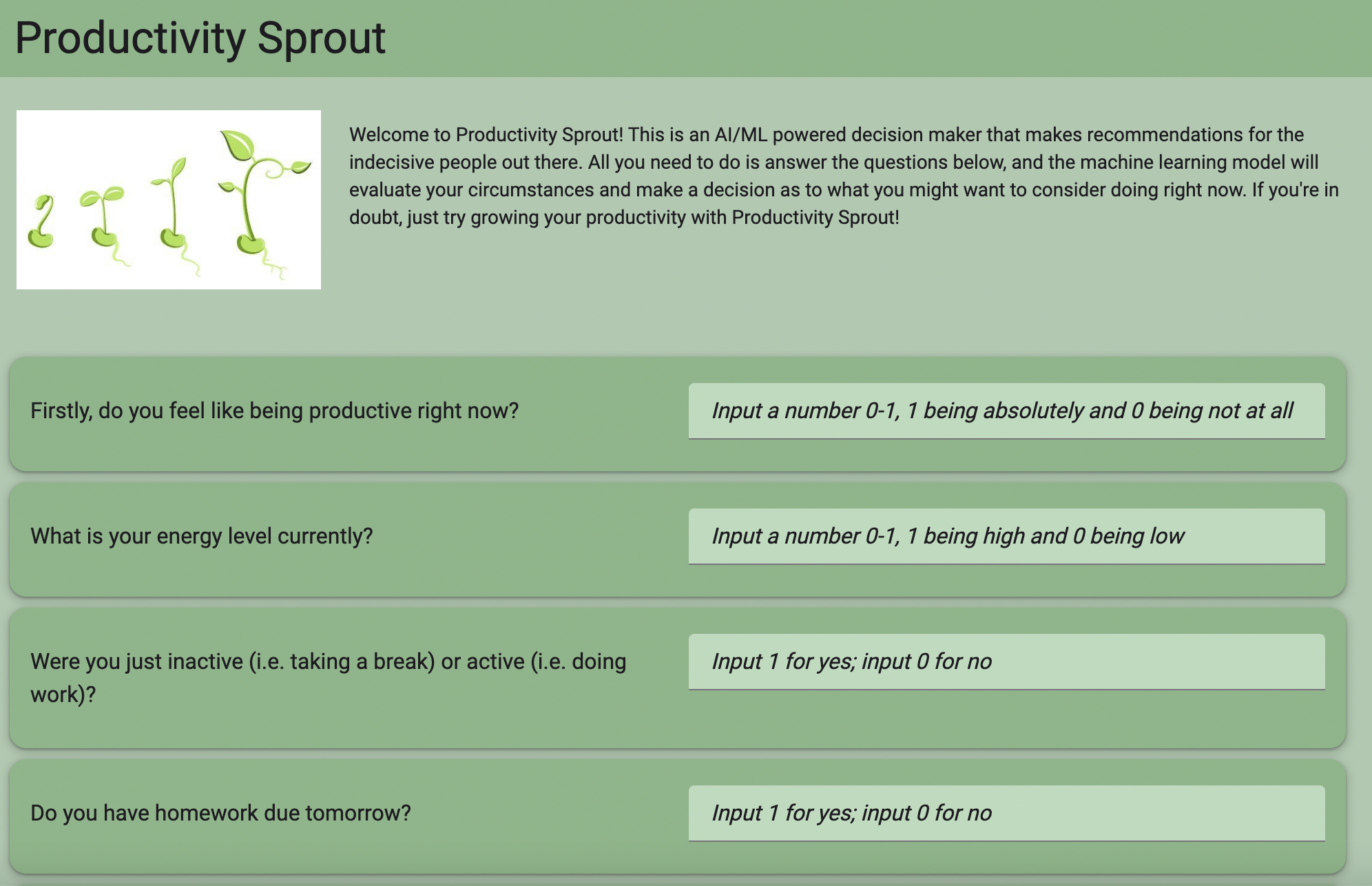
Productivity Sprout uses an AI machine learning model to determine what the user might want to consider doing. All the user has to do is answer five questions about whether they feel productive, their current energy level, whether they were just active or inactive, if they have homework due the next day, and if they have an upcoming assessment. From these inputs, a decision tree classifier is run and determines whether the user should do homework, study, practice extracurricular activities, or take a break. Of course, these are just recommendations for the user, but it is designed to help indecisive people make decisions a little bit quicker.
How we built it
I built Productivity Sprout using Google Colab for the back-end and Anvil for the front-end. In Google Colab, I used Pandas and Sci-Kit Learn to train a decision tree classifier off of a database I created myself. In Anvil, I created the user interface and then connected it to Google Colab.
Challenges we ran into
Some challenges that I ran into were that I have very limited experience with Python, so I ran into some bugs while trying to connect my model in Colab to the front-end website in Anvil. Also, I hadn’t used a decision tree classifier before, so learning how to use it took some time as well. On top of that, I had to create an entire database by myself to train the machine learning model, as I couldn’t find any databases online that had the inputs that I wanted. Thus, I made a database manually with 80 examples during the hackathon, but because there was so little training data, the model wasn’t always accurate, which was yet another problem I ran into.
Accomplishments that we're proud of
The accomplishments that I’m proud of were overcoming the challenges I encountered. I came into the hackathon knowing nothing about what it would be like, and decided to code in a language I hadn’t used extensively in the past, but I was able to problem-solve and build a working website that I’m now quite proud of. It serves the purpose that I created it for, and though it still isn’t polished, I’m surprised that I was able to complete it!
What we learned
I learned a lot from this hackathon, since it was the first one I’ve attended. (I think this means that I qualify for the Beginner Hack?) Basically everything I did was learned on-site, from using the Ski-Kit Learn Decision Tree Classifier, to working Anvil, to creating my own database. It was a wonderful experience and I’m glad that I attended!
What's next for Productivity Sprout
Some areas that I will continue to work on for Productivity Sprout are including some more inputs, creating more training data for a more accurate model, and improving the design of the website. I might also include a timer so that the user is reminded to check in every once in a while, especially if they are taking a break.
Built With
- ai
- anvil
- colab
- machine-learning
- python

Log in or sign up for Devpost to join the conversation.